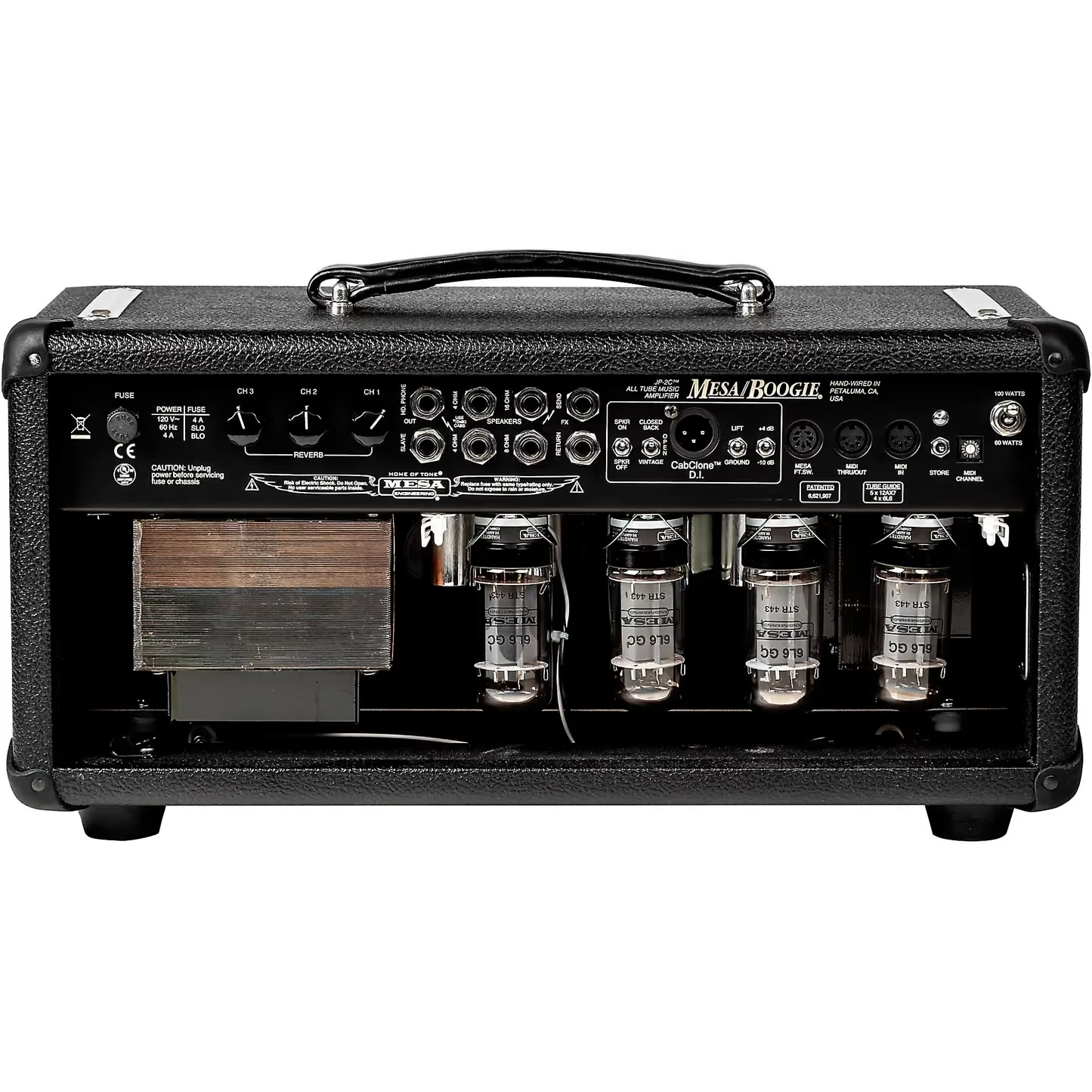
Week 10 Stage: The Amplifier
Inside the Guitar Amplifier
Photo: Rob Robinette · CC BY-SA 4.0
Why is a guitar amplifier more than a device that simply makes a signal louder?
- InputA signal that has already been shaped by every earlier stage
- ProcessA small signal chain of its own: repeated gain, filtering, and nonlinearity
- OutputA louder, further-shaped signal, still electrical rather than acoustic
Where we left off
The amplifier as a further signal chain
Weeks 5 through 9 covered every transformation this course teaches that happens before amplification: gain, clipping, filtering, modulation, and delay/reverb. This week shows that the amplifier itself is not one simple multiplier — it is a small signal chain of its own, and it can repeat several of those same processes: it applies gain (more than once), it can filter, and it can distort. By the end of this week you should be able to identify the major stages of a simplified amplifier (preamp, tone stack, power amp); explain the difference between a preamp stage and a power-amp stage; explain gain staging; describe, conceptually, how tube and solid-state amplifying elements differ without claiming one sounds inherently better; explain negative feedback as a general technique; and explain why preamp gain and master level don’t do the same thing.
- Preamp: gain + clipping
- Tone stack: filtering
- Power amp: gain + saturation
- Master level: output only
A chain within the chain
Input, preamp, tone stack, power amp, speaker
A simplified amplifier can be drawn the same way any other stage in this course has been: input in, a sequence of blocks, output out. Some real amplifiers add further stages — extra gain stages, phase-splitter or driver stages between preamp and power amp — but this course doesn’t require knowing every topology, only that the amplifier is a chain with more than one place something can happen to the signal. The preamp provides voltage gain, can filter, and can introduce nonlinear distortion — it’s usually where a guitar amplifier’s distortion character mostly comes from. The power amplifier’s main job is providing enough power to actually drive a speaker; it may also add its own, often gentler, nonlinear behaviour. The tone stack sits between them, reshaping which frequencies pass through, not how loud the signal is.
Gain staging
The same total gain, distributed differently
Week 5 introduced gain staging as one stage’s headroom. An amplifier with more than one gain stage extends that idea: the same overall amount of amplification can be placed mostly in the preamp, mostly in the power amp, or split between them — and where it’s placed changes which stage actually reaches its own saturation point. This is a genuinely different-sounding choice, not just a louder-or-quieter one.
Both examples end at the same master-level setting, and both put a stage at its saturation ceiling somewhere in the chain — but a different stage. That’s also why master level and preamp gain don’t behave the same way: master level sits after both nonlinear stages and only turns the already-decided result up or down, while preamp gain decides whether, and how hard, the preamp itself distorts.
Two amplifying elements, two kinds of distortion
Tubes vs. transistors, negative feedback, preamp vs. power-amp clipping
Historically, guitar amplifiers have been built around two different kinds of amplifying component: tubes (valves), which amplify by controlling a current through a vacuum using a charged grid, and transistors (solid-state devices), which amplify by controlling current through a semiconductor. Both are, at the level this course cares about, doing the same job — turning a small input signal into a larger output signal — using different physical mechanisms to do it. It’s tempting to reach for “tubes sound warm, transistors sound harsh” as a settled fact. Treat that with caution: how any particular amplifying element actually behaves depends heavily on the rest of its circuit (biasing, feedback, gain staging, the tone stack, the power-amp design) and not on the component type alone. This course doesn’t take a side.
Many amplifier stages route a portion of their output back to their input in a way that opposes the original signal — negative feedback. As a general technique (not specific to guitar amplifiers, or even to audio), it can trade away some raw gain in exchange for more predictable, more linear behaviour, and it can change how a stage responds over time as well as in level.
Because the preamp and power amp are separate stages, each with its own gain and its own nonlinearity, a signal can be distorted at one, the other, both, or neither. A preamp typically clips a relatively small, low-power signal, and — as with earlier weeks’ clipping circuits — that clipping is often asymmetric. A power amplifier is driving a much higher-power signal into a speaker’s load, and its own saturation, when it happens, is often comparatively softer. These are two different nonlinear elements in the same chain, not two names for one thing.
These are simplified teaching curves illustrating where each kind of nonlinearity tends to sit, not measured transfer functions of any specific real amplifier circuit.
Try it
Preamp, tone, power stage, and master level
- Physical mechanism
- Signal transformation
- Waveform / spectral consequence
- Audible consequence
Preamp Gain and Power-Stage Saturation each drive a separate stage into its own nonlinearity — try pushing one hard while keeping the other low, then the reverse, and watch which bar in the level plot below hits the saturation line. Tone reshapes frequency content without changing level. Master Level always comes last, after both stages have already decided how distorted the signal is.
Audio never plays automatically — press play to hear it, press again to stop.
Preamp driving 3.0×, tone stack rolled off above 2500 Hz, power stage driving 1.5×, master at 70%.
Preamp Gain and Power-Stage Saturation each drive their own stage into its own nonlinearity — that's why a signal can be "preamp-distorted", "power-amp-distorted", both, or neither. Master Level only turns the already-decided result up or down; it never adds distortion of its own in this model.
Takeaways
What this week establishes
A simplified amplifier is Input → Preamp → Tone stack → Power amplifier → Speaker — a small signal chain, not a single multiplier.
The preamp mainly provides voltage gain, filtering, and (often asymmetric) nonlinear distortion; the power amp mainly provides enough power to drive the speaker, and may add its own, often softer, nonlinearity.
Gain staging is choosing how the same total amplification is distributed across stages — which stage saturates, and how hard, depends on that distribution.
Tubes and transistors are two different physical ways to build an amplifying element; how an amplifier actually sounds depends on the whole circuit around that element, not the component type alone.
Negative feedback is a general technique that trades gain for more predictable, linear behaviour — not something specific to guitar amplifiers.
Preamp distortion and power-amp distortion are two separate nonlinear events in the same chain; master level, placed after both, changes loudness without changing either.
The chain
Where this sits, and what comes next
- 01INPUTWhat Is Guitar Tone?
- 02STRINGThe Vibrating String
- 03PICKUPFrom Vibration to Voltage
- 04CIRCUITThe Guitar Is a Circuit
- 05DRIVEGain, Headroom and Clipping
- 06DISTORTIONInside overdrive, distortion and fuzz
- 07FILTERFilters, EQ and Tone Stacks
- 08MODULATIONModulation: Phase, Pitch and Motion
- 09SPACEDelay, Reverb and Space
- 10AMPInside the Guitar Amplifier
- 11SPEAKERSpeaker, Cabinet and Air
- 12OUTPUTEngineering the Complete Tone
Weeks 5 through 9 covered every transformation this course teaches that happens before amplification: gain, clipping, filtering, modulation, delay and reverb. This week showed that the amplifier itself isn’t a separate kind of thing — it’s a further, small signal chain that can repeat several of those same processes (gain, more than once; filtering; nonlinear distortion) in its own arrangement. But an amplifier’s electrical output still isn’t sound in the air. Week 11 follows the signal through its last physical stage: the loudspeaker and cabinet that turn this electrical signal back into acoustic sound.
- Physical mechanism
- Signal transformation
- Waveform / spectral consequence
- Audible consequence