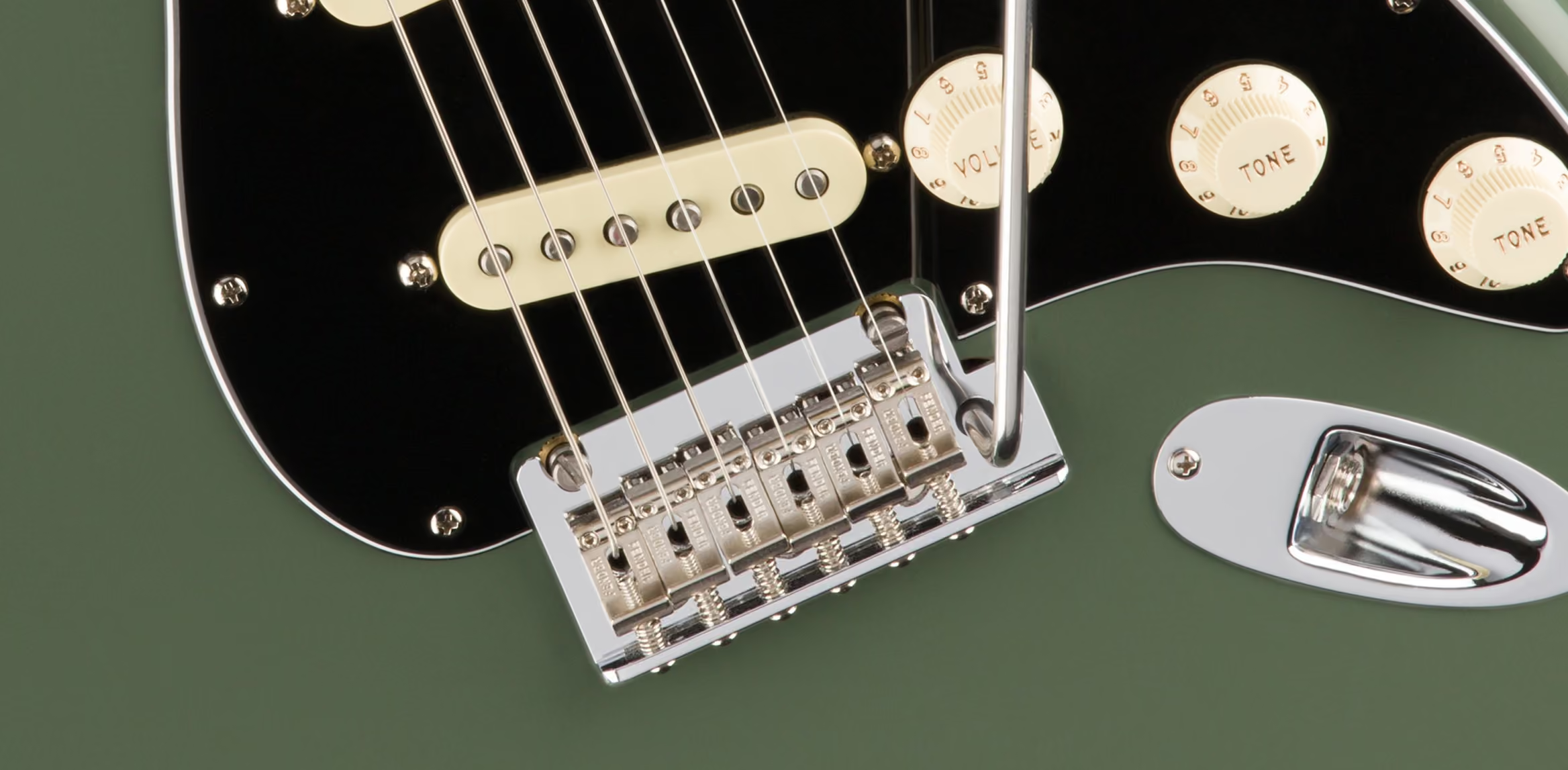
Week 02 Stage: Mechanism
The Vibrating String
Photo: Shixart1985 · CC BY 2.0
What decides the pitch a plucked string produces, before any pickup or circuit gets involved?
- InputLength, tension, and mass per unit length
- ProcessStanding waves on a fixed string
- OutputA fundamental and its harmonics
Where we left off
From abstract harmonics to their physical origin
Week 1 introduced harmonics and spectra in the abstract, comparing waveforms that already existed. Before any pickup or circuit gets involved, a plucked string is already producing a fundamental and a series of harmonics on top of it — purely as a matter of how a string fixed at both ends is allowed to vibrate. By the end of this week you should be able to describe standing waves on a fixed string intuitively; distinguish the fundamental frequency from its harmonics; explain how length and tension affect fundamental frequency; relate fretting to a length change, including the twelfth-fret octave; and explain how picking position changes which harmonics a pluck excites.
- Length & tension
- Standing wave modes
- Harmonic frequencies
- Perceived pitch
Standing waves
Nodes, antinodes, and the fundamental
Dots mark nodes — points that stay still in that mode. Every mode is pinned to zero at both ends (the bridge and the fret or nut), same as Week 2's boundary condition; only the pattern in between differs.
A string fixed at both ends can only vibrate in a limited set of shapes — standing waves — each with fixed points (nodes) that never move and points of maximum motion (antinodes) between them. The lowest of these, the fundamental, sets the pitch you hear; the higher modes are its harmonics. For an idealised string, fₙ = n·f₁ — each harmonic sits at an exact whole-number multiple of the fundamental. Real strings aren’t perfectly ideal, so this relationship holds closely but not exactly.
The fundamental itself follows f₁ = 1/(2L) · √(T/μ), where L is the vibrating length, T is tension, and μ is the string’s mass per unit length. Shortening the string, tightening it, or using a lighter string all raise the fundamental. Fretting a string is exactly a length change — the twelfth fret halves the vibrating length, which (holding tension and mass per length fixed) doubles the fundamental frequency: an octave up.
Before electronics
Picking position: an early kind of tone shaping
Where a string is plucked doesn’t change which frequencies are available — those are set by length and tension — but it changes how strongly each mode gets excited. Picking near the middle of the string favours the fundamental and suppresses harmonics that have a node there; picking close to the bridge excites a richer set of higher harmonics. This is an early example of spectral tone shaping that happens before any electronics are involved at all. The spectrum also isn’t static after the pluck — it keeps evolving through the note’s attack and decay, a detail this week only flags rather than develops.
Try it
A virtual string
- Physical mechanism
- Signal transformation
- Waveform / spectral consequence
- Audible consequence
Adjust the string’s length and tension below and watch the computed fundamental frequency change exactly according to f₁ = 1/(2L)·√(T/μ). Picking position updates the waveform shape and harmonic-content display using the same idealised standing-wave physics — an approximate, illustrative model of how strongly a pluck at that position excites each harmonic, not a measurement of any real instrument.
Fundamental: Hz
Audio never plays automatically — press play to hear it, press again to stop.
Length and tension change the pitch you hear. Picking position changes only the diagrams above — the live pluck doesn't model its effect on timbre.
Takeaways
What this week establishes
A string fixed at both ends vibrates only in a limited set of standing-wave modes, with fixed nodes and moving antinodes.
The lowest mode is the fundamental; for an idealised string, the higher modes (harmonics) sit at whole-number multiples of it.
Fundamental frequency depends on length, tension, and mass per unit length: f₁ = 1/(2L)·√(T/μ).
Fretting shortens the vibrating length; the twelfth fret halves it, giving an octave.
Picking position changes which harmonics a pluck excites most strongly — tone shaping before any electronics.
The chain
Where this sits, and what comes next
- 01INPUTWhat Is Guitar Tone?
- 02STRINGThe Vibrating String
- 03PICKUPFrom Vibration to Voltage
- 04CIRCUITThe Guitar Is a Circuit
- 05DRIVEGain, Headroom and Clipping
- 06DISTORTIONInside overdrive, distortion and fuzz
- 07FILTERFilters, EQ and Tone Stacks
- 08MODULATIONModulation: Phase, Pitch and Motion
- 09SPACEDelay, Reverb and Space
- 10AMPInside the Guitar Amplifier
- 11SPEAKERSpeaker, Cabinet and Air
- 12OUTPUTEngineering the Complete Tone
Week 1 introduced harmonics abstractly, comparing waveforms that already existed. This week explained their mechanical origin: standing waves on a fixed string. But a vibrating string alone only produces mechanical motion — nothing electrical yet. Week 3 explains how a magnetic pickup turns that motion into the voltage the rest of the signal chain actually works with.
- Physical mechanism
- Signal transformation
- Waveform / spectral consequence
- Audible consequence