Week 09 Stage: Delay & Reverb
Delay, Reverb and Space
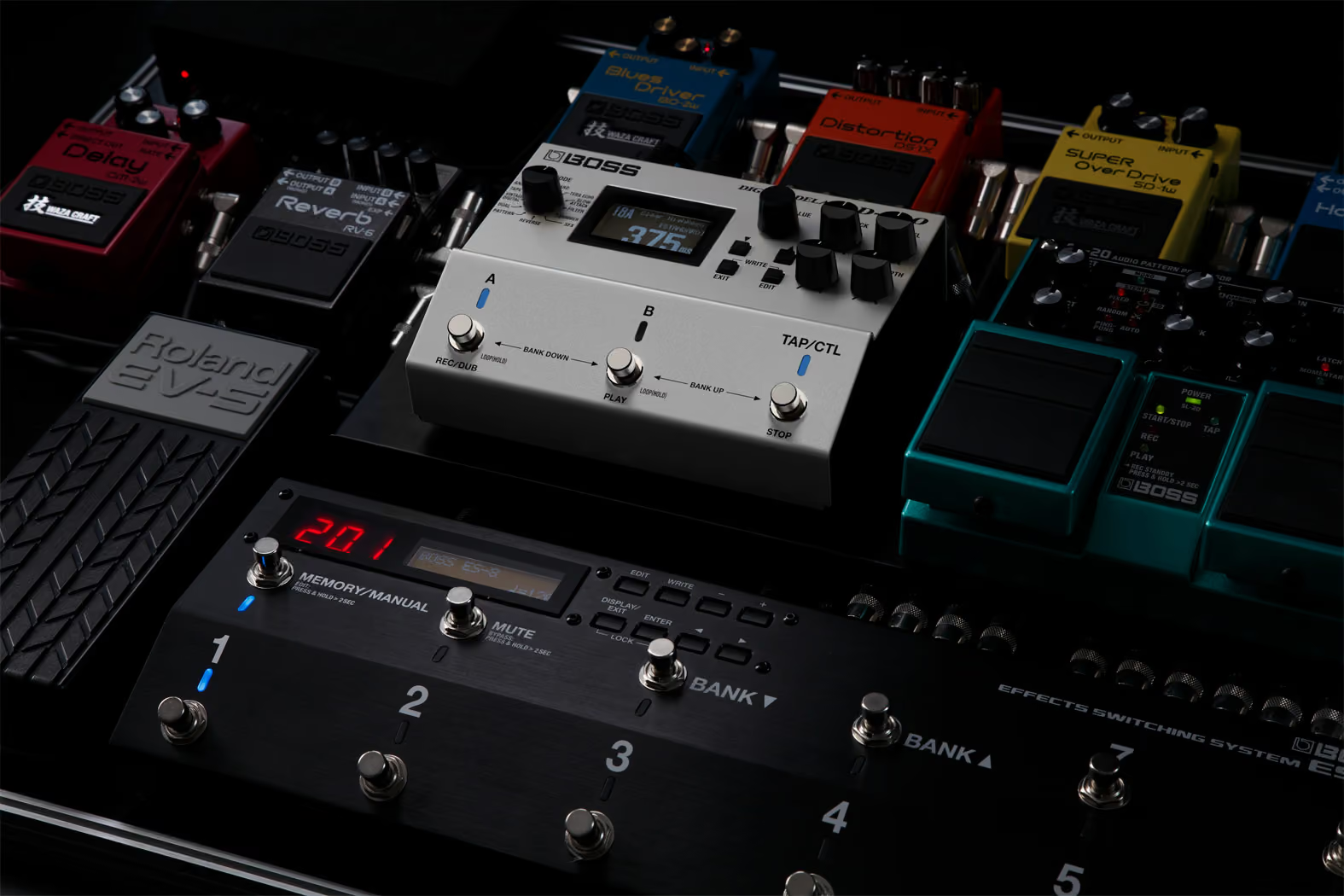
Photo: Guitar Chalk · CC BY 2.0
How does a single delay line, fed back into itself, scale up into echoes and even the simulation of a physical room?
- InputA signal and a delay line with a feedback loop
- ProcessA fraction of the delayed output is recirculated into the delay's own input
- OutputA decaying series of echoes, or — at much higher density — the sense of a physical space
Where we left off
From one delayed copy to a feedback loop
Chorus, flanger, and phaser all combined a signal with one modulated copy of itself. This week asks what happens once that delayed copy is fed back into its own delay line, round and round, rather than summed just once. By the end of this week you should be able to explain a delay line and its feedback loop; explain why decaying repeats — not runaway repeats — are the normal case; connect feedback delay to the comb filtering met in Week 8; describe the structure of a natural reverb (direct sound, early reflections, dense decaying tail); and distinguish algorithmic from convolution reverb.
- Delay line
- Feedback loop (gain < 1)
- Decaying repeats
- Wet/dry mix
Feedback delay
One loop, recirculated
g of the delay's own output is returned to its input. Because g < 1, every pass round the loop is quieter than the last — the source of the repeated, decaying echoes.A delay line stores a signal and releases it again some fixed time
later. On its own that produces one repeat. Feeding a fraction g of that
delayed output back into the delay’s own input, alongside the new incoming
signal, produces a whole series of repeats: the first echo re-enters the
delay and comes back out again, smaller, over and over. Because g is
always kept below one, each pass round the loop is quieter than the last —
the series decays rather than growing without bound. A wet/dry mix
control then blends that whole decaying series back in with the original,
undelayed signal.
- low feedback (g = 0.25)
- high feedback (g = 0.7)
Feeding a delayed copy back into itself is exactly the mechanism behind Week 8’s flanger comb filter, just recirculated instead of summed once. The same regularly spaced peaks and notches appear at the same fixed spacing (set by the delay time), but recirculating the signal through the loop repeatedly sharpens them: more feedback produces taller peaks and deeper notches at that same spacing, without moving where they sit.
From echoes to rooms
What a reverberant space actually contains
A single feedback delay produces a sparse, evenly spaced set of repeats — recognisable as discrete echoes rather than a room. Natural reverberation is what happens once a sound reflects off every surface in an enclosed space, producing far more reflections than one delay line can, arriving from every direction at once. That structure has three parts in sequence: the direct sound (arriving first, straight from source to listener), the early reflections (a handful of distinct, separately audible bounces off nearby surfaces), and a dense reverberant tail (thousands of reflections arriving so closely together they blur into one continuous decaying wash). Two properties describe that tail: room size, which sets how far apart the early reflections are spaced, and decay time, which sets how long the tail takes to die away.
Two families of reverb reproduce that structure differently. Algorithmic reverb never records a real space at all — it builds the direct/early/tail structure out of networks of delay lines and feedback loops (an extension of exactly the feedback loop above), tuned to produce a plausible early-reflection pattern and a smoothly decaying tail. Convolution reverb instead measures a real room’s actual impulse response — its reflections, recorded directly — and applies that measured response to any input signal, reproducing that specific space’s reflections rather than an approximation of one.
Try it
Time, feedback and mix, in two modes
- Physical mechanism
- Signal transformation
- Waveform / spectral consequence
- Audible consequence
Switch between Echo and Reverb. Time/Feedback/Mix always control the same underlying thing — how long the loop is, how much comes back round it, and how much of the wet signal is mixed in — but which physical picture they describe changes with the mode: seconds-of-delay and loop-feedback for a single echo, versus room-size and decay for a dense reflection scatter.
Audio never plays automatically — press play to hear it, press again to stop.
Echo — 300 ms delay, 45% feedback, 40% mix.
Time/Feedback/Mix always control the same thing — how long the loop is, how much comes back round it, and how much of the wet signal is mixed in — but which physical picture they describe changes with the mode.
Takeaways
What this week establishes
A feedback delay recirculates a fraction g (g < 1) of its own delayed output, producing a series of repeats that decays rather than growing without bound.
Feedback delay is the same mechanism behind Week 8's comb filter, just recirculated: more feedback sharpens the same peak/notch spacing into taller peaks and deeper notches.
Natural reverberation has three parts: direct sound, a handful of distinct early reflections, and a dense reverberant tail of thousands of overlapping reflections.
Room size sets how far apart early reflections are spaced; decay time sets how long the reverberant tail takes to die away.
Algorithmic reverb builds that structure from delay/feedback networks; convolution reverb measures a real room's impulse response and applies it directly.
The chain
Where this sits, and what comes next
- 01INPUTWhat Is Guitar Tone?
- 02STRINGThe Vibrating String
- 03PICKUPFrom Vibration to Voltage
- 04CIRCUITThe Guitar Is a Circuit
- 05DRIVEGain, Headroom and Clipping
- 06DISTORTIONInside overdrive, distortion and fuzz
- 07FILTERFilters, EQ and Tone Stacks
- 08MODULATIONModulation: Phase, Pitch and Motion
- 09SPACEDelay, Reverb and Space
- 10AMPInside the Guitar Amplifier
- 11SPEAKERSpeaker, Cabinet and Air
- 12OUTPUTEngineering the Complete Tone
Week 8 modulated a short delay line to produce motion — chorus, flanger, phaser. This week kept the delay line fixed and instead recirculated it, turning one delayed copy into a whole decaying series, and then scaled that same idea up into the simulation of physical space. Every effect so far has acted on the signal itself. Week 10 turns to what happens after the signal leaves the circuit entirely: the loudspeaker and cabinet that turn an electrical signal back into sound.
- Physical mechanism
- Signal transformation
- Waveform / spectral consequence
- Audible consequence