Week 01 Stage: Input
What Is Guitar Tone?
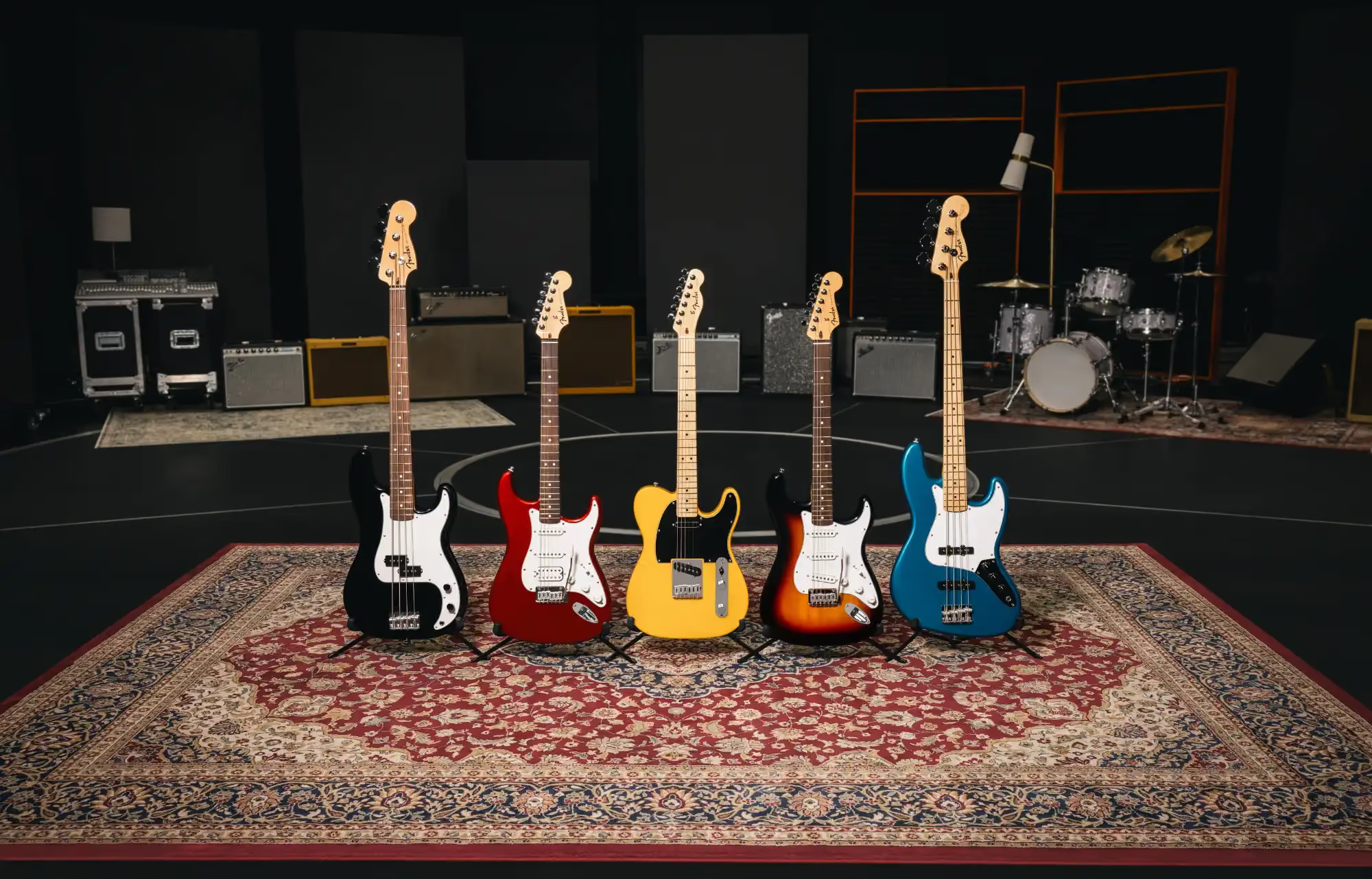
Photo: Lightburst · CC BY-SA 4.0
What do we actually mean when we say two guitars have different “tone”?
- InputA player's touch
- ProcessAn eight-stage signal chain
- OutputWhat we call tone
No week before this one
Tone as an engineering question
“Tone” gets used loosely — warm, bright, aggressive, muddy. This course treats it as an engineering question instead: two signals can share a pitch and a loudness and still sound completely different, and that difference has a name, a cause, and a measurable signature. This week sets up the vocabulary and the signal chain that the rest of the course keeps returning to. By the end of it you should be able to distinguish pitch, loudness, and timbre as separate properties of a sound; recognise that different waveforms can share a fundamental frequency; read a signal in both the time domain and the frequency domain; identify the stages of the guitar signal chain; and explain why tone is the product of a whole system, not any single component.
- Physical mechanism
- Signal transformation
- Waveform / spectral consequence
- Audible consequence
Vocabulary
Pitch, loudness, and timbre
Three separate properties get bundled together in casual listening. Pitch is how high or low a note sounds, and corresponds to the fundamental frequency of the vibration. Loudness is how intense the sound is, corresponding to amplitude. Timbre is everything else — the property that lets you tell a guitar apart from a violin playing the identical pitch at the identical loudness. Timbre itself is shaped by several contributors at once: the balance of harmonics in the spectrum, transient behaviour at the start of a note, how the sound dies away, modulation over time, nonlinear distortion, resonances in the instrument and signal chain, and other temporal effects — no single number captures it; it is the composite of all of these.
Two readings
Time domain and frequency domain
The same sound can be described two ways. A time-domain view — a waveform — plots amplitude against time and shows how a signal literally moves. A frequency-domain view — a spectrum — plots how much energy sits at each frequency, and shows what that motion is built from. Neither view is more “real” than the other; they’re two readings of the same signal, and this course moves between them constantly.
The system
The guitar signal chain
From the string’s first vibration to the sound reaching a listener’s ear, a guitar’s tone passes through every one of these stages — and every stage can change it. That’s why tone is a property of the whole system: the same string and pickup can sound different behind a different set of electronics, pedals, amplifier, speaker, or room, and each week of this course studies one stage of this chain in more depth.
Try it
Same pitch, three timbres
- Physical mechanism
- Signal transformation
- Waveform / spectral consequence
- Audible consequence
Sine, square, and sawtooth waves below all play at exactly the same 220 Hz fundamental — the same pitch. Switch between them and look at the waveform and spectrum as you listen: the difference you hear is entirely timbre, built from a different balance of harmonics above that shared fundamental.
Audio never plays automatically — press play to hear it, press again to stop.
All three waveforms play at exactly the same 220 Hz fundamental. Whatever difference you hear is timbre, not pitch — the harmonic content shown above.
Takeaways
What this week establishes
Pitch (frequency), loudness (amplitude), and timbre (everything else) are separate properties of a sound.
Different waveforms can share a fundamental frequency and still sound completely different — that difference is timbre.
The time domain (waveform) and frequency domain (spectrum) are two views of the same signal, not two different signals.
The guitar signal chain runs string → pickup → electronics → pedals → amplifier → speaker → room → listener, and every stage can shape tone.
Tone is a property of the whole system, not any single link in that chain.
The chain
Where this sits, and what comes next
- 01INPUTWhat Is Guitar Tone?
- 02STRINGThe Vibrating String
- 03PICKUPFrom Vibration to Voltage
- 04CIRCUITThe Guitar Is a Circuit
- 05DRIVEGain, Headroom and Clipping
- 06DISTORTIONInside overdrive, distortion and fuzz
- 07FILTERFilters, EQ and Tone Stacks
- 08MODULATIONModulation: Phase, Pitch and Motion
- 09SPACEDelay, Reverb and Space
- 10AMPInside the Guitar Amplifier
- 11SPEAKERSpeaker, Cabinet and Air
- 12OUTPUTEngineering the Complete Tone
This week has no previous material to connect to — it’s the conceptual starting point for the course. It introduced harmonics and spectra in the abstract, comparing waveforms that already existed. Week 2 asks where those harmonics physically come from in the first place: what happens, mechanically, when a guitar string vibrates.