Week 05 Stage: Nonlinearity
Gain, Headroom and Clipping
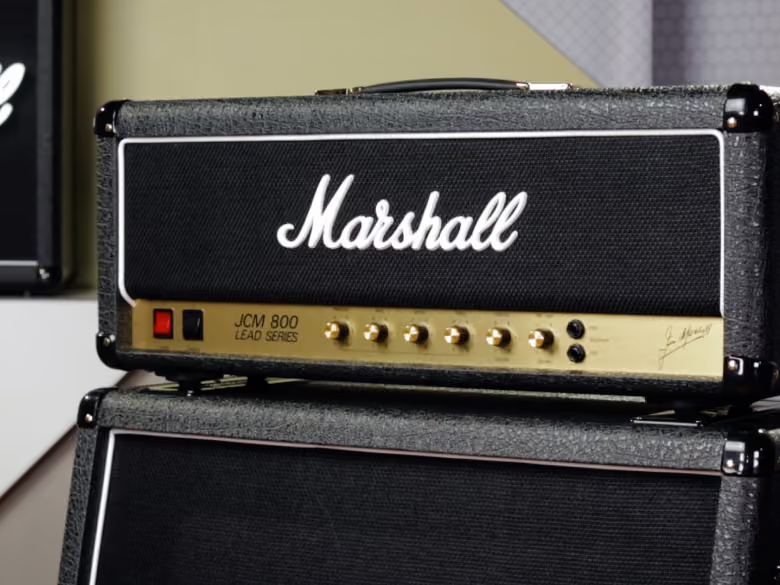
Photo: Tim Patterson · CC BY-SA 2.0
What physically happens when an amplified signal stops behaving linearly?
- InputA signal driven past a stage's headroom
- ProcessClipping: hard or soft
- OutputNew harmonic content that wasn't there before
Where we left off
From linear filtering to nonlinear transformation
Every stage covered so far — pickup, volume pot, tone control, cable — has been linear: it can reshape which frequencies are present, but it never adds anything that wasn’t already there. Gain changes that. Once a signal is amplified far enough, the system running out of room to represent it stops being a detail and becomes the whole story. By the end of this week you should be able to distinguish gain from output volume; explain linear amplification; define headroom conceptually; explain clipping in terms of input-output limits; distinguish hard and soft clipping; and explain why clipping introduces harmonic content that wasn’t in the original signal.
- Gain (amplitude scaling)
- Headroom limit reached
- Clipped waveform shape
- New harmonic content
Gain versus volume
Running out of headroom
Gain is amplification applied within a stage: for an ideal linear amplifier, output(t) = G · input(t) — the waveform’s shape is unchanged, only its amplitude scales. Volume is a separate, later control over how loud the already-processed signal ends up. A real stage can’t raise amplitude indefinitely, though: it has a maximum level it can represent before something has to give. The gap between a signal’s current level and that maximum is its headroom. As gain increases, headroom shrinks — and once it reaches zero, the waveform can no longer just get bigger.
Clipping
What happens when headroom runs out
Clipping is what a system does once it can’t represent an amplified waveform’s true peak: rather than continuing to follow G · input(t), the output stops tracking the input once it nears the limit. How it stops tracking it is a design choice, not a single fixed behaviour — and that choice is exactly what separates the two clipping families below.
Two clipping families
Linear, soft, and hard transfer curves
Either way, the output is no longer a scaled copy of the input — it’s a genuinely different waveform shape. A nonlinear transformation is exactly one where output isn’t simply proportional to input, and clipping is the simplest example this course studies. A clipped sine wave contains frequency components that were never present in the clean sine at all: flattening the waveform’s peaks is, in the frequency domain, equivalent to adding new harmonics on top of the fundamental. No detailed derivation is needed here — what matters is the causal link: reshape the waveform → change its harmonic content. Those extra harmonics change the signal’s perceived timbre, though “more harmonics” on its own doesn’t mean “better tone” — whether added harmonics sound pleasant depends on which ones appear and how they’re balanced, not just how many there are.
Try it
One gain stage, two ways to clip
- Physical mechanism
- Signal transformation
- Waveform / spectral consequence
- Audible consequence
Turn the Drive knob up from its low default and watch the transfer curve, waveform, and spectrum all update together. At low drive the curve stays close to the straight reference line and the output is just a louder sine; past a point it bends (soft) or folds sharply (hard), and the spectrum grows new bars exactly as the waveform starts to flatten. Play the tone to hear the same transition.
Audio never plays automatically — press play to hear it, press again to stop.
At low drive the output is just a bigger sine — same shape, no new frequencies. Turn Drive up and watch new harmonic bars appear in the spectrum exactly as the waveform starts to flatten.
Takeaways
What this week establishes
Gain is amplification within a stage; volume is a separate, later control over overall loudness.
An ideal linear amplifier scales amplitude without changing waveform shape: output(t) = G · input(t).
Headroom is the gap between a signal's current level and the maximum a stage can represent — gain shrinks it.
Clipping is what happens once headroom reaches zero: soft clipping compresses gradually, hard clipping cuts off abruptly.
Clipping is nonlinear and adds harmonic content that wasn't in the original signal — more harmonics isn't automatically 'better tone'.
The chain
Where this sits, and what comes next
- 01INPUTWhat Is Guitar Tone?
- 02STRINGThe Vibrating String
- 03PICKUPFrom Vibration to Voltage
- 04CIRCUITThe Guitar Is a Circuit
- 05DRIVEGain, Headroom and Clipping
- 06DISTORTIONInside overdrive, distortion and fuzz
- 07FILTERFilters, EQ and Tone Stacks
- 08MODULATIONModulation: Phase, Pitch and Motion
- 09SPACEDelay, Reverb and Space
- 10AMPInside the Guitar Amplifier
- 11SPEAKERSpeaker, Cabinet and Air
- 12OUTPUTEngineering the Complete Tone
Week 4 focused on linear filtering — reshaping frequency content without adding anything new. Week 5 introduced nonlinear signal transformation: past a headroom limit, a stage’s output stops being a scaled copy of its input, and new harmonics appear. So far, clipping has stayed an abstract mathematical function — a curve, applied to a sine wave. Week 6 builds that same function out of a real gain stage and real clipping components, and asks why two circuits that both “clip the signal” can still sound different from each other.
- Physical mechanism
- Signal transformation
- Waveform / spectral consequence
- Audible consequence