Week 07 Stage: Filtering
Filters, EQ and Tone Stacks
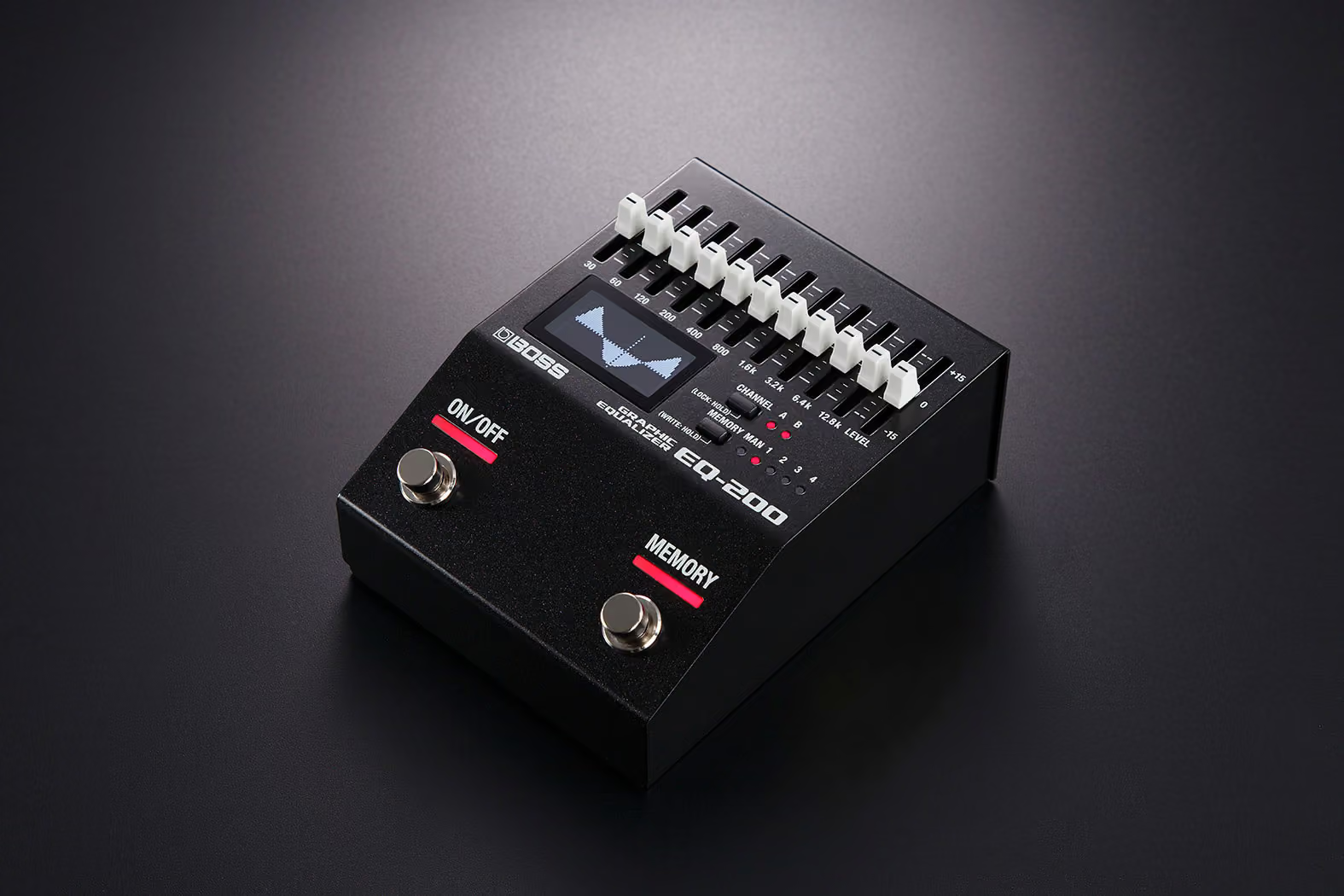
Photo: GabeMc · CC BY-SA 3.0
Once a signal contains many frequencies, how can a circuit reshape its tonal balance?
- InputA signal already containing many frequencies
- ProcessFrequency-dependent gain: cutoff and resonance
- OutputA reshaped spectrum, a changed tonal balance
Where we left off
From adding frequencies to reshaping them
Weeks 1-4 already showed several stages that filter a guitar’s signal — a passive tone control, cable capacitance. Weeks 5 and 6 showed a gain stage that adds new frequencies through clipping. This week studies the general tool for deliberately reshaping which frequencies come through afterward: the filter, and the EQ and tone-stack circuits built from it. By the end of this week you should be able to recognise low-pass, high-pass, and band-pass/band-reject behaviour; interpret a frequency-response graph; explain cutoff frequency; explain resonance and Q conceptually; distinguish passive from active filtering at a broad level; and explain why EQ placed before a distortion stage behaves differently from EQ placed after it.
- Frequency-dependent gain
- Cutoff & resonance (Q)
- Reshaped spectrum
- Changed tonal balance
Frequency response
Cutoff, and the filter family
A filter’s frequency response is simply its gain plotted as a function of frequency: how much of each frequency component survives. A low-pass filter passes frequencies below some cutoff frequency and reduces those above it — Week 4’s passive tone control was already one example. A high-pass filter is its mirror image, passing what’s above cutoff and reducing what’s below. A band-pass filter passes a range in between and reduces frequencies on both sides of it; a band-reject filter does the opposite, reducing a range in the middle while passing what’s above and below. Introduced at this level, band-pass and band-reject are exactly a low-pass and a high-pass response combined, rather than a separate mechanism to learn from scratch. Whatever the filter’s shape, the underlying operation is the same: a gain that depends on frequency, applied to every frequency component of the input at once.
Some filters don’t just roll off past cutoff — they briefly boost frequencies right around it before rolling off, a resonant peak. Q controls how narrow and tall that peak is: a low Q gives a broad, gentle emphasis (or none at all), while a high Q gives a sharp, narrow spike right at the cutoff frequency. A plain low-pass or high-pass filter can be built with no resonance at all — Q only becomes an audible, adjustable parameter once a filter is deliberately designed to have one.
Passive vs. active
And where a tone stack fits
Week 4’s tone control was a passive filter: built only from resistors and capacitors, with no power supply and no amplification, at the cost of inevitably reducing the signal somewhat even at frequencies it’s meant to pass. An active filter adds an amplifying stage (typically built around an operational amplifier) to the same resistor-capacitor idea, which can compensate for that loss or even boost a chosen range instead of only reducing others — the broad distinction that matters here, without going into the amplifier circuitry itself.
A tone stack — the bass/middle/treble network found in many guitar amplifiers — is several of these frequency-shaping ideas wired together so they interact. That interaction is the important, easily-missed point: the three controls are not three independent filters quietly agreeing to share a signal. Adjusting one can measurably shift what the others appear to do, because the same resistor and capacitor networks are shared between them. Reproducing any specific tone stack’s exact interacting response accurately would need specific circuit values this course doesn’t have grounds to assert — the qualitative lesson (shared components mean interacting controls) is what this week is scoped to.
EQ and distortion order
Before the nonlinear stage, or after it
Week 5 and 6 showed that a nonlinear gain stage generates new harmonic content from whatever reaches it. That makes EQ placement around a distortion stage a genuinely different decision each way, not just a matter of taste — a guitar-specific application of everything above.
EQ before distortion changes which frequencies drive the nonlinear stage in the first place — cutting bass before clipping, for instance, changes what gets clipped and so changes which harmonics the clipping stage generates.
EQ after distortion instead shapes a spectrum that already contains whatever harmonics clipping just created — it can remove or emphasise those new frequencies, but it can no longer change which ones were generated to begin with.
Try it
Cutoff, type, and resonance
- Physical mechanism
- Signal transformation
- Waveform / spectral consequence
- Audible consequence
Switch between Low-pass, High-pass, and Resonant, and adjust Cutoff and Resonance (Q). Notice the Resonance knob does nothing visible in Low-pass or High-pass mode — only Resonant mode uses it — and that a higher Q there produces a taller, narrower peak right at the cutoff frequency, exactly as described above. Play the tone to hear the same shift.
Audio never plays automatically — press play to hear it, press again to stop.
Low-pass and High-pass hold Q fixed at 1/√2 — maximally flat, no peak — so the Resonance knob only visibly bends the curve in Resonant mode. That's the point: a plain first-order-style low-pass or high-pass doesn't resonate; a resonant peak is a distinct design choice.
Takeaways
What this week establishes
A filter's frequency response is its gain as a function of frequency; cutoff frequency marks where a low-pass or high-pass response transitions.
Band-pass and band-reject responses are a low-pass and a high-pass combined, not a separate mechanism.
Q controls how narrow and tall a resonant peak is — a plain low-pass or high-pass can have no resonance at all.
Passive filters use only resistors and capacitors; active filters add amplification, at the cost of needing power.
A tone stack's bass/middle/treble controls interact through shared components rather than acting as independent bands.
EQ before a distortion stage changes which frequencies get clipped; EQ after it only reshapes a spectrum that already contains the new harmonics clipping created.
The chain
Where this sits, and what comes next
- 01INPUTWhat Is Guitar Tone?
- 02STRINGThe Vibrating String
- 03PICKUPFrom Vibration to Voltage
- 04CIRCUITThe Guitar Is a Circuit
- 05DRIVEGain, Headroom and Clipping
- 06DISTORTIONInside overdrive, distortion and fuzz
- 07FILTERFilters, EQ and Tone Stacks
- 08MODULATIONModulation: Phase, Pitch and Motion
- 09SPACEDelay, Reverb and Space
- 10AMPInside the Guitar Amplifier
- 11SPEAKERSpeaker, Cabinet and Air
- 12OUTPUTEngineering the Complete Tone
Week 6 generated new frequencies through nonlinear clipping. This week studied the tool for deliberately reshaping frequency content — filters, EQ, and tone stacks — and showed that where a filter sits relative to a distortion stage changes what it actually does. Until now, every transformation covered has been relatively static: set a cutoff, a gain, a clipping shape, and it stays put. Week 8 introduces parameters that change continuously over time.
- Physical mechanism
- Signal transformation
- Waveform / spectral consequence
- Audible consequence