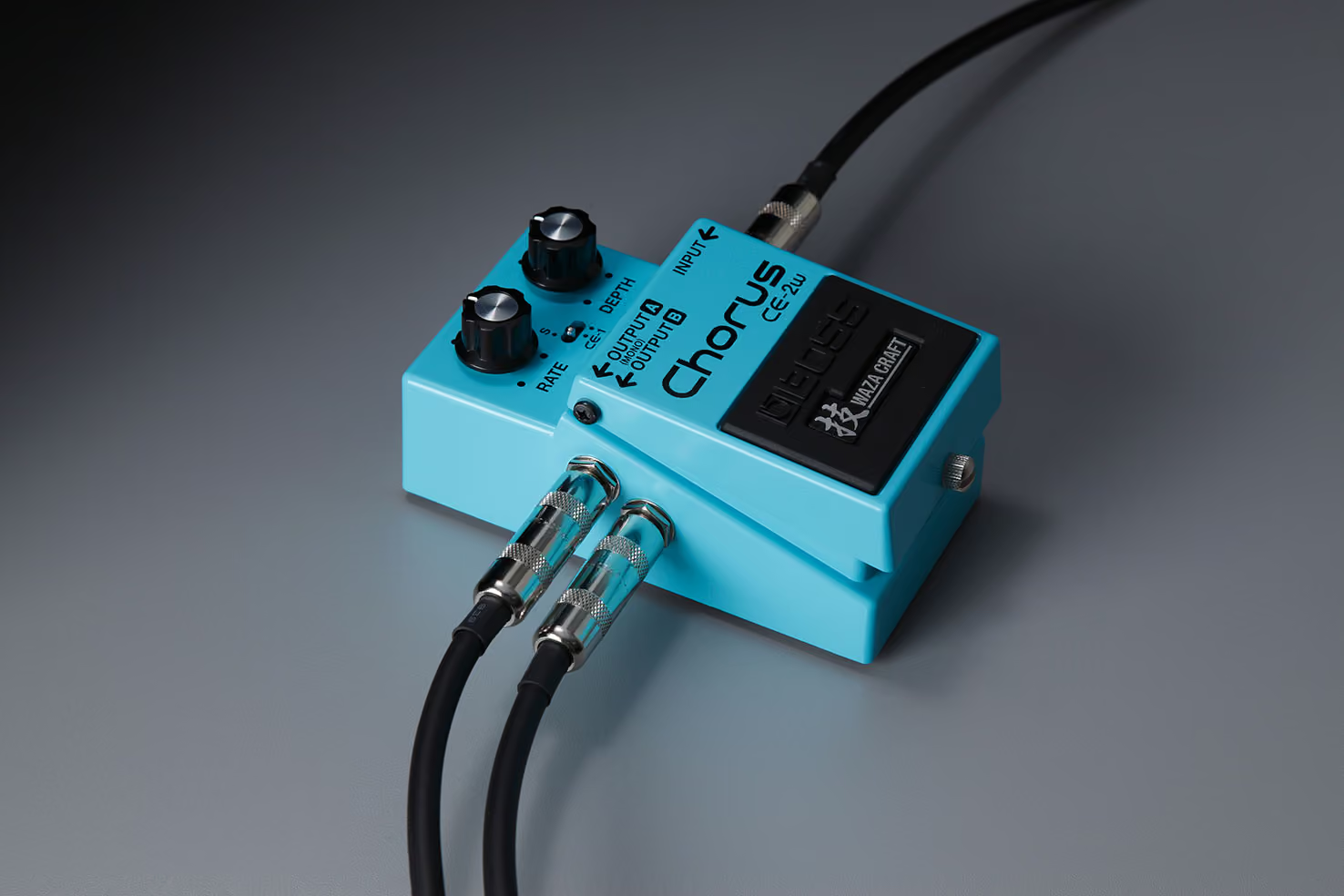
Week 08 Stage: Modulation
Modulation: Phase, Pitch and Motion
Photo: Guitar Chalk · CC BY 2.0
How can continuously changing delay, phase, pitch, or amplitude create the sensation of movement?
- InputA static signal and a slow control oscillator
- ProcessThe LFO continuously varies a gain, delay, or corner frequency
- OutputA moving, time-varying effect: tremolo, vibrato, chorus, flanger, or phaser
Where we left off
From static shaping to motion
Every transformation so far — gain, clipping, filtering — has been static: set a value and it stays put while a note rings out. This week asks what happens once a parameter is deliberately made to change continuously over time, on its own clock, independent of anything the player does. Five familiar effects — tremolo, vibrato, chorus, flanger, and phaser — turn out to share one mechanism underneath rather than being five unrelated pedals. By the end of this week you should be able to explain what an LFO is; distinguish tremolo from vibrato; explain chorus as a short modulated delayed copy mixed with the original; explain flanging as the same idea with a much shorter delay; explain phasing conceptually, through phase-shifting filter stages rather than delay; and connect interference — constructive and destructive — to what any of this actually sounds like.
- LFO (control signal)
- Modulated parameter
- Two versions interfering
- Moving, time-varying effect
The LFO
A control signal, not a sound
A low-frequency oscillator (LFO) is a plain, slow oscillator — a sine wave is the simplest case — that is never sent to the output. Instead its value at each instant is used to steer some other parameter: a gain, a delay time, a filter’s cutoff. It is a control signal, not something anyone hears directly. Every effect this week is built the same way: one LFO, wired to a different parameter depending on the effect. The two traces above are the same waveform. The left one is the LFO itself; the right one is that same shape reframed as “the parameter this effect varies,” swinging between whatever minimum and maximum that parameter takes. Only the framing changes from effect to effect.
Tremolo is the simplest case: the LFO drives the signal’s amplitude directly, so the output rises and falls in loudness at the LFO’s rate. No delay, no filtering — just gain, moved continuously instead of held fixed.
Vibrato is periodic pitch modulation rather than amplitude modulation. The standard way to produce it electronically is to run the signal through a very short delay line and modulate the delay time itself with the LFO: continuously shortening and lengthening a delay stretches and compresses the signal passing through it, which is heard as the pitch rising and falling — a small, fast Doppler-like effect, not a literal pitch-shifting algorithm.
Chorus and flanger
Two delayed copies, two different delay ranges
Chorus and flanger both work by combining the dry signal with a copy of itself passed through an LFO-modulated delay line — mixed back in, rather than replacing the original the way vibrato does. What separates them is simply how short that delay is.
Chorus uses a delay long enough (tens of milliseconds) that the ear hears the copy as a second, subtly detuned voice alongside the original — the sound of two people meant to be in unison rather than one signal interacting with itself. Flanger uses much shorter delay times (a few milliseconds), short enough that the ear no longer hears “two voices” but instead a single, moving, metallic-sounding shift in timbre.
At flanger-length delays, summing the dry and delayed copies produces interference: at some frequencies the two copies arrive in phase and reinforce each other (constructive interference); at others they arrive out of phase and cancel (destructive interference). Sweeping the delay time sweeps which frequencies fall into each category, producing a comb filter — a response with a regularly spaced series of notches — whose notches visibly move as the LFO cycles.
Two ways to get interference
Comb filter versus phase-shifting cascade
- shortest delay in the sweep
- mid-sweep
- longest delay in the sweep
Each trace is the comb filter’s response at one instant of the sweep; a shorter delay spaces the notches further apart. A static diagram can only show a few snapshots — in the live bench below, the notches actually sweep as the LFO cycles.
A phaser reaches the same kind of interference by a different route. Instead of a delay line, the signal passes through a cascade of phase-shifting filter stages, each of which shifts the phase of different frequencies by different amounts without changing their level. Summing that phase-shifted copy with the original produces the same constructive/destructive interference as a comb filter — but the notch positions are set by how much phase each frequency has picked up, not by a travel-time delay. LFO-modulating the filter stages’ corner frequency sweeps those notches, exactly as a flanger sweeps its delay-based ones.
- low end of the sweep
- mid-sweep
- high end of the sweep
A cascade of a few phase-shifting stages typically produces only a handful of moving notches — visibly fewer and less evenly spaced than a flanger’s comb filter, which is the usual audible way to tell the two effects apart even though both are built from the same underlying interference.
Try it
Rate, depth, and mix, across five effects
- Physical mechanism
- Signal transformation
- Waveform / spectral consequence
- Audible consequence
Switch between Tremolo, Vibrato, Chorus, Flanger, and Phaser. Rate and Depth always mean the same thing — how fast and how far the LFO swings a parameter — but watch the panel underneath the knobs: it shows exactly which parameter is moving and between what values, which changes with the effect even though the two knobs controlling it don’t.
Audio never plays automatically — press play to hear it, press again to stop.
Rate and Depth always mean the same thing — how fast and how far the LFO swings a parameter — but which parameter changes with the effect: output gain for Tremolo, delay time for Vibrato/Chorus/Flanger, and an allpass filter's corner frequency for Phaser.
Takeaways
What this week establishes
An LFO is a slow, inaudible control signal used to steer some other parameter, not something heard directly.
Tremolo modulates amplitude; vibrato modulates pitch, typically via a modulated short delay line.
Chorus and flanger both mix a modulated delayed copy with the dry signal — chorus uses longer delays (a second voice), flanger much shorter ones (a moving comb filter).
A comb filter's notches come from constructive and destructive interference between the dry and delayed copies; sweeping the delay sweeps the notches.
A phaser produces the same kind of interference using phase-shifting filter stages instead of a delay line, giving fewer, unevenly spaced moving notches.
Rate and depth are shared, effect-independent parameters: how fast and how far the LFO swings whichever parameter that effect happens to modulate.
The chain
Where this sits, and what comes next
- 01INPUTWhat Is Guitar Tone?
- 02STRINGThe Vibrating String
- 03PICKUPFrom Vibration to Voltage
- 04CIRCUITThe Guitar Is a Circuit
- 05DRIVEGain, Headroom and Clipping
- 06DISTORTIONInside overdrive, distortion and fuzz
- 07FILTERFilters, EQ and Tone Stacks
- 08MODULATIONModulation: Phase, Pitch and Motion
- 09SPACEDelay, Reverb and Space
- 10AMPInside the Guitar Amplifier
- 11SPEAKERSpeaker, Cabinet and Air
- 12OUTPUTEngineering the Complete Tone
Week 7 shaped frequency response using mostly static filters — set a cutoff and it stays there. This week made that kind of transformation time-dependent: an LFO continuously varying a gain, a delay, or a filter’s corner frequency, producing motion instead of a fixed shape. Chorus and flanging already needed a short delay line to work. Week 9 takes that same idea of a delayed copy of the signal and expands it — into echoes, feedback systems, and the simulation of physical space.
- Physical mechanism
- Signal transformation
- Waveform / spectral consequence
- Audible consequence