Week 03 Stage: Pickup
From Vibration to Voltage
Photo: John Tuggle · CC BY 2.0
How does a magnetic pickup convert string motion into an electrical signal?
- InputString motion
- ProcessMagnetic field variation
- OutputElectrical voltage
Lecture deck
Present this lecture as slides
Where we left off
A vibrating string is not yet a signal
Week 2 explained where a string’s vibration comes from and what shape it takes: a sum of standing-wave modes, each with its own frequency and its own spatial pattern of nodes and antinodes. But a vibrating string on its own produces only mechanical motion. No electrical signal exists anywhere in the instrument until something senses that motion — and what does the sensing, and where it sits, turns out to already shape the tone before a single cable is plugged in.
This week is the first of the course’s two transductions: the point where the signal stops being a moving object and starts being a voltage. Everything from Week 4 onward operates on that voltage.
By the end of it you should be able to describe a magnetic pickup’s basic structure; explain, conceptually, how string motion induces a voltage; explain why pickup position changes the measured harmonic balance; contrast neck and bridge positions without relying only on subjective language; and describe, at a broad level, why humbuckers use two coils.
Mechanism
Structure, and what actually induces the voltage
A magnetic pickup is built from a permanent magnet, one or more ferromagnetic pole pieces, and a coil of wire wound around them — sitting beneath a string that itself has to be ferromagnetic to interact with the field at all. The magnet magnetises the part of the string directly above it, and the field of that magnetised section threads back down through the coil. As the string vibrates, the flux through the coil rises and falls, and a changing flux is exactly what induces a voltage across a coil. It is the change that matters, not the string’s position by itself — which the figure below lets you test directly.
- Flux through coil
- changing
- Rate of change dΦ/dt
- high
Position
A pickup samples the string at one point
Week 2 showed that a string’s vibration is a sum of modes, each with a different spatial pattern. A pickup senses motion only at the one location it sits at, so it effectively samples that sum at a single point — and because each mode has a different amplitude at that point, position changes the measured balance between harmonics, just as picking position did for excitation in Week 2. The useful description is exactly that: which partials are relatively stronger or weaker at that position, rather than reaching for “warm” or “bright” on their own.
Mode 1 · f₀
Mode 2 · 2f₀
Mode 3 · 3f₀
Mode 4 · 4f₀
A pickup senses the string at one point, so it reads each mode at whatever displacement that mode happens to have there. Close to the bridge every mode is near its fixed end, and the lowest one — which carries most of the energy — is sensed at barely a fifth of its amplitude, so the partials above it dominate what leaves the guitar. Move to the neck-like position and the first mode comes through at three times that, while the fourth collapses to 13%: one of its nodes sits a quarter of the way along the string, almost exactly where the pickup is, so there is very little there for it to sense. That is the whole mechanism. Not “warmer” — a different set of numbers in this figure.
Try it
Move the pickup, and listen
Drag the pickup along the string and the sensitivity curve moves with it. Press play and drag again: the sound moves too, because the filter processing the recording is the same expression the curve plots — the nulls you can see are the nulls you can hear. Watch the measured spectrum settle onto the predicted curve while a note rings.
Lab 03Pickup position
The recording is the course's canonical dry DI take of an open low E, and the comb spacing is derived from that note's fundamental — the same position on a higher note would space the nulls further apart. This is an idealised point sensor: a real pickup senses across the width of its pole pieces, which softens the deepest nulls, and its coil adds a resonance this model does not include.
Two coils
Single coil versus humbucker
Everything so far has assumed one coil. A single-coil pickup is exactly that — simple, and with nothing to reject the electromagnetic interference it picks up from nearby equipment, which is the source of its characteristic hum. A humbucker solves that with a second coil, and the solution is worth understanding because the same trick appears again later in the chain.
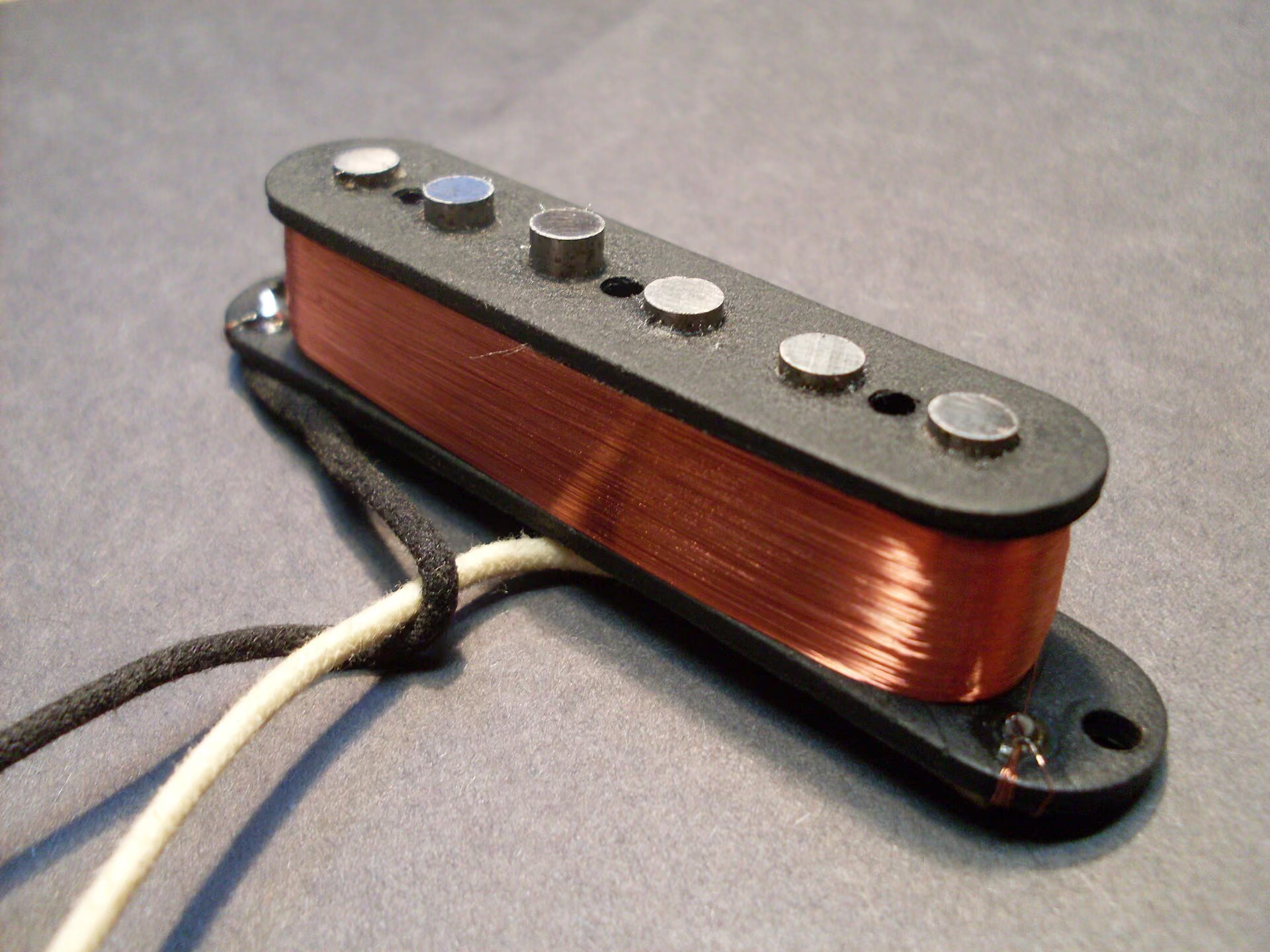
A single coil, wound around six magnets that double as its pole pieces. The copper is the whole sensing element — several thousand turns of it. Nothing here rejects an interfering field, which is the source of the mains hum a single coil is known for.
Photo: Roadside Guitars · CC BY-SA 2.0
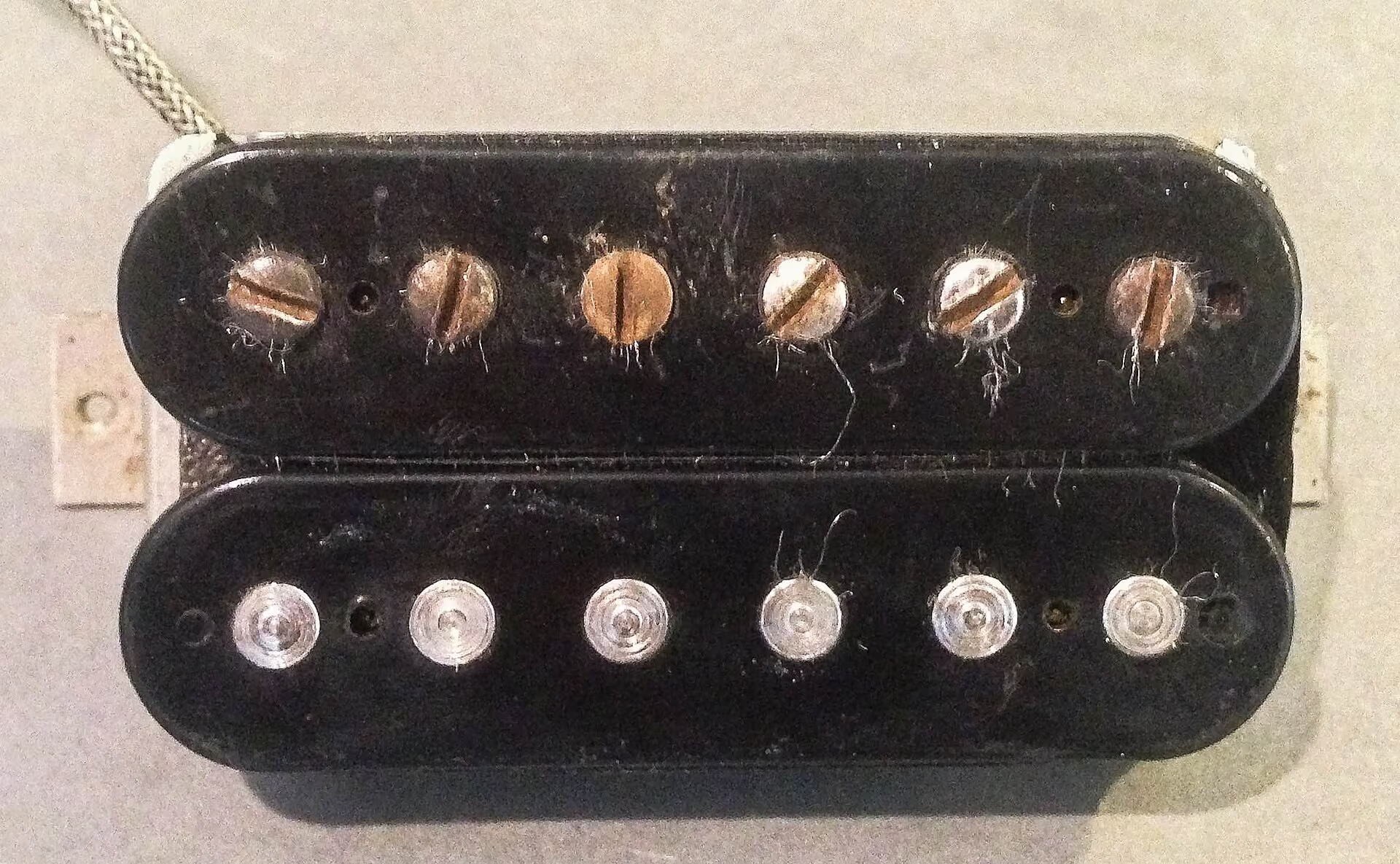
The same idea twice, with the cover off. One bobbin carries adjustable screw poles, the other plain slugs — and the two are wound in opposite directions, with opposite magnetic polarity, which is what lets their outputs be added without cancelling the string.
Photo: Stratocaster27 · CC BY-SA 4.0
Interference from nearby equipment reaches both coils the same way, so summing their outputs cancels it. The string does not: because the coils are wound in opposite senses and face opposite magnetic poles, the string's signal arrives inverted in one relative to the other, and summing adds it. The detailed wiring is beyond this week — the principle is that one subtraction can remove what is common to two sensors while keeping what is not.
Takeaways
What this week establishes
A pickup is a magnet, one or more pole pieces, and a coil, sensing a ferromagnetic string above it.
String motion changes the magnetic flux through the coil, and it is the changing flux that induces the voltage — a string held still, however close, induces nothing.
A pickup senses motion at one point, so it samples the string's standing-wave modes at that location; changing position changes the measured harmonic balance.
Neck versus bridge is best described by which partials are stronger or weaker, not by subjective terms alone — at a bridge-like position the fundamental is sensed at roughly a fifth of its amplitude.
A humbucker's two oppositely-wound coils cancel what is common to both — interference — while adding what is not: the string.
The chain
Where this sits, and what comes next
- 01INPUTWhat Is Guitar Tone?
- 02STRINGThe Vibrating String
- 03PICKUPFrom Vibration to Voltage
- 04CIRCUITThe Guitar Is a Circuit
- 05DRIVEGain, Headroom and Clipping
- 06DISTORTIONInside overdrive, distortion and fuzz
- 07FILTERFilters, EQ and Tone Stacks
- 08MODULATIONModulation: Phase, Pitch and Motion
- 09SPACEDelay, Reverb and Space
- 10AMPInside the Guitar Amplifier
- 11SPEAKERSpeaker, Cabinet and Air
- 12OUTPUTEngineering the Complete Tone
Week 2 explained the modes a string supports. This week showed that pickup placement samples those modes, converting motion at one specific point into a voltage. But that voltage does not reach the rest of the signal chain untouched — it immediately meets resistance, capacitance, cable, and the guitar’s own volume and tone controls. Week 4 studies that electrical system.