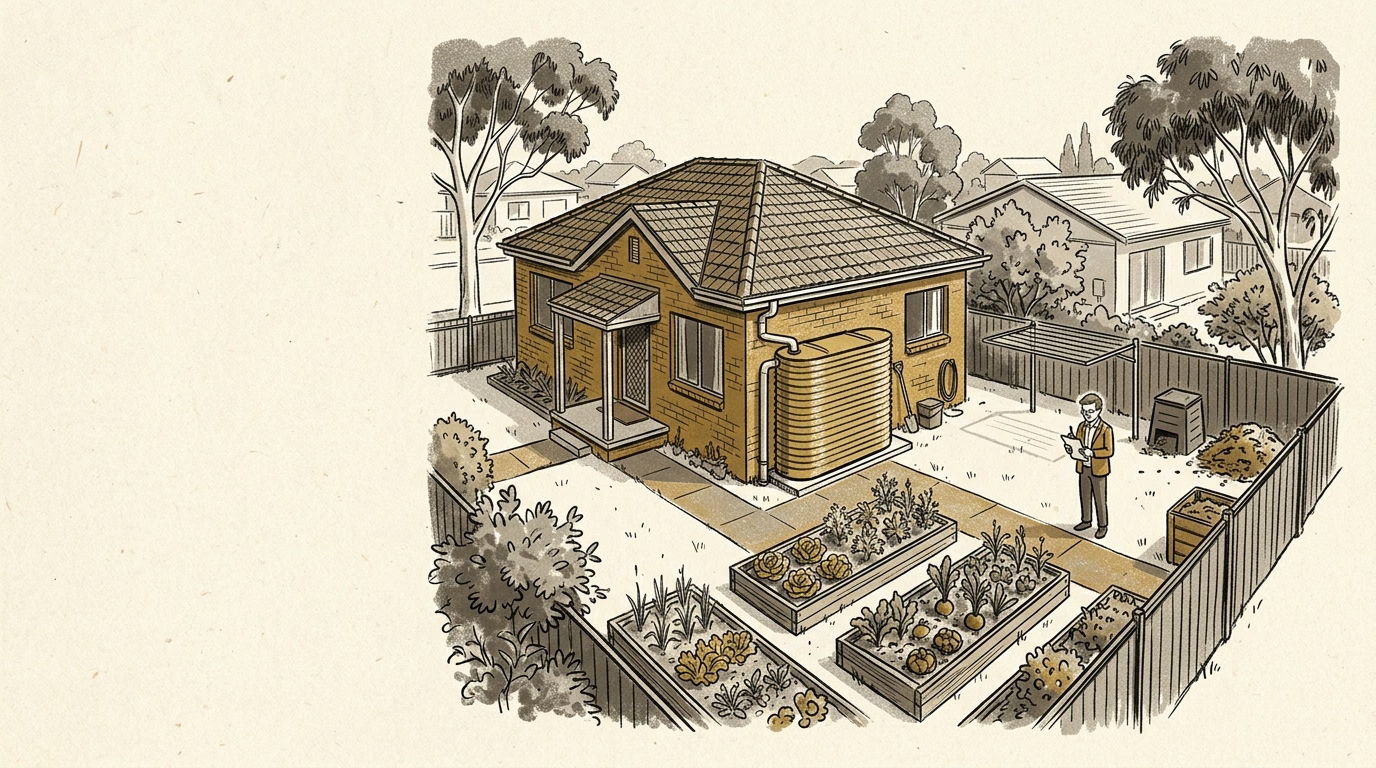
Graduate consultants measure a client's home for a year, then design the lowest-cost food, water and waste retrofit that meets the household's own targets, and argue for every dollar spent beyond it. Five fixed homes, one loan programme, real climates.
What can this client's land reliably provide, and which improvements justify their cost?
That is the question a homeowner asks when they apply for a loan to make their house more self-reliant, and it is the one this course trains you to answer. You work as a graduate engineer at a small consultancy, taking one household from its first meeting to a costed proposal. The government is imaginary. Your water balance still has to add up.
Take the site tour
5 steps
Five steps, about a minute. It explains how this site is arranged and where to start.
Step 1 The setting is invented. The engineering is not.
You advise a fictional household applying to a fictional government loan programme. The government is imaginary; the climates, water balances, soils, pumps and prices are real, and your water balance still has to add up.
Step 2 The site has three groups
Weekly study is what you do each week. Course reference is material you come back to all semester. People and policies is the admin. The top navigation is grouped the same way, and so is the menu on a phone.
Step 3 Four things are assessed
Ten small tutorial checkpoints, five short quizzes, a measurement programme in week 7 and an investment proposal in the assessment period. Half the marks are for the weekly work the assignments are assembled from.
Step 4 The planner has two views
Deadlines and materials shows what exists and when it is due. Suggested weekly effort shows roughly how the hours fall, so you can spread the work rather than meet it all at a deadline. Both are on this page and on the weekly map.
Step 5 Start at week 1
Choose a client home, build the evidence workbook, and fill one row properly. Every week after it writes into that file.
- What this course is
- A twelve-week engineering design course. You are given one real Australian climate, one fixed existing house and one fictional client, and you decide what their household should spend to become more self-reliant in food, water and waste. Theloan programme and the consultancy are fiction; the climates, the water balances, the soil, the pumps and the prices are not.
- What you submit
- Ten small tutorial checkpoints (20 %), five short quizzes (20 %), a measurement programme in week 7 (20 %), and an investment proposal in the assessment period (40 %).Assessment has the criteria; half the marks are for the weekly work the two assignments are assembled from.
- What to do this week
- Open the weekly map, find your week, and read the two paragraphs at the top of it. If this is your first visit, start atweek 1: choose a client home and build the evidence workbook every later week writes into.
How this site is arranged
Three groups, in the navigation above and in the menu on a phone. Knowing which group you are in tells you whether something is a task or a reference.
Weekly study
What you do each week. Weeks first — it is the map, and the other three are entry points into the same material:Lectures,Tutorials andAssessments.
Course reference
Material you come back to all semester, not another weekly task list. Thefive client homes, andProgramme & method — the scenario, the definitions, the bands, the price schedule and the datasets.
One commission, two assignments
First you work out what you would need to know. From an intake dossier and a scaled plan of an existing home you design a year of measurement: which instruments, where, how often, how accurate, what it costs against a $1,500 allowance, and how every reading feeds a decision. That is Assignment 1, due in week 7.
Then the story jumps twelve months. A specialist team hands over what the measurement year found, and you compare the existing home with three feasible retrofit options and recommend one: the cheapest arrangement that meets the household's own service targets, then an honest case for any money spent beyond it. That is Assignment 2, the technical annex to the family's loan application.
Nobody applies for a real loan and nobody waits a real year. Everything you calculate before week 7's handover is a scoping estimate on published figures, labelled as one.
The semester at a glance
Deadlines and materials
Twelve teaching weeks, the mid-semester break after week 5, then the assessment period. Every marker is a link.
Scroll sideways to see every week, or read the list below.
- Week overview
- Lecture and slides
- Tutorial
- Quiz
- Assignment deadline
Break: 29 March 2027 to 11 April 2027. Tutorial checkpoints are one 20 % record with ten Friday deadlines, not ten separate assessments. This course's calendar is in 2027, so no "today" line is drawn.
The same thing as a list
- Week overview. Week 1 (Meet your client: household systems and evidence); Week 2 (Soil, plants and irrigation demand); Week 3 (Mushrooms: substrate, yield and what to measure); Week 4 (Insects: waste streams and conversion limits); Week 5 (Aquaponics: feed, fish and operating conditions); Week 6 (Preservation and assembling the measurement plan); Week 7 (Water sourcing and the specialist handover); Week 8 (Treatment, reuse and service requirements); Week 9 (Storage and seasonal reliability); Week 10 (Waste recovery and integrated balances); Week 11 (Sanitation, nutrient limits and choosing between options); Week 12 (Integration and the investment recommendation)
- Lecture and slides. Lecture 1 (Meet your client: household systems and evidence — with slides); Lecture 2 (Soil, plants and irrigation demand — with slides); Lecture 3 (Mushrooms: substrate, yield and what to measure — with slides); Lecture 4 (Insects: waste streams and conversion limits — with slides); Lecture 5 (Aquaponics: feed, fish and operating conditions — with slides); Lecture 6 (Preservation and assembling the measurement plan — with slides); Lecture 7 (Water sourcing and the specialist handover — with slides); Lecture 8 (Treatment, reuse and service requirements — with slides); Lecture 9 (Storage and seasonal reliability — with slides); Lecture 10 (Waste recovery and integrated balances — with slides); Lecture 11 (Sanitation, nutrient limits and choosing between options — with slides); Lecture 12 (Integration and the investment recommendation — with slides)
- Tutorial. Tutorial 1 (Ungraded practice); Tutorial 2 (Checkpoint 1 of 10, 2 % — due 5 pm Friday); Tutorial 3 (Checkpoint 2 of 10, 2 % — due 5 pm Friday); Tutorial 4 (Checkpoint 3 of 10, 2 % — due 5 pm Friday); Tutorial 5 (Checkpoint 4 of 10, 2 % — due 5 pm Friday); Tutorial 6 (Checkpoint 5 of 10, 2 % — due 5 pm Friday); Tutorial 7 (Checkpoint 6 of 10, 2 % — due 5 pm Friday); Tutorial 8 (Checkpoint 7 of 10, 2 % — due 5 pm Friday); Tutorial 9 (Checkpoint 8 of 10, 2 % — due 5 pm Friday); Tutorial 10 (Checkpoint 9 of 10, 2 % — due 5 pm Friday); Tutorial 11 (Checkpoint 10 of 10, 2 % — due 5 pm Friday); Tutorial 12 (Ungraded practice)
- Quiz. Quiz 1 (4 % — 2027-03-11); Quiz 2 (4 % — 2027-03-25); Quiz 3 (4 % — 2027-04-29); Quiz 4 (4 % — 2027-05-13); Quiz 5 (4 % — 2027-05-27)
- Assignment deadline. Household Resilience Investment Proposal (40 % — 2027-06-18); Year-long Measurement Programme (20 % — 2027-04-23)
Suggested weekly effort
An illustrative planning guide, not observed student data, not required attendance and not a guarantee. It is drawn to encourage steady weekly work rather than a fortnight of panic. 90 hours across the twelve teaching weeks, plus 4 in the assessment period — 94 in total.
Hours on the vertical axis, one bar per teaching week. Scroll sideways if it is cut off.
- Lecture and notes — The lecture, its slides, and reading the week's notes afterwards
- Tutorial — The session itself. Tidying and submitting the checkpoint is inside this, not extra
- Preparation and quiz — Preparing for the tutorial. In a quiz week, sitting the quiz is inside this, not extra
- Assignment 1 — The measurement programme, built a few hours a week from week 3
- Assignment 2 — The investment proposal, built from week 7's handover onwards
No compulsory work in the mid-semester break. Catching up there is optional and sits outside these totals. A separate allowance for final review, drawing and submission after teaching ends — one block of four hours, not four hours a week.
The same thing as a table
| Week | Lecture and notes | Tutorial | Preparation and quiz | Assignment 1 | Assignment 2 | Total | Assignment milestone |
|---|---|---|---|---|---|---|---|
| 1 | 2 | 2 | 1 | — | — | 5 | Orientation and tutorial practice only; no assignment work scheduled |
| 2 | 2 | 2 | 1 | — | — | 5 | Orientation and tutorial practice only; no assignment work scheduled |
| 3 | 2 | 2 | 1 | 3 | — | 8 | Substrate balance, and what would have to be measured to trust it |
| 4 | 2 | 2 | 1 | 3 | — | 8 | Waste-stream rows added to the register |
| 5 | 2 | 2 | 1 | 3 | — | 8 | Biological operating conditions added as measurement rows |
| 6 | 2 | 2 | 1 | 3 | — | 8 | QA, safety and access; the register costed against the allowance |
| 7 | 2 | 2 | 1 | 2 | 1 | 8 | Both cross-checks, final costing, submission; then Findings read; the baseline written down |
| 8 | 2 | 2 | 1 | — | 3 | 8 | Treatment and reuse; service requirements for each end use |
| 9 | 2 | 2 | 1 | — | 3 | 8 | Storage sized, saturation found, dry year run |
| 10 | 2 | 2 | 1 | — | 3 | 8 | Waste balance closed; recovery options costed |
| 11 | 2 | 2 | 1 | — | 3 | 8 | Three options built and compared; dominated ones struck out |
| 12 | 2 | 2 | 1 | — | 3 | 8 | Recommendation drafted, uncertainty listed, skeleton assembled |
| Assessment period | — | — | — | — | 4 | 4 | Final review, drawing and submission |
| Total | 24 | 24 | 12 | 14 | 20 | 94 | — |
- Week 1Meet your client: household systems and evidenceall five homes
- Week 2Soil, plants and irrigation demandCanberra leads
- Week 3Mushrooms: substrate, yield and what to measureBrisbane leads · Quiz 1
- Week 4Insects: waste streams and conversion limitsDarwin leads
- Week 5Aquaponics: feed, fish and operating conditionsAdelaide leads · Quiz 2
- Week 6Preservation and assembling the measurement planAdelaide leads
- Week 7Water sourcing and the specialist handoverAlice Springs leads · Year-long Measurement Programme
- Week 8Treatment, reuse and service requirementsBrisbane leads · Quiz 3
- Week 9Storage and seasonal reliabilityDarwin leads
- Week 10Waste recovery and integrated balancesAlice Springs leads · Quiz 4
- Week 11Sanitation, nutrient limits and choosing between optionsCanberra leads · Tutorial Completion Checkpoints
- Week 12Integration and the investment recommendationall five homes · Quiz 5
- Assessment periodHousehold Resilience Investment Proposal40 %
Every tile is a week overview: its question, its lecture, its tutorial, what is assessed in it, and what you leave holding.
The five clients
Every student advises one of five fixed existing homes in five Australian climates. There is no sixth option and no custom site: the comparison between homes is part of what the course teaches.
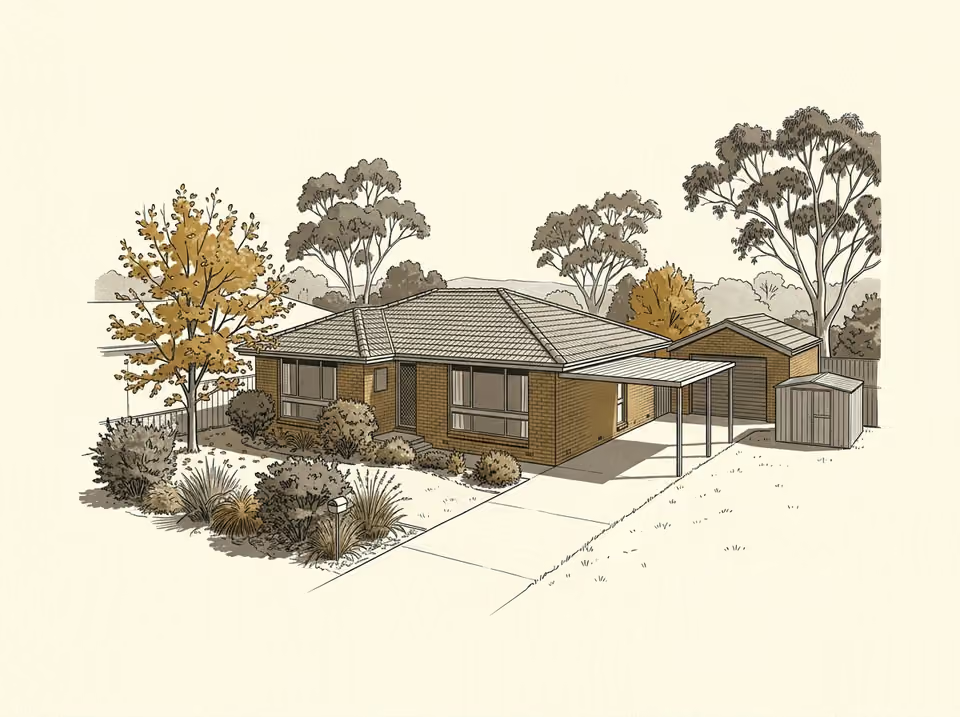
Canberra: the Taylor household
Keep the fruit trees and the raised beds productive through summer without watering from the mains.
Conceptual illustration · scaled plans govern.
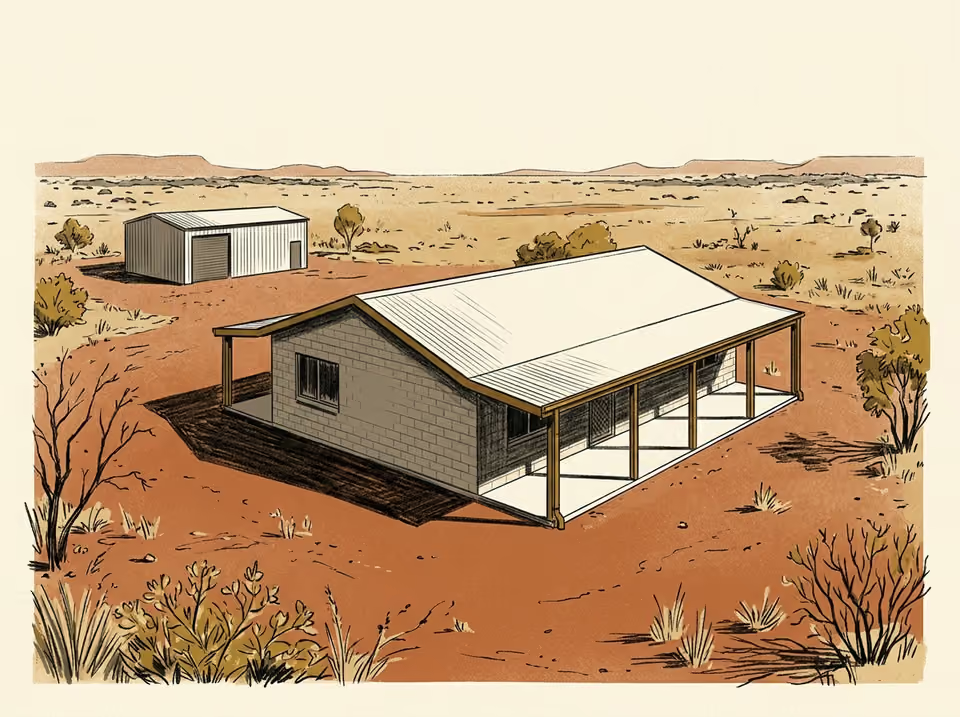
Alice Springs: the Nguyen household
Cart as little water as possible, and none at all in an ordinary year if that can be done.
Conceptual illustration · scaled plans govern.
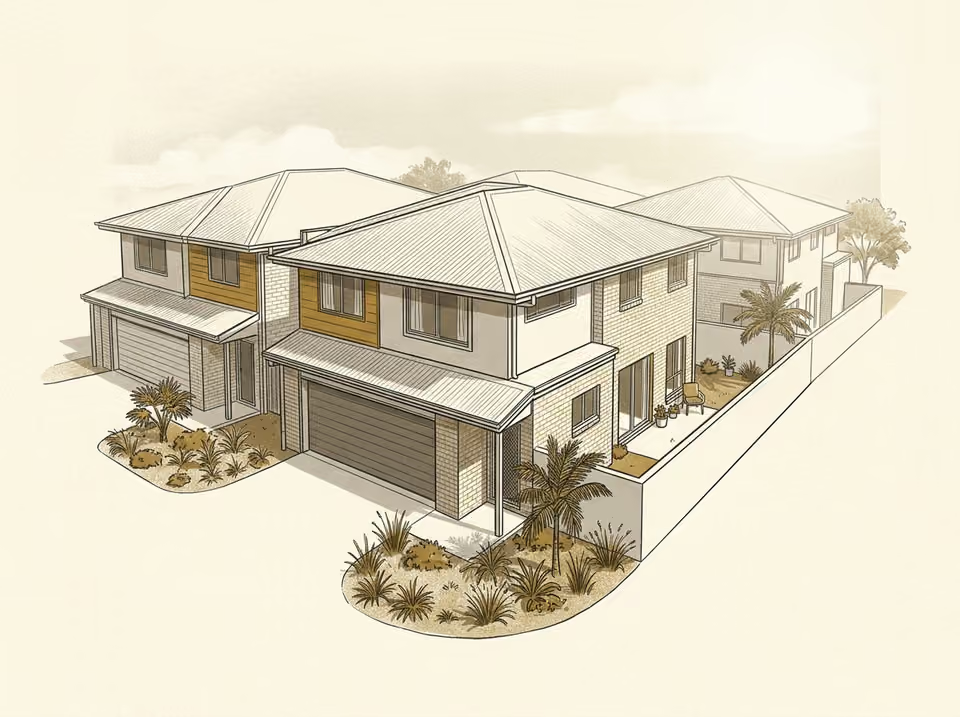
Brisbane: the Patel household
Grow something worthwhile in a small space without losing the courtyard.
Conceptual illustration · scaled plans govern.
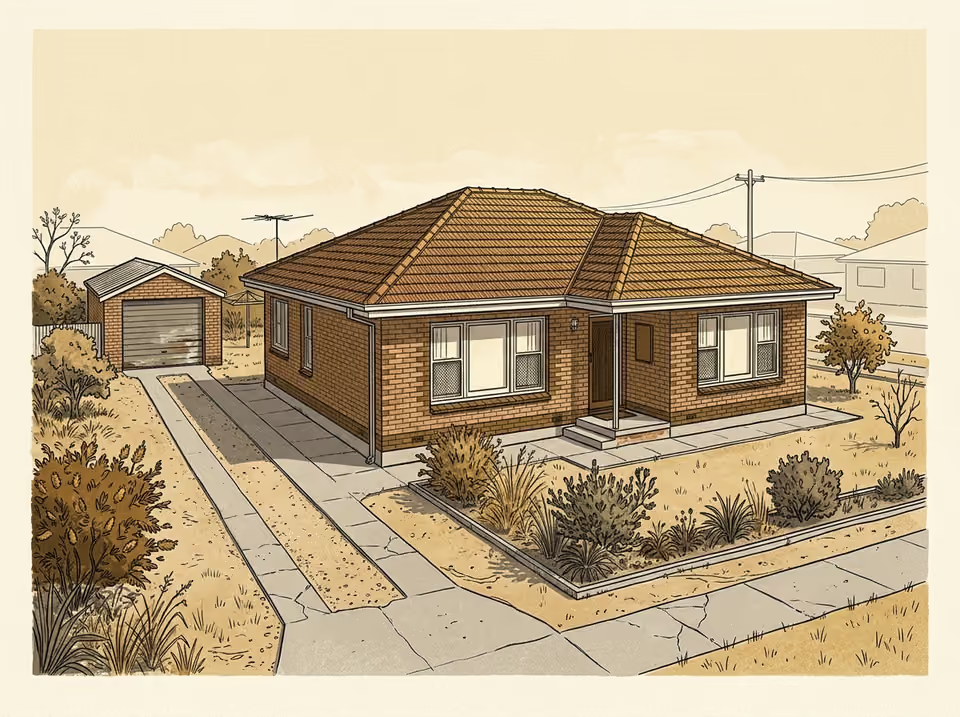
Adelaide: the Rossi household
Reliable summer irrigation for the beds and fruit trees without a rising water bill.
Conceptual illustration · scaled plans govern.
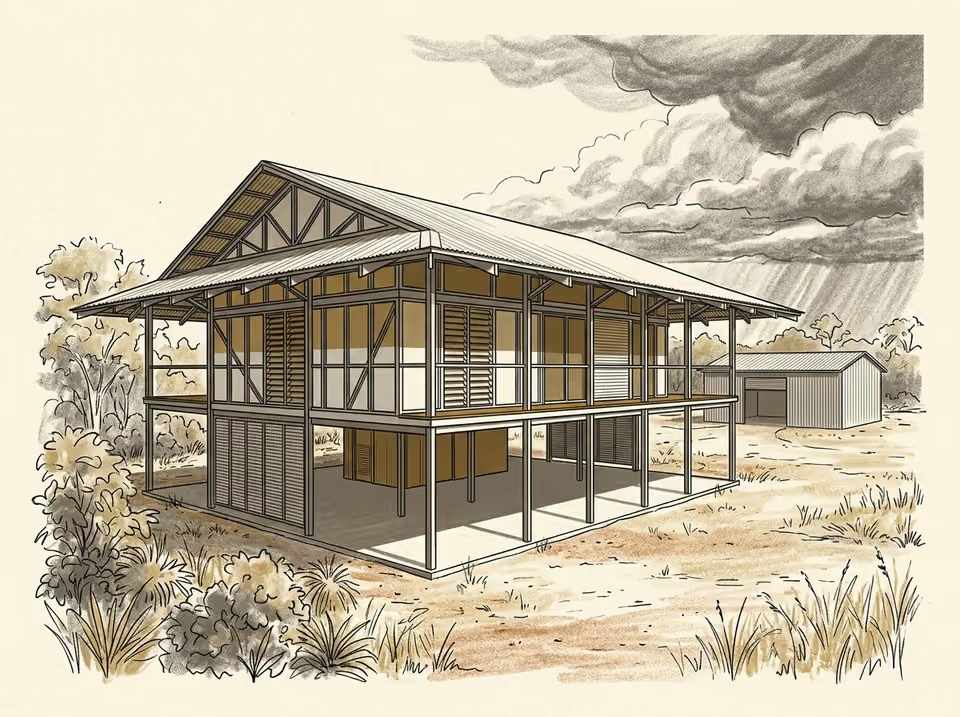
Darwin: the Williams household
Carry enough of the wet season into the dry to stop buying water.
Conceptual illustration · scaled plans govern.
What the engineering is
A constrained, multi-objective decision made with spreadsheet-sized models you can check by hand. Seven decision variables — storage, which roof zones to connect, how much ground to crop and with what, how to use rainwater and greywater, which biological modules to adopt, and how to run it all through the year — each with a short list of options bounded by what the home already has. Two hard limits from the programme: $30,000 including contingency, and 5 kWh a day in the peak month.
You will size storage from a monthly balance, estimate a critical flow and a pump head, check nutrient recovery against what the crop can take up, and test your recommendation against a dry year. You will not pick pipe diameters, draw wiring or certify anything; you specify performance and how a builder proves it has been met.
What you will not do
You will not build, operate, eat from or drink from anything, and you will not collect a year of real data. Where the course sets a safety rule stricter than the law in your client's jurisdiction, it says so, and says why.
Energy supply and shelter are out of scope. Biogas is recorded and not credited; only the digestate's nutrients count. Those belong to SLOP4762 — Designing the Closed-Loop Household II: Energy and Shelter, a proposed follow-on course that adds energy physics and introductory thermodynamics to the prerequisites.
Who it is for
Fourth-year engineering students. You should arrive with:
- Engineering design (a 2000- or 3000-level design course)
- Mass and energy balances
- Introductory statistics and measurement
- Spreadsheet modelling
- Basic CAD
Prior environmental or biological study is helpful; the course teaches the biological context it needs.
The semester
Twelve teaching weeks from 22 February 2027 to 28 May 2027, with a two-week mid-semester break from 29 March 2027. Assignment 2 falls in the assessment period, which is why the course record runs to 18 June 2027.
Where to go next
The twelve weeks
The weekly map: what each week asks, what it teaches, and what you leave holding.
Programme & method
The fictional loan programme and the consultancy, then every definition, band, price and dataset.
Lectures
One engineering question a week, a named method, and a worked example at that week's home.
Tutorials
Ninety-minute sessions with worked examples on a practice house and exercises on your own home.
Assessment
Ten tutorial checkpoints, five conceptual quizzes, the measurement programme and the investment proposal.
Measurement primer
What a household measurement programme measures, in what units, how often and how well.
Policies
Deadlines, extensions, generative AI, and how the fiction and the facts are kept apart.