LAB / WEEK 09
Play the Part
Negotiate legitimate responsibilities using verified records, multiple feasible proposals and explicit costs and obligations.
IN PERSON (PREFERRED) · ONLINE AVAILABLE
What you will learn in this lab
Negotiate legitimate responsibilities using verified records, multiple feasible proposals and explicit costs and obligations.
Keep this evidence: claim verification. Later use: The final team must defend a recovery objective and agree custody and monitoring obligations. This lab practises the judgement behind that agreement.
The online environment also supports preparation and revision between classes. Campus packs specify the proposed teaching setup; physical apparatus has not been validated by this website prototype.
For online participation and revision: follow the Lab mission checklist and named controls below. Complete the practical outcome named for this week. Perform an intervention or receiving handover only when the activity requires it; other field extensions are optional. Explain and save the attempt before switching phases. Need an example first? The demonstration uses a different scenario and keeps separate practice progress.
FIELD TRAINING / 09
Play the Part
The Custodian’s Terms. Secure an agreement the custodian can honour while protecting the original and respecting the support limit.
Confident accounts contradict the comparison log, mandate and cart certificate. Without a feasible agreement the custodian cannot release the requested record.
The skill you need: Check three people’s claims against records and negotiate an agreement that meets the published mandate.
Evidence output: claim-verification. Later use: The final team must defend a recovery objective and agree custody and monitoring obligations. This lab practises the judgement behind that agreement.
Learn the skill · worked example
In a different case, a museum can lend a scan today or offer supervised access tomorrow. The first serves speed; the second preserves direct inspection. Both can be feasible if custody, verification and responsibilities are explicit. A feasible agreement still has costs someone must accept.
First explain what you predict. Manipulate the apparatus, compare the observed result, then change one relevant condition. The transfer challenge changes the context so that repeating an earlier answer may fail.
Start here: read the worked example, then use the controls in Practice. The completed investigation, experiment or agreement is your practical output. The field operation is an optional narrative extension. Then try Skill check and Transfer challenge. The six rows in the lab timetable describe the whole teaching session; they are not six hidden game levels.
Scene guide · people, evidence and object placement
Who is making each claim
A council whose claims must be checked against records.
- Your part
- The moving student avatar represents you. Inspect the scene and use the lesson controls to record and test your decisions.
- Your instructor
- Mara stands in the marked teaching bay outside the investigation area. She guides the exercise. Her presence, appearance and idle gestures are not clues about what happened in the case.
- People in this scenario
- Operator Neri, Custodian Pell and Engineer Sen appear in the supplied claim and role cards. They are distinct fictional roles, not Mara or the student; council dossiers identify the speakers. You act as mediator.
- What counts as evidence
- Check Neri against the comparison log, Pell against Mandate 4, and Sen against the cart and cradle capacity records. Appearance and confidence do not establish truth.
- Why the objects are here
- The council table represents a discussion. Capacity bars and documents model the dispute; a miniature object is not evidence that the original has already moved.
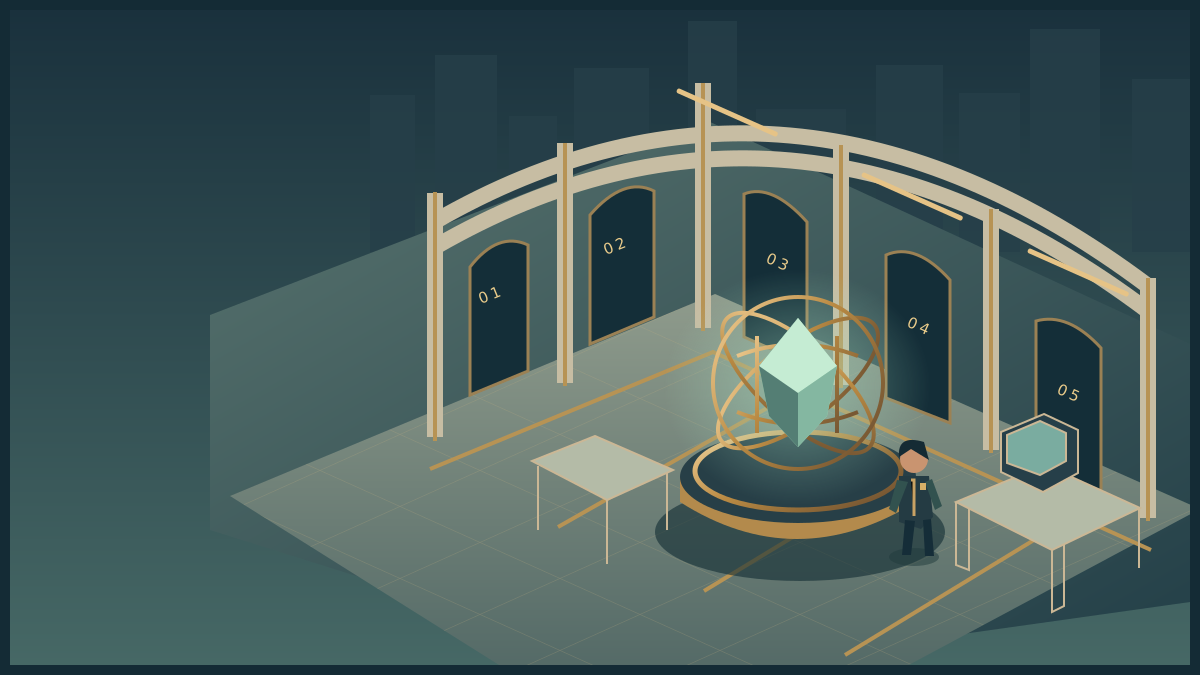
Council Studio
Explore the room. Inspect its instruments. Discover the obstacle, use your skills and complete the operation.
Loads on request · all equipment also has accessible controls belowHow to move, inspect and complete the activity
Use WASD or arrow keys to walk. Press E near an instrument to examine it. Inspect means read its details; Use equipment performs the action named in its status message. The task controls let you choose exact settings and test a solution. Once verified, use the mission station to put it into effect, collect the resulting evidence or cargo, follow its checkpoints and complete the handover at the receiving station.
Scroll over the scene or use Zoom + / Zoom − for a closer or wider view. Click and drag to turn whenever the cursor is free. Choose Fullscreen mission to keep the scene, mission instructions and all task controls together. Fullscreen starts with a free cursor so you can scroll the panel and choose options. Press X or Lock cursor (X) to turn by moving the mouse. Press X again to free the cursor and return to click-and-drag turning. Tab also frees the cursor. The X shortcut stays inactive while typing or choosing a form value. Press Escape or Exit fullscreen to return to the page. On touchscreens, drag to look and use the zoom buttons. If your browser cannot enter native fullscreen, the mission expands to fill its window.
The activity below also works without 3D. Follow its objective and feedback, then save your record. Walking around the scene is optional and does not complete the lab by itself. The campus worksheet provides a printable alternative.
Optional field extension · act on your result
Your lab record does not require this transport and handover sequence. Use it to rehearse the result in the academy story.
FIELD OPERATION · Briefing
The Custodian’s Terms
Secure an agreement the custodian can honour while protecting the original and respecting the support limit. Negotiate copy, stabilisation or supported-original terms, including responsibility, verification, timing and costs.
Confident accounts contradict the comparison log, mandate and cart certificate. Without a feasible agreement the custodian cannot release the requested record.
Inspect the mission station to begin your investigation.
Nothing collected.
Mission actions become available when the activity loads.
Mission record and accessible controls
These controls perform the same actions as the marked stations in the scene. Use them with a keyboard or touch, or when graphics are unavailable. Equipment tests establish whether your intervention is supported. The final handover records a mission outcome; your explanation is assessed separately.
- No mission actions yet.
LAB MISSION / Practice
What you are trying to do
Negotiate an agreement that fits the evidence, capacity and current mandate.
DO THIS NEXT
Read what must be recovered and what must be preserved. The transfer phase changes the requirement for the original.
Equipment instructions for this mission
- Read the recovery mandate
Read what must be recovered and what must be preserved. The transfer phase changes the requirement for the original.
- Check all three accounts
Select Check … against the record for each person. Compare the claim with the document revealed below it; confidence is not proof.
- Negotiate the actual terms
Choose a proposal, custody terms, verification, continuing responsibility and timing. The published constraints permit more than one agreement; each has a cost.
- Compare feasible agreements
Select Test this configuration. Revise infeasible terms, then compare a feasible alternative. Feedback states costs; explain why the recommended concession is justified.
How you know you are done: Check the records and negotiate feasible custody, verification, responsibility and timing terms; explain the costs of an alternative. Save the practical record and your explanation; no package delivery is required.
Inspect means select a named object and read its finding. Use the equipment means operate the labelled controls below, then check the result. Exploring the scene does not automatically complete the task.
The apparatus and the controls below use the same model. All tasks can be completed with keyboard controls. No timer is required.
The complete worksheet below is available while the interactive lab loads.
Practice in progress
Load the controls or use the worksheet to begin.
Hint 1. Ask which record could support or contradict the claim.
Hint 2. A pause, confident voice or disguise is not reliable evidence of truth.
Hint 3. State your role's responsibility without pretending it overrides every other role.
After playing · explain and save this attempt
Finish the practical attempt first. Then record what you noticed, what changed and any help you used. You can also preserve an unfinished attempt.
Recording preserves your actions and explanation. Practice feedback does not award an academic grade.
Your recent action trace
- No actions recorded yet.
Complete worksheet and explanation · works without JavaScript
Mission: Secure an agreement the custodian can honour while protecting the original and respecting the support limit.
Obstacle: Confident accounts contradict the comparison log, mandate and cart certificate. Without a feasible agreement the custodian cannot release the requested record.
Task: Check three people’s claims against records and negotiate an agreement that meets the published mandate.
Optional field extension: once the equipment check passes, present the evidence-backed agreement. Trace the result through Custodian acknowledgement, then confirm the custody terms are recorded. Expected consequence: The custodian accepts the supported proposal and issues the appropriate custody authority.
Negotiate explicit terms
- Operator Neri: “Every archive copy is identical.”
The comparison log records A = M-42 and B = M-99. Identical section counts do not settle identical content. - Custodian Pell: “A verified copy may leave if its custody is recorded.”
Mandate 4 permits verified recovery with a signed handover. It does not require the custodian to surrender the original. - Engineer Sen: “The cart can carry the original without support.”
Cart certificate: 8 units. Original archive: 11 units; a stabilising cradle raises supported capacity to 12.
Protect provenance and restore service, or negotiate a recorded deferral. Choose a verified copy now, monitored stabilisation until review, or a supported-original move next shift. Every proposal needs recorded custody and independent verification. Match responsibility to the proposal: receiver, monitor, or custodian escort with certified support. An unsupported immediate move exceeds capacity.
Check mandate: original stays on site today. Transfer mandate: original provenance is essential; a copy alone is insufficient. Find two feasible agreements under the current mandate, describe each cost, and explain the concession you recommend. Feasibility is checked; fairness and reasoning require human review.
Reflection and example
Separate demonstration: Rin's claim was supported by the two matching twelve-section records, and the seven-unit original fit the nine-unit cart. A later remote-access request changed our agreement from planned physical handover to a Cedar copy. We kept the original with Ada and preserved the unexecuted plan.
Your output: claim-verification. Record the conditions, actions, result and what you would test next. An explanation can be defensible while differing from the example.
YOUR SKILLS PASSPORT
Keep what you learn.
Practice stays in this browser. Export it to take your work with you.
Which save or export should I use?
- Record attempt in skills passport on a lab keeps that phase's actions and your explanation. Save it before switching to a different phase.
- Export backup JSON downloads a backup you can bring back with Restore backup.
- Export learning record creates a readable account for your portfolio. Print record prepares the same kind of evidence for printing.
- Export assessment record inside a mission keeps that trial's decisions and debrief. Keep your written assessment explanation with it.
These controls keep your work; they do not submit it to an institution. Export a backup before changing browser, clearing browser data or resetting the passport.
Preparing your saved progress…
Your mission, in plain language
Your task: Reach an agreement among Neri, Pell and Sen without treating their different responsibilities as an obstacle to click away.
What you will produce: Record two feasible proposals, who gains or bears costs, the term another role challenged, its revision and named obligations. A feasibility tick does not establish that a negotiation happened.
Start here: in-person attendance is preferred. Read the briefing and In-person lab instructions. If you cannot attend, use the Online lab with the same learning record. The 3D environment also supports preparation and revision.
Before you arrive
Read your role brief and write its objective, authority and limit (15 minutes). Read the three records without inventing motives (10 minutes).
Read the briefing. All starting rules and data are supplied here, so you can begin directly even if you missed an earlier lab. For the preferred in-person route, read the campus pack. The online route is available when you cannot attend. Both assess the outcomes below.
What you will learn
- Check specific claims without inferring honesty from appearance.
- Compare feasible proposals with distinct costs and responsibilities.
- Negotiate and revise explicit custody, verification, responsibility and timing terms.
Supplied case file and rules
RP-01 gives responsibilities and claims. RP-02 gives comparison, mandate, capacity and timing records.
- Neri needs useful access and claims the copies are identical. Comparison log: A=M-42, B=M-99.
- Pell must maintain named, recorded custody. Independent verification against the current authority is required for any agreement.
- Sen claims the cart can carry the original unaided. Certificate: cart capacity 8 units; original 11 units; certified cradle support raises capacity to 12.
- Options: verified copy, monitored stabilisation, or supported original with custodian escort. Unsupported immediate movement cannot exceed the published capacity.
- Timing/roles: a copy can be received and verified this shift; stabilisation needs a responsible monitor and scheduled review; certified support crew with custodian escort arrives next shift.
- Practice mandate: enable access while protecting provenance; a documented deferral may be negotiated.
- Skill-check mandate: the original must remain on site today.
- Transfer mandate: original provenance is required; a digital copy alone does not fulfil it.
- For each mandate, compare at least two feasible agreements. Specify custody, verification, responsibility and timing. Explain a real cost and a concession; feasibility is not an automatic academic ranking.
From example to independent challenge
Worked example: use the alternate scenario to learn the method. Its completed decisions cannot be copied into your assigned case.
Practice: use prompts and hints, recording help. Make the prediction or choice before checking.
Skill check: begin from the objective and evidence. Decide which test or action matters before consulting the optional explanation.
Transfer: inspect the changed condition. Decide what it invalidates and what remains supported; a justified unchanged decision can be correct.
The two-hour lab
These are the teaching session’s time blocks, not six compulsory game objectives. Adjust timing as needed; reasoning matters more than speed.
| Time | Activity |
|---|---|
| 0–10 minutes | Assign roles; each records a legitimate concern and limit. |
| 10–30 minutes | Review the alternate council and separate corroboration from general trust. |
| 30–60 minutes | Check assigned records and propose two feasible agreements. |
| 60–80 minutes | Hold the council: challenge a term and revise an offer while an observer records costs. |
| 80–105 minutes | Apply the changed mandate, preserve the earlier offer and renegotiate. |
| 105–120 minutes | Keep agreed terms, a rejected feasible alternative, remaining obligation and contribution record. |
In-person lab · preferred route
Equipment: Three named role cards, comparison log, custody mandate, cart certificate and an agreement sheet. Acting and costumes are optional.
Setup: Print Neri, Pell and Sen role cards with the exact supplied records. Publish the practice, check and transfer mandates, which leave more than one feasible agreement. Actors may explain a position but may not invent decisive evidence.
What you do together: Hold a council with Neri, Pell and Sen role cards. Compare feasible copy, monitored-deferral and supported-original offers under each mandate, negotiate a concession and record costs and obligations.
The printable facilitator pack includes rules, prompts and explanation. Campus apparatus is a proposed teaching design; physical construction and handling have not been validated by browser tests. Use the paper model when equipment is unavailable.
Keep the same prediction, changed-condition attempt and explanation as the online route. A dated observation, test, agreement or route sheet serves as the action record. Add acknowledgement where a handoff is part of the task; an additional browser run is not required.
Online lab · equivalent participation and revision
Do these actions in order
- Choose Practice and inspect Neri, Pell and Sen’s records. Separate their responsibilities from their factual claims.
- Draft two feasible proposals on the agreement sheet before selecting one: copy, monitored stabilisation or supported original.
- In the agreement controls, choose custody, verification, responsibility and timing terms. Match the actual mandate and capacity; record each role’s concern and the proposed concession.
- Select Test this configuration. Read constraint failures or the cost of the feasible offer. The feedback does not rank its fairness or grade your negotiation.
- Save the selected agreement and the rejected alternative. The field extension may stage the agreed consequence but is optional for this council task.
- Apply Skill check and Transfer challenge mandates. Renegotiate rather than repeating the earlier answer. Preserve whose obligation changes and what remains unresolved.
Optional field extension
Your investigation, experiment, agreement or revision is already the practical output. You may also stage its consequence in the scene; this extension is not required for the learning record. In Field operation, first Inspect mission station. Once your skill check is verified, select Present the evidence-backed agreement. The scene and mission record now show the consequence: The custodian accepts the supported proposal and issues the appropriate custody authority.
Collect the named result or record, follow the checkpoint controls in order (or visit the marked stations in the scene), and select Confirm the custody terms are recorded at the receiver. The optional extension displays Mission accomplished after that acknowledgement; your learning record does not require it. Keyboard and touch controls perform the same actions. If you change the underlying model, the dependent intervention must be verified again.
Keep any field-extension actions separate from the evidence supporting your practical decision. Neither its completion nor its absence determines an academic grade.
Finish and keep your work
After each practical phase, open After playing · explain and save this attempt, write a brief reflection and select Record attempt in skills passport before switching phases. Keep the attempts and changed-condition evidence you discuss; an unfinished attempt can still be useful if you explain its limit. Export a backup using the passport tools.
For an uninterrupted view, choose Fullscreen mission. The Mission & controls panel contains the task and lesson controls. Scroll over the scene to zoom, click and drag to turn with the cursor free. Press X to lock the cursor for mouse-look; press X again (or Tab) to free it for scrolling and choosing options. Esc or Exit fullscreen returns to the page. Touch and keyboard controls remain available.
What leaves the room
claim-verification
Record two feasible proposals, who gains or bears costs, the term another role challenged, its revision and named obligations. A feasibility tick does not establish that a negotiation happened.
Include scenario and assistance. Preserve a failed attempt if it explains a useful revision. Add approximately 100 words connecting result to decision.
The final team must defend a recovery objective and agree custody and monitoring obligations. This lab practises the judgement behind that agreement.
Feedback and explanation
Optional explanation and separate exemplar · open after an attempt
Several agreements can meet a mandate. Their costs differ: immediate copy access preserves the original but transfers no physical provenance; monitoring delays service and occupies a role; supported transport waits for the crew. Explain whose obligation is changed and obtain agreement. The software checks feasibility, not fairness or negotiation quality.
Worked reflection from the separate demonstration: Rin’s claim was supported by the two matching twelve-section records, and the seven-unit original fit the nine-unit cart. A later remote-access request changed our agreement from planned physical handover to a Cedar copy. We kept the original with Ada and preserved the unexecuted plan.
Inspect this example’s complete record. Use your own assigned scenario and observations for your reflection.
How to judge the response
A strong response makes a decision the instructions did not supply, supports it with evidence and explains an alternative or limit. A model check establishes its published conditions only; a facilitator judges reasoning. Text length and game endings are not academic grades.
Record two feasible proposals, who gains or bears costs, the term another role challenged, its revision and named obligations. A feasibility tick does not establish that a negotiation happened.
Closing reflection
Which assumption about a person did you replace with a question about evidence?
Afterwards
Export your record and keep a backup. It contributes to Weekly Fieldwork, with the best ten of twelve counting. Continue to the assessment brief and consult policies for access, collaboration and extensions. Exporting does not submit coursework.
SLOP UNIVERSITY · THE ACADEMY OF IMPOSSIBLE SKILLS
An original fictional course. Progress records practice, not academic certification.