The method behind this example
Compare feasible agreements against the participants’ priorities before choosing one.
Your independent challenge: Your council has different capacity and mandate constraints. More than one agreement may be feasible; state what your terms cost each role.
The investigated explanation and learning record complete this example. The scene delivery is an optional extension.
Start this worked example
- Choose Watch the worked example. The student demonstrator explains the task, talks through each action, then reviews the observations and finished submission. Narration starts with this click; Mute narration keeps the same experience captioned.
- Choose Take control to try the current chapter. Follow its prompt, change the labelled controls and select Test my decision.
- Read the feedback, retry if needed, then continue with Next chapter. Each checked chapter provides evidence for one connected operation.
- After every chapter check, return to the mission station, perform the intervention, collect its package and follow the marked checkpoints to complete the handover. Watching performs these same actions with narration. Direct chapter access is a partial preview until the full evidence and handover are complete.
- Use Fullscreen mission after opening the scene to keep the instructions, chapter controls and equipment together. Reflections and exports come after your practical attempt.
This is an alternate example, not your assigned exercise. Your course task is linked after the player.
YOUR SKILL
Evidence-based negotiation
A NEW SETTING
A conservatory council prepares an authorised physical ledger handover, then receives a narrower request before dispatch.
WHAT CHANGES
The copy claim is corroborated, the original fits the certified cart, and the initial physical handover is replaced by copy-only access before dispatch. Judge each agreement against its current evidence and mandate.
Scene guide · people, evidence and object placement
Who speaks in the changing-brief council
Ada, Rin and Bo prepare a physical handover to Mira; a replacement request arrives before dispatch.
- Your part
- Watch follows a worked solution. Take control lets you move the student avatar and try its decisions. The demonstrator in the explanation is modelling a solution, not an extra witness in the story.
- Your instructor
- Mara stands in the marked teaching bay outside the investigation area. She guides the exercise. Her presence, appearance and idle gestures are not clues about what happened in the case.
- People in this scenario
- Ada is caretaker, Rin compares copies and Bo checks capacity; their labelled dossiers identify the council roles. Mira is the proposed recipient named in the written record, not an additional person shown in the 3D scene. None is Mara. The example learner mediates.
- What counts as evidence
- Matching digests corroborate a limited claim; the seven-unit original fits the nine-unit cart. The replacement brief changes the required outcome before dispatch.
- Why the objects are here
- The council display represents evidence and proposed agreements. Capacity does not prove movement occurred, and role dossiers are not additional witnesses.
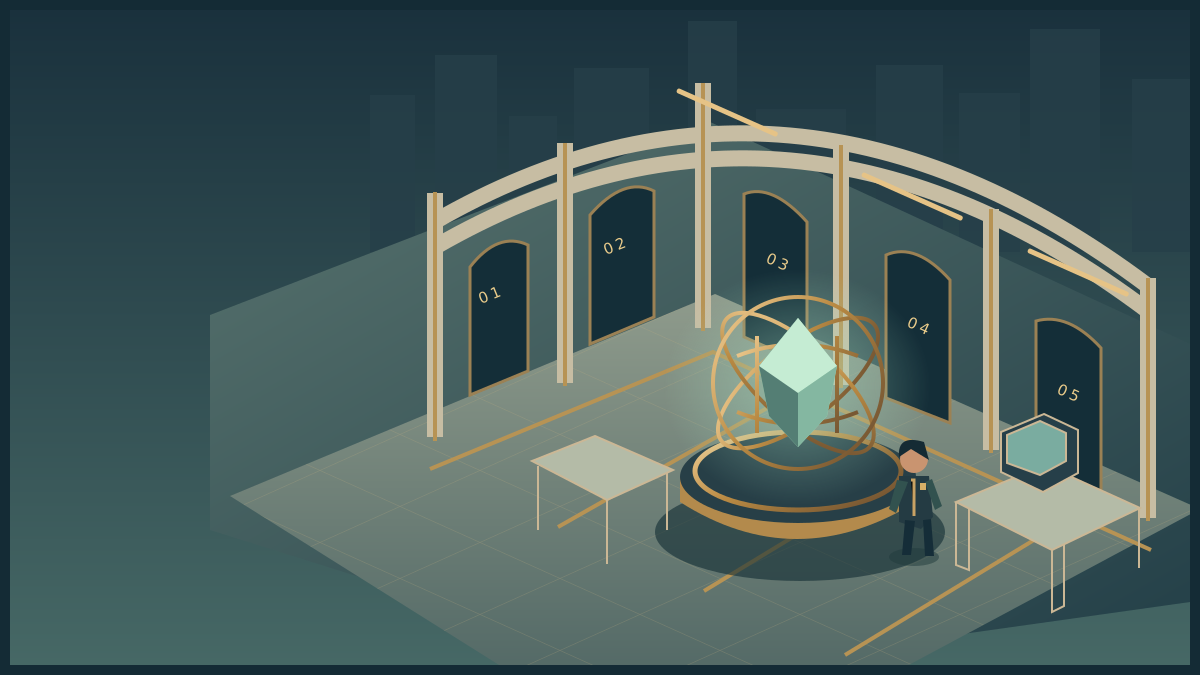
Council Studio
Watch the complete alternate example. Take control of the equipment whenever you are ready.
An alternate example · separate from your assessed workHow to move, inspect and complete the activity
Use WASD or arrow keys to walk. Press E near an instrument to examine it. Inspect means read its details; Use equipment performs the action named in its status message. The task controls let you choose exact settings and test a solution. Once verified, use the mission station to put it into effect, collect the resulting evidence or cargo, follow its checkpoints and complete the handover at the receiving station.
Scroll over the scene or use Zoom + / Zoom − for a closer or wider view. Click and drag to turn whenever the cursor is free. Choose Fullscreen mission to keep the scene, mission instructions and all task controls together. Fullscreen starts with a free cursor so you can scroll the panel and choose options. Press X or Lock cursor (X) to turn by moving the mouse. Press X again to free the cursor and return to click-and-drag turning. Tab also frees the cursor. The X shortcut stays inactive while typing or choosing a form value. Press Escape or Exit fullscreen to return to the page. On touchscreens, drag to look and use the zoom buttons. If your browser cannot enter native fullscreen, the mission expands to fill its window.
Choose Watch to follow the worked example, or Take control to try it yourself. The transcript and completed example remain available if 3D is unavailable. Demonstrations never change assessed progress.
I am mediating a conservatory handover with Ada, Rin and Bo represented in the records. The original brief requests a physical provenance examination. I will test the copy claim, compare load with certified capacity, prepare an authorised agreement, then reconsider it if the brief changes before dispatch. The method we are practising is: Compare feasible agreements against the participants’ priorities before choosing one.. Our field objective is: Complete a conservatory handover that meets the amended request and custodian conditions. A narrower request changes what is justified even when the earlier transfer remains possible. The investigation and explained record complete this lesson. A scene delivery is an optional extension. You can pause, mute, replay, or take control at any point. The captions show the same explanation.
Narration starts after you choose Watch or Play. Captions remain available if this browser has no working voice.
Optional scene extension
Each chapter provides evidence for this operation. Inspect, investigate, act, and complete the handover.
FIELD OPERATION · Briefing
Operation Narrow Mandate
Complete a conservatory handover that meets the amended request and custodian conditions.
A narrower request changes what is justified even when the earlier transfer remains possible.
Inspect the mission station to begin your investigation.
Nothing collected.
Mission actions become available when the activity loads.
Mission record and accessible controls
These controls perform the same actions as the marked stations in the scene. Use them with a keyboard or touch, or when graphics are unavailable. Equipment tests establish whether your intervention is supported. The final handover records a mission outcome; your explanation is assessed separately.
- No mission actions yet.
The complete transcript and finished example are available below while the player loads.
THE DEMONSTRATOR’S REASONING
Identify the actual responsibility
Ada permits the original ledger to travel to named recipient Mira for a physical provenance examination, provided custody and return are recorded. The mediator must find an agreement within that brief. A verified copy alone does not meet this original request.
Why this matters
A defensible agreement serves the published objective and the custodian’s conditions together.
A plausible mistake
Assuming the lowest-effort copy is sufficient ignores physical provenance.
WHAT THE DEMONSTRATOR DID
YOUR LEARNING CONTROLS
Make the skill your own.
Which outcome is required by the original brief?
Watch the apparatus change as the student demonstrates. Take control whenever you want to test the same idea yourself.
BASED ON YOUR ATTEMPTS
Watching and practising are recorded separately in this visit. These examples do not change your assessed work or skills passport.
NOW TRANSFER THE SKILL
Carry the method into your own work.
Your council has different capacity and mandate constraints. More than one agreement may be feasible; state what your terms cost each role.
A COMPLETE WORKED SUBMISSION
The council that changes its brief — completed record
Example work from this demonstration's scenario. Use it to understand the expected evidence and explanation, then make your own decisions in the assigned activity.
Download the complete exampleRead the finished work
Completed demonstration example — changing-brief council agreement
Authored alternate example. This council reaches a different decision sequence from the assigned negotiation.
Responsibilities and original authority
Ada is the caretaker. Rin compares the record copies. Bo checks transport capacity. The mediator coordinates the agreement. Recipient Mira initially needs the physical ledger for a provenance examination; Ada authorises that handover if custody and return are recorded.
Claim and capacity checks
Rin claims the supplied copies have matching recorded content. Cedar and Birch each contain twelve sections with digest R-4. The record corroborates that limited claim; it does not prove the observations scientifically true or establish Rin’s intent.
The original weighs 7 units. Bo’s current certificate rates the standard cart for 9, and the supplied handling inspection is marked passed. The original fits; no additional cradle is required. Capacity establishes feasibility within this model, not independent permission to move the original.
Agreement Version 1 — prepared, not executed
Send the original to named recipient Mira using the certified cart, record custody with Ada and retain the return commitment. Copy-only delivery would not meet the physical provenance request. No dispatch occurs before the next notice.
Replacement brief and Agreement Version 2
The replacement signed brief cancels physical examination before dispatch. Mira now needs remote catalogue access; the original must remain with Ada. Transfer the verified Cedar copy, record the reference used and confirm the recipient’s access. The 9-unit cart remains usable but is no longer needed. The original stays with Ada.
Reflection and limit
I checked the claim even though it turned out to be supported. I did not infer honesty or deceit from the speaker’s manner. The adequate cart made the first physical agreement feasible, but it did not entitle me to ignore the later instruction. The change was in the requested outcome, not a new equipment failure. Preserving the unexecuted first agreement made that distinction visible. In the assigned council I must reread its comparison records, capacity certificate and current mandate instead of copying this physical-then-copy sequence.
Named output: claim-verification. These are authored example agreements, not evidence of a real delivery.
Method to carry forward
Compare feasible agreements against the participants’ priorities before choosing one.
Your council has different capacity and mandate constraints. More than one agreement may be feasible; state what your terms cost each role.
The complete example explains one defensible approach. In your own challenge, select observations and tests from the supplied rules, keep your prediction separate from the result, and justify both the checks you perform and those you omit.
The chapter investigation and its explained record complete the core method. The scene delivery is an optional extension; it is not evidence of deeper understanding on its own.
Complete transcript and decisions · readable without JavaScript
Before we begin · expected task and evidence
I am mediating a conservatory handover with Ada, Rin and Bo represented in the records. The original brief requests a physical provenance examination. I will test the copy claim, compare load with certified capacity, prepare an authorised agreement, then reconsider it if the brief changes before dispatch. The method we are practising is: Compare feasible agreements against the participants’ priorities before choosing one.. Our field objective is: Complete a conservatory handover that meets the amended request and custodian conditions. A narrower request changes what is justified even when the earlier transfer remains possible. The investigation and explained record complete this lesson. A scene delivery is an optional extension. You can pause, mute, replay, or take control at any point. The captions show the same explanation.
1. Identify the actual responsibility
What I need to do: Step 1. Identify the actual responsibility. I read the original request and custody conditions before assuming a copy is sufficient.
Supplied context: Ada permits the original ledger to travel to named recipient Mira for a physical provenance examination, provided custody and return are recorded. The mediator must find an agreement within that brief. A verified copy alone does not meet this original request.
Watch my actions: For "Original required outcome", I choose "Handover original to Mira". I check the demonstrated result.
What I observed: The mediator has an explicit required outcome and custody condition before choosing transport. A defensible agreement serves the published objective and the custodian’s conditions together.
Why: A defensible agreement serves the published objective and the custodian’s conditions together.
Decision: Which outcome is required by the original brief?
- Original required outcome: Handover original to Mira
Result: The mediator has an explicit required outcome and custody condition before choosing transport.
Common mistake: Assuming the lowest-effort copy is sufficient ignores physical provenance.
2. Accept corroboration within its limits
What I need to do: Step 2. Accept corroboration within its limits. I compare both digests and counts. This time the record supports the limited claim rather than contradicting it.
Supplied context: Rin says the two supplied copies contain identical recorded content. The comparison log lists twelve sections and digest R-4 for both. This record supports that content-identity claim. It does not prove every measurement true or establish Rin’s honesty in general.
Watch my actions: For "Supported conclusion", I choose "Count and digest both match". I check the demonstrated result.
What I observed: The records support the specific identity claim while leaving scientific accuracy and intent outside their scope. Verification can support a claim as well as contradict it; neither outcome is a personality test.
Why: Verification can support a claim as well as contradict it; neither outcome is a personality test.
Decision: What does the comparison record support?
- Supported conclusion: Count and digest both match
Result: The records support the specific identity claim while leaving scientific accuracy and intent outside their scope.
Common mistake: Automatically finding a contradiction because a previous exercise contained one would misread these records.
3. Check whether the equipment really fits
What I need to do: Step 3. Check whether the equipment really fits. I check seven against nine instead of assuming the cart has the same deficit as another scenario.
Supplied context: Bo’s certificate gives the standard cart a supported capacity of nine units. The original ledger weighs seven units. No extra cradle is required under this certificate; the handling inspection is recorded as passed. Equipment capacity supports the proposed physical handover.
Watch my actions: I set "Seven-unit original fits the nine-unit cart" to yes. I check the demonstrated result.
What I observed: Physical handover is feasible under the published model. Capacity does not independently grant permission. A familiar transport concern must be checked against the current numbers rather than assumed to recur.
Why: A familiar transport concern must be checked against the current numbers rather than assumed to recur.
Decision: Does the certified cart support this original?
- Seven-unit original fits the nine-unit cart: Yes
Result: Physical handover is feasible under the published model. Capacity does not independently grant permission.
Common mistake: Calling stabilisation mandatory because another cart was too small substitutes an old result for a measurement.
4. Prepare the authorised physical agreement
What I need to do: Step 4. Prepare the authorised physical agreement. I prepare the physical agreement with a named recipient and custody record while clearly stating dispatch has not happened.
Supplied context: The council records a proposed handover of the original to Mira on the certified cart, with Ada retaining the custody record and a return commitment. Copy-only delivery cannot serve the original provenance examination. Nothing has been dispatched yet. Two agreements are feasible under the first brief: send a verified copy while Ada keeps the original, or lend the supported original with a named return condition. Mira prioritises examining the original; Ada accepts temporary custody with recorded return. The demonstrator chooses the latter and records its greater handling obligation.
Watch my actions: For "Proposed agreement", I choose "Original + custody + return". For "A verified copy also meets access needs: why choose physical handover here?", I choose "Mira requests physical provenance inspection and Ada accepts a recorded return". I check the demonstrated result.
What I observed: The first agreement satisfies objective, capacity and custody. Its status is a prepared plan, not a completed delivery. A verified copy was also feasible for research access. The selected original loan serves the stated provenance priority and accepts a handling and return obligation. A feasible plan still needs an authorised recipient and a recorded custody condition. Feasibility alone does not select between legitimate interests. The later remote-access brief removes the reason to incur physical handling.
Why: A feasible plan still needs an authorised recipient and a recorded custody condition. Feasibility alone does not select between legitimate interests. The later remote-access brief removes the reason to incur physical handling.
Decision: Select the agreement supported by the current brief.
- Proposed agreement: Original + custody + return
- A verified copy also meets access needs: why choose physical handover here?: Mira requests physical provenance inspection and Ada accepts a recorded return
Result: The first agreement satisfies objective, capacity and custody. Its status is a prepared plan, not a completed delivery. A verified copy was also feasible for research access. The selected original loan serves the stated provenance priority and accepts a handling and return obligation.
Common mistake: Presenting a proposed agreement as an accomplished handover would invent evidence.
5. Revise the agreement when scope narrows
What I need to do: Step 5. Revise the agreement when scope narrows. I reread the replacement brief. It changes the desired outcome, so the usable cart no longer justifies moving the original.
Supplied context: Before dispatch, a replacement signed brief cancels the physical examination. Mira now needs remote catalogue access only; the original must remain with Ada. A verified Cedar copy can meet the new request. Cart capacity has not changed.
Watch my actions: For "Revised agreement", I choose "Cedar copy; original with Ada". I check the demonstrated result.
What I observed: The scope change, rather than a transport failure, justifies switching from physical handover to copy access. The right agreement can change even though the equipment and earlier evidence remain valid.
Why: The right agreement can change even though the equipment and earlier evidence remain valid.
Decision: Choose the agreement for the replacement brief.
- Revised agreement: Cedar copy; original with Ada
Result: The scope change, rather than a transport failure, justifies switching from physical handover to copy access.
Common mistake: A valid capacity certificate does not override a new instruction to retain the original.
6. Keep corroboration and both decisions
What I need to do: Step 6. Keep corroboration and both decisions. I keep the corroborated claim and both agreements while stating their scope and actual completion status.
Supplied context: The record preserves the matching copies, adequate cart, first physical agreement, replacement remote-access brief and revised copy agreement. The demonstrator states that no physical dispatch occurred and that Rin’s general intent was never established.
Watch my actions: For "Closing statement", I choose "Claim supported; brief changed". I check the demonstrated result.
What I observed: The completed record explains the changed objective without inventing a faulty cart or a dishonest speaker. A traceable account reports both what evidence supports and what it cannot establish.
Why: A traceable account reports both what evidence supports and what it cannot establish.
Decision: Choose the defensible closing statement.
- Closing statement: Claim supported; brief changed
Result: The completed record explains the changed objective without inventing a faulty cart or a dishonest speaker.
Common mistake: Forcing a familiar copy-then-stabilise story onto this evidence reverses its supported decisions.
Optional field extension
All chapter evidence checks are complete. I return to the mission station and enact the amended agreement. I am putting the verified solution into effect, then checking what changes.
I collect Amended conservatory handover package. The verified intervention released this package. I now carry it through the marked handover route.
I carry Amended conservatory handover package to Council authorisation desk. I confirm this checkpoint before continuing so the handover trace records the route actually followed.
I carry Amended conservatory handover package to Custodian receiving station. I confirm this checkpoint before continuing so the handover trace records the route actually followed.
At the receiving station, I record the agreed handover. I check the receipt before calling the field operation complete.
My observations and finished submission
The two twelve-section copies both matched R-4, supporting Rin’s specific claim. The seven-unit original fit the nine-unit cart, so a documented physical handover to Mira was feasible under the first brief. Before dispatch, a replacement request required remote access while the original stayed with Ada. I revised the agreement to a verified Cedar copy, preserved the unexecuted physical plan and made no claim about Rin’s general honesty. Compare feasible agreements against the participants’ priorities before choosing one. Open "Read the finished work" or download the complete example to inspect the evidence and explanation together. Your council has different capacity and mandate constraints. More than one agreement may be feasible; state what your terms cost each role.
The complete submission is available in Read the finished work above and as a Markdown download.