LAB / WEEK 02
Build a Memory Palace
Compare unaided recall, location cues and written notes, then choose a retrieval strategy appropriate to the task.
IN PERSON (PREFERRED) · ONLINE AVAILABLE
What you will learn in this lab
Compare unaided recall, location cues and written notes, then choose a retrieval strategy appropriate to the task.
Keep this evidence: recall strategy. Later use: Memory is optional support in A1 and handoffs. The final project does not require recall when an accurate external record serves the objective better.
The online environment also supports preparation and revision between classes. Campus packs specify the proposed teaching setup; physical apparatus has not been validated by this website prototype.
For online participation and revision: follow the Lab mission checklist and named controls below. Complete the practical outcome named for this week. Perform an intervention or receiving handover only when the activity requires it; other field extensions are optional. Explain and save the attempt before switching phases. Need an example first? The demonstration uses a different scenario and keeps separate practice progress.
FIELD TRAINING / 02
Build a Memory Palace
The Memory Trial. Choose a reliable way to remember or record a short manifest for its actual use.
A temporary spoken briefing and a later audited handover need different support. Compare unaided recall, location cues and written records, including their errors and limits.
The skill you need: Compare unaided recall, location cues and written notes, then select a strategy suited to the stated use.
Evidence output: recall-strategy. Later use: Memory is optional support in A1 and handoffs. The final project does not require recall when an accurate external record serves the objective better.
Learn the skill · worked example
Imagine an oversized compass drawing circles across the Atrium floor. At the Fountain, imagine a lantern glowing underwater. A useful association connects both place and item; simply rereading the list does not create a retrieval cue.
First explain what you predict. Manipulate the apparatus, compare the observed result, then change one relevant condition. The transfer challenge changes the context so that repeating an earlier answer may fail.
Start here: read the worked example, then use the controls in Practice. The completed investigation, experiment or agreement is your practical output. The field operation is an optional narrative extension. Then try Skill check and Transfer challenge. The six rows in the lab timetable describe the whole teaching session; they are not six hidden game levels.
Scene guide · people, evidence and object placement
People, memory cues and scenery
An ordered memory route: Atrium, Fountain, Workshop and Observatory.
- Your part
- The moving student avatar represents you. Inspect the scene and use the lesson controls to record and test your decisions.
- Your instructor
- Mara stands in the marked teaching bay outside the investigation area. She guides the exercise. Her presence, appearance and idle gestures are not clues about what happened in the case.
- People in this scenario
- You are the learner practising recall. No person in the room is an item to memorise unless the task explicitly names one.
- What counts as evidence
- Recall the four published items in route order. Your own associations are memory aids, not extra facts about the scene.
- Why the objects are here
- The locations and item displays are labelled memory cues. The surrounding academy room is not an additional recall test.
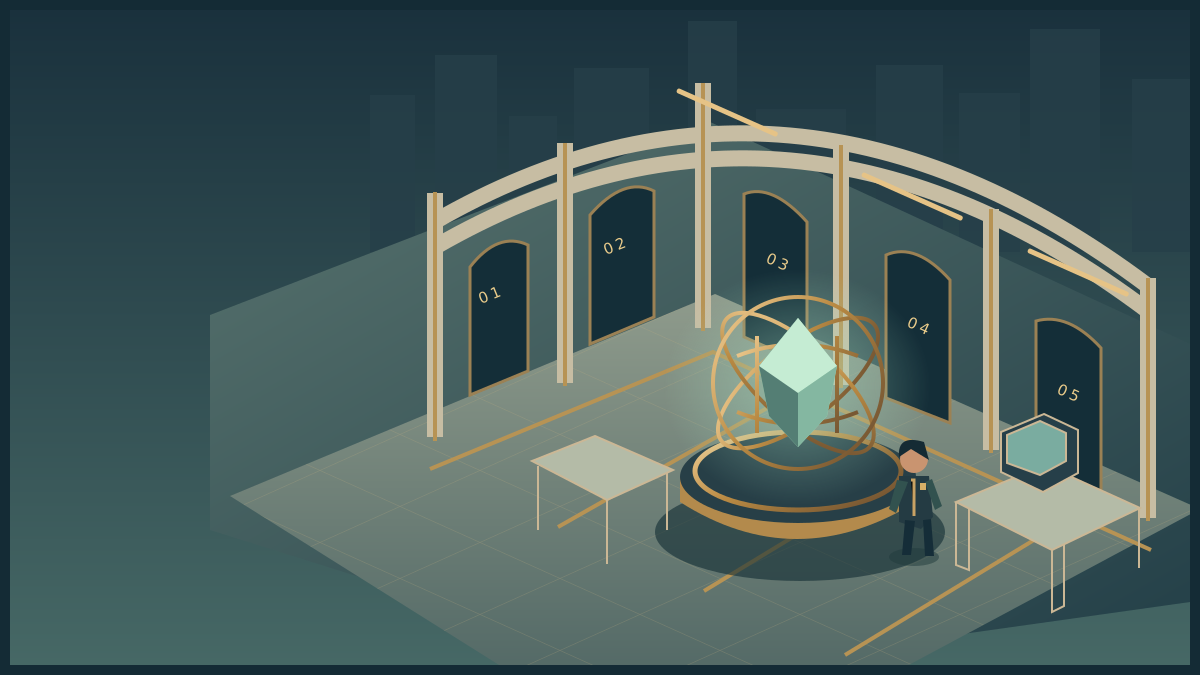
Perception Gallery
Explore the room. Inspect its instruments. Discover the obstacle, use your skills and complete the operation.
Loads on request · all equipment also has accessible controls belowHow to move, inspect and complete the activity
Use WASD or arrow keys to walk. Press E near an instrument to examine it. Inspect means read its details; Use equipment performs the action named in its status message. The task controls let you choose exact settings and test a solution. Once verified, use the mission station to put it into effect, collect the resulting evidence or cargo, follow its checkpoints and complete the handover at the receiving station.
Scroll over the scene or use Zoom + / Zoom − for a closer or wider view. Click and drag to turn whenever the cursor is free. Choose Fullscreen mission to keep the scene, mission instructions and all task controls together. Fullscreen starts with a free cursor so you can scroll the panel and choose options. Press X or Lock cursor (X) to turn by moving the mouse. Press X again to free the cursor and return to click-and-drag turning. Tab also frees the cursor. The X shortcut stays inactive while typing or choosing a form value. Press Escape or Exit fullscreen to return to the page. On touchscreens, drag to look and use the zoom buttons. If your browser cannot enter native fullscreen, the mission expands to fill its window.
The activity below also works without 3D. Follow its objective and feedback, then save your record. Walking around the scene is optional and does not complete the lab by itself. The campus worksheet provides a printable alternative.
Optional field extension · act on your result
Your lab record does not require this transport and handover sequence. Use it to rehearse the result in the academy story.
FIELD OPERATION · Briefing
The Memory Trial
Choose a reliable way to remember or record a short manifest for its actual use. Encode Compass, Lantern, Coil and Archive along the four-place route.
A temporary spoken briefing and a later audited handover need different support. Compare unaided recall, location cues and written records, including their errors and limits.
Inspect the mission station to begin your investigation.
Nothing collected.
Mission actions become available when the activity loads.
Mission record and accessible controls
These controls perform the same actions as the marked stations in the scene. Use them with a keyboard or touch, or when graphics are unavailable. Equipment tests establish whether your intervention is supported. The final handover records a mission outcome; your explanation is assessed separately.
- No mission actions yet.
LAB MISSION / Practice
What you are trying to do
Compare unaided retrieval, location cues and a written record, then choose what the actual task needs.
DO THIS NEXT
Visit all four locations with Walk to next location. Record one association per location if using cues; disclose earlier exposure to the list.
Equipment instructions for this mission
- Inspect the route and items
Visit all four locations with Walk to next location. Record one association per location if using cues; disclose earlier exposure to the list.
- Record three comparison trials
Choose Retrieval method for this trial, Cover list and retrieve, enter remembered items, and select Record retrieval trial. Repeat for unaided, location cues and written notes. Notes remain visible only in that condition.
- Choose a method for the use
Read Use context and select Which strategy suits this use? A temporary spoken account and a later audited handover do not have the same requirements.
- Explain the comparison
Select Test this configuration and discuss scores, repeated exposure and the limits of each method. Save the experiment; no compulsory delivery or perfect-memory score is needed.
How you know you are done: Record a covered trial for all three methods and select a context-appropriate strategy. Perfect recall is not required. Save the practical record and your explanation; no package delivery is required.
Inspect means select a named object and read its finding. Use the equipment means operate the labelled controls below, then check the result. Exploring the scene does not automatically complete the task.
The apparatus and the controls below use the same model. All tasks can be completed with keyboard controls. Compare three disclosed retrieval methods. Accuracy is evidence to discuss, not a perfect-score gate. No timer is required.
The complete worksheet below is available while the interactive lab loads.
Practice in progress
Load the controls or use the worksheet to begin.
Hint 1. Choose the four locations in an order you can reproduce.
Hint 2. Give each item a distinctive association at its place.
Hint 3. Compare unaided, cued and written-note trials; state whether the chosen context needs a durable shared record.
After playing · explain and save this attempt
Finish the practical attempt first. Then record what you noticed, what changed and any help you used. You can also preserve an unfinished attempt.
Recording preserves your actions and explanation. Practice feedback does not award an academic grade.
Your recent action trace
- No actions recorded yet.
Complete worksheet and explanation · works without JavaScript
Mission: Choose a reliable way to remember or record a short manifest for its actual use.
Obstacle: A temporary spoken briefing and a later audited handover need different support. Compare unaided recall, location cues and written records, including their errors and limits.
Task: Compare unaided recall, location cues and written notes, then select a strategy suited to the stated use.
Optional field extension: once the equipment check passes, share the retrieval comparison. Trace the result through Dispatch channel, then confirm the comparison was received. Expected consequence: Control receives the strategy comparison, including recorded errors and the proposed use of a durable record. The receipt does not certify perfect or unaided recall.
Compare retrieval strategies
Atrium → Fountain → Workshop → Observatory
- practice: Compass, Lantern, Coil, Archive.
- check: Lens, Battery, Map, Seal.
- transfer: Sample, Receipt, Sensor, Capsule.
Record a covered unaided attempt, a location-cue attempt and an attempt using a written record. Count correct items and preserve errors. Repeated exposure makes this a practice comparison, not a controlled experiment. Completion requires the comparison, not perfect recall.
Select a strategy for each use: a short hands-occupied briefing; an audited handover tomorrow; a temporary record outage followed by reconciliation. Explain why a cue can help temporarily while a durable record serves other people and later checks.
Reflection and example
Separate demonstration: My storm-kit baseline contained Lens and Beacon only. The location cues helped me retrieve all four items in the guided attempt, but I later substituted ‘book’ for Pocket atlas. I preserved the error and strengthened the atlas cue instead of claiming perfect memory.
Your output: recall-strategy. Record the conditions, actions, result and what you would test next. An explanation can be defensible while differing from the example.
YOUR SKILLS PASSPORT
Keep what you learn.
Practice stays in this browser. Export it to take your work with you.
Which save or export should I use?
- Record attempt in skills passport on a lab keeps that phase's actions and your explanation. Save it before switching to a different phase.
- Export backup JSON downloads a backup you can bring back with Restore backup.
- Export learning record creates a readable account for your portfolio. Print record prepares the same kind of evidence for printing.
- Export assessment record inside a mission keeps that trial's decisions and debrief. Keep your written assessment explanation with it.
These controls keep your work; they do not submit it to an institution. Export a backup before changing browser, clearing browser data or resetting the passport.
Preparing your saved progress…
Your mission, in plain language
Your task: Prepare an instruction handoff. Compare three ways of keeping details available and decide when memory is useful and when an external record is better.
What you will produce: Keep three labelled trials—unaided, location cues and written notes—with item score, order score, assistance and context. Recommend a strategy when notes are available and when they are not.
Start here: in-person attendance is preferred. Read the briefing and In-person lab instructions. If you cannot attend, use the Online lab with the same learning record. The 3D environment also supports preparation and revision.
Before you arrive
Read MP-01 and choose familiar or supplied locations (10 minutes). Make one association for an ordinary shopping item and test it after a short pause (5 minutes).
Read the briefing. All starting rules and data are supplied here, so you can begin directly even if you missed an earlier lab. For the preferred in-person route, read the campus pack. The online route is available when you cannot attend. Both assess the outcomes below.
What you will learn
- Record separate unaided, location-cued and written-note trials without concealing errors or assistance.
- Compare exact-item and order accuracy while identifying rehearsal limits.
- Choose a strategy based on note access, exactness and shared verification.
Supplied case file and rules
MP-01 is the four-location route. MP-02 supplies lists and contexts; use the student record for the comparison.
- Route: Atrium → Fountain → Workshop → Observatory.
- Practice: Compass, Lantern, Coil, Archive. Context: a short spoken briefing with your hands occupied; the receiver keeps the printed record for checking.
- Skill check: Lens, Battery, Map, Seal. Context: tomorrow’s audit needs exact order available to someone absent today.
- Transfer: Sample, Receipt, Sensor, Capsule. Context: a brief equipment outage prevents the receiver opening the written record; reconcile with it afterwards.
- Record one unaided trial, one location-cue trial and one written-note trial for each phase you discuss. A separate note remains available in the written-note condition.
- Score exact items and correct positions separately out of four. Imperfect recall can complete this investigation when the trials and suitable strategy are recorded.
- Record assistance, list reuse and extra rehearsal; this practice comparison is not a controlled experiment or proof of photographic memory.
From example to independent challenge
Worked example: use the alternate scenario to learn the method. Its completed decisions cannot be copied into your assigned case.
Practice: use prompts and hints, recording help. Make the prediction or choice before checking.
Skill check: begin from the objective and evidence. Decide which test or action matters before consulting the optional explanation.
Transfer: inspect the changed condition. Decide what it invalidates and what remains supported; a justified unchanged decision can be correct.
The two-hour lab
These are the teaching session’s time blocks, not six compulsory game objectives. Adjust timing as needed; reasoning matters more than speed.
| Time | Activity |
|---|---|
| 0–10 minutes | Predict which strategy helps when instructions must be exact and notes may be unavailable. |
| 10–30 minutes | Attempt unaided retrieval and preserve errors before seeing the worked mnemonic. |
| 30–60 minutes | Build four place–item associations; retrieve and compare with the baseline. |
| 60–80 minutes | Perform a written-note trial and compare accuracy and shared verification. |
| 80–105 minutes | Use the changed list and access condition; choose and justify a strategy. |
| 105–120 minutes | Keep all three trials and state what the comparison cannot establish. |
In-person lab · preferred route
Printable scene and memory cards. Print at 100% on A4; each sheet includes a 50 mm scale check.
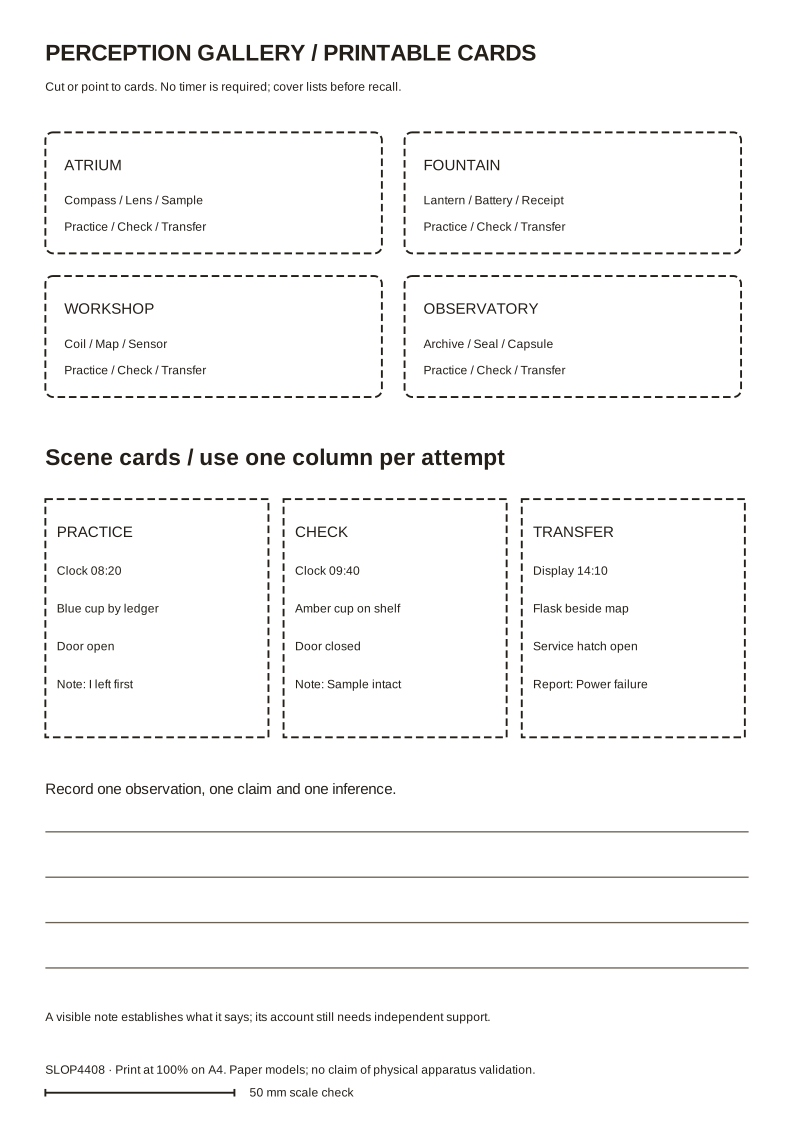
Equipment: Four location cards, the three item lists, opaque cover sheets and a recall comparison sheet. Real walking is optional.
Setup: Place location cards around a room or in a row on a table. Provide a seated, visual or spoken route with the same order. Give each student their own list copy and a separate note sheet; permit that note in the written-note condition only.
What you do together: Compare covered unaided retrieval, location cues and written-note use. Keep errors and assistance, then choose a strategy for a hands-occupied briefing, later audit or temporary record outage.
The printable facilitator pack includes rules, prompts and explanation. Campus apparatus is a proposed teaching design; physical construction and handling have not been validated by browser tests. Use the paper model when equipment is unavailable.
Keep the same prediction, changed-condition attempt and explanation as the online route. A dated observation, test, agreement or route sheet serves as the action record. Add acknowledgement where a handoff is part of the task; an additional browser run is not required.
Online lab · equivalent participation and revision
Do these actions in order
- Select Practice, read the list once and choose Unaided as the retrieval method. Cover the list, enter your recalled items and select Record retrieval trial. Preserve mistakes.
- Reopen the list with Review associations. Write a place–item association at each location and visit the four stops with Walk to next location.
- Choose Location cues, cover the list and record another trial. Score exact items separately in your written comparison; the browser records positions out of four.
- Choose Written notes, keep a separate written checklist available, cover the encoding list and record this third trial. Disclose the note use rather than presenting this as unaided recall.
- Choose a strategy fitting the displayed context: location cues, written notes or combined temporary cues and later reconciliation. Select Test this configuration; perfect recall is not required. Save the comparison before switching.
- Try the changed lists and contexts in Skill check and Transfer challenge. Explain when an external record is preferable and why repeated exposure limits your conclusions.
Optional field extension
Your investigation, experiment, agreement or revision is already the practical output. You may also stage its consequence in the scene; this extension is not required for the learning record. In Field operation, first Inspect mission station. Once your skill check is verified, select Share retrieval comparison. The scene and mission record now show the consequence: The shared record preserves retrieval errors and the proposed durable record. It does not certify perfect or unaided recall.
Collect the named result or record, follow the checkpoint controls in order (or visit the marked stations in the scene), and select the comparison’s labelled acknowledgement at the receiver. The optional extension displays Mission accomplished after that acknowledgement; your learning record does not require it. Keyboard and touch controls perform the same actions. If you change the underlying model, the dependent intervention must be verified again.
Keep any field-extension actions separate from the evidence supporting your practical decision. Neither its completion nor its absence determines an academic grade.
Finish and keep your work
After each practical phase, open After playing · explain and save this attempt, write a brief reflection and select Record attempt in skills passport before switching phases. Keep the attempts and changed-condition evidence you discuss; an unfinished attempt can still be useful if you explain its limit. Export a backup using the passport tools.
For an uninterrupted view, choose Fullscreen mission. The Mission & controls panel contains the task and lesson controls. Scroll over the scene to zoom, click and drag to turn with the cursor free. Press X to lock the cursor for mouse-look; press X again (or Tab) to free it for scrolling and choosing options. Esc or Exit fullscreen returns to the page. Touch and keyboard controls remain available.
What leaves the room
recall-strategy
Keep three labelled trials—unaided, location cues and written notes—with item score, order score, assistance and context. Recommend a strategy when notes are available and when they are not.
Include scenario and assistance. Preserve a failed attempt if it explains a useful revision. Add approximately 100 words connecting result to decision.
Memory is optional support in A1 and handoffs. The final project does not require recall when an accurate external record serves the objective better.
Feedback and explanation
Optional explanation and separate exemplar · open after an attempt
Compare all three methods, including errors and assistance. Durable written records support later audit and other people; temporary cues can help when notes cannot be consulted. Explain later reconciliation and the limits of your small, repeated-list comparison. Perfect recall is not required.
Worked reflection from the separate demonstration: My storm-kit baseline contained Lens and Beacon only. The location cues helped me retrieve all four items in the guided attempt, but I later substituted ‘book’ for Pocket atlas. I preserved the error and strengthened the atlas cue instead of claiming perfect memory.
Inspect this example’s complete record. Use your own assigned scenario and observations for your reflection.
How to judge the response
A strong response makes a decision the instructions did not supply, supports it with evidence and explains an alternative or limit. A model check establishes its published conditions only; a facilitator judges reasoning. Text length and game endings are not academic grades.
Keep three labelled trials—unaided, location cues and written notes—with item score, order score, assistance and context. Recommend a strategy when notes are available and when they are not.
Closing reflection
Which cue helped you retrieve an item, and what would make that cue fail?
Afterwards
Export your record and keep a backup. It contributes to Weekly Fieldwork, with the best ten of twelve counting. Continue to the assessment brief and consult policies for access, collaboration and extensions. Exporting does not submit coursework.
SLOP UNIVERSITY · THE ACADEMY OF IMPOSSIBLE SKILLS
An original fictional course. Progress records practice, not academic certification.