The method behind this example
Choose a recall strategy for the task, and compare it with an external written record.
Your independent challenge: Your lists and associations differ. Explain when notes outperform deliberate recall instead of treating memorisation as compulsory.
The investigated explanation and learning record complete this example. The scene delivery is an optional extension.
Start this worked example
- Choose Watch the worked example. The student demonstrator explains the task, talks through each action, then reviews the observations and finished submission. Narration starts with this click; Mute narration keeps the same experience captioned.
- Choose Take control to try the current chapter. Follow its prompt, change the labelled controls and select Test my decision.
- Read the feedback, retry if needed, then continue with Next chapter. Each checked chapter provides evidence for one connected operation.
- After every chapter check, return to the mission station, perform the intervention, collect its package and follow the marked checkpoints to complete the handover. Watching performs these same actions with narration. Direct chapter access is a partial preview until the full evidence and handover are complete.
- Use Fullscreen mission after opening the scene to keep the instructions, chapter controls and equipment together. Reflections and exports come after your practical attempt.
This is an alternate example, not your assigned exercise. Your course task is linked after the player.
YOUR SKILL
Memory and recall
A NEW SETTING
A conservatory route with Gate, Pool, Press and Dome landmarks.
WHAT CHANGES
The alternate items are Lens, Tether, Pocket atlas and Beacon, linked to new locations.
Scene guide · people, evidence and object placement
Who is practising recall
A memory route with Gate, Pool, Press and Dome landmarks.
- Your part
- Watch follows a worked solution. Take control lets you move the student avatar and try its decisions. The demonstrator in the explanation is modelling a solution, not an extra witness in the story.
- Your instructor
- Mara stands in the marked teaching bay outside the investigation area. She guides the exercise. Her presence, appearance and idle gestures are not clues about what happened in the case.
- People in this scenario
- The demonstrator is the example learner. Mara guides the lesson; neither character is one of the four items to recall.
- What counts as evidence
- Use the supplied objects and published location route. Baseline and later recall results belong to this example learner.
- Why the objects are here
- The landmarks are memory anchors and the objects are retrieval cues. The example's improvement is not a claim about your own memory.
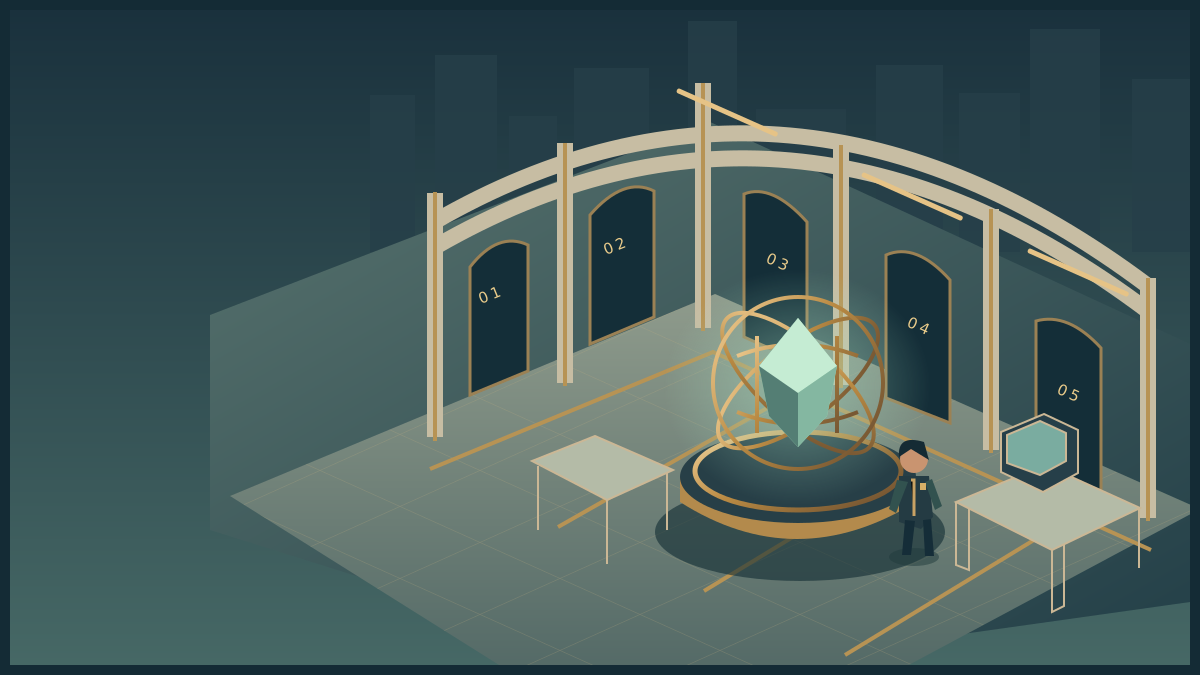
Perception Gallery
Watch the complete alternate example. Take control of the equipment whenever you are ready.
An alternate example · separate from your assessed workHow to move, inspect and complete the activity
Use WASD or arrow keys to walk. Press E near an instrument to examine it. Inspect means read its details; Use equipment performs the action named in its status message. The task controls let you choose exact settings and test a solution. Once verified, use the mission station to put it into effect, collect the resulting evidence or cargo, follow its checkpoints and complete the handover at the receiving station.
Scroll over the scene or use Zoom + / Zoom − for a closer or wider view. Click and drag to turn whenever the cursor is free. Choose Fullscreen mission to keep the scene, mission instructions and all task controls together. Fullscreen starts with a free cursor so you can scroll the panel and choose options. Press X or Lock cursor (X) to turn by moving the mouse. Press X again to free the cursor and return to click-and-drag turning. Tab also frees the cursor. The X shortcut stays inactive while typing or choosing a form value. Press Escape or Exit fullscreen to return to the page. On touchscreens, drag to look and use the zoom buttons. If your browser cannot enter native fullscreen, the mission expands to fill its window.
Choose Watch to follow the worked example, or Take control to try it yourself. The transcript and completed example remain available if 3D is unavailable. Demonstrations never change assessed progress.
I need to remember a four-item storm kit using a stable route through four locations. I will keep an honest baseline, build distinctive associations, retrieve with the list covered, and record a mistake and repair. The finished work is a recall-strategy record, not a claim of photographic memory. The method we are practising is: Choose a recall strategy for the task, and compare it with an external written record.. Our field objective is: Deliver a checked storm-kit manifest to the Dome without silently repairing a failed recall. The covered list and a generic book cue could lead to the wrong item. The investigation and explained record complete this lesson. A scene delivery is an optional extension. You can pause, mute, replay, or take control at any point. The captions show the same explanation.
Narration starts after you choose Watch or Play. Captions remain available if this browser has no working voice.
Optional scene extension
Each chapter provides evidence for this operation. Inspect, investigate, act, and complete the handover.
FIELD OPERATION · Briefing
Operation Storm Kit
Deliver a checked storm-kit manifest to the Dome without silently repairing a failed recall.
The covered list and a generic book cue could lead to the wrong item.
Inspect the mission station to begin your investigation.
Nothing collected.
Mission actions become available when the activity loads.
Mission record and accessible controls
These controls perform the same actions as the marked stations in the scene. Use them with a keyboard or touch, or when graphics are unavailable. Equipment tests establish whether your intervention is supported. The final handover records a mission outcome; your explanation is assessed separately.
- No mission actions yet.
The complete transcript and finished example are available below while the player loads.
THE DEMONSTRATOR’S REASONING
Keep an honest baseline
Before learning the route, the demonstrator recalls Lens and Beacon but omits Tether and Pocket atlas. Two of four items are correct. That limited baseline is retained.
Why this matters
A baseline makes improvement inspectable. It is not a judgement of intelligence.
A plausible mistake
Do not replace the first attempt after seeing the missing items.
WHAT THE DEMONSTRATOR DID
YOUR LEARNING CONTROLS
Make the skill your own.
Record the baseline item count.
Watch the apparatus change as the student demonstrates. Take control whenever you want to test the same idea yourself.
BASED ON YOUR ATTEMPTS
Watching and practising are recorded separately in this visit. These examples do not change your assessed work or skills passport.
NOW TRANSFER THE SKILL
Carry the method into your own work.
Your lists and associations differ. Explain when notes outperform deliberate recall instead of treating memorisation as compulsory.
A COMPLETE WORKED SUBMISSION
Completed recall strategy — storm kit
Example work from this demonstration's scenario. Use it to understand the expected evidence and explanation, then make your own decisions in the assigned activity.
Download the complete exampleRead the finished work
Completed demonstration example — storm-kit recall strategy
This alternate worked example uses Gate, Pool, Press and Dome. It does not supply the assigned lab's item answers.
Baseline
I recalled Lens and Beacon: two correct items out of four. I kept that result before inspecting the full list.
Encoding route
1. Gate: a giant Lens frames the entrance. 2. Pool: a Tether splashes in the water. 3. Press: a Pocket atlas unfolds into maps under the rollers. 4. Dome: a Beacon lights the roof.
Retrieval and error
With the list covered, I retrieved Lens, Tether, Pocket atlas and Beacon in order. A later attempt produced “book” at the Press. I recorded the substitution and strengthened the map-specific cue rather than silently counting it as exact recall.
Comparison
The guided attempt improved from two correct items to four. That is a result of this small demonstration, not proof of permanent improvement or photographic memory. Rehearsal and item familiarity may also have helped.
Reflection
The fixed locations helped order, while the distinctive images helped item identity. The delayed substitution showed that a generic association preserved a category but not the required object. In another task I would preserve the route, change the items, and inspect whether the same weakness returned. For a critical instruction set that can be carried openly, a checklist may remain the better tool.
Route: guided example with list covering. Hints: association prompts. Named output: recall-strategy.
Method to carry forward
Choose a recall strategy for the task, and compare it with an external written record.
Your lists and associations differ. Explain when notes outperform deliberate recall instead of treating memorisation as compulsory.
The complete example explains one defensible approach. In your own challenge, select observations and tests from the supplied rules, keep your prediction separate from the result, and justify both the checks you perform and those you omit.
The chapter investigation and its explained record complete the core method. The scene delivery is an optional extension; it is not evidence of deeper understanding on its own.
Complete transcript and decisions · readable without JavaScript
Before we begin · expected task and evidence
I need to remember a four-item storm kit using a stable route through four locations. I will keep an honest baseline, build distinctive associations, retrieve with the list covered, and record a mistake and repair. The finished work is a recall-strategy record, not a claim of photographic memory. The method we are practising is: Choose a recall strategy for the task, and compare it with an external written record.. Our field objective is: Deliver a checked storm-kit manifest to the Dome without silently repairing a failed recall. The covered list and a generic book cue could lead to the wrong item. The investigation and explained record complete this lesson. A scene delivery is an optional extension. You can pause, mute, replay, or take control at any point. The captions show the same explanation.
1. Keep an honest baseline
What I need to do: Step 1. Keep an honest baseline. Before I learn a strategy, I keep the attempt in which I recalled only Lens and Beacon. I count exact items rather than filling in missing answers afterwards.
Supplied context: Before learning the route, the demonstrator recalls Lens and Beacon but omits Tether and Pocket atlas. Two of four items are correct. That limited baseline is retained.
Watch my actions: For "Correct baseline items", I enter 2. I check the demonstrated result.
What I observed: The initial two-item result remains visible for comparison. A baseline makes improvement inspectable. It is not a judgement of intelligence.
Why: A baseline makes improvement inspectable. It is not a judgement of intelligence.
Decision: Record the baseline item count.
- Correct baseline items: 2
Result: The initial two-item result remains visible for comparison.
Common mistake: Do not replace the first attempt after seeing the missing items.
2. Fix the location order
What I need to do: Step 2. Fix the location order. I fix the order of locations before assigning objects, so I can follow the same retrieval route every time.
Supplied context: The route is Gate, Pool, Press, Dome. The demonstrator walks it once before attaching items, because changing the route later would change the retrieval cues.
Watch my actions: I arrange "Route order" in this order: Gate, then Pool, then Press, then Dome. I check the demonstrated result.
What I observed: The route now has a reproducible beginning and end. A stable sequence of places organises order independently of the item list.
Why: A stable sequence of places organises order independently of the item list.
Decision: Arrange the route.
- Route order: Gate → Pool → Press → Dome
Result: The route now has a reproducible beginning and end.
Common mistake: A collection of vivid places without order can retrieve items in the wrong sequence.
3. Attach distinctive images
What I need to do: Step 3. Attach distinctive images. At the Pool, I imagine a Tether splashing in the water. I need one distinctive connection between this location and this item.
Supplied context: A giant Lens frames the Gate. A Tether splashes around the Pool. A Pocket atlas unfolds under the Press. A Beacon lights the Dome. Each image joins one place and one item.
Watch my actions: For "Pool association", I choose "Tether". I check the demonstrated result.
What I observed: The cue connects the item to the correct location. Distinctive associations create retrieval cues; rereading alone does not exercise recall.
Why: Distinctive associations create retrieval cues; rereading alone does not exercise recall.
Decision: Which item belongs at the Pool?
- Pool association: Tether
Result: The cue connects the item to the correct location.
Common mistake: A vivid image of an item with no place can lose its position.
4. Cover and retrieve
What I need to do: Step 4. Cover and retrieve. I cover the list and follow my location route. This is retrieval, so I make the attempt before revealing the objects.
Supplied context: The item shelf is covered. Following the route recovers Lens, Tether, Pocket atlas and Beacon. The demonstrator retrieves before revealing the list.
Watch my actions: I arrange "Recalled items" in this order: Lens, then Tether, then Pocket atlas, then Beacon. I check the demonstrated result.
What I observed: All four items are recovered in order in this demonstration. Retrieval tests access to the memory; recognising a visible list tests something else.
Why: Retrieval tests access to the memory; recognising a visible list tests something else.
Decision: Reconstruct the item sequence.
- Recalled items: Lens → Tether → Pocket atlas → Beacon
Result: All four items are recovered in order in this demonstration.
Common mistake: Do not treat a correct reconstruction with the list visible as unaided recall.
5. Diagnose a weak association
What I need to do: Step 5. Diagnose a weak association. I notice that book is too broad to identify Pocket atlas. I repair the Press association with a map unfolding from the atlas.
Supplied context: On a delayed attempt the demonstrator says 'book' at the Press, losing the distinction between an atlas and another book. The cue is revised to a map unfolding across the press rollers.
Watch my actions: For "Revised Press cue", I choose "A map unfolding from a pocket atlas". I check the demonstrated result.
What I observed: The revised cue distinguishes the atlas from the broader category of books. A substitution reveals what the cue failed to preserve. Repair that feature rather than claiming perfect memory.
Why: A substitution reveals what the cue failed to preserve. Repair that feature rather than claiming perfect memory.
Decision: Which cue best preserves the required item?
- Revised Press cue: A map unfolding from a pocket atlas
Result: The revised cue distinguishes the atlas from the broader category of books.
Common mistake: Making the whole scene brighter does not necessarily preserve the missing distinction.
6. State the measured result
What I need to do: Step 6. State the measured result. I compare the recorded baseline with this guided retrieval. I state the improvement I actually observed and keep the later substitution in the record.
Supplied context: The supported result is a change from two correctly recalled items to four in one guided trial, with a later substitution. The demonstrator reports that result without promising permanent photographic memory. The next dispatch permits a written list and requires exact checking by another person. The demonstrator chooses a carried checklist with read-back; the earlier mnemonic remains useful if the list is temporarily unavailable.
Watch my actions: For "Conclusion", I choose "This guided retrieval improved on this recorded baseline". For "Next task: a safety-critical kit list may be carried on paper", I choose "Written checklist with receiver read-back". I check the demonstrated result.
What I observed: The completed record explains a strategy, its measured use and its limits. For the new dispatch, the written checklist makes the list inspectable by the receiver and avoids depending on unaided recall. Practice, cue quality and material familiarity can all affect a small comparison. A memory technique is a tool to choose, not a rule that prohibits external records.
Why: Practice, cue quality and material familiarity can all affect a small comparison. A memory technique is a tool to choose, not a rule that prohibits external records.
Decision: Choose the defensible conclusion.
- Conclusion: This guided retrieval improved on this recorded baseline
- Next task: a safety-critical kit list may be carried on paper: Written checklist with receiver read-back
Result: The completed record explains a strategy, its measured use and its limits. For the new dispatch, the written checklist makes the list inspectable by the receiver and avoids depending on unaided recall.
Common mistake: A single improved trial does not establish an unlimited memory ability.
Optional field extension
All chapter evidence checks are complete. I return to the mission station and prepare the storm-kit manifest. I am putting the verified solution into effect, then checking what changes.
I collect Storm-kit route manifest. The verified intervention released this package. I now carry it through the marked handover route.
I carry Storm-kit route manifest to Pool rendezvous. I confirm this checkpoint before continuing so the handover trace records the route actually followed.
I carry Storm-kit route manifest to Dome supply station. I confirm this checkpoint before continuing so the handover trace records the route actually followed.
At the receiving station, I deliver the manifest at the dome. I check the receipt before calling the field operation complete.
My observations and finished submission
My baseline contained two correct items. Gate, Pool, Press and Dome gave me a fixed route, with Lens, Tether, Pocket atlas and Beacon as its cues. I recovered all four during the guided attempt, but later substituted book for atlas. I recorded that error and strengthened the map-specific image. My completed record compares these attempts and explains their limits; one guided success does not establish permanent improvement. Choose a recall strategy for the task, and compare it with an external written record. Open "Read the finished work" or download the complete example to inspect the evidence and explanation together. Your lists and associations differ. Explain when notes outperform deliberate recall instead of treating memorisation as compulsory.
The complete submission is available in Read the finished work above and as a Markdown download.