The method behind this example
Compare route traces against an explicit objective, not an assumed preference for zero contacts.
Your independent challenge: The assigned map and objective differ. Recompute the relevant count or route cost before selecting an approach.
The investigated explanation and learning record complete this example. The scene delivery is an optional extension.
Start this worked example
- Choose Watch the worked example. The student demonstrator explains the task, talks through each action, then reviews the observations and finished submission. Narration starts with this click; Mute narration keeps the same experience captioned.
- Choose Take control to try the current chapter. Follow its prompt, change the labelled controls and select Test my decision.
- Read the feedback, retry if needed, then continue with Next chapter. Each checked chapter provides evidence for one connected operation.
- After every chapter check, return to the mission station, perform the intervention, collect its package and follow the marked checkpoints to complete the handover. Watching performs these same actions with narration. Direct chapter access is a partial preview until the full evidence and handover are complete.
- Use Fullscreen mission after opening the scene to keep the instructions, chapter controls and equipment together. Reflections and exports come after your practical attempt.
This is an alternate example, not your assigned exercise. Your course task is linked after the player.
YOUR SKILL
Route modelling
A NEW SETTING
A five-by-five gallery leads from cell 20 to cell 3; highlighted cells record entries.
WHAT CHANGES
The destination and sensor pattern differ from the assigned grid.
Scene guide · people, evidence and object placement
Who the route marker represents
An instrumented five-by-five gallery model.
- Your part
- Watch follows a worked solution. Take control lets you move the student avatar and try its decisions. The demonstrator in the explanation is modelling a solution, not an extra witness in the story.
- Your instructor
- Mara stands in the marked teaching bay outside the investigation area. She guides the exercise. Her presence, appearance and idle gestures are not clues about what happened in the case.
- People in this scenario
- The route marker is the modelled traveller. The instructor and student avatar are outside the sensor calculation.
- What counts as evidence
- Use the listed route, sensor cells and recorded contacts, then compare the revised sensor set.
- Why the objects are here
- The grid models the gallery; its numbered cells define movement. Walking elsewhere in the teaching room does not run the route.
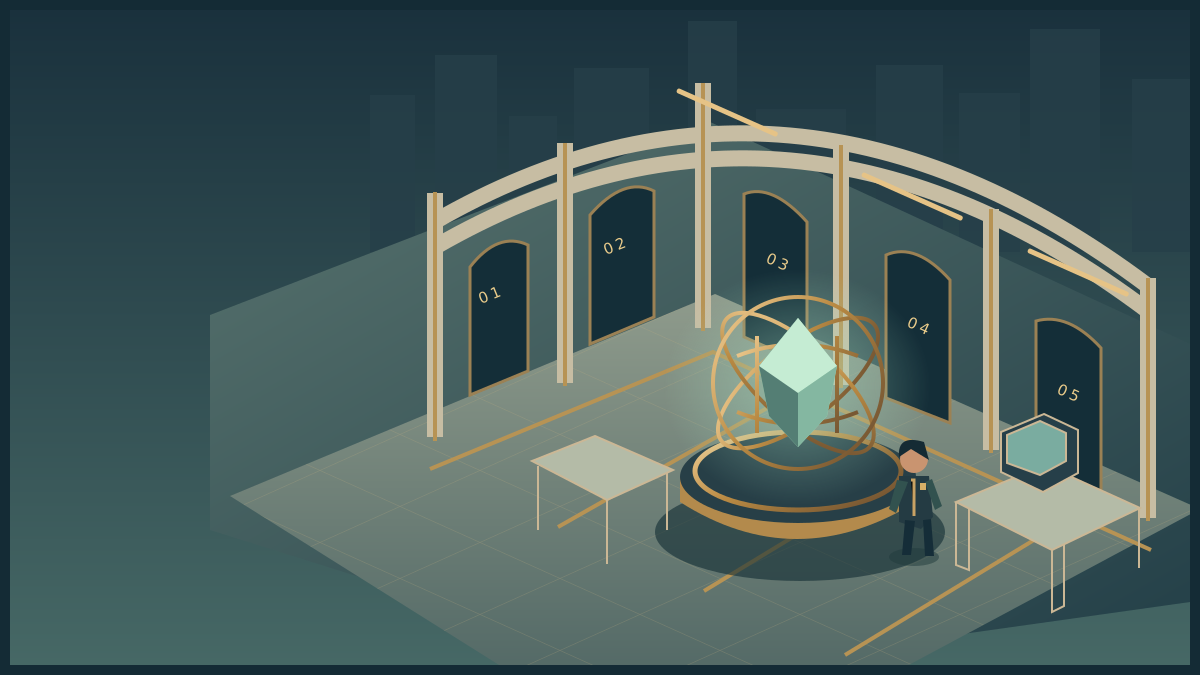
Movement Hall
Watch the complete alternate example. Take control of the equipment whenever you are ready.
An alternate example · separate from your assessed workHow to move, inspect and complete the activity
Use WASD or arrow keys to walk. Press E near an instrument to examine it. Inspect means read its details; Use equipment performs the action named in its status message. The task controls let you choose exact settings and test a solution. Once verified, use the mission station to put it into effect, collect the resulting evidence or cargo, follow its checkpoints and complete the handover at the receiving station.
Scroll over the scene or use Zoom + / Zoom − for a closer or wider view. Click and drag to turn whenever the cursor is free. Choose Fullscreen mission to keep the scene, mission instructions and all task controls together. Fullscreen starts with a free cursor so you can scroll the panel and choose options. Press X or Lock cursor (X) to turn by moving the mouse. Press X again to free the cursor and return to click-and-drag turning. Tab also frees the cursor. The X shortcut stays inactive while typing or choosing a form value. Press Escape or Exit fullscreen to return to the page. On touchscreens, drag to look and use the zoom buttons. If your browser cannot enter native fullscreen, the mission expands to fill its window.
Choose Watch to follow the worked example, or Take control to try it yourself. The transcript and completed example remain available if 3D is unavailable. Demonstrations never change assessed progress.
I need to predict and test contacts on an invented instrumented floor grid. I will read the coordinate rule, trace two routes, compare predicted and recorded contacts, then recompute after coverage changes. My output is a route and trace explanation, not a success badge. The method we are practising is: Compare route traces against an explicit objective, not an assumed preference for zero contacts.. Our field objective is: Deliver the gallery survey through a checked route with an honest predicted contact record. A plausible route may fail its endpoints or miscount entries into marked sensor cells. The investigation and explained record complete this lesson. A scene delivery is an optional extension. You can pause, mute, replay, or take control at any point. The captions show the same explanation.
Narration starts after you choose Watch or Play. Captions remain available if this browser has no working voice.
Optional scene extension
Each chapter provides evidence for this operation. Inspect, investigate, act, and complete the handover.
FIELD OPERATION · Briefing
Operation Gallery Transit
Deliver the gallery survey through a checked route with an honest predicted contact record.
A plausible route may fail its endpoints or miscount entries into marked sensor cells.
Inspect the mission station to begin your investigation.
Nothing collected.
Mission actions become available when the activity loads.
Mission record and accessible controls
These controls perform the same actions as the marked stations in the scene. Use them with a keyboard or touch, or when graphics are unavailable. Equipment tests establish whether your intervention is supported. The final handover records a mission outcome; your explanation is assessed separately.
- No mission actions yet.
The complete transcript and finished example are available below while the player loads.
THE DEMONSTRATOR’S REASONING
Read the coordinate contract
Cells are numbered 0–24 in rows from top left. Start is 20 and destination 3. Sensors occupy 15, 16 and 11; every step ending on a sensor records one contact.
Why this matters
A visible game rule can be applied exactly without borrowing assumptions about real surveillance.
A plausible mistake
Changing the camera does not renumber the world cells.
WHAT THE DEMONSTRATOR DID
YOUR LEARNING CONTROLS
Make the skill your own.
Record the destination cell.
Watch the apparatus change as the student demonstrates. Take control whenever you want to test the same idea yourself.
BASED ON YOUR ATTEMPTS
Watching and practising are recorded separately in this visit. These examples do not change your assessed work or skills passport.
NOW TRANSFER THE SKILL
Carry the method into your own work.
The assigned map and objective differ. Recompute the relevant count or route cost before selecting an approach.
A COMPLETE WORKED SUBMISSION
Predict the instrumented gallery — completed record
Example work from this demonstration's scenario. Use it to understand the expected evidence and explanation, then make your own decisions in the assigned activity.
Download the complete exampleRead the finished work
Completed demonstration example — instrumented gallery routes
This alternate five-by-five model uses zero-based cells, start 20 and destination 3.
Original sensor set
15, 16, 11.
Route A: 20 → 15 → 10 → 5 → 0 → 1 → 2 → 3. Prediction: one contact. Trace: one contact at 15. Route B: 20 → 21 → 22 → 23 → 18 → 13 → 8 → 3. Prediction: zero. Trace: zero. Both routes use seven moves.
Changed sensor set
21, 22, 23. Route B now records three contacts; Route A records zero. The earlier records remain labelled with the original pattern.
Decision
If the objective is minimal recorded contact, Route B fits the original pattern and Route A fits the changed one. If the task is to verify detector observations, a route through the sensor cells may be more useful. Contact is a game event, not automatic failure.
Reflection
The most useful artefact was the ordered route plus the sensor set, because it made each count reproducible. I avoided treating a once-correct zero as a permanent property of the path. In my own task I would predict before execution and inspect the first disagreement rather than changing the route until an attractive ending appears.
Named output: sensor-route.
Method to carry forward
Compare route traces against an explicit objective, not an assumed preference for zero contacts.
The assigned map and objective differ. Recompute the relevant count or route cost before selecting an approach.
The complete example explains one defensible approach. In your own challenge, select observations and tests from the supplied rules, keep your prediction separate from the result, and justify both the checks you perform and those you omit.
The chapter investigation and its explained record complete the core method. The scene delivery is an optional extension; it is not evidence of deeper understanding on its own.
Complete transcript and decisions · readable without JavaScript
Before we begin · expected task and evidence
I need to predict and test contacts on an invented instrumented floor grid. I will read the coordinate rule, trace two routes, compare predicted and recorded contacts, then recompute after coverage changes. My output is a route and trace explanation, not a success badge. The method we are practising is: Compare route traces against an explicit objective, not an assumed preference for zero contacts.. Our field objective is: Deliver the gallery survey through a checked route with an honest predicted contact record. A plausible route may fail its endpoints or miscount entries into marked sensor cells. The investigation and explained record complete this lesson. A scene delivery is an optional extension. You can pause, mute, replay, or take control at any point. The captions show the same explanation.
1. Read the coordinate contract
What I need to do: Step 1. Read the coordinate contract. I read how cells are numbered and what counts as a contact before drawing a route.
Supplied context: Cells are numbered 0–24 in rows from top left. Start is 20 and destination 3. Sensors occupy 15, 16 and 11; every step ending on a sensor records one contact.
Watch my actions: For "Destination cell", I enter 3. I check the demonstrated result.
What I observed: The route has a clear start, target and detection rule. A visible game rule can be applied exactly without borrowing assumptions about real surveillance.
Why: A visible game rule can be applied exactly without borrowing assumptions about real surveillance.
Decision: Record the destination cell.
- Destination cell: 3
Result: The route has a clear start, target and detection rule.
Common mistake: Changing the camera does not renumber the world cells.
2. Predict the first route
What I need to do: Step 2. Predict the first route. I compare every visited cell with the published sensor set and count entries onto sensor cells.
Supplied context: The route 20→15→10→5→0→1→2→3 enters sensor 15 once. Its other cells are outside the detection set.
Watch my actions: For "Predicted contacts", I enter 1. I check the demonstrated result.
What I observed: One contact follows directly from the listed cells. An explicit prediction lets the later trace test your model.
Why: An explicit prediction lets the later trace test your model.
Decision: Predict the contact count.
- Predicted contacts: 1
Result: One contact follows directly from the listed cells.
Common mistake: Reaching the target does not prove that a guessed count was correct.
3. Follow the ordered path
What I need to do: Step 3. Follow the ordered path. I follow the recorded cells in order, keeping the path so another person can check my contact count.
Supplied context: The demonstrator executes the recorded route one step at a time and reaches cell 3 with one contact. The path is retained rather than replaced by a success badge.
Watch my actions: I arrange "Route order" in this order: 20, then 15, then 10, then 5, then 0, then 1, then 2, then 3. I check the demonstrated result.
What I observed: The complete path supports the stated count. The event trace explains the result and supports replay.
Why: The event trace explains the result and supports replay.
Decision: Arrange the route cells in execution order.
- Route order: 20 → 15 → 10 → 5 → 0 → 1 → 2 → 3
Result: The complete path supports the stated count.
Common mistake: A reordered jump between nonadjacent cells is not a legal step.
4. Compare a different route
What I need to do: Step 4. Compare a different route. I trace a second route under the same rules and compare both contact count and length.
Supplied context: A second route goes 20→21→22→23→18→13→8→3. Under the original sensor set it records no contacts and has the same seven moves.
Watch my actions: For "Alternative contacts", I enter 0. I check the demonstrated result.
What I observed: The comparison supports choosing either route for an explicitly stated purpose. An alternative makes the objective and trade-off explicit.
Why: An alternative makes the objective and trade-off explicit.
Decision: Predict this alternative's contact count.
- Alternative contacts: 0
Result: The comparison supports choosing either route for an explicitly stated purpose.
Common mistake: Zero contacts is not an automatic academic grade.
5. Recompute when coverage changes
What I need to do: Step 5. Recompute when coverage changes. The sensor set has changed. I recompute the prediction without overwriting the earlier trace under the old rule.
Supplied context: The published new sensor set is 21, 22 and 23. The second route now records three contacts. The demonstrator preserves its earlier zero count under the old rule.
Watch my actions: For "Contacts under changed sensors", I enter 3. I check the demonstrated result.
What I observed: The changed prediction follows the changed cells. A previously successful route is not a substitute for an updated model.
Why: A previously successful route is not a substitute for an updated model.
Decision: Predict the revised contact count for the second route.
- Contacts under changed sensors: 3
Result: The changed prediction follows the changed cells.
Common mistake: Reusing zero because it was correct before ignores the new contract.
6. Explain rather than glorify an ending
What I need to do: Step 6. Explain rather than glorify an ending. I state whether my objective is testing a detector or minimising contact before I recommend a route.
Supplied context: For a training objective of checking the detector, the three-contact route may be useful. For minimising recorded contact, the first route now has zero. The demonstrator states the objective before choosing. A survey brief then asks for confirmation that three marked sensors respond. Under that objective, a route with three predicted and observed contacts supplies better evidence than a zero-contact route. The preferred route depends on the job.
Watch my actions: For "Decision basis", I choose "State the objective and compare both traces". For "Changed scenario: each marked-cell contact confirms a functioning sensor; the task is to verify three sensors", I choose "Choose the three-contact route and compare its trace". I check the demonstrated result.
What I observed: The output demonstrates a model and its transfer to changed conditions. Under the sensor-verification brief, the three-contact trace establishes the required coverage; zero contacts would leave the sensors untested. Route quality is relative to a stated task, not a universal stealth score.
Why: Route quality is relative to a stated task, not a universal stealth score.
Decision: Which approach makes the decision defensible?
- Decision basis: State the objective and compare both traces
- Changed scenario: each marked-cell contact confirms a functioning sensor; the task is to verify three sensors: Choose the three-contact route and compare its trace
Result: The output demonstrates a model and its transfer to changed conditions. Under the sensor-verification brief, the three-contact trace establishes the required coverage; zero contacts would leave the sensors untested.
Common mistake: A dramatic 'undetected' label would hide the actual learning evidence.
Optional field extension
All chapter evidence checks are complete. I return to the mission station and commit the checked gallery route. I am putting the verified solution into effect, then checking what changes.
I collect Gallery route and contact record. The verified intervention released this package. I now carry it through the marked handover route.
I carry Gallery route and contact record to Gallery junction. I confirm this checkpoint before continuing so the handover trace records the route actually followed.
I carry Gallery route and contact record to Gallery receiving post. I confirm this checkpoint before continuing so the handover trace records the route actually followed.
At the receiving station, I deliver the gallery survey. I check the receipt before calling the field operation complete.
My observations and finished submission
The first route reached cell three and contacted sensor fifteen once. The alternative east route made zero contacts under the original sensor set, with the same number of moves. When sensors moved to twenty-one, twenty-two and twenty-three, that east route made three contacts. I preserved both traces under their respective rules and chose by the stated training objective. Compare route traces against an explicit objective, not an assumed preference for zero contacts. Open "Read the finished work" or download the complete example to inspect the evidence and explanation together. The assigned map and objective differ. Recompute the relevant count or route cost before selecting an approach.
The complete submission is available in Read the finished work above and as a Markdown download.