The method behind this example
Use information held by another role to choose and verify your next action.
Your independent challenge: Iris has a load fault and an amended calibration deliverable; the assigned relay requires its own source and receiver checks.
The example includes the practical intervention and its required handover.
Start this worked example
- Choose Watch the worked example. The student demonstrator explains the task, talks through each action, then reviews the observations and finished submission. Narration starts with this click; Mute narration keeps the same experience captioned.
- Choose Take control to try the current chapter. Follow its prompt, change the labelled controls and select Test my decision.
- Read the feedback, retry if needed, then continue with Next chapter. Each checked chapter provides evidence for one connected operation.
- After every chapter check, return to the mission station, perform the intervention, collect its package and follow the marked checkpoints to complete the handover. Watching performs these same actions with narration. Direct chapter access is a partial preview until the full evidence and handover are complete.
- Use Fullscreen mission after opening the scene to keep the instructions, chapter controls and equipment together. Reflections and exports come after your practical attempt.
This is an alternate example, not your assigned exercise. Your course task is linked after the player.
YOUR SKILL
Circuit diagnosis, digital evidence, permissions and communication
A NEW SETTING
Iris Relay: a twelve-volt lamp circuit, mirrored core records and a calibration-trace dispatch request.
WHAT CHANGES
The lamp is open even though every powered supply point reads 12 V. Two mirrored records both satisfy the first request; a later calibration-trace requirement selects a larger bundle. The assigned relay has a supply-break fault and a different archive problem.
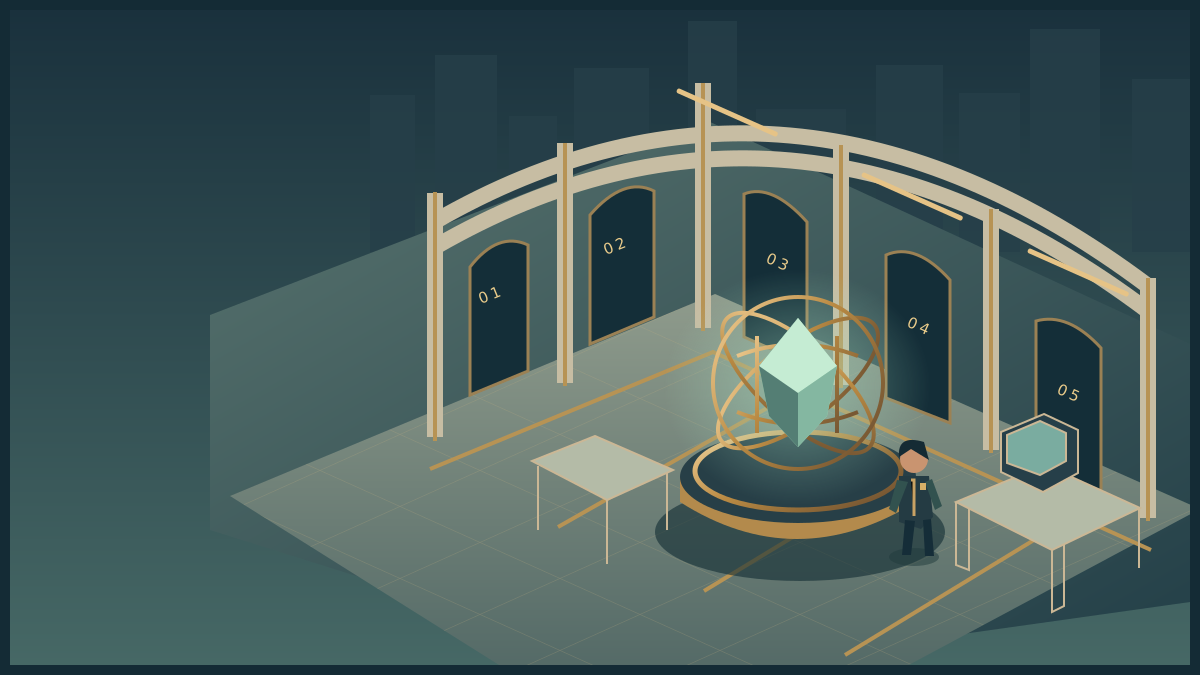
Scene guide · people, evidence and object placement
Who Ari and Nia are
Iris Relay: a twelve-volt dark-load diagnosis and mirrored-core versus calibration-trace records.
- Your part
- Watch follows a worked solution. Take control lets you move the student avatar and try its decisions. The demonstrator in the explanation is modelling a solution, not an extra witness in the story.
- Your instructor
- Mara stands in the marked teaching bay outside the investigation area. She guides the exercise. Her presence, appearance and idle gestures are not clues about what happened in the case.
- People in this scenario
- Ari and Nia are the example student pair. They rotate operator, analyst, sender and receiver responsibilities. The controllable example student lets you try either role; Mara is the instructor, not Ari or Nia.
- What counts as evidence
- Use the full-supply voltage trace, isolated lamp continuity, verified output, signed content scope, nine policy decisions and corrected read-backs. Two identical mirrors can both be valid under one request; a larger trace bundle needs its own scope justification.
- Why the objects are here
- The circuit and console are labelled teaching models. Reader, maintainer and custodian are policy identities, distinct from the pair. Archive book models identify records; their colours and positions do not establish authority.
Council Studio
Watch the complete alternate example. Take control of the equipment whenever you are ready.
An alternate example · separate from your assessed workHow to move, inspect and complete the activity
Use WASD or arrow keys to walk. Press E near an instrument to examine it. Inspect means read its details; Use equipment performs the action named in its status message. The task controls let you choose exact settings and test a solution. Once verified, use the mission station to put it into effect, collect the resulting evidence or cargo, follow its checkpoints and complete the handover at the receiving station.
Scroll over the scene or use Zoom + / Zoom − for a closer or wider view. Click and drag to turn whenever the cursor is free. Choose Fullscreen mission to keep the scene, mission instructions and all task controls together. Fullscreen starts with a free cursor so you can scroll the panel and choose options. Press X or Lock cursor (X) to turn by moving the mouse. Press X again to free the cursor and return to click-and-drag turning. Tab also frees the cursor. The X shortcut stays inactive while typing or choosing a form value. Press Escape or Exit fullscreen to return to the page. On touchscreens, drag to look and use the zoom buttons. If your browser cannot enter native fullscreen, the mission expands to fill its window.
Choose Watch to follow the worked example, or Take control to try it yourself. The transcript and completed example remain available if 3D is unavailable. Demonstrations never change assessed progress.
We are Ari and Nia, the fictional pair restoring Iris Relay. A dark lamp has supply at every test point, so we must choose a test that separates available voltage from a working load. We will also compare identical archive mirrors, respond to a changed evidence scope, repair the policy, and complete two confirmed handoffs while rotating roles. Our finished work includes both contribution records, preserved versions and a joint explanation. Mara is the instructor, not either partner. The method we are practising is: Use information held by another role to choose and verify your next action.. Our field objective is: Restore Iris Relay and deliver its amended calibration trace through a confirmed paired handoff. The original core-package confirmation cannot authorise the later trace package. I will perform the supported intervention and handover. You can pause, mute, replay, or take control at any point. The captions show the same explanation.
Narration starts after you choose Watch or Play. Captions remain available if this browser has no working voice.
Perform the practical outcome
Each chapter provides evidence for this operation. Inspect, investigate, act, and complete the handover.
FIELD OPERATION · Briefing
Operation Iris Relay
Restore Iris Relay and deliver its amended calibration trace through a confirmed paired handoff.
The original core-package confirmation cannot authorise the later trace package.
Inspect the mission station to begin your investigation.
Nothing collected.
Mission actions become available when the activity loads.
Mission record and accessible controls
These controls perform the same actions as the marked stations in the scene. Use them with a keyboard or touch, or when graphics are unavailable. Equipment tests establish whether your intervention is supported. The final handover records a mission outcome; your explanation is assessed separately.
- No mission actions yet.
The complete transcript and finished example are available below while the player loads.
THE DEMONSTRATOR’S REASONING
Agree who knows what
Ari initially operates the apparatus; Nia holds its requirement cards and predicts readings. They agree to rotate after the circuit verification and keep both traces.
Why this matters
A shared outcome should not conceal who obtained or interpreted the evidence.
A plausible mistake
A single role label cannot prove that both people understood the work.
WHAT THE DEMONSTRATOR DID
YOUR LEARNING CONTROLS
Make the skill your own.
Select the initial operator.
Watch the apparatus change as the student demonstrates. Take control whenever you want to test the same idea yourself.
BASED ON YOUR ATTEMPTS
Watching and practising are recorded separately in this visit. These examples do not change your assessed work or skills passport.
NOW TRANSFER THE SKILL
Carry the method into your own work.
Iris has a load fault and an amended calibration deliverable; the assigned relay requires its own source and receiver checks.
A COMPLETE WORKED SUBMISSION
Complete A2 model submission — Iris Relay
Example work from this demonstration's scenario. Use it to understand the expected evidence and explanation, then make your own decisions in the assigned activity.
Download the complete exampleRead the finished work
Complete authored A2 example — Iris Relay
Teaching demonstration, not an assigned response or a claim of real student activity.
Checkpoint: diagnosis before repair
| State / test | Source | Fuse output | Cable output | Lamp supply | Lamp |
|---|---|---|---|---|---|
| Powered before repair | 12 V | 12 V | 12 V | 12 V | Dark |
| Isolated continuity | Source off | Continuous | Continuous | Lamp continuity: OPEN | Fault confirmed |
| Powered after lamp replacement | 12 V | 12 V | 12 V | 12 V | Lit |
All voltage readings use the common return. The unchanged voltage trace does not prove the lamp repair; the OPEN pre-repair continuity and verified light explain it. Ari replaced only the lamp with the source isolated.
Source comparison: more than one valid match
Original signed scope: exactly 22 core sections, digest I-4.
| Record | Content | Transfer time | Original scope |
|---|---|---|---|
| Delta | 22 sections / I-4 | 09:10 | Matches |
| Echo | 22 sections / I-4; byte-identical mirror of Delta | 10:40 | Matches |
| Foxtrot | Same 22 core sections plus 6 calibration-trace sections; 28 / I-9 bundle | 10:15 | Different scope |
The signed source card supplies both the I-4 core identity and the I-9 bundle composition. Delta and Echo are equally defensible matches for the original request. A later transfer timestamp does not distinguish their content.
Before and after policy
| Role | Before read/service/approve | After read/service/approve |
|---|---|---|
| Reader | Allow / Allow / Allow | Allow / Deny / Deny |
| Maintainer | Allow / Deny / Deny | Allow / Allow / Deny |
| Custodian | Allow / Deny / Deny | Allow / Deny / Allow |
All nine resulting decisions were checked. Positive regression: maintainer service allowed. Negative regression: reader approval denied. The other seven results also matched the charter.
Handoff records
- Core package: South Dome / 4 / TEAL. Nia initially repeated 3. Ari corrected the count; Nia repeated all fields and Ari confirmed.
- Amended trace package: Hill Station / 2 / GOLD. Ari repeated all fields and Nia confirmed. This receipt applies to the Foxtrot bundle, not the earlier core-only instruction.
Preserved revision
Version 1: accepted both Delta and Echo under the 22-section/I-4 core-only scope; completed the first package handoff.
Signed scope amendment: deliver the same core plus six calibration-trace sections, exactly 28 sections with bundle digest I-9.
Version 2: selected Foxtrot under that larger evidence requirement. The original mirrors remain valid for the original scope. The permission charter remains unchanged; the new delivery requires its own confirmed handoff.
Responsibilities and contribution statements
| Stage | Operator / receiver | Analyst / sender |
|---|---|---|
| Circuit | Ari measured, isolated and replaced the lamp | Nia compared fault predictions and continuity |
| Archive and policy | Nia compared both mirrors and operated the policy | Ari read the signed scope and checked all nine cells |
| First handoff | Nia corrected 3 to 4 and repeated the full message | Ari issued and confirmed South Dome / 4 / TEAL |
| Revised handoff | Ari received and repeated the new message | Nia issued and confirmed Hill Station / 2 / GOLD |
Ari: I collected the powered readings, performed the isolated continuity and replacement sequence, and verified the lamp output. After rotation I checked the archive scope and policy; I later received the amended handoff. I did not claim that identical mirrors required a unique winner.
Nia: I proposed the continuity check because available supply did not prove a healthy load. I then operated the record and policy comparisons, preserved my corrected count error, and issued the amended trace-package instruction after another role exchange.
Joint explanation (580 words)
Our pair restored Iris Relay and prepared the research package authorised by its current signed request. Ari initially operated the circuit while Nia held the requirement cards and predicted what each possible fault would produce. We agreed to exchange responsibilities after verification. This is an authored example of paired reasoning: the contribution records show who measured, compared, operated and confirmed, rather than treating a shared result as proof of equal understanding.
The lamp was dark, but Ari measured twelve volts at the source, fuse output, cable output and lamp supply, all against the common return. These readings established available supply throughout the model. They did not establish a complete path through the lamp. Nia rejected an immediate fuse replacement because there was no missing supply after that component. We chose a different test: isolate the source and inspect continuity through the load, with healthy components as comparisons.
With power off, the supplied continuity record showed the fuse and cable continuous and the lamp open. That evidence supported replacing the lamp. Ari made the replacement while isolated, then restored power. All four supply readings remained twelve volts, but the lamp now lit. The voltage trace alone therefore could not explain the repair; the retained continuity result and changed output could. We preserved both the original dark condition and the verified result before rotating roles.
Nia next operated the archive console while Ari stated the first request: exactly twenty-two core sections with digest I-4. Delta and Echo had identical content satisfying both conditions. Their different transfer timestamps did not create different content identities. We recorded both as matching mirrors instead of inventing a unique winner. Foxtrot contained the same core plus six calibration-trace sections, forming a twenty-eight-section bundle with digest I-9. Its extra material was outside the original exact scope, without making that material false or corrupt.
The permission charter remained a separate question. The reader originally held excess service and approval rights, while specialist roles lacked their required actions. We repaired all nine cells: everyone could read, only the maintainer could service, and only the custodian could approve. We checked both the permitted maintainer service and the denied reader approval, alongside the other seven decisions. Denying everything would remove misuse but also prevent the relay from performing its intended work.
For the first delivery, either matching mirror supported the core package. Ari issued South Dome, four units, TEAL. Nia initially repeated three units. Ari corrected that discrepancy, and Nia repeated the entire message before confirmation. We retained the mistake because it demonstrates what the protocol caught. Confirmation applied to this package and these fields; it was not general permission for a later delivery.
The signed amendment then required the core together with six calibration-trace sections, exactly twenty-eight sections and bundle digest I-9. Foxtrot alone met that enlarged scope. Delta and Echo remained valid answers to the earlier request, so Version Two preserved the original two-match finding rather than rewriting it as failure. The amendment changed the deliverable, not the permission charter. Roles rotated again: Nia issued Hill Station, two units, GOLD, and Ari completed a fresh read-back.
Our completed evidence links diagnosis, content scope, authority and communication without treating them as interchangeable checks. Matching a supplied digest establishes reference agreement within this model; it does not establish scientific truth, permanent hardware reliability or a real-world delivery. In a new task we would reuse the reasoning method, identify its actual measurement conventions and requirements, and collect fresh evidence before reusing any conclusion.
Attribution and limitation
The names, actions and records are a complete authored example. No physical measurements, external system tests, real student participation or real delivery are claimed. An assessed pair must provide its own records, reasoning, contributions and declared assistance.
Method to carry forward
Use information held by another role to choose and verify your next action.
Iris has a load fault and an amended calibration deliverable; the assigned relay requires its own source and receiver checks.
The complete example explains one defensible approach. In your own challenge, select observations and tests from the supplied rules, keep your prediction separate from the result, and justify both the checks you perform and those you omit.
Complete transcript and decisions · readable without JavaScript
Before we begin · expected task and evidence
We are Ari and Nia, the fictional pair restoring Iris Relay. A dark lamp has supply at every test point, so we must choose a test that separates available voltage from a working load. We will also compare identical archive mirrors, respond to a changed evidence scope, repair the policy, and complete two confirmed handoffs while rotating roles. Our finished work includes both contribution records, preserved versions and a joint explanation. Mara is the instructor, not either partner. The method we are practising is: Use information held by another role to choose and verify your next action.. Our field objective is: Restore Iris Relay and deliver its amended calibration trace through a confirmed paired handoff. The original core-package confirmation cannot authorise the later trace package. I will perform the supported intervention and handover. You can pause, mute, replay, or take control at any point. The captions show the same explanation.
1. Agree who knows what
What I need to do: Step 1. Agree who knows what. We state who operates, who supplies the requirements, and when we will exchange those responsibilities.
Supplied context: Ari initially operates the apparatus; Nia holds its requirement cards and predicts readings. They agree to rotate after the circuit verification and keep both traces.
Watch my actions: For "Initial operator", I choose "Ari". I check the demonstrated result.
What I observed: The task has explicit ownership and a planned exchange. A shared outcome should not conceal who obtained or interpreted the evidence.
Why: A shared outcome should not conceal who obtained or interpreted the evidence.
Decision: Select the initial operator.
- Initial operator: Ari
Result: The task has explicit ownership and a planned exchange.
Common mistake: A single role label cannot prove that both people understood the work.
2. Full supply, but no light
What I need to do: Step 2. Full supply, but no light. Ari records twelve volts at all four supply points while the lamp remains dark. Nia chooses isolated continuity because this trace contains no supply break to locate.
Supplied context: Ari records 12 V at the source, fuse output, cable output and lamp supply, all relative to the common return. The lamp stays dark. Nia explains that supply is present throughout: these readings do not yet prove the lamp is continuous. The next discriminating test is lamp continuity with the source isolated.
Watch my actions: For "Source voltage", I enter 12 V. For "Next discriminating test", I choose "Isolate and check lamp continuity". I check the demonstrated result.
What I observed: All four supply points read 12 V. The next justified action is an isolated lamp-continuity check. A healthy supply reading does not prove that current can pass through the load. Looking for the first zero would not locate this fault.
Why: A healthy supply reading does not prove that current can pass through the load. Looking for the first zero would not locate this fault.
Decision: Record the source voltage and choose the next test; do not replace a part from these readings alone.
- Source voltage: 12 V
- Next discriminating test: Isolate and check lamp continuity
Result: All four supply points read 12 V. The next justified action is an isolated lamp-continuity check.
Common mistake: No supply zero appears in this trace. Replacing the fuse would skip the test that distinguishes an open load from a supply break.
3. Prove the load fault, then replace
What I need to do: Step 3. Prove the load fault, then replace. We isolate power, record the lamp as OPEN and the fuse and cable as continuous, then replace only the lamp while retaining that diagnostic evidence.
Supplied context: Ari isolates the source. The supplied continuity record now reads CONTINUOUS through the fuse and cable, but OPEN through the lamp. Nia identifies the lamp as the supported fault. Ari replaces only that lamp while power remains off; they keep the OPEN reading as pre-repair evidence.
Watch my actions: I set "Source powered during replacement" to no. For "Lamp continuity before replacement", I choose "OPEN". For "Component to replace", I choose "lamp". I check the demonstrated result.
What I observed: The isolated lamp tested OPEN while the fuse and cable were continuous. Only the lamp was replaced, with power off. The isolated continuity result supplies the missing evidence. Replacing a part does not by itself establish what was wrong.
Why: The isolated continuity result supplies the missing evidence. Replacing a part does not by itself establish what was wrong.
Decision: Set the source off, record the lamp continuity result, and choose the component supported for replacement.
- Source powered during replacement: No
- Lamp continuity before replacement: OPEN
- Component to replace: lamp
Result: The isolated lamp tested OPEN while the fuse and cable were continuous. Only the lamp was replaced, with power off.
Common mistake: Zero voltage after isolation is expected everywhere; it cannot locate this fault. Keep the specific continuity result and the healthy comparison checks.
4. Verify and rotate responsibility
What I need to do: Step 4. Verify and rotate responsibility. We restore power. The voltage trace stays at twelve volts throughout, but the lamp now lights. We verify that output before Nia operates and Ari takes the requirement pack.
Supplied context: Ari restores power. The same four supply readings remain 12/12/12/12 V, but now the lamp lights. Nia checks that a changed output, not a changed voltage, supports the repair. Nia then becomes operator and Ari takes the requirement pack.
Watch my actions: I set "Restore source" to yes. For "Next operator", I choose "Nia". I check the demonstrated result.
What I observed: The repaired lamp lights with 12 V supply, and Nia takes over the console with Ari checking the requirements. The before and after voltage traces are identical; the verified lamp output and retained continuity evidence explain what changed.
Why: The before and after voltage traces are identical; the verified lamp output and retained continuity evidence explain what changed.
Decision: Restore power and identify the next operator.
- Restore source: Yes
- Next operator: Nia
Result: The repaired lamp lights with 12 V supply, and Nia takes over the console with Ari checking the requirements.
Common mistake: Claiming that voltage rose after this repair would misreport the trace. The lamp output changed; the measured supply did not.
5. Recognise two defensible matches
What I need to do: Step 5. Recognise two defensible matches. We compare all candidates against the exact core-only scope. Both identical mirrors match; neither timestamp justifies excluding the other.
Supplied context: The signed first request requires exactly 22 core sections with digest I-4. Delta and Echo are byte-identical mirrors: both contain 22 sections and I-4, although their transfer timestamps differ. Foxtrot contains the same core plus six calibration-trace sections, a 28-section bundle with digest I-9. Identify every copy that meets the first request.
Watch my actions: For "Copies matching the original request", I choose "Delta and Echo". I check the demonstrated result.
What I observed: Both Delta and Echo meet 22 sections/I-4. Foxtrot has additional trace material and is outside the original core-only scope. A reference can admit more than one matching copy. A later transfer timestamp does not make identical content more authentic, and a larger bundle does not match an exact-scope request.
Why: A reference can admit more than one matching copy. A later transfer timestamp does not make identical content more authentic, and a larger bundle does not match an exact-scope request.
Decision: Select the complete set of copies that satisfies the original core-only request.
- Copies matching the original request: Delta and Echo
Result: Both Delta and Echo meet 22 sections/I-4. Foxtrot has additional trace material and is outside the original core-only scope.
Common mistake: Forcing a unique winner between identical mirrors invents a distinction the evidence does not support. More sections is not automatically better.
6. Repair the complete policy
What I need to do: Step 6. Repair the complete policy. We repair the complete policy against its charter, retaining each specialist responsibility and removing reader excess rights.
Supplied context: The reader initially has every right, while specialist roles lack their intended actions. The pair repairs all nine decisions: all read, maintainer services, custodian approves.
Watch my actions: I set "reader may read" to yes. I set "reader may service" to no. I set "reader may approve" to no. I set "maintainer may read" to yes. I set "maintainer may service" to yes. I set "maintainer may approve" to no. I set "custodian may read" to yes. I set "custodian may service" to no. I set "custodian may approve" to yes. I check the demonstrated result.
What I observed: Every expected permitted and denied action is represented. The fix must restore useful authority as well as remove excess authority.
Why: The fix must restore useful authority as well as remove excess authority.
Decision: Set all nine expected decisions.
- reader may read: Yes
- reader may service: No
- reader may approve: No
- maintainer may read: Yes
- maintainer may service: Yes
- maintainer may approve: No
- custodian may read: Yes
- custodian may service: No
- custodian may approve: Yes
Result: Every expected permitted and denied action is represented.
Common mistake: Denying all actions would leave the relay unusable.
7. Test a positive and a negative
What I need to do: Step 7. Test a positive and a negative. We check an allowed maintainer service and a denied reader approval, alongside the other seven expected decisions.
Supplied context: The maintainer's service action succeeds; a reader approval request fails. The pair records these alongside the rest of the nine-cell check.
Watch my actions: For "Positive regression test", I choose "Maintainer services". For "Negative regression test", I choose "Reader approval denied". I check the demonstrated result.
What I observed: Maintainer service is allowed and reader approval is denied; both outcomes agree with the charter alongside the other seven checks. One successful denial is not enough to show a repair preserves required work.
Why: One successful denial is not enough to show a repair preserves required work.
Decision: Select one required success and one required denial.
- Positive regression test: Maintainer services
- Negative regression test: Reader approval denied
Result: Maintainer service is allowed and reader approval is denied; both outcomes agree with the charter alongside the other seven checks.
Common mistake: A negative-only check set could endorse a blanket denial.
8. Repair the first read-back
What I need to do: Step 8. Repair the first read-back. We keep the first core-package instruction separate from the copy-equivalence finding. We correct three to four, repeat all fields, and obtain confirmation.
Supplied context: The confirmed core package can be read from either Delta or Echo. Ari issues South Dome / four / TEAL for its labelled delivery units. Nia first repeats three; Ari corrects the count and waits for the complete destination, quantity and code before confirming this first handoff.
Watch my actions: For "Destination", I enter South Dome. For "Units", I enter 4. For "Code", I enter TEAL. I set "Corrected read-back confirmed" to yes. I check the demonstrated result.
What I observed: The record preserves the initial count mismatch and its correction. The copy-equivalence decision and delivery instruction answer different questions. Explicit read-back catches the count error without inventing a unique archive winner.
Why: The copy-equivalence decision and delivery instruction answer different questions. Explicit read-back catches the count error without inventing a unique archive winner.
Decision: Complete the correct handoff.
- Destination: South Dome
- Units: 4
- Code: TEAL
- Corrected read-back confirmed: Yes
Result: The record preserves the initial count mismatch and its correction.
Common mistake: A generic acknowledgement would not expose the wrong count.
9. A changed scope needs a different bundle
What I need to do: Step 9. A changed scope needs a different bundle. We read the additional trace requirement. The original mirrors still match the old scope; the larger Foxtrot bundle alone contains the newly requested evidence.
Supplied context: A new signed scope requests the 22-section core together with six calibration-trace sections: exactly 28 sections with bundle digest I-9. Delta and Echo still match the old core-only request, but neither contains the required trace. Foxtrot contains the signed core-and-trace bundle. Preserve the original two-match finding and select the deliverable for the amended scope.
Watch my actions: For "Bundle for the amended trace request", I choose "Foxtrot". For "Why the deliverable changes", I choose "Core plus calibration trace". I check the demonstrated result.
What I observed: Foxtrot alone provides the signed 28-section/I-9 core-and-trace bundle. Delta and Echo remain valid mirrors of the earlier 22-section/I-4 core. The decision changes because the required evidence package changes, not because either mirror becomes corrupt or less authentic. Content scope and permission authority remain separate.
Why: The decision changes because the required evidence package changes, not because either mirror becomes corrupt or less authentic. Content scope and permission authority remain separate.
Decision: Choose the amended deliverable and the criterion that justifies it.
- Bundle for the amended trace request: Foxtrot
- Why the deliverable changes: Core plus calibration trace
Result: Foxtrot alone provides the signed 28-section/I-9 core-and-trace bundle. Delta and Echo remain valid mirrors of the earlier 22-section/I-4 core.
Common mistake: Calling the mirrors corrupt would erase a valid earlier finding. Choosing the newest timestamp would ignore the added trace requirement.
10. Complete the revised delivery
What I need to do: Step 10. Complete the revised delivery. We rotate responsibilities again and attach a fresh confirmed message to the amended trace package. We do not reuse the old package confirmation.
Supplied context: The revised delivery contains the verified Foxtrot core-and-trace bundle. Roles rotate again: Nia issues Hill Station / two / GOLD; Ari repeats all three fields and Nia confirms that exact message. The joint explanation links the load diagnosis, two-copy finding, changed scope, policy checks and both role records.
Watch my actions: For "New destination", I enter Hill Station. For "New units", I enter 2. For "New code", I enter GOLD. I set "New read-back confirmed" to yes. I check the demonstrated result.
What I observed: The Foxtrot trace bundle has its own current destination, count, code and confirmed read-back. The earlier TEAL confirmation remains attached to the earlier core package. A later instruction needs its own current fields and acknowledgement.
Why: A later instruction needs its own current fields and acknowledgement.
Decision: Record the revised handoff.
- New destination: Hill Station
- New units: 2
- New code: GOLD
- New read-back confirmed: Yes
Result: The Foxtrot trace bundle has its own current destination, count, code and confirmed read-back. The earlier TEAL confirmation remains attached to the earlier core package.
Common mistake: Reusing TEAL would apply the old instruction to the wrong delivery.
Performing the field operation
All chapter evidence checks are complete. I return to the mission station and dispatch the verified iris trace. I am putting the verified solution into effect, then checking what changes.
I collect Iris calibration-trace dispatch. The verified intervention released this package. I now carry it through the marked handover route.
I carry Iris calibration-trace dispatch to Iris relay station. I confirm this checkpoint before continuing so the handover trace records the route actually followed.
I carry Iris calibration-trace dispatch to Calibration-team receiving post. I confirm this checkpoint before continuing so the handover trace records the route actually followed.
At the receiving station, I complete the paired relay handover. I check the receipt before calling the field operation complete.
My observations and finished submission
We measured twelve volts throughout the dark circuit, then isolated it and found the lamp open while fuse and cable were continuous. After lamp replacement the voltages stayed the same, but the light worked. Both Delta and Echo satisfied the first twenty-two-section I-4 request. The amendment added six calibration-trace sections, so Foxtrot became the required twenty-eight-section I-9 bundle without making the original mirrors corrupt. We verified all nine policy decisions, corrected the South Dome count to four with TEAL, and completed a fresh Hill Station, two, GOLD handoff after rotating again. Our complete record explains the changed test, the non-unique first match and the scope-based revision. Use information held by another role to choose and verify your next action. Open "Read the finished work" or download the complete example to inspect the evidence and explanation together. Iris has a load fault and an amended calibration deliverable; the assigned relay requires its own source and receiver checks.
The complete submission is available in Read the finished work above and as a Markdown download.