The method behind this example
Build an individual explanation from observations and tests chosen for an unfamiliar apparatus.
Your independent challenge: The botanical mechanism needs different gearing, orientation and readiness. Its memory rehearsal illustrates a strategy, not a mandatory gate in your assigned trial.
The example includes the practical intervention and its required handover.
Start this worked example
- Choose Watch the worked example. The student demonstrator explains the task, talks through each action, then reviews the observations and finished submission. Narration starts with this click; Mute narration keeps the same experience captioned.
- Choose Take control to try the current chapter. Follow its prompt, change the labelled controls and select Test my decision.
- Read the feedback, retry if needed, then continue with Next chapter. Each checked chapter provides evidence for one connected operation.
- After every chapter check, return to the mission station, perform the intervention, collect its package and follow the marked checkpoints to complete the handover. Watching performs these same actions with narration. Direct chapter access is a partial preview until the full evidence and handover are complete.
- Use Fullscreen mission after opening the scene to keep the instructions, chapter controls and equipment together. Reflections and exports come after your practical attempt.
This is an alternate example, not your assigned exercise. Your course task is linked after the player.
YOUR SKILL
Observation, memory, spatial reasoning and mechanism diagnosis
A NEW SETTING
An alternate botanical workshop preparing a model carriage.
WHAT CHANGES
13:15 scene, new mnemonic list, level-2 connector and 20-tooth carriage driver differ from the assigned trial.
Scene guide · people, evidence and object placement
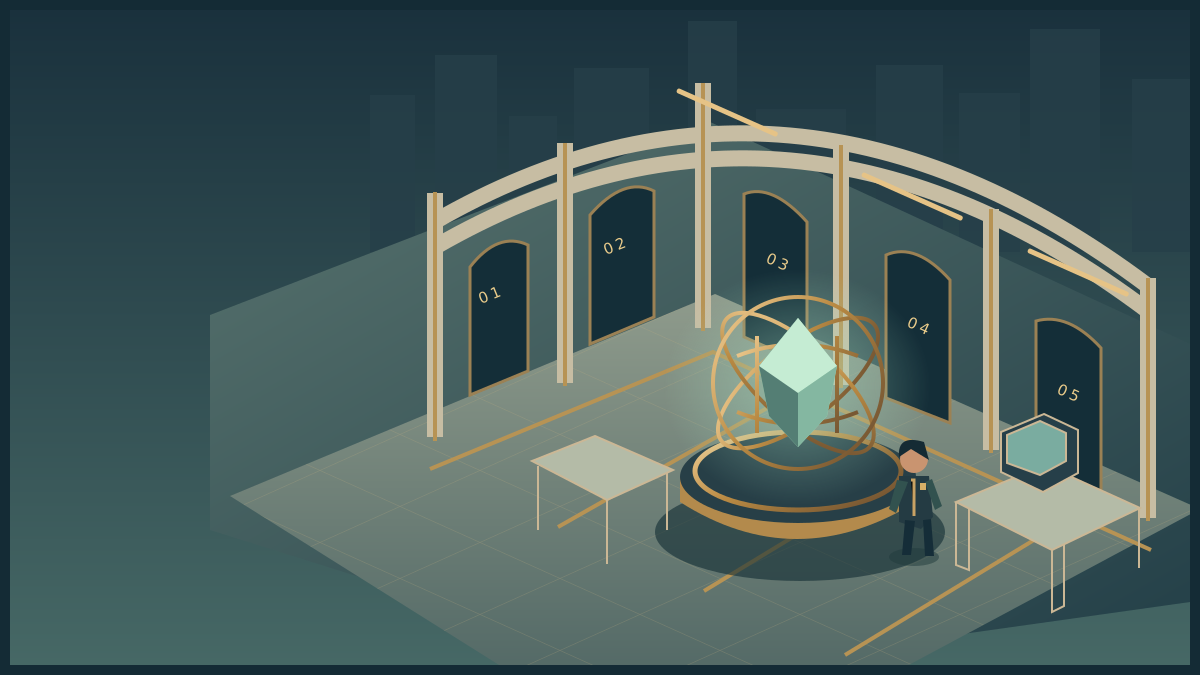
Who is in the botanical workshop
An alternate botanical transfer workshop and model carriage.
- Your part
- Watch follows a worked solution. Take control lets you move the student avatar and try its decisions. The demonstrator in the explanation is modelling a solution, not an extra witness in the story.
- Your instructor
- Mara stands in the marked teaching bay outside the investigation area. She guides the exercise. Her presence, appearance and idle gestures are not clues about what happened in the case.
- People in this scenario
- The demonstrator is the example student. The note's writer and the person in the hurried-departure explanation are not identified by a visible character; Mara is the instructor.
- What counts as evidence
- Observe the clock, white jar, ledger and window; treat the Tray Delta note as a claim. Then use the published memory, connector and mechanism rules.
- Why the objects are here
- Room fixtures belong in the observation scene. The connector and exposed carriage mechanism are separate teaching rigs used in later chapters.
Perception Gallery
Watch the complete alternate example. Take control of the equipment whenever you are ready.
An alternate example · separate from your assessed workHow to move, inspect and complete the activity
Use WASD or arrow keys to walk. Press E near an instrument to examine it. Inspect means read its details; Use equipment performs the action named in its status message. The task controls let you choose exact settings and test a solution. Once verified, use the mission station to put it into effect, collect the resulting evidence or cargo, follow its checkpoints and complete the handover at the receiving station.
Scroll over the scene or use Zoom + / Zoom − for a closer or wider view. Click and drag to turn whenever the cursor is free. Choose Fullscreen mission to keep the scene, mission instructions and all task controls together. Fullscreen starts with a free cursor so you can scroll the panel and choose options. Press X or Lock cursor (X) to turn by moving the mouse. Press X again to free the cursor and return to click-and-drag turning. Tab also frees the cursor. The X shortcut stays inactive while typing or choosing a form value. Press Escape or Exit fullscreen to return to the page. On touchscreens, drag to look and use the zoom buttons. If your browser cannot enter native fullscreen, the mission expands to fill its window.
Choose Watch to follow the worked example, or Take control to try it yourself. The transcript and completed example remain available if 3D is unavailable. Demonstrations never change assessed progress.
I am completing the Botanical Transfer Workshop, an alternate individual assignment. I must combine an observation record, recall strategy, connector transformation and mechanism diagnosis, then explain a changed output requirement. I will show the practical decisions and the finished written explanation, so you can see both parts of a complete submission. The method we are practising is: Build an individual explanation from observations and tests chosen for an unfamiliar apparatus.. Our field objective is: Commission the botanical carriage and deliver the solo evidence dossier. Observation, recalled order, alignment and the mechanism must support the same carriage. I will perform the supported intervention and handover. You can pause, mute, replay, or take control at any point. The captions show the same explanation.
Narration starts after you choose Watch or Play. Captions remain available if this browser has no working voice.
Perform the practical outcome
Each chapter provides evidence for this operation. Inspect, investigate, act, and complete the handover.
FIELD OPERATION · Briefing
Operation Botanical Carriage
Commission the botanical carriage and deliver the solo evidence dossier.
Observation, recalled order, alignment and the mechanism must support the same carriage.
Inspect the mission station to begin your investigation.
Nothing collected.
Mission actions become available when the activity loads.
Mission record and accessible controls
These controls perform the same actions as the marked stations in the scene. Use them with a keyboard or touch, or when graphics are unavailable. Equipment tests establish whether your intervention is supported. The final handover records a mission outcome; your explanation is assessed separately.
- No mission actions yet.
The complete transcript and finished example are available below while the player loads.
THE DEMONSTRATOR’S REASONING
Inspect the actual workshop
The scene shows 13:15, a white jar by the handling ledger and an open window. The demonstrator records those details before deciding what happened.
Why this matters
The integrated trial still begins with checkable observations.
A plausible mistake
An urgent-looking environment does not establish its cause.
WHAT THE DEMONSTRATOR DID
YOUR LEARNING CONTROLS
Make the skill your own.
Record the visible display.
Watch the apparatus change as the student demonstrates. Take control whenever you want to test the same idea yourself.
BASED ON YOUR ATTEMPTS
Watching and practising are recorded separately in this visit. These examples do not change your assessed work or skills passport.
NOW TRANSFER THE SKILL
Carry the method into your own work.
The botanical mechanism needs different gearing, orientation and readiness. Its memory rehearsal illustrates a strategy, not a mandatory gate in your assigned trial.
A COMPLETE WORKED SUBMISSION
Complete A1 model submission — Botanical Transfer Workshop
Example work from this demonstration's scenario. Use it to understand the expected evidence and explanation, then make your own decisions in the assigned activity.
Download the complete exampleRead the finished work
Complete authored A1 example — Botanical Transfer Workshop
Demonstration material, not assigned answers or a real student's submission. The alternate scene, memory list, connector and carriage parameters differ from the assessed workshop.
Attempt record
- Objective: prepare the model botanical carriage for documented transfer. - Observation: 13:15 display; white jar; open window. Note's sealing assertion retained as a claim. - Recall baseline error: “packing” substituted for Foam; cue revised and four-item sequence retrieved. - Connector: north/east at level 0 → 180-degree clockwise rotation → south/west at level 2. - Mechanism: driver 20, follower 40, input 6, output 3 opposite; interlock released, cam 90, spring attached. - Transfer: follower 30, input 6, output 4 opposite; other valid readiness conditions retained.
Causal model
Input → gear pair → cam → spring-return follower → carriage. Engaged interlock blocks cam adjustment. Missing spring prevents the required return cycle. Ratio alone does not establish readiness. Output turns = driver teeth ÷ follower teeth × input turns.
Individual explanation (422 words)
My objective was to prepare a model botanical carriage for a documented transfer, using observation, deliberate recall, spatial transformation and mechanism diagnosis. I treated these as connected checks. Recognising a familiar component did not establish that its current configuration met the new requirement. I recorded the attempt before examining the worked explanation so the difference between prediction and correction remained visible.
The inspection established a 13:15 display, a white jar beside the handling ledger and an open window. A note asserted that Tray Delta was sealed. I initially interpreted the open window as evidence of hurried departure, then withdrew that claim because the scene supplied no cause. Keeping the visible condition separate from the note's account prevented a plausible story from becoming a false premise for the transfer.
I encoded Lens, Foam, Map and Beacon along Arch, Basin, Bench and Dome. The Foam cue was initially too generic: I recalled “packing” rather than the required item. I revised the cue to a large foam block floating in the Basin, covered the list and retrieved the four items in order. This was a guided retrieval result, not evidence of perfect memory or a permanent improvement. The record preserves both the substitution and its repair.
The replacement connector began with north/east ports on level zero. I predicted that two clockwise quarter-turns would move the original north port south and the east port west. After rotating 180 degrees, I moved the module to level two without further rotation. Checking orientation and height separately mattered: a correct outline at the wrong level would still have failed the stated fit requirement.
For the carriage, a 20-tooth driver had to produce three output turns from six input turns. The required follower was 40 teeth, with output opposite the driver. My first ratio calculation was correct, but the engaged interlock and detached spring prevented a ready mechanism. I released the interlock, set the published 90-degree cam and attached the spring before applying the six turns. The observed three-turn result supported both the transmission model and the readiness diagnosis.
The changed task required four output turns from the same six input turns. I selected a 30-tooth follower because 20 divided by 30, multiplied by six, equals four. The cam and spring requirements remained unchanged. This transfer showed why replaying the earlier configuration would have been insufficient. My remaining limitation is that these are model observations, not physical measurements of a constructed carriage. In another apparatus I would re-establish its rules and tolerances rather than assume this demonstration's exact values apply.
Counterexample and limitation
A 40-tooth follower with an engaged interlock has the correct ratio but an unready mechanism. The example establishes behaviour within the published model, not a verified physical build.
Assistance and attribution
This is an authored worked demonstration using narrated feedback and a supplied domain model. A student's own response must identify their own attempt and assistance; copying this account does not demonstrate personal understanding.
Method to carry forward
Build an individual explanation from observations and tests chosen for an unfamiliar apparatus.
The botanical mechanism needs different gearing, orientation and readiness. Its memory rehearsal illustrates a strategy, not a mandatory gate in your assigned trial.
The complete example explains one defensible approach. In your own challenge, select observations and tests from the supplied rules, keep your prediction separate from the result, and justify both the checks you perform and those you omit.
Complete transcript and decisions · readable without JavaScript
Before we begin · expected task and evidence
I am completing the Botanical Transfer Workshop, an alternate individual assignment. I must combine an observation record, recall strategy, connector transformation and mechanism diagnosis, then explain a changed output requirement. I will show the practical decisions and the finished written explanation, so you can see both parts of a complete submission. The method we are practising is: Build an individual explanation from observations and tests chosen for an unfamiliar apparatus.. Our field objective is: Commission the botanical carriage and deliver the solo evidence dossier. Observation, recalled order, alignment and the mechanism must support the same carriage. I will perform the supported intervention and handover. You can pause, mute, replay, or take control at any point. The captions show the same explanation.
1. Inspect the actual workshop
What I need to do: Step 1. Inspect the actual workshop. I inspect the workshop and record visible features before deciding what happened.
Supplied context: The scene shows 13:15, a white jar by the handling ledger and an open window. The demonstrator records those details before deciding what happened.
Watch my actions: For "Display reading", I enter 13:15. I check the demonstrated result.
What I observed: The exact scene state is recorded. The integrated trial still begins with checkable observations.
Why: The integrated trial still begins with checkable observations.
Decision: Record the visible display.
- Display reading: 13:15
Result: The exact scene state is recorded.
Common mistake: An urgent-looking environment does not establish its cause.
2. Do not promote the note to proof
What I need to do: Step 2. Do not promote the note to proof. I keep the note's sealing statement as a claim and avoid treating an open window as proof of a hurried departure.
Supplied context: The note says Tray Delta is sealed. The demonstrator keeps that as a claim to verify and rejects an unsupported hurried-departure explanation.
Watch my actions: For "Statement status", I choose "claim". I check the demonstrated result.
What I observed: The note supplies an account, not independent verification. The subsequent plan must not depend on invented certainty.
Why: The subsequent plan must not depend on invented certainty.
Decision: Classify the sealing assertion.
- Statement status: claim
Result: The note supplies an account, not independent verification.
Common mistake: Seeing the words does not establish the claimed seal state.
3. Build the alternate retrieval route
What I need to do: Step 3. Build the alternate retrieval route. I attach Foam to the Basin with a specific image, correcting my earlier vague packing cue.
Supplied context: Lens belongs at Arch, Foam at Basin, Map at Bench and Beacon at Dome. The demonstrator uses a foam block rather than a generic packing image at the Basin.
Watch my actions: For "Basin cue", I choose "Foam". I check the demonstrated result.
What I observed: The cue repairs the earlier vague 'packing' substitution. A useful association preserves the item's identity as well as its place.
Why: A useful association preserves the item's identity as well as its place.
Decision: Which item belongs at the Basin?
- Basin cue: Foam
Result: The cue repairs the earlier vague 'packing' substitution.
Common mistake: A broad category may be remembered while the required item is lost.
4. Retrieve with the list covered
What I need to do: Step 4. Retrieve with the list covered. I cover the list and retrieve the kit in its fixed route order before checking the result.
Supplied context: The demonstrator covers the item list and follows the location route. The four items return in the order Lens, Foam, Map, Beacon.
Watch my actions: I arrange "Kit order" in this order: Lens, then Foam, then Map, then Beacon. I check the demonstrated result.
What I observed: The recorded retrieval uses the stable route. The record should distinguish retrieval from reading a visible answer.
Why: The record should distinguish retrieval from reading a visible answer.
Decision: Reconstruct the alternate kit.
- Kit order: Lens → Foam → Map → Beacon
Result: The recorded retrieval uses the stable route.
Common mistake: Do not erase the earlier substitution from the account.
5. Predict and rotate the connector
What I need to do: Step 5. Predict and rotate the connector. I predict how two clockwise quarter-turns map both original connector ports to the target.
Supplied context: The connector starts north/east. Its target is south/west. Two clockwise quarter-turns map both original ports to the target directions.
Watch my actions: For "Connector rotation", I enter 180 degrees. I check the demonstrated result.
What I observed: The two labelled ports reach their predicted directions. A labelled mapping is stronger evidence than an attractive silhouette.
Why: A labelled mapping is stronger evidence than an attractive silhouette.
Decision: Set the clockwise rotation.
- Connector rotation: 180 degrees
Result: The two labelled ports reach their predicted directions.
Common mistake: One clockwise turn would produce east/south instead.
6. Check position independently
What I need to do: Step 6. Check position independently. I check the target level separately and move the correctly oriented connector without rotating again.
Supplied context: The correctly oriented connector must be on level 2. The demonstrator raises it without another turn.
Watch my actions: For "Connector level", I enter 2. I check the demonstrated result.
What I observed: Both fit conditions now hold. Position and orientation are independent requirements.
Why: Position and orientation are independent requirements.
Decision: Set the required level.
- Connector level: 2
Result: Both fit conditions now hold.
Common mistake: Correct ports at level 0 would still be misplaced.
7. Choose a defensible transmission
What I need to do: Step 7. Choose a defensible transmission. I calculate the follower required for three output turns from six input turns with a twenty-tooth driver.
Supplied context: The driver has 20 teeth. Six input turns must yield three opposite output turns, so the follower needs 40 teeth.
Watch my actions: For "Follower teeth", I enter 40 teeth. I check the demonstrated result.
What I observed: The selected ratio predicts the required magnitude. The unfamiliar numbers require the ratio principle rather than a copied gear choice.
Why: The unfamiliar numbers require the ratio principle rather than a copied gear choice.
Decision: Choose the driven tooth count.
- Follower teeth: 40 teeth
Result: The selected ratio predicts the required magnitude.
Common mistake: A correct number does not yet establish an operable mechanism.
8. Resolve the readiness failure
What I need to do: Step 8. Resolve the readiness failure. I resolve the blocked dependencies before running: release the interlock, set the required cam angle and attach the spring.
Supplied context: The interlock is engaged and the spring detached. The demonstrator releases the interlock, sets the required 90-degree cam and attaches the spring.
Watch my actions: I set "Interlock engaged" to no. For "Cam angle", I enter 90 degrees. I set "Spring attached" to yes. I check the demonstrated result.
What I observed: The model now has the support required for its predicted motion. The initial failure came from blocked dependencies rather than an incorrect ratio.
Why: The initial failure came from blocked dependencies rather than an incorrect ratio.
Decision: Set the three readiness conditions.
- Interlock engaged: No
- Cam angle: 90 degrees
- Spring attached: Yes
Result: The model now has the support required for its predicted motion.
Common mistake: Changing gears again would not fix the blocked cam.
9. Apply the predicted input
What I need to do: Step 9. Apply the predicted input. I run the model and compare both output magnitude and direction with my prediction.
Supplied context: Six input turns produce three opposite output turns. The demonstrator compares the amount and direction, then records the model's limits.
Watch my actions: For "Input turns", I enter 6 turns. For "Output direction", I choose "opposite". I check the demonstrated result.
What I observed: The observed model result supports the causal account. Verification tests the actual requirement, not merely visible movement.
Why: Verification tests the actual requirement, not merely visible movement.
Decision: Apply six turns and identify the direction.
- Input turns: 6 turns
- Output direction: opposite
Result: The observed model result supports the causal account.
Common mistake: The outcome should not be presented as a physical hardware measurement.
10. Meet a changed output requirement
What I need to do: Step 10. Meet a changed output requirement. I recompute the follower for four output turns, retain the valid readiness conditions and preserve the first result.
Supplied context: The revised task asks for four output turns from six input turns. A 30-tooth follower meets that requirement while the still-valid cam and spring settings remain.
Watch my actions: For "Revised follower teeth", I enter 30 teeth. I check the demonstrated result.
What I observed: The finished example explains the change and retains the first result. A complete A1 account needs a justified response to a changed situation.
Why: A complete A1 account needs a justified response to a changed situation.
Decision: Set the revised follower.
- Revised follower teeth: 30 teeth
Result: The finished example explains the change and retains the first result.
Common mistake: Repeating the first gear configuration would give only three output turns.
Performing the field operation
All chapter evidence checks are complete. I return to the mission station and commission the botanical carriage. I am putting the verified solution into effect, then checking what changes.
I collect Botanical carriage commissioning dossier. The verified intervention released this package. I now carry it through the marked handover route.
I carry Botanical carriage commissioning dossier to Workshop dispatch. I confirm this checkpoint before continuing so the handover trace records the route actually followed.
I carry Botanical carriage commissioning dossier to Botanical receiving bay. I confirm this checkpoint before continuing so the handover trace records the route actually followed.
At the receiving station, I hand over the solo dossier. I check the receipt before calling the field operation complete.
My observations and finished submission
I recorded 13:15, the white jar and open window, while keeping the sealing note as a claim. I repaired a vague memory cue and retrieved Lens, Foam, Map and Beacon. I rotated the connector one hundred and eighty degrees and raised it to level two. A forty-tooth follower produced three opposite turns from six input turns after the interlock, cam and spring checks. For four output turns, I revised it to thirty teeth. My complete example joins the attempt record, causal model, transfer explanation and reflection. Build an individual explanation from observations and tests chosen for an unfamiliar apparatus. Open "Read the finished work" or download the complete example to inspect the evidence and explanation together. The botanical mechanism needs different gearing, orientation and readiness. Its memory rehearsal illustrates a strategy, not a mandatory gate in your assigned trial.
The complete submission is available in Read the finished work above and as a Markdown download.