SLOP1562: Undocumented Protocols: Field Methods in Neurotypical Interoperation
The social protocol everyone runs has no specification, no changelog and no maintainer who will admit to writing it. Twelve weeks observing it, documenting it, testing the documentation, and deciding which parts of it you will run.
The protocol is undocumented, not obvious; a minority implementation is not a broken one.

What this course is
The social protocol of the neurotypical majority is a large, undocumented, inconsistently implemented legacy system. The people who run it can't describe it, and none of them designed it. For twelve weeks, SLOP1562 reverse-engineers it: a specification of the handshake, the hint, the pause, the apology and the email to your tutor, so that anyone can interoperate with it on purpose.
Every week ends with scripts you can say, timings you can check, and lines you can test yourself against.
- A to B: How are you?
- B to A: Good, you?. not a status report
- A to B: Yeah, good.
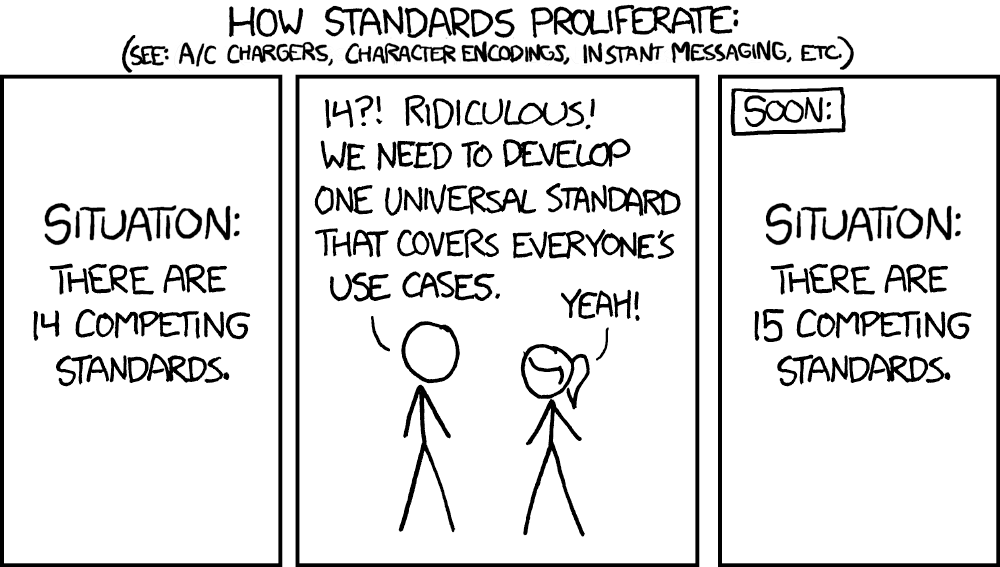
Read the comic as text
How standards proliferate (see: A/C chargers, character encodings, instant messaging, etc.). Situation: there are 14 competing standards.
Two people: “14?! Ridiculous! We need to develop one universal standard that covers everyone’s use cases.” “Yeah!”
Soon: situation: there are 15 competing standards.
Who it is for
Anyone who wants the protocol written down. Autistic and otherwise divergent students, who were never handed the implicit version. And students who run the protocol fluently and couldn't describe a line of it, which is a reason to enrol in its own right. The class is mixed on purpose; week 11 explains why that matters.
Nobody is here because something is wrong with them. Entry is by three references from people who know you well. No diagnosis is required, and none is accepted as evidence. The policies page has the details.
What you'll do
A lecture writes a part of the protocol down, and a lab tests that writing in the room. From week 2, a weekly journal entry checks it against a real exchange of your own.
- From Tue lecture to Thu lab: test it in the room
- From Thu lab to Sun journal: one real exchange
- From Sun journal to Tue lecture: revise
And three pieces of work that draw on the loop:
- In week 6, a Protocol Specification of one subroutine, with conformance tests.
- Over weeks 9 to 11, an Interoperation Report, negotiated with a partner.
- To finish, a Personal Protocol Document or a Field Experiment.
The twelve weeks
I. Read the protocol
Write down what everyone runs and nobody describes.
II. Implement selectively
Run parts of it on purpose, and count what they cost.
III. Negotiate
Institutions, closeness, disclosure, and other implementations.
IV. Horizon
What the course leaves out, and where to read further.
What you'll leave able to do
- Document one part of the social protocol precisely enough that someone who does not run it could implement it.
- Run a documented subroutine on purpose when it is worth running, and put a number on what it cost.
- Decline a subroutine knowing what declining costs, and say in plain words what you are doing instead.
- Negotiate a working protocol with someone whose implementation differs from yours, and write down what each side conceded.
The outcome is fluency plus choice, without having to become indistinguishable from anybody. You'll be able to run a part of the protocol when it's worth the cost, and decline it knowing what declining costs.
Where to go next
Week 1
Start where the course does: "how are you?", specified.
Timetable
Where to be, when, and the room rules nobody writes down.
Labs
Twelve Thursdays, each with a run sheet and timings.
Assessment
Four tasks, what each is worth, and every deadline.
Readings
71 sources, with notes on what was checked.
Glossary
The vocabulary the class builds, and the week each term arrives.
People
Who teaches the course, and who to ask about what.