A Tuesday might include subroutines you wouldn’t run if nobody were watching: looking at the tutor’s face while thinking better at the table, laughing at a second joke, or saying “yeah, totally” to a plan you have doubts about.
Each of those bought you something. Each one cost something. This week, we keep the books.
What masking is, in this course#
This week’s term is masking: running a subroutine you wouldn’t run by default, so that you will be read a particular way.
The research word is camouflaging. Hull and colleagues asked 92 autistic adults about it and built a three-stage model. People camouflage to fit in and connect with others. They do it through a mix of masking (hiding a default response) and compensation (performing an expected one). And it has consequences, including exhaustion and threats to how people see themselves (Hull et al., 2017).
Notice the first stage. Masking is not irrational, and it’s not dishonest. It buys real things: a smoother tutorial, a group that keeps inviting you. This course will never tell you to stop, and never tell you to get better at it.
Bradley, Shaw, Baron-Cohen and Cassidy surveyed 277 autistic adults, in a survey designed in partnership with autistic adults. One of the three themes was “positive aspects of camouflaging”: greater access to social spaces, and protection from harm. Camouflaging was “seen as necessary to survive in a world designed for the neurotypical majority” (Bradley et al., 2021).
It is a measured thing, not a mood#
Before 2019 there was no self-report measure of camouflaging at all. Hull and colleagues built one — the Camouflaging Autistic Traits Questionnaire — from autistic adults’ own accounts rather than from a clinician’s model, and administered it to 354 autistic and 478 non-autistic adults. Factor analysis suggested three factors across 25 items, with good model fit, internal consistency of α = 0.94 and test–retest reliability of r = 0.77 (Hull et al., 2019).
We read the abstract, so the course doesn’t name the three factors.
The result to carry is this one: the measurement invariance analyses demonstrated equivalent factor structures across diagnostic group. The same instrument measures the same thing the same way whether or not the person filling it in is autistic.
It works, and it has a price#
The price shows up in the data. In a survey of 262 autistic people, both camouflaging heavily across contexts and switching between camouflaging in some contexts and not in others were related to poorer mental health (Cage & Troxell-Whitman, 2019).
Be precise about what that means. These are associations, not measured prices. Nobody has shown that one hour of sustained eye contact costs a fixed amount of anything. The ledger below uses a planning unit because a budget needs one, not because research has priced masking.
Bradley et al. asked their participants about the frequency and the length of time they spent camouflaging. Their conclusion names the axis: “Time spent camouflaging is what seems to be most damaging” (Bradley et al., 2021). Their “dangers of camouflaging” theme ties the amount of time to exhaustion, isolation, poor mental and physical health, loss of identity and self-acceptance, other people’s unreal expectations, and delayed diagnosis.
The ledger uses recovery hours to help plan the time you may need alongside those demands. That remains a course planning device: time spent camouflaging and time needed to recover are different quantities. This study does not give a conversion between them.
Give switching its own line in the ledger. Estimate what changing how much you mask costs you between the tutorial and the corridor, or between home and work.
A choice made under pressure#
“Just decide when it’s worth it” sounds empowering. Pearson and Rose argue it’s less free than it sounds. Masking is a predictable response to stigma and to how autism has been narrated (the deficit narrative, in their analysis). The choice to mask is made inside that pressure. They call this “the illusion of choice” (Pearson & Rose, 2021).
Bradley et al. name the same pressure from the other side. Asked why they needed to spend so much time camouflaging, their participants pointed at society’s lack of awareness and acceptance of autism (Bradley et al., 2021). Their lay summary adds that reducing the pressure to camouflage “could benefit everyone in society”.
So the course’s ledger has a column most budgets don’t: pressure. Beside each subroutine, record whether you ran it because you chose to, because it was expected, or because not running it would have cost you something you couldn’t afford. A budget where the prices are set by someone else is still a budget. It helps to write down who set them.

Using the ledger across the room#
Masking is not an autistic peculiarity. Undergraduates who have never been diagnosed with autism also report camouflaging, and the more they do it, the more psychological distress they report (O’Loghlen & Lang, 2024). Long before that study, Arlie Hochschild wrote about emotional labor. Flight attendants were paid to be “nicer than natural”, and managing feeling for pay could estrange people from their own smiles (Hochschild, 2012).
And recall the CAT-Q result from §2: the same factor structure held across diagnostic group. The instrument built from autistic adults’ accounts measures the same construct, the same way, in people who aren’t autistic.
Managed performance occurs across diagnostic groups. Its cost can differ: sustained eye contact for a whole tutorial might cost one person almost nothing and another the rest of their afternoon. In the lab you’ll compare your own estimates. Neither person’s estimate sets the price for the other.
In the room — price one subroutine (8 min)#
Not a whole day. One shared situation, so we know what the prices are for.
Three minutes, alone: imagine five minutes of small talk before a tutorial with two classmates you know. Joining is optional. Estimate the cost for you, or for a fictional student if you prefer. Fill all five fields: subroutine, context, what it might buy, recovery hours and pressure. Use “private” in any field you do not want to share. Label this as an estimate, not an observed event.
Five minutes, in pairs: spend one minute predicting the other person’s estimate for that same situation, then reveal only the cost and pressure values you are willing to share. Use fictional values if preferred. Compare for the remaining four minutes: what did you assume, and what remains unknown?
No one has to explain a personal price. A correct guess does not give you the right to set it.
The ledger#
One row per masked subroutine. The recovery column uses recovery hours, the course’s planning unit: your honest estimate of how long it will take to be back to baseline. Revise the estimate against what recovery actually took.
| Subroutine | Context | What it bought | Cost (recovery h) | Pressure |
|---|---|---|---|---|
| Eye contact while thinking | 9am tutorial | tutor reads me as engaged | 1.5 | expected |
| Small talk before the lecture | lecture theatre | two people now say hi | 0.5 | chosen |
| Laughing at a joke I didn’t get | group meeting | meeting kept moving | 0.25 | chosen |
| “Yeah, totally” to a plan I doubt | group chat | avoided a thread about it | 1 | enforced |
| Hiding that the room was too loud | café, lunch | stayed with the group | 2 | expected |
| Switching charge: masked all day, then home | campus to home | none | 1 | n/a — transition |
| Total | 6.25 |
That’s one fictional student’s Tuesday. Six and a quarter hours of recovery, for a day with six hours of teaching in it, is a number worth knowing.
The total adds estimates for planning; recovery can overlap, so check it against the day as a whole. It is not a measured physiological bill. Every row has all five fields. For a transition with no separate social demand, n/a — transition is an explicit pressure entry. If no switch occurred, write that; if no masking occurred, record an empty day. Do not invent a cost to make the ledger look occupied. Private fields can say private.
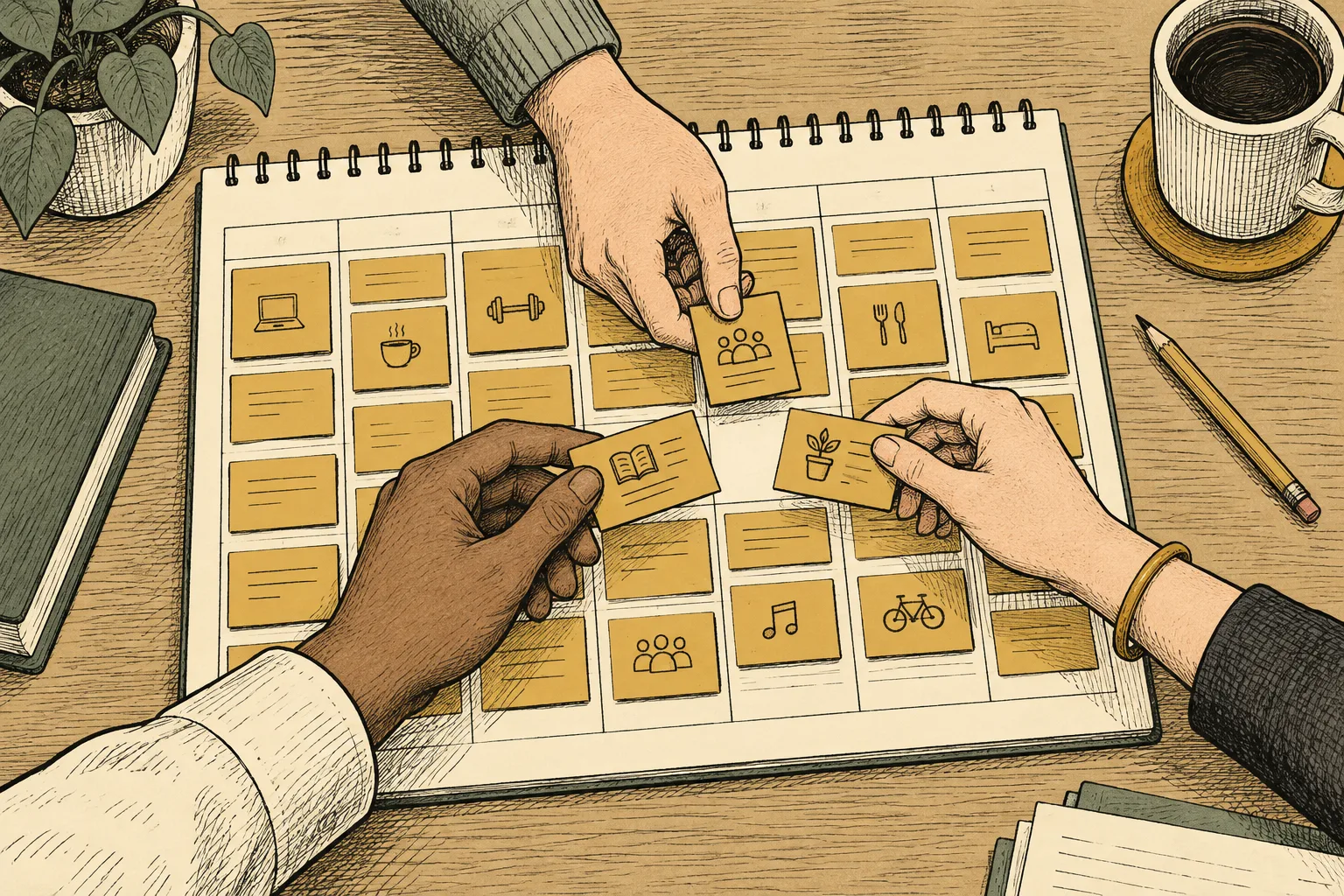
Spending rules#
The course’s rules, stated as rules so you can test them in your journal:
- Budget before, not after. Look at tomorrow’s timetable and estimate the spend. Use the estimate to decide what can move before the day starts.
- Declining is a line item. Not running a subroutine costs something too: being read as cold, or asked if you’re alright. Write that cost down beside the decline, so you’re comparing two prices, not a price and a free option.
- Buy what you need. Spend on the subroutines that buy something you want. Some of your rows will turn out to have bought nothing but the absence of a question.
- Watch the switching charge. If it’s large, consider fewer switches, not only less masking.
- Don’t run over budget for long. That’s week 7.
In the room — price both options (7 min)#
Use the shared small-talk row from earlier. Two minutes: estimate what declining would buy and cost, with the same context and five fields. Keep the run and decline rows labelled predictions. Three minutes, in pairs: compare whichever values you are willing to share and choose run, decline or no affordable change. Two minutes: write what information could change the decision. Neither option earns a better mark. A fictional comparison is available throughout.
In the room — revise a fictional budget (12 min)#
One fictional Wednesday: a 9am tutorial, a 10am group meeting, then a paid shift at noon. There is one quiet hour available from 11 to 12. These are the student’s rough estimates, provided for the exercise:
| Subroutine and context | What it buys | Run: recovery h | Decline: recovery h | Pressure |
|---|---|---|---|---|
| Look at faces throughout the tutorial | tutor sees engagement | 0.5 | 0.25, explaining the choice to look at notes | expected |
| Five minutes of small talk before the group meeting | time with classmates | 0.5 | 0 | chosen |
| Switch from campus manner to work manner | transition to the paid shift | 0.5 | not available in this scenario | n/a — transition |
This comparison places the two options side by side; the ordinary ledger still records five fields for each chosen row.
Two minutes: read the timetable and estimates. Four minutes, in pairs: compare two possible plans and state which demand each changes. One plan keeps the tutorial routine and skips small talk: estimated total 1 hour. Keeping all three is 1.5 hours. Neither total is a measurement.
Three minutes: the shift now starts at 11:30, leaving only half an hour. Recheck both plans. Even declining both optional performances leaves an estimated 0.75 hours. Write what you would ask to change, or state that the given options do not fit. Three minutes, the room: compare two proposals and name one limitation of adding these estimates. A timetable can leave no affordable option; the spreadsheet does not get to call that a personal failure.
A day with a large spend isn’t a failure. A day with no spend at all isn’t the goal. The ledger is for deciding, not for grading yourself.
What’s due#
The Protocol Specification is due Friday 2 April, 23:59: one social subroutine, documented as though it were an undocumented API, with conformance tests. A row from this week’s ledger makes a good candidate.
If time remains#
Which demand in the fictional day could an institution change, and how would you decide whether that change helped the people using it?
Optional discussion. Finish by 15:55.