Standards documents end with a section called something like Open Issues: the problems the authors know about, have decided not to solve in this version, and would like the next reader to take on. This course ends the same way.
Three parts of the protocol are left out of scope. Each gets an issue number, a reason, the reading where its documentation starts, and a question you could take into your capstone.
Why these three are out of scope#
Each one runs on top of everything the course has documented: handshakes, envelopes, timing, repair, masking, disclosure and rate limits, all at once. Each one is high-stakes enough that a first-year course would teach it badly in one week. And in each one, running the protocol on purpose raises questions the course isn’t equipped to settle for you.
Open issues#
- OI-1, Romance: status OPEN.
- OI-2, Persuasion: status OPEN.
- OI-3, Power: status OPEN / CONTESTED.
OI-1: Romance#
Status: open. Why out of scope: every earlier week at once, with the highest cost of error.
Where the documentation starts. Hall and colleagues identified five styles of communicating romantic interest (traditional, physical, sincere, playful and polite) from over five thousand adults. The physical, sincere and playful styles correlated with more dating success (Hall et al., 2010). The inventory measures how people say they signal interest, not what receivers understand.
The course’s reading of it. If there are five styles, then “I can’t tell when someone’s flirting” is sometimes a style mismatch rather than a failure to read. Week 3’s decoder would handle the sincere style well and the playful style badly. That’s the course’s inference, not the paper’s finding.
Asked of the people concerned. The inventory above is general-population and self-reported, so on its own it would leave this issue resting on how people say they flirt. Sala, Hooley and Stokes asked 31 autistic and 26 non-autistic people what makes emotional and physical intimacy possible, and what blocks it (Sala et al., 2020).
Both groups named the same enablers: communication, sharing and similarity, respect and safety for self and other, and working on the relationship. Both named conflict, within a person and between people, as a barrier. What the authors report as specific to the autistic participants is uncertainty — about relationships, and about communication. Their conclusion is that the two groups hold similar notions of intimacy and meet different challenges in reaching it.
Uncertainty points back to week 3’s envelope — where the sender doesn’t know the answer — and week 9’s rate limit, for moving when you can’t predict the other person’s next step. Those give you two places to start with OI-1.
The paper’s opening line states the clinical framing its authors are writing inside. This course takes the findings and leaves the framing, which is the same call week 2 made about the thin-slice study.
A capstone question. For a Personal Protocol Document: what are your rate limit (week 9) and your need-without-label sentences (week 10) for dating?
OI-2: Persuasion#
Status: open. Why out of scope: the protocol used deliberately to move someone, where the ethics are the hard part.
Where the documentation starts. Cialdini and Goldstein’s review organises the research on compliance and conformity around three goals people already pursue: seeing things accurately, keeping their relationships, and feeling good about themselves. Much of the influence it describes is subtle, indirect, and outside the target’s awareness (Cialdini & Goldstein, 2004).
The course’s reading of it. The decoder reads an envelope; it also writes one. The rate limit paces closeness; it can also pace a sale.
And the reason the reflection carries marks. Route B of the capstone varies a protocol parameter in exchanges with other people, who may not have agreed to be part of a study. The ethics reflection is worth 35%: you must account for what you do to them.
Thursday’s lab reviews every proposed parameter against four questions:
- Is it ordinary here? Is this something people do in this setting?
- Who is it on? And why is that group the appropriate one?
- What could it cost them? Not “is it harmless” — what, specifically, and how would you notice?
- What stops it? At what point do you stop varying and repair, and what is the repair?
Garfinkel’s method deliberately breached expectancies. This experiment keeps variations inside ordinary behaviour in the setting at hand. There is no universal minimum amount of eye contact. Someone noticing a change gives you information for questions 3 and 4; it is not an automatic failure or a reason to conceal the experiment. Do not turn another person’s discomfort into a result you must obtain before you are allowed to stop.
One parameter, two contexts#
Dev’s fictional proposal replaces a hint about noise with a direct request: “Could we work at the quieter table?”
| Question | A possible answer for Dev’s study session |
|---|---|
| Ordinary here? | Two classmates are already deciding where to sit; either can suggest a table. |
| Who is affected? | The classmate Dev arranged to study with, not strangers recruited for a reaction. |
| Possible cost? | Moving books, interrupting a task, or feeling pressed to agree. Watch for reluctance and allow a no. |
| Stop and repair? | Ask once. At a refusal or reluctance, stop pursuing the variation and agree where to work without collecting further reactions. |
Now change the context: the classmate has already started a timed online test. The same request can impose a different cost. Postpone the experiment; the sentence’s wording did not give it a universal permit.
In the room — check your parameter (7 min)#
One minute, alone. Write your proposed parameter, or use Dev’s fictional one. State the setting as well as the behaviour.
Four minutes, in pairs. Two minutes per proposal: one asks all four questions and the other answers briefly, then swap. Route A students can review the fictional proposal.
Two minutes. Record a possible cost, a stopping condition, and any answer you still need before Thursday’s fuller review.
A capstone question. For a Field Experiment: can you vary one parameter without trying to change what anybody decides?
OI-3: Power#
Status: open, and contested. Why out of scope: it changes every other parameter, and the research is still arguing.
Where the documentation starts. Keltner, Gruenfeld and Anderson proposed that elevated power activates approach: more positive affect, more automatic processing, more disinhibited behaviour. Reduced power activates inhibition: more attention to threat and to other people’s interests, more controlled processing, more inhibited behaviour (Keltner et al., 2003). The account has drawn published criticism, so treat it as a proposal, not a settled result.
The criticism. Moskowitz published a comment in the same journal a year later. The objection is not that the proposal is false. It is that the studies behind it have permitted examining the opposite effects but not the specific effects of high and low power — they can show high and low power differing, but not that each half of the proposal does what it separately claims. The comment then sets out designs and analytic strategies that would let researchers evaluate the specific claims (Moskowitz, 2004).
The comment gives us a format for an erratum: name the claim, say what the evidence cannot distinguish, and specify the test that would close it.
There is a further update — the authors revisited the theory years later — and this course could not retrieve an abstract for it, so it isn’t cited here. That gap is itself part of the open issue: OI-3 cannot currently tell you how the argument came out.
The course’s reading of it. If the proposal holds even partly, then whoever holds less power runs more of the protocol. They attend more to the other person, inhibit more, and pay week 6’s costs more often. Week 11’s finding that conversion falls on the minority is the same shape. The connection is the course’s; the proposal is theirs.
A capstone question. For either route: in which of your relationships do you run the most protocol, and who holds the power in it?
Errata#
A specification that publishes no known issues is either very new or not being honest. This course’s are listed below. Each can guide a question for your journal or capstone; your own observations will not settle every general claim.
Hold them to Moskowitz’s standard: a good known issue names the claim, says what the evidence can’t currently distinguish, and specifies the test that would address it. Some of the five below do that better than others. Today’s workshop makes the missing parts explicit.
| # | Model | Known issue |
|---|---|---|
| E-1 | The timeout (week 4) | an observed association around 700 ms is not a deadline for an individual reply |
| E-2 | Recovery hours (week 6) | the course’s planning estimates, not an established measure of masking cost |
| E-3 | The depth scale (week 9) | the course’s model; the five levels haven’t been tested as levels |
| E-4 | Partial disclosure (week 10) | a synthesis from the disclosure literature, not a tested intervention |
| E-5 | The branch signals (week 1) | “stops moving, asks twice, asks somewhere private” are working rules to test, not validated predictions |

A worked erratum#
“The email rules don’t work” is a complaint without a test. Try this instead:
- Model: week 8’s one-request default makes it easier to see whether a reply answered the request.
- Evidence limit: the course has not compared that default with clearly numbered requests in one email. The cited register study does not isolate this clause.
- Small test: give consenting classmates fictional exchanges with the same three requests, either separated or bundled. Vary which format comes first. After a partial reply, ask them to mark unanswered requests; compare missed requests and time taken. No real email needs sending.
That test could challenge the classroom rule. It would not establish how every tutor handles a real inbox. Put that limit beside the result too.
In the room — write E-6 (12 min)#
Two minutes, in pairs. Choose one course-model claim below, or another that is not E-1 to E-5. Read the worked example before drafting.
- Week 8: one request per email helps a reader identify what remains unanswered.
- Week 8: agreeing a going-quiet message reduces guesses about a group member’s silence.
- Week 11: shared course vocabulary helps partners specify a mismatch.
Five minutes. Write the model, what the current evidence cannot distinguish, and a test. Name an observable result that would count against your model. Use fictional material and willing participants where possible.
Three minutes. Swap with a nearby pair. Can a person run the test this year without a grant? Does it test the stated claim? What would remain unknown?
Two minutes. Revise one weak part. At most two volunteers read an erratum to the room; everyone keeps their own version for the capstone.
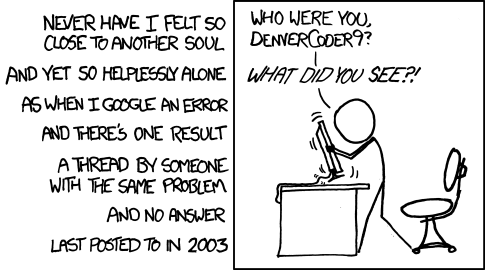
Read the comic as text
“Never have I felt so close to another soul and yet so helplessly alone as when I Google an error and there’s one result: a thread by someone with the same problem and no answer. Last posted to in 2003.”
A person shaking their monitor: “Who were you, DenverCoder9? What did you see?!”
The errata you should trust least#
Pay particular attention to E-3 and E-2 when you use them in your capstone.
E-3, the depth scale, is used in week 9 to teach a rule about pacing, drawn as a ladder, and given a spec line. It is five levels somebody invented. If depth isn’t ordered that way, the numerical ±1 rule needs revision or abandonment. The ability to ask, hold or decline does not depend on the ladder being valid.
E-2, recovery hours, is the unit of week 6’s ledger. The course has not established a measured price. Keep the observations and compare your estimates with what the following days were actually like. Revise the planning rule if it does not help. Consistency alone does not guarantee a useful ranking of weeks, and the estimates should not be reported as measured masking costs.
Three places to start reading#
Each entry pairs a reading with its limit.
| Issue | Start here | And its limit |
|---|---|---|
| OI-1 Romance | Hall et al. (2010); Sala et al. (2020) | self-reported style; a qualitative sample of 57 |
| OI-2 Persuasion | Cialdini & Goldstein (2004) | a review of work from 1997–2002, not a manual |
| OI-3 Power | Keltner et al. (2003), with Moskowitz (2004) | read the comment beside the paper, not after it |
Petty and Cacioppo’s elaboration likelihood model is a standard entry point for persuasion. We could not retrieve a text to check it against, so it is not cited here.
Before using a source in your capstone, check what it does not establish.
What this course refused to teach you#
There is a version of this material that ends with pass as one of them. That is not this course’s outcome.
A convention is not a condition. What you were handed is the specification of one, and a convention is a thing you can read, run, and decline.
The joke was never at anyone in this room. It was at a protocol that nobody wrote down and that everybody insists is self-evident.
What the course documented#
Twelve weeks, four parts:
- Read the protocol: the handshake, why nobody wrote it down, envelopes, and the clock.
- Implement selectively: repair, masking as a budget, and a runbook for when the budget runs out.
- Negotiate with it: institutions, closeness, disclosure, and other implementations.
- Horizon: this page.
The outcome was never that you become indistinguishable from anyone. It was fluency plus choice: read the protocol, run a part of it when it’s worth the cost, and decline a part of it knowing what declining costs.
The capstone#
Due Sunday 13 June, 23:59, two weeks after teaching ends. Two routes, equal weight:
- Personal Protocol Document. What you run, what you decline, and what you need from others, with the costs attached.
- Neurotypical Interaction Field Experiment. Vary one protocol parameter deliberately, record what comes back, and report it straight, with a graded ethics reflection.
Thursday’s lab is the clinic for both.
A Route A example#
This is an invented practice document, not journal evidence for a submission:
- What I run: “I check the group chat at 18:00. I usually budget ten minutes; my notes would need to show whether that estimate holds.”
- What I decline: “I skip the optional coffee after the lab to catch my bus. I miss that time with the group; I do not yet know whether it changes how often they invite me.”
- What I need from others: “Put the task and its deadline in the shared document, so I can check it after my shift.”
If no decline is affordable in your circumstances, say so under the second heading. You can compare a hypothetical decline with what you currently run, keeping predicted consequences separate from observed costs. A compulsory refusal would be a strange assessment of choice.
In the room — pick your route (9 min)#
Use these nine minutes to prepare a first paragraph for Thursday’s clinic.
One minute, alone. Choose Route A or Route B.
Five minutes, alone. Write a first paragraph. For Route A, start under one of its three headings and leave a line for each of the other two. State a cost you know or a prediction you would need to check. “No affordable decline now” is allowed. For Route B, name one parameter and setting, then draft brief answers to all four ethics questions.
Three minutes, in pairs. Take turns checking the structure; private details can stay private. For Route A, are all three headings represented, with observations separate from predictions? For Route B, are all four contextual questions answered, including a stopping condition? Mark one gap for Thursday.
One thing before you go#
The register above leaves three open issues and five published errata, plus whatever the room filed today.
The protocol you have been studying has none of either. No issue numbers, no errata, no version, no comment published beside it in the same journal a year later. It is not maintained. It is not documented. And the people who run it fluently will tell you, with complete sincerity, that it is obvious.
You now have twelve weeks of evidence that it is not, and the vocabulary to say so precisely. What you do with that is the part this course was never going to decide for you.
If time remains#
Who should get to change an unwritten protocol, and how could the people paying its highest costs have a say in the change?
Optional discussion. Finish by 15:55.