Last week we wrote down the handshake. This week asks two questions the handshake raises. Why did nobody write it down before? And when the handshake fails between two people, whose fault is it?
Then we start the tool you’ll use for the rest of the semester: a way of writing down what happened between people without turning it into a verdict about one of them.
Why the maintainers can’t document it#
In the 1960s, Harold Garfinkel argued that ordinary interaction runs on background expectancies: unstated assumptions that make an everyday situation recognisable as the ordinary thing it is. His method for seeing them was to breach them on purpose. When an expectancy isn’t met, the people involved start working to make the situation normal again, and that work shows what the expectancy was (Garfinkel, 1964).
The finding explains the missing specification. The people who run the protocol fluently aren’t hiding it and aren’t failing to notice it. It’s background: a rule you have never seen broken is a rule you don’t know you have. Asking a fluent runner to state it is like asking someone to describe the smell of their own house.
The protocol is undocumented because it is background, not because it is obvious. “Obvious” is what background feels like from the inside.
The course adds an observation of its own. Garfinkel breached expectancies on purpose, to study them. When your implementation differs from the majority’s, a mismatch can expose an expectancy without your having set out to test it.
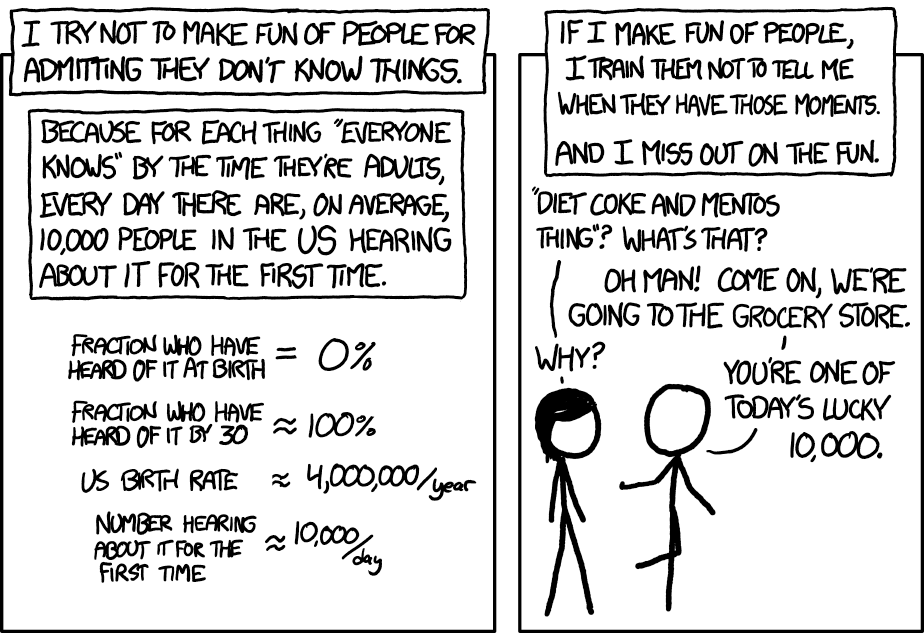
Read the comic as text
“I try not to make fun of people for admitting they don’t know things. Because for each thing ‘everyone knows’ by the time they’re adults, every day there are, on average, 10,000 people in the US hearing about it for the first time.”
The comic’s calculation: fraction who have heard of it at birth = 0%; fraction who have heard of it by 30 ≈ 100%; US birth rate ≈ 4,000,000/year; number hearing about it for the first time ≈ 10,000/day.
“If I make fun of people, I train them not to tell me when they have those moments. And I miss out on the fun.”
“‘Diet Coke and Mentos thing’? What’s that?” “Oh man! Come on, we’re going to the grocery store.” “Why?” “You’re one of today’s lucky 10,000.”
So ask them, and see what you get#
Background expectancies explain why nobody wrote it down. They don’t explain what happens when you ask anyway, which is that you get an answer.
Nisbett and Wilson reviewed the evidence on how well people can report their own mental processes, and concluded there is little or no direct introspective access to higher order cognitive processes. People could be unaware of the thing that influenced them, unaware of their response, or unaware that one produced the other. Their proposal for what a person is doing when they answer a “why did you” question: not introspecting, but producing a priori, implicit causal theories — judgements about whether some thing is a plausible cause of what they did (Nisbett & Wilson, 1977).
So the answer you get is fluent, confident and built on the spot. Not evasion. Not a bad memory. The report was never a reading of the process to begin with, which is why a more co-operative interviewee would hand you the same thing.
The clause everyone skips#
The abstract’s last sentence is the useful one. Reports will sometimes be accurate: when the influential thing is salient, and is a plausible cause of the response.
The course uses that limit to propose a more specific question:
| General question | Question about one instance |
|---|---|
| “Why do people say ‘how are you’ if they don’t want to know?” | “You just said ‘good, you?’ — what would have happened if you’d said ‘terrible’?” |
| “How do you know when to stop talking?” | “You stopped just then. What did she do right before?” |
| “What makes an email rude?” | “You rewrote that subject line. What was wrong with the first one?” |
The right-hand column points at something salient that happened seconds ago. The left asks for a general explanation. “What would have happened?” asks for a prediction, not an observation. “What was wrong?” still asks for an interpretation. Label the answer accordingly and check it against actual exchanges; a specific question does not guarantee an accurate answer.
In week 11, use specific exchanges when checking whether a clause of your shared protocol held. A general claim about your partner will not tell you which clause needs changing.
And they can’t tell how hard it is, either#
There is a second failure stacked on the first, and it is the one that makes “it’s obvious” so hard to argue with.
Hinds had experts, intermediate users and novices predict how long a complex task would take a novice. In a second study she manipulated expertise rather than measuring it. Both times, the more expert the predictor, the worse the prediction — underestimating what the novice was in for. The participants were also resistant to debiasing techniques aimed at that underestimation (Hinds, 1999).
The checked abstract does not identify those techniques, so this course does not claim that any particular warning or instruction was tested.
If you run the protocol fluently: “it’s obvious” describes your experience. Ask which step the other person is trying to learn before estimating how much time or effort they will need.
If you don’t: Hinds suggests intermediate expertise may improve estimates of novice performance. The course’s teaching suggestion is to ask a classmate who learned the tutorial protocol recently which steps they had to work out.
Her task was a technical one with a clock on it, not a conversation, and this course is taking the shape of the result rather than claiming somebody timed a tutorial.
In the room — ask generally, then specifically (9 min)#
In pairs, and both of you take a turn.
Three minutes. Ask your partner: “How do you know when it’s your turn to speak?” Write down their answer word for word. Do not help them.
Three minutes. Now ask about something that happened in this room in the last ten minutes: “When I stopped talking, what did you say or do next?” Then ask “What might you have done if I’d kept talking?” Write down the reported event and the prediction separately. Split each three-minute block so both partners ask and answer.
Three minutes, the room. Read one pair’s answers. Mark what was observed, what was reported from memory and what was predicted. What could another exchange check? Use the fictional line “A stopped; B asked a question” if nobody wants to use a personal example, and label it fictional.
Nobody in this exercise is being tested, and nobody’s first answer is wrong. Compare the kinds of evidence the questions can produce.
Whose failure is a mismatch#
In 2012, Damian Milton, an autistic researcher, gave a name to something autistic people had been saying for a long time: the double empathy problem (Milton, 2012). When an autistic person and a non-autistic person misunderstand each other, the misunderstanding is mutual. It’s a problem of reciprocity between two people, and the standard account, which puts the whole difficulty inside the autistic person, is a choice of where to look rather than a finding.
The majority’s half of the problem has been measured. Sasson and colleagues showed observers seconds-long clips of autistic and non-autistic people. The observers formed less favourable impressions of the autistic people, quickly, and those impressions made them less willing to interact. When observers judged what the same people said, without the audio-visual cues, the difference disappeared (Sasson et al., 2017).
Record what was said and done before judging how it came across.
Week 11 brings the rest of the evidence. For now the principle is enough: a mismatch has two sides, and a note that records only one of them is incomplete.
The frame is contested, and the course says so#
This course takes the difference view as its working frame. It would be dishonest to pretend that view is settled. When Kapp and colleagues surveyed 657 people, many held parts of the difference view and parts of the medical view at once, and on several questions, people’s answers didn’t differ with their relationship to autism (Kapp et al., 2013).
So the course’s claim is a narrow one. The protocol is a convention, and a minority implementation of a convention is not a broken one. You can hold that and still find parts of your own life hard.
Field notes without pathology#
From this week you keep a Field Journal. Each entry follows the shape of a good engineering retrospective:
- What happened. One concrete exchange: who (by role, not name), where, and what was said and done.
- The rule you inferred. Written so someone who wasn’t there could run it.
- The test. A second time you checked the rule, including if it failed.
- The rule now. Revised or held, and why.
- 1. What happened: one exchange; people by role, not name
- 2. The rule you inferred: runnable by someone who wasn't there
- 3. The test: a second instance, failures included
- 4. The rule now: revised or held, and why
One discipline makes the format work: describe the exchange before you interpret it. Sasson’s observers judged style in seconds, and the judgement didn’t survive a look at the content alone; a note that starts with an impression inherits the same problem.

One complete entry#
A worked example:
1. What happened. Thursday lab, five of us. I asked the tutor a question about the assignment; she answered the group rather than me. I asked again, more specifically, and she answered me directly.
2. The rule you inferred. A general question gets a general answer, addressed to the room. A specific question gets answered to the asker.
3. The test. Tried it on Friday in the stats tutorial. Held — the tutor answered me directly both times, and I had been specific both times.
4. The rule now. The specific-question part held in Friday’s tutorial. I did not retest the general-question part. I still do not know whether question framing caused the change, or whether the same pattern holds with a tutor who doesn’t know the class.
The last box names a limit: the rule has not been tested with a tutor who doesn’t already know the class. Include what remains untested in your own entry.
The argument this course is not going to make#
The actor–observer asymmetry offers an appealing justification: people explain their own behaviour by the situation and other people’s by the person. You were in a hurry; he is rude. It would make the asleep test sound inevitable.
Malle collected 173 published studies of it. The average effect sizes ran from d = -0.016 to d = 0.095 (Malle, 2006). For a rough sense of scale, those are numbers you would struggle to see in a room this size. His abstract notes that the asymmetry had been described as robust, firmly established, and pervasive.
So the course isn’t going to use it. The asleep test is our own rule of thumb, and its justification is the plain one: a rule about an exchange is something you can test next week, and a verdict about a person is not.
Malle also found that the asymmetry held for negative events, and reversed for positive ones. If your entry concerns an exchange that went badly, check whether you have described the other person’s actions or judged their character.
The asleep test#
If a sentence in your note would still be true of the person while they’re asleep, it’s about the person, not the exchange. Rewrite it.
He’s socially awkward survives the asleep test, so it fails. “He answered before I’d finished the question, twice” doesn’t survive it, so it passes.
Before and after#
The test applies to notes about anyone. Two worked examples, one about each side of the room:
| Diagnosing note | Protocol note |
|---|---|
| Sam has no social awareness; kept talking over the group. | Tuesday tutorial, four people. Twice in ten minutes, two students started speaking at once; each time student A kept going and student B stopped. Rule inferred: when two start together in this group, whoever stops first gives up the turn. |
| Jess is fake. She said she loved my idea and never mentioned it again. | Group chat, Wednesday. A group member replied “love this!!” to my proposal, then proposed a different plan on Friday without referring to mine. Rule inferred: in this group, enthusiastic replies to a proposal don’t commit anyone to it. (Week 3 has a name for this.) |
Neither rewrite excuses anyone. Both give you a rule to test in another exchange.
In the room — the asleep test, ten sentences (10 min)#
For each fictional note, decide whether it describes an exchange, judges a person, or needs more information. The asleep test is a prompt, not a lie detector.
- “The tutor is impatient.”
- “The tutor looked at the clock twice during my question.”
- “My partner doesn’t care.”
- “My partner replied ‘can’t today’ to the invitation.”
- “A began speaking before B finished the question.”
- “A is always inconsiderate.”
- “The group chose Tuesday after both dates were read out.”
- “A ignored my question.”
- “B sounded angry.”
- “The tutor waited politely.”
Three minutes, alone: mark all ten. Four minutes, in pairs: compare 8–10, the deliberately borderline cases, and rewrite one. Three minutes, the room: discuss at most two disagreements and record what evidence is missing. For example, “ignored” assumes intent; a note could instead say there was no spoken answer in the next five seconds, if that was observed. An impression such as “sounded angry” can be recorded as your interpretation, separately from the words or volume you heard.
In the room — rewrite one of yours (8 min)#
Four minutes, alone. Write one sentence you concluded about a person in the last week, or choose a fictional note from the bank above. It does not leave your notebook. Mark which source you used.
Four minutes. Rewrite it as a field note: the exchange, then the rule you inferred, then how you would test it.
Nobody reads these out. What we will collect at the end is one thing only: put your hand up if the rewrite gave you something you could actually check.
What makes a rule runnable#
A verdict can wear a rule’s clothes. Three examples, with rewrites:
| Not a rule | A rule |
|---|---|
| “People find him too intense.” | “In this tutorial, a second follow-up question on the same point gets an answer to the group rather than to the asker.” |
| “You have to read the room.” | “When two people have already agreed out loud, a third disagreement is raised as a question, not a statement.” |
| “Jess isn’t reliable.” | “In this group, enthusiasm in the chat doesn’t commit anyone; a commitment is a named person plus a date.” |
The test for the right-hand column: could a person who was not in the room run it tomorrow, and find out whether it holds?
What’s due#
Your first journal entry is due Sunday 7 March, 23:59. At least one entry, all four parts. It can be fifty words or five thousand. Grammar, spelling and presentation are not marked. Talk it through with an AI if that helps; the writing has to be yours.
If time remains#
What evidence would persuade you to abandon a rule you had become fond of after writing it in your journal?
Optional discussion. Finish by 15:55.