Where we were
Week 1: we wrote the handshake down. Six lines and a branch for a real answer.
This week: why nobody had written it down, and what to do when the writing-down is about a person.
Why the maintainers can’t document it
Ordinary interaction runs on background expectancies: unstated assumptions that only show when someone breaches them.
When one is breached, people work to make things normal again, and that work reveals it.
Garfinkel (1964), Social Problems 11(3)“Obvious” is what background feels like from the inside.
Apparently, everyone knows
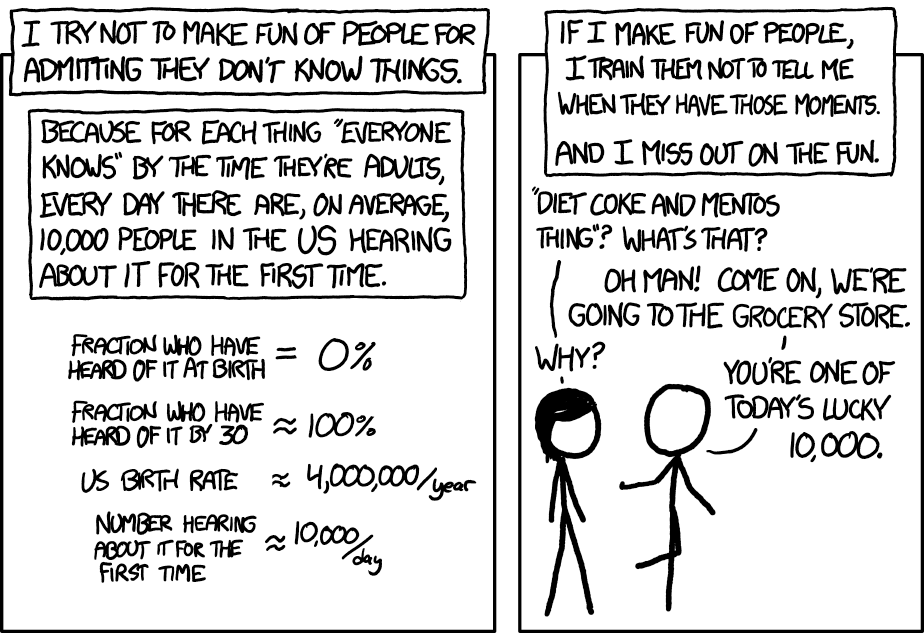
Read the comic as text
“I try not to make fun of people for admitting they don’t know things. Because for each thing ‘everyone knows’ by the time they’re adults, every day there are, on average, 10,000 people in the US hearing about it for the first time.”
The comic’s calculation: fraction who have heard of it at birth = 0%; fraction who have heard of it by 30 ≈ 100%; US birth rate ≈ 4,000,000/year; number hearing about it for the first time ≈ 10,000/day.
“If I make fun of people, I train them not to tell me when they have those moments. And I miss out on the fun.”
“‘Diet Coke and Mentos thing’? What’s that?” “Oh man! Come on, we’re going to the grocery store.” “Why?” “You’re one of today’s lucky 10,000.”
So ask them, and see what you get
Garfinkel says the rule is invisible.
He doesn’t say what happens when you ask anyway — which is that you get an answer.
Where the answer comes from
Evidence for little or no direct introspective access to higher-order cognitive processes.
A person answering “why did you” isn’t introspecting. They produce a priori, implicit causal theories — judgements about what is a plausible cause.
Nisbett & Wilson (1977), Psychological Review 84(3)The answer is fluent, confident, and built on the spot.
The clause everyone skips
Reports will sometimes be accurate — when the influential thing is salient and a plausible cause.
| General question | Question about one instance |
|---|---|
| “Why do people say ‘how are you’?” | “You just said ‘good, you?’ — what if you’d said ‘terrible’?” |
| “How do you know when to stop talking?” | “You stopped just then. What did she do first?” |
“What if?” produces a prediction, even when the prompt names a real event.
In the room: ask generally, then specifically (9 min)
Three minutes. Ask your partner: “How do you know when it’s your turn to speak?” Write the answer word for word.
Three minutes. “When I stopped talking, what did you say or do next?” Then: “What might you have done if I’d kept talking?” Keep report and prediction separate.
Both partners ask and answer in each block. You may use the fictional line “A stopped; B asked a question” and label it fictional.
Three minutes, the room. Mark what was observed, recalled or predicted.
And they can’t tell how hard it is
Experts, intermediate users and novices predicted how long a complex task would take a novice.
More expertise, worse prediction. Underestimating, both studies, and resistant to debiasing.
Hinds (1999), Journal of Experimental Psychology: Applied 5(2)“It’s obvious” is not evidence that a thing is easy. It is evidence about the speaker.
Who to ask instead
Hinds suggests intermediate expertise may improve estimates of novice performance.
A teaching suggestion: ask someone who learned the tutorial protocol recently which steps they had to work out.
Whose failure is a mismatch?
The double empathy problem: a misunderstanding between two people of different implementations is mutual, a question of reciprocity.
Milton (2012), Disability & Society 27(6)Style is judged before substance
Observers formed less favourable impressions of autistic people from seconds of behaviour, and were less willing to interact.
Judging only what was said, without audio-visual cues, the difference disappeared.
Sasson et al. (2017), Scientific Reports 7The frame is contested
657 people surveyed: many held parts of the difference view and parts of the medical view at once.
The course’s claim is narrow: a minority implementation of a convention is not a broken one.
Kapp et al. (2013), Developmental Psychology 49(1)The argument this course is not going to make
The actor–observer asymmetry: we explain ourselves by the situation, other people by the person.
You were in a hurry; he is rude.
It would make the next rule sound inevitable.
173 studies
Average effect sizes: d = -0.016 to d = 0.095.
Described in the literature as robust, firmly established, and pervasive.
Malle (2006), Psychological Bulletin 132(6)So we’re not going to use it.
Except for one thing
The asymmetry did hold for negative events. It reversed for positive ones.
If an exchange didn’t go smoothly, check your note for judgements of the other person’s character.
The field note
- What happened: one exchange, people by role
- The rule you inferred: runnable by someone who wasn’t there
- The test: a second instance, failures included
- The rule now: revised or held, and why
Describe the exchange before you interpret it.
- 1. What happened: one exchange; people by role
- 2. The rule you inferred: runnable by someone who wasn't there
- 3. The test: a second instance, failures included
- 4. The rule now: revised or held, and why
If a sentence would still be true of the person while they’re asleep, it’s about the person, not the exchange.
Before and after
| Diagnosing note | Protocol note |
|---|---|
| “Jess is fake. She said she loved my idea and never mentioned it again.” | A group member replied “love this!!”, then proposed a different plan without referring to mine. Rule: in this group, enthusiasm doesn’t commit anyone. |
The test applies to notes about anyone, on either side of the room.
Break
14:55–15:05
Resume at 15:05.
What double empathy does and doesn’t say
Does: the misunderstanding is mutual, and reciprocity is the thing to look at.
Doesn’t: that nobody has any difficulty. Milton relocates the problem; he doesn’t dissolve it.
What the thin-slice study doesn’t say
It doesn’t say autistic people are hard to talk to. It says observers judged fast, on style, and then withdrew.
Strip the audio-visual cues, judge the content alone, and the gap went away.
Before and after, the other one
| Diagnosing note | Protocol note |
|---|---|
| “Sam has no social awareness; kept talking over the group.” | Tuesday tutorial, four people. Twice in ten minutes students A and B started at once; A kept going and B stopped. Rule: when two start together in this group, whoever stops first gives up the turn. |
Neither rewrite excuses anyone. The rewrite is more useful, because you can test it on Thursday.
The explanation can wait

One complete entry
1. What happened. Thursday lab, five of us. I asked the tutor a question; she answered the group. I asked again more specifically; she answered me directly.
2. The rule. A general question gets a general answer addressed to the room. A specific one gets answered to the asker.
3. The test. Tried it Friday in the stats tutorial. Held. The tutor answered me directly both times, and I had been specific both times.
4. The rule now. The specific-question part held on Friday. The general-question part was not retested. Framing has not been shown to cause the difference; a tutor who doesn’t know the class remains untested.
In the room: the asleep test, ten sentences (10 min)
- The tutor is impatient.
- The tutor looked at the clock twice during my question.
- My partner doesn’t care.
- My partner replied “can’t today” to the invitation.
- A began speaking before B finished the question.
- A is always inconsiderate.
- The group chose Tuesday after both dates were read out.
- A ignored my question.
- B sounded angry.
- The tutor waited politely.
3 min: mark exchange, judgement or unclear. 4 min: compare 8–10 in pairs; rewrite one. 3 min: discuss at most two disagreements.
In the room: rewrite one of yours (8 min)
Four minutes, alone. One sentence you concluded about someone this week, or a fictional note from the bank. Keep it private and mark which source you used.
Four minutes. Rewrite it as a field note — exchange, rule inferred, how you’d test it.
What makes a rule runnable
| Not a rule | A rule |
|---|---|
| “People find him too intense.” | “In this tutorial, a second follow-up on the same point gets answered to the group, not the asker.” |
| “You have to read the room.” | “When two people have agreed out loud, a third disagreement is raised as a question.” |
| “Jess isn’t reliable.” | “Enthusiasm in the chat doesn’t commit anyone; a commitment is a named person plus a date.” |
Could someone who wasn’t there run it tomorrow, and find out if it holds?
What this week added to the vocabulary
- background expectancies — unstated assumptions that a breach can expose
- the double empathy problem — a mismatch with two sides
- the asleep test — the course’s own rule of thumb, and labelled as such
- the field note — exchange, rule, test, revision
Next week: what an utterance carries, and what it’s wrapped in.
Check yourself against this week
Why can’t a fluent runner state the rules?
Does this sentence pass the asleep test?
First journal entry: Sunday 7 March, 23:59
If time remains
What evidence would persuade you to abandon a rule you had become fond of after writing it in your journal?
Optional discussion. Finish by 15:55.