Someone says “how are you?” in a corridor. You have about a second to reply, and the correct reply is not an answer.
Some of you run that exchange without a thought and couldn’t state one rule it follows. Some of you have spent years noticing that it has rules, and that nobody will tell you what they are. This course is for both of you. By the end of this lecture the rules will be written down.
What this course is#
SLOP1562 treats the social protocol of the neurotypical majority as what it is: a large, undocumented, inconsistently implemented legacy system. Its own users can’t describe it, and none of them designed it. For twelve weeks we reverse-engineer it, so that anyone can interoperate with it on purpose.
One sentence runs the semester:
The protocol is undocumented, not obvious; a minority implementation is not a broken one.
This is not a remedial course. Nobody is here to be brought up to a standard, because there is no standard, only a majority. You are here because the specification is missing and you have noticed. Some of you noticed because the protocol never quite ran for you. Some of you noticed because it runs so smoothly that you couldn’t explain it to someone who asked.
The outcome is not that you become indistinguishable from anybody. It is fluency plus choice. You will be able to read the protocol, run a part of it when running it is worth what it costs, and decline a part of it knowing what declining costs. Some weeks you will decide to run more of it. Some weeks less. Both are passing grades.
The documentation exists#
In 1968, Emanuel Schegloff published an attempt to “ascertain rules” for how conversations open, and named some of the properties those rules have (Schegloff, 1968). One is called conditional relevance. It’s in American Anthropologist, volume 70, issue 6.
Researchers have been writing these rules down for over fifty years, for other researchers. The protocol has documentation. It was never shipped to the users.
Compare a protocol that was.
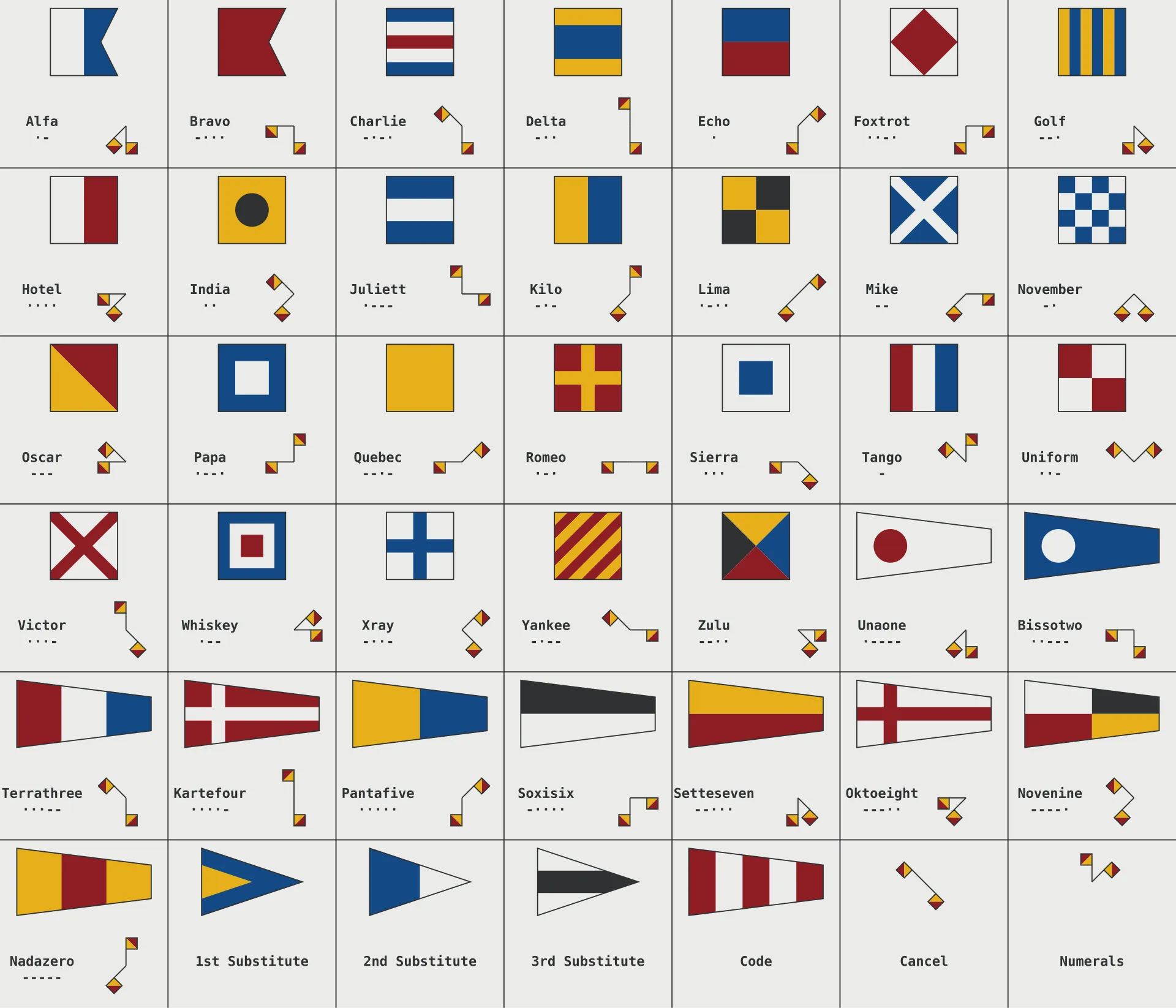
Two ships from countries with no shared language can agree a course of action from a flag hoist, because the code was written down, printed, and put aboard both of them. Nobody expects a sailor to intuit Cancel. Somewhere in a building on this campus, two people who share a first language are going to misread each other this afternoon, and the reason is that their protocol never got the same treatment.
There is a word for the kind of talk we start with. “Phatic communion” is Malinowski’s term, from the 1920s, for talk whose job is the relationship rather than the information (Coupland, Coupland & Robinson, 1992). “How are you?” is the flagship example. You aren’t being asked for data. You’re being asked to confirm that the connection is up.
What counts as a greeting#
Before specifying the handshake, a question a standards body would ask first: what is the thing being specified?
The greetings literature had a habit of asserting properties of greetings — that they carry no real content, that they are purely expressive — without agreeing what counted as one. Alessandro Duranti’s response was to propose six criteria for identifying a greeting exchange across languages and speech communities, so that the claims could be tested rather than repeated (Duranti, 1997).
We read his abstract, not the paper, so this page does not list the six. Before testing a claim about greetings, say what would count as a greeting.
Then he applied the criteria in a speech community in Western Samoa and found four types of greeting exchange there. They broke the standard claim. Samoan greetings, in his account, are not devoid of propositional content, and need not be “expressive” acts in the speech-act sense. People use them to do things — including searching for new information and sanctioning social behaviour.
The next section specifies one local convention: the handshake between acquaintances passing in a corridor. Elsewhere, the same place in an exchange can be used to ask a question and get an answer.
In the room — is it a greeting? (6 min)#
In pairs, decide whether each of these is a greeting exchange, and say what test you used. There is no answer key; the point is that you had to invent a criterion to decide.
- A nod across a lecture theatre, no words, no reply.
- “Alright?” shouted across a road, and the other person keeps walking.
- A barista saying “hi, how are you, what can I get you?” as one unit.
- Two people who pass each other four times in a day and greet once.
Use one minute to read, three to compare your criteria, and two to hear two different decisions from the room. Keep the criterion that produced each one.
The handshake, specified#
Here is the exchange as the majority implementation runs it between two people who know each other slightly, passing in a corridor.
- A to B: How are you?
- B to A: Good, you?. a token, not a status report
- A to B: Yeah, good.
- B to A: (both keep walking) (expected, not said aloud)
Written as clauses, in the register a standards document would use:
The request#
“How are you?”, “How’s it going?”, “You alright?”, “How’ve you been?” and “Hey, how are things?” are, in passing, the same message. None of them requests information. Each one requests a single acknowledgement that the relationship is in working order.
Valid replies#
A valid reply is a positive or neutral token, optionally followed by the request returned:
| Reply | Token | Returns the request? | Closes the exchange? |
|---|---|---|---|
| Good, you? | positive | yes | after one more turn |
| Not bad, you? | neutral | yes | after one more turn |
| Yeah, fine. | neutral | no | yes, immediately |
| Can’t complain. | neutral | no | yes, immediately |
| Surviving. | mildly negative, played as a joke | no | yes, if said lightly |
The reply SHOULD return the request when there’s time for one more turn, and MAY skip it when both people are clearly moving on. A returned request MUST be answered with a token too. That is the “Yeah, good” in the diagram, and it ends the exchange.
The branch nobody takes#
“Honestly, I’ve had a rough week. I haven’t slept properly since Tuesday and I think I might fail the stats quiz” is a correct answer to the question as asked, and a nonconforming reply under this protocol.
It isn’t wrong. It is a different message. It switches the other person from a two-second handshake into listening to troubles, which they hadn’t budgeted time for, and the corridor was not the room for it. Some of you have taken this branch and watched the other person’s face change without knowing why. That’s why.
The branch is sometimes worth taking. Learn to see the fork while you’re standing at it.
When it is a real question#
The question is negotiated, not fixed (Coupland, Coupland & Robinson, 1992). The same words become a real enquiry when the setting makes them one. A doctor asking at the start of an appointment may well mean it. So does a friend who stops walking, asks again (“no, how are you actually?”), or asks in a different room from the usual one.
The signals this course uses: the asker stops moving, asks twice, or asks somewhere private. These are the course’s working rules, not a research finding. Week 1’s lab tests them.

In the room — three openings, three records (12 min)#
These are fictional transcripts. They give us the same events to argue about.
| Case | What happens |
|---|---|
| A | Both keep walking. “How are you?” / “Good, you?” / “Fine.” They part at the stairs. |
| B | A stops. “How are you?” / “Fine.” / “No, how are you actually?” / “Worried about Friday.” A offers to sit down. |
| C | Both wait for a lift. “How are you?” / “Surviving.” The doors open and both enter. |
Two minutes, alone: mark each closed, branched or unclear. Underline the observed words or actions behind your decision.
Four minutes, in pairs: compare labels. For C, give two possible readings and name an observation that would distinguish them. Waiting for a lift is not the same evidence as choosing to stop walking.
Three minutes: write a reply that closes C and a reply that invites a longer answer without demanding one. For example: “Fair enough; see you in class”, or “Want to talk about it, or leave it there?”
Three minutes, the room: compare two pairs’ records. A models closure; B contains an explicit second question and continuation. C leaves the intention unresolved. Keep that uncertainty in the record. The protocol does not become documented by putting a confident tick in every box.
Why you owe a reply at all#
Why does an opening make a reply expected? Schegloff names conditional relevance, but we read only his abstract, so we will not define the term from that source.
Stivers and Rossano took the question on directly: what is it about some turns that reliably gets a response, and when is a person accountable for not giving one (Stivers & Rossano, 2010)? They test two inherited answers. The linguistic one says interrogativity does it — a question is a question. The sociological one says the social action does it. Their conclusion is that each has merit and neither settles it.
What they argue instead is the useful part:
- Different actions mobilise a response to different degrees. Obligation is not a switch. It is a dial.
- Speakers design turns with response-mobilising features, and those features hold a recipient more or less accountable for replying.
- Sequential position, the action being done, and turn design each contribute.
We read the abstract, so the course does not list their features. But the existence of the dial changes the advice this week gives, in two directions.
If replies are hard for you, you can match the level you were given. A nod can answer a nod; a person already walking away may not be inviting a conversation.
If replies are automatic for you, you have a dial you did not know you were turning. When you actually want an answer — from a quiet student, a tired friend, someone who has said “fine” three times — you can turn it up on purpose instead of hoping.
In the room — turn the dial (8 min)#
The examples below are the course’s, not the paper’s. In pairs, take the sentence “You’ve been quiet this week.” and say it twice.
- Once so that a reply is hard to withhold. Stop moving. Use their name. Ask a second time. Leave the silence.
- Once so that a reply is easy to skip. Say it in passing, over your shoulder, with an exit already in it: “no need to answer that.”
Then swap, and each name what you changed — not how it felt. Position, wording, timing, body. Keep the list for week 4’s work on timing.
Use one minute to read the task, two minutes per partner to try both versions, then three minutes to compare the changed features. These are fictional lines: either person may pass on acting them and annotate the scripts instead.
Why nobody handed it to you#
Week 2 takes this properly. The short version: the people who run this protocol fluently can’t see it. It was never written down for them either; they learned it by running it, and a rule you’ve never seen broken is a rule you don’t know you have.
That explains the room. If you run the handshake without effort, the spec above probably read as a description of the obvious. Familiarity can make the rules hard to see. If you’ve found the handshake strange for years, you were right that it has rules. You were never told them. That’s a documentation problem, not a problem with you.
How the course runs#
- Tuesday, a lecture like this one argues something about the protocol and writes part of it down.
- Thursday, the lab checks the argument in the room. Labs have run sheets with timings; nothing in one is sprung on you.
- Sunday, from week 2, you turn in a Field Journal entry: one exchange you observed, the rule you inferred, a test of it, and the rule as it now stands.
The twelve weeks come in four parts. Weeks 1–4 read the protocol. Weeks 5–7 implement selected parts and count the cost. Weeks 8–11 negotiate with it: institutions, closeness, disclosure, and other implementations. Week 12 points at what the course leaves out.
If time remains#
Which part of the opening handshake would you document for your tutorial group, and what might writing it down change?
Optional discussion. Finish by 15:55.