Week 9 Module: Phase Transitions in Cooking
What actually happens inside a youtiao as it deep-fries — a moving moisture front and a crust crossing its glass transition.
Research question
A youtiao (油条, fried dough stick) goes into hot oil as a soft, moist dough and comes out with a rigid, crisp shell around a still-soft interior. No new ingredient is added during frying. What physical change, exactly, is responsible for the shell being rigid when the interior a millimetre away is not?
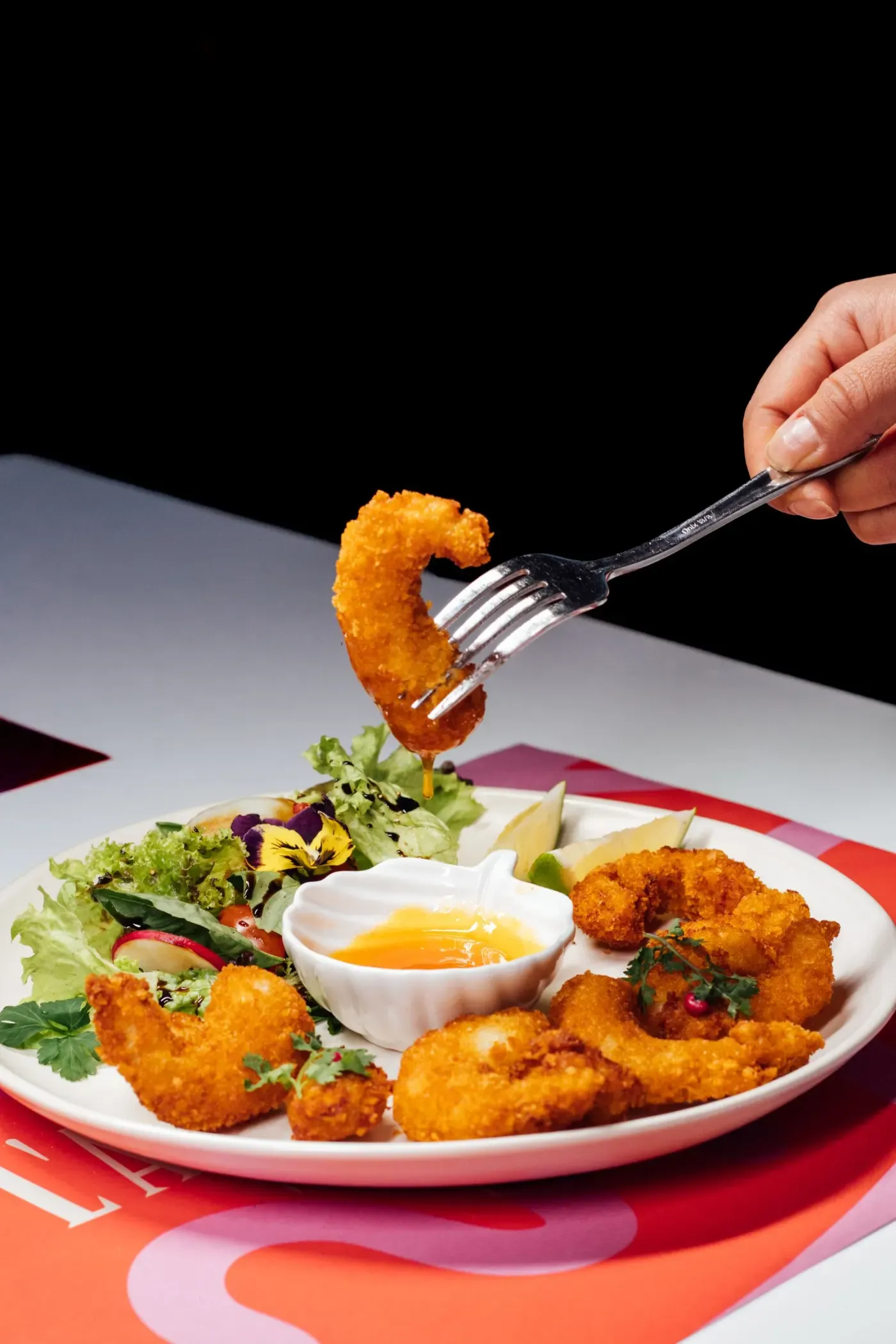
Specimen youtiao (油条), fried dough stick, crust mid-formation
Where this sits
Closing module of Stage 3, Transport, Kinetics and Transformation. Module 7 gave the transport mechanics (heat and moisture moving through a food object); Module 8 gave the kinetics of thermally-driven change. This module combines both to explain a moving internal boundary, and introduces the glass transition concept that Module 11 turns into a full design space.
The model: a moving moisture front and a glass transition
As the dough fries, heat conducts inward (Module 7) while water at the surface evaporates rapidly into the surrounding oil. Water loss is fastest where the temperature is highest — near the surface — so a boundary forms and moves inward over time: outside it, the dough has lost most of its water and is hot; inside it, moisture content is still close to the raw dough’s. This is structurally the same “moving boundary” idea as the gelatinisation front in a thick dumpling wrapper, but driven by moisture loss rather than heat alone.
Losing water does more than dry the crust out — it changes which physical state the starch-water crust matrix occupies. An amorphous (non- crystalline) food solid has a glass transition temperature, T_g, below which it is a rigid, brittle “glass” and above which it is a soft, deformable “rubber.” Critically, T_g is not fixed: water acts as a plasticiser, and T_g depends strongly on how much moisture remains, in a relationship the Gordon-Taylor equation approximates:
- Tg (mixture glass transition temperature, K)
- the Tg of the dry-solid/water mixture at a given composition.
- w1, w2 (mass fractions)
- of dry solid and water respectively; w1 + w2 = 1.
- Tg1, Tg2 (K)
- glass transition temperatures of the pure dry solid and of pure water (water's own Tg is far below 0 °C).
- K (Gordon-Taylor constant)
- a material-specific fitting parameter reflecting how strongly the two components' free volumes mix.
As the crust loses water (w₂ falls), its T_g rises. Once the crust’s falling moisture content pushes T_g above the crust’s actual temperature, the crust vitrifies, moving from a rubbery amorphous state into a rigid glassy amorphous state — this is the instant it becomes crisp. The soft interior, still at high moisture, has a T_g far below its temperature and stays rubbery.
- States
- glass ⇌ rubber
- Model
- Gordon–Taylor
- Plasticiser
- water lowers Tg
What you measure and analyse
Using a supplied moisture-vs-depth profile at a fixed frying time, and Gordon-Taylor parameters for a starch-based dough, you compute T_g at each depth and identify the depth at which T_g first exceeds the local temperature — locating the crust/core boundary from the model rather than by eye.
Activity
Two youtiao are fried for the same total time, one in oil 15 °C hotter than the other. Using the moving-front and glass-transition framing above, predict which one has a thicker crust, and separate your reasoning into the transport effect (Module 7: how fast the temperature and moisture fronts move) and the thermodynamic effect (this module: at what moisture content T_g is crossed).
References
- Gordon, M. & Taylor, J.S. (1952). “Ideal Copolymers and the Second-Order Transitions of Synthetic Rubbers. I. Non-Crystalline Copolymers.” Journal of Applied Chemistry 2(9), 493–500.
- Roos, Y.H. Phase Transitions in Foods, 2nd ed. Academic Press.
The spec
What you bring to the session. Written so a reader can tell whether it has been met without asking you.
- describe the two zones (crust, moist core) that form inside a piece of dough during frying and why a boundary moves between them
- explain what a glass transition is and why crossing it is what makes a fried crust rigid
- name the two variables a Gordon-Taylor-style model links for a food glass transition
Teaching team
- Marisol Quaye — convenor