Week 7 Module: Heat and Mass Transport
Why a xiaolongbao's filling is still cold when its wrapper is done — Fourier's law, the Biot number, and simultaneous heat and moisture transport.
Research question
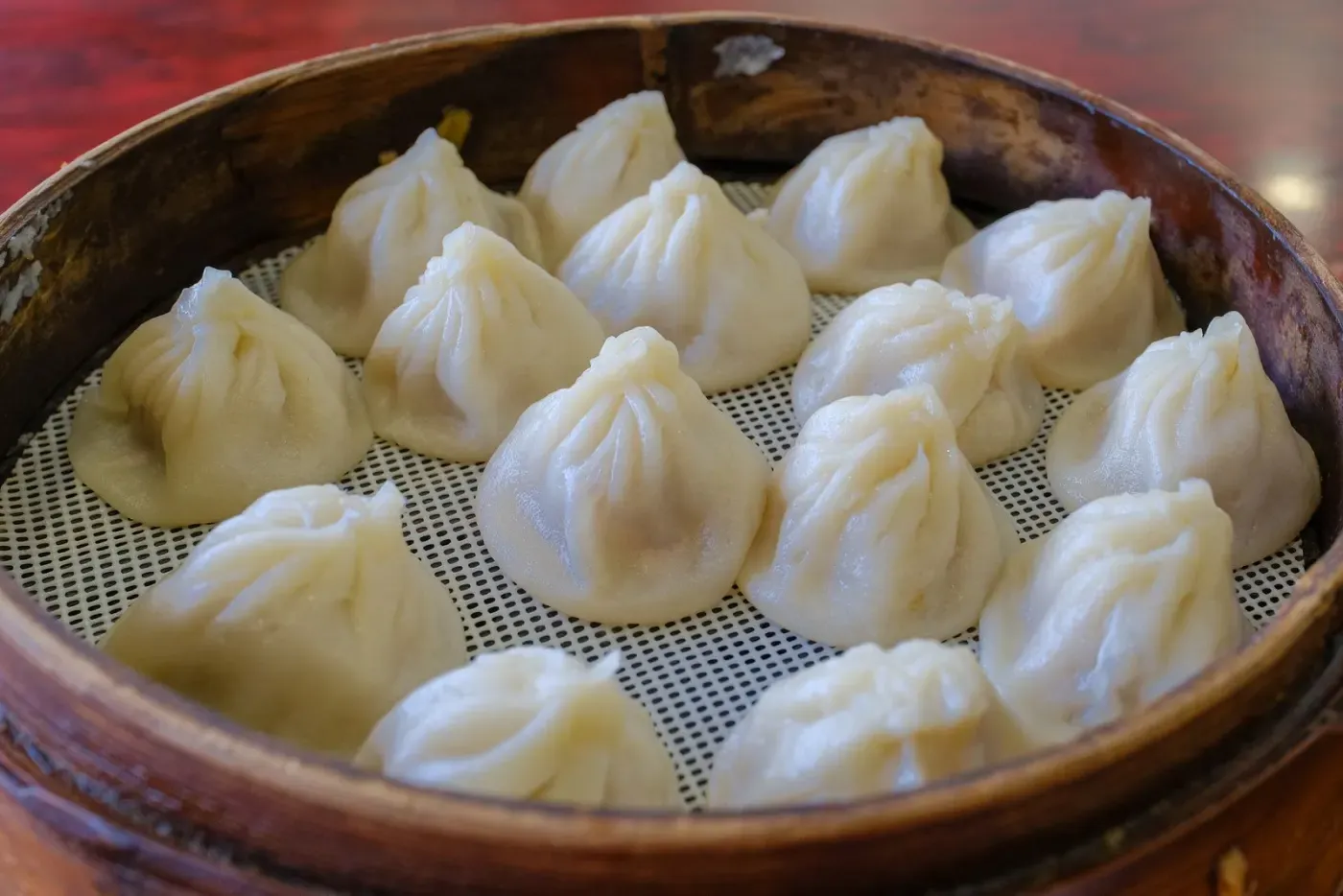
A xiaolongbao (小笼包, soup dumpling) is steamed until its wrapper is translucent and fully cooked — but if pierced immediately, its gelatin-rich filling may still be cool and only partly melted. Both wrapper and filling sit in the same steam. Why does heat reach them at such different effective rates, and can that be predicted rather than just observed?
Specimen xiaolongbao (小笼包), wrapper vs. gelatin-rich filling, mid-steam
Where this sits
Opening module of Stage 3, Transport, Kinetics and Transformation. Stage 2 was about what gives a material structure; Stage 3 is about how that structure changes during cooking, starting with the physical mechanism — transport — that makes any change happen at all. This module’s Biot-number framing is used again, less formally, in Module 9’s discussion of a moisture front moving through frying dough.
The model: conduction and the Biot number
Heat moves through the dumpling wrapper primarily by conduction, governed by Fourier’s law:
- q (heat flux, W·m⁻²)
- the rate of heat flow through a unit area.
- k (thermal conductivity, W·m⁻¹·K⁻¹)
- a property of the material — higher k conducts heat faster for the same temperature gradient.
- dT/dx (temperature gradient, K·m⁻¹)
- how sharply temperature changes with position; the negative sign says heat flows from hot to cold.
Whether it is reasonable to treat an object as having one uniform internal temperature (a “lumped” model, useful for quick estimates) or whether you must account for internal temperature gradients is decided by the Biot number:
- Bi (Biot number, dimensionless)
- ratio of internal (conductive) resistance to surface (convective) resistance.
- h (convective heat-transfer coefficient, W·m⁻²·K⁻¹)
- how effectively steam transfers heat to the dumpling's surface.
- Lc (characteristic length, m)
- typically volume divided by surface area — larger objects have a larger Lc.
When Bi ≪ 0.1, surface heat transfer is the bottleneck and the object heats almost uniformly — a lumped model is a good approximation. When Bi ≫ 0.1, internal conduction is the bottleneck and real temperature gradients form inside the object — a lumped model badly understates how much colder the centre is than the surface. A thin xiaolongbao wrapper has a small L_c and a comparatively high effective k (it’s mostly water-saturated starch gel, Module 4), giving a low Bi: it heats almost uniformly and finishes cooking quickly. The denser, larger filling ball has a bigger L_c and, being partly solid fat and gelled stock, a different k — its Biot number is substantially higher, so a real temperature gradient persists inside it and its centre lags well behind its surface.
Steaming additionally transfers moisture, not heat alone: condensing steam deposits water (and its latent heat) directly onto the wrapper’s surface, which is why a steamed wrapper gains weight and becomes translucent — a distinct process from a dry oven’s heat-only transfer, governed by an analogous mass-transfer equation with a moisture-content gradient in place of dT/dx.
- Lumped model valid
- Bi ≪ 0.1
- Transports
- heat + moisture
- Bi
- = h·Lc/k
What you measure and analyse
Using supplied k, h, and L_c values for a wrapper and a filling ball, you compute Bi for each, decide which is well approximated by a lumped model, and estimate the ratio of characteristic heating times implied by each Biot regime.
Activity
A cook wants xiaolongbao filling to finish melting at the same moment the wrapper finishes cooking. Using the Biot-number framing, propose one process change (not an ingredient change) that would bring the two closer together, and identify which variable in the Bi formula it acts on.
References
- Singh, R.P. & Heldman, D.R. Introduction to Food Engineering, 5th ed. Academic Press.
- Walstra, P. (2003). Physical Chemistry of Foods. Marcel Dekker.
The spec
What you bring to the session. Written so a reader can tell whether it has been met without asking you.
- write Fourier's law for one-dimensional conduction and name each term
- use the Biot number to decide whether a lumped (uniform-temperature) model is valid for a given food object
- explain why steaming transfers both heat and moisture to a dumpling, not heat alone
Teaching team
- Marisol Quaye — convenor