Week 10 · Block IV Limits
Unflattening and hidden assumptions
Four runs of one unmodified tool. Two working rewrites, one valid executable that returns the wrong answer, and one failure that never reached the part of the tool everybody talks about.
The tool exited zero and the graph got smaller. How would you find out whether it worked?
One tool, unmodified, pointed at four flattened functions from four implementations. It is a reasonable tool built on a reasonable idea: discover the dispatcher, recover each region’s successors by symbolic execution, then patch the binary so the blocks jump to each other directly.
Four runs. Four different kinds of outcome.
The scoreboard, before anything else#
Unflattening: the smaller graph can be wrong
Stock ollvm-unflattener results on four O0 implementations.
| Input | Block counts | What happened? | Outcome |
|---|---|---|---|
| OLLVM FLA | 60 flattened17 rewritten | 25/25 semantic successor pairs recovered | PASSWorking rewrite |
| Hikari FLA | 66 flattened20 rewritten | 28/28 semantic successor pairs recovered | PASSWorking rewrite |
| Polaris FLA | 56 flattened10 rewritten | Multiple legitimate switch cases now run sequentially | FAILWrong result |
| Tigress Flatten | 38 actual6 stock-discovered | Indirect jump-table discovery is incomplete | BLOCKEDNo rewrite |
Visual simplification is not proof of correct deobfuscation.
Miasm CFG counts split at calls. Tigress numbers compare reference vs discovery, NOT a before/after rewrite.Open the original lecture figure (SVG)
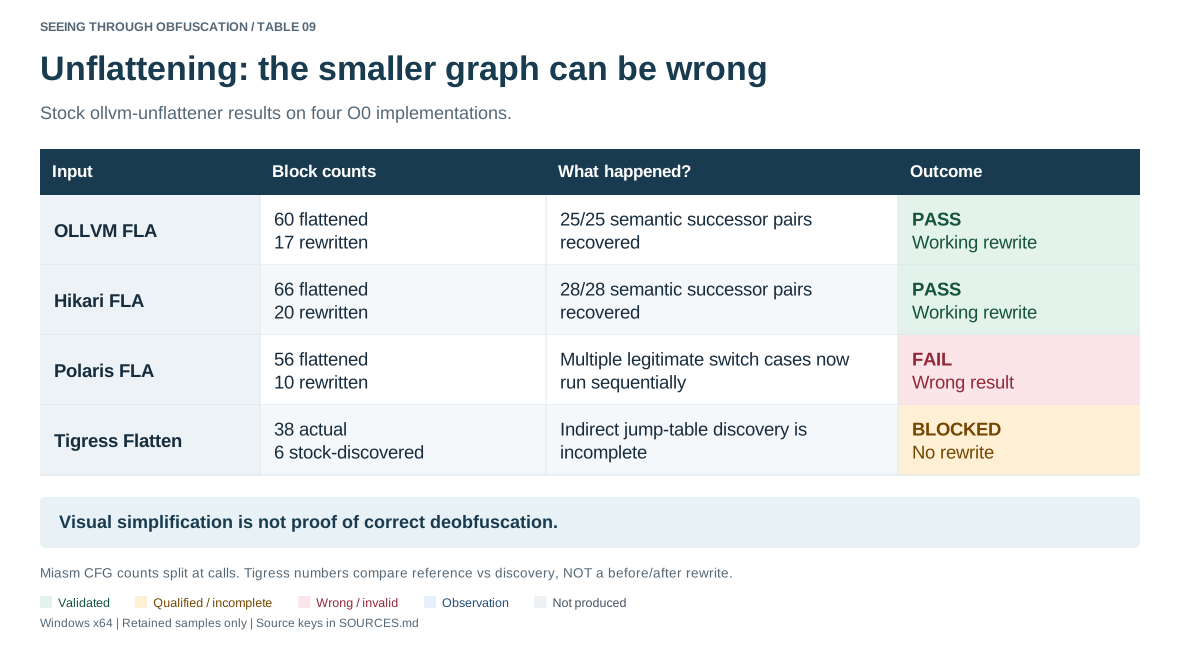
Two working rewrites, one wrong answer, one no-output. Keep the third and fourth rows apart in your head — they are different failures with different causes, and treating them as one is the most common misreading of this table.
The two that worked#
- successor pairs recovered in the first implementation — 60 blocks to 17
- 25 / 25successor pairs recovered in the first implementation — 60 blocks to 17semantic_edge_score.json
- successor pairs in a second, related implementation — 66 blocks to 20
- 28 / 28successor pairs in a second, related implementation — 66 blocks to 20semantic_edge_score.json
- bytes changed in the first rewrite, with the file size unchanged
- 862bytes changed in the first rewrite, with the file size unchangedstock_result.json
- rewritten blocks against the compiler's own clean build
- 17 vs 21rewritten blocks against the compiler's own clean buildselected_metrics.md
Both produced working executables: the canonical run prints all six expected values and exits zero. The transfer is genuine — the tool was built against one implementation and worked unmodified on another — and it is bounded, because those two implementations share a lineage, a dispatcher shape and a state layout.
The fourth number is the interesting one. The rewritten function has 17 blocks; the compiler’s own clean build of the same source has 21. The recovered version is smaller than the original, keeps dead state writes that no longer control anything, and is correct on every retained test. Graph identity was never the goal and would have been the wrong goal.
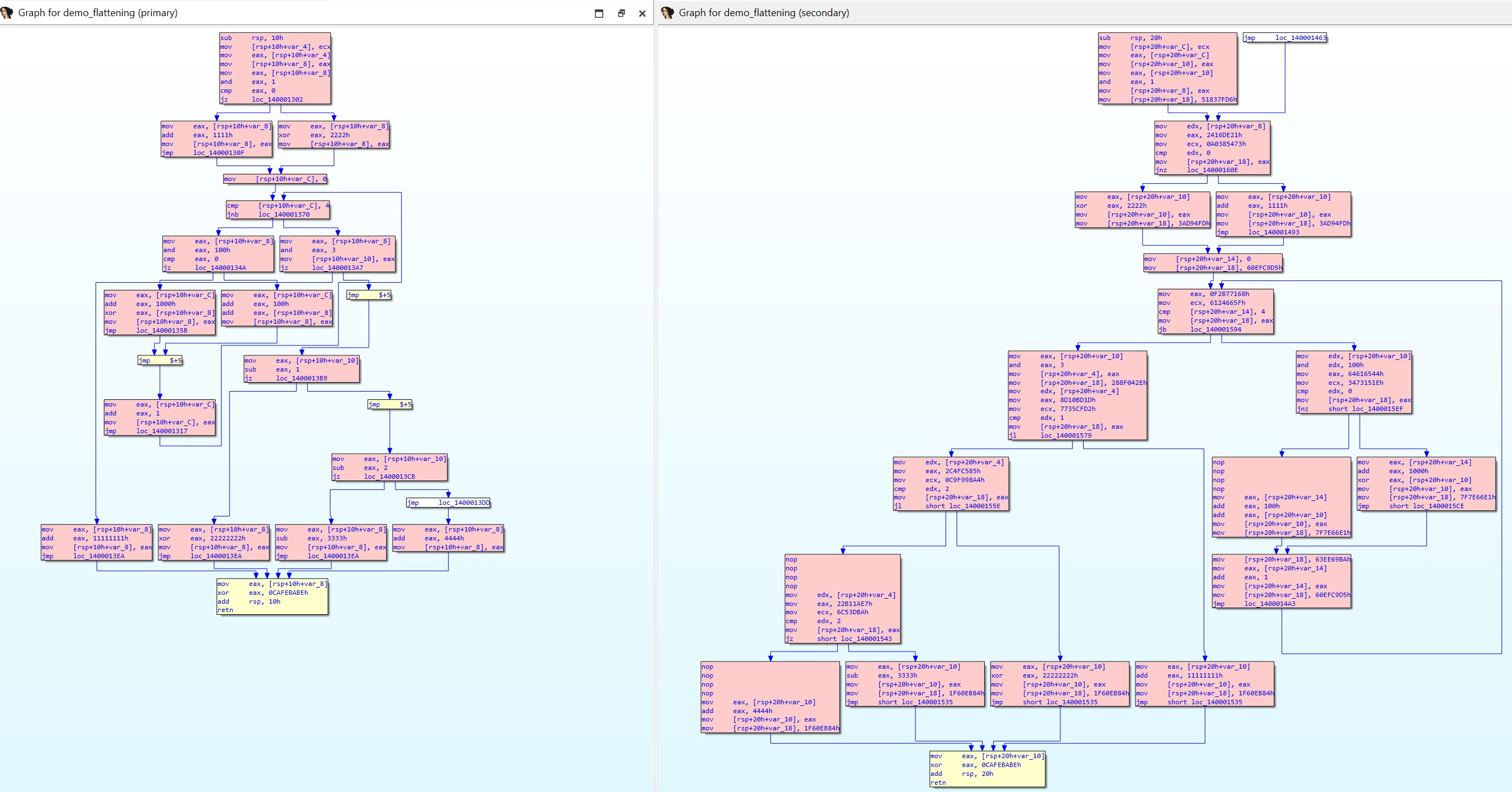
Clean on the left, the successful rewrite on the right. Different instructions, different layout, same tested behaviour. “Correct” and “identical” were never the same requirement.
The one that produced a valid, wrong executable#
the flattened original
PASSSUB = 08080000
BCF = 6665BBBC
FLA = DBEFFCE7
CALLS = 12345F05
DATA = 57977293
COMBINED = EEBB6D71
SHOWCASE PASSthe smaller, cleaner, valid rewrite
FAILSUB = 08080000
BCF = 6665BBBC
FLA = F9CD8332
CALLS = 12345F05
DATA = 57977293
COMBINED = EEBB6D71
SHOWCASE FAIL: 1 mismatchesOne line differs. FLA = DBEFFCE7 became FLA = F9CD8332, and the process
exits 1 instead of 0. Every other value is untouched, because the tool was
only ever asked to rewrite one function.
Here is why, and it is completely legible once you look at the right file.
the clean build: four alternatives
four blocks, each reconverging0x1400013a7 -> 0x1400013ea
0x1400013a7 MOV EAX, DWORD PTR [RSP + 0x8]
0x1400013ab ADD EAX, 0x11111111
0x1400013b0 MOV DWORD PTR [RSP + 0x8], EAX
0x1400013b4 JMP loc_key_11
0x1400013b9 -> 0x1400013ea
0x1400013b9 MOV EAX, DWORD PTR [RSP + 0x8]
0x1400013bd XOR EAX, 0x22222222
0x1400013c2 MOV DWORD PTR [RSP + 0x8], EAX
0x1400013c6 JMP loc_key_11
0x1400013cb -> 0x1400013ea
0x1400013cb MOV EAX, DWORD PTR [RSP + 0x8]
0x1400013cf SUB EAX, 0x3333
0x1400013d4 MOV DWORD PTR [RSP + 0x8], EAX
0x1400013d8 JMP loc_key_11
0x1400013dd -> 0x1400013ea
0x1400013dd MOV EAX, DWORD PTR [RSP + 0x8]
0x1400013e1 ADD EAX, 0x4444
0x1400013e6 MOV DWORD PTR [RSP + 0x8], EAXthe rewrite: one block, four operations
no branch, no choice0x140001348 ->
0x140001348 NOP
0x140001349 NOP
0x14000134a NOP
0x14000134b NOP
0x14000134c MOV EAX, DWORD PTR [RSP + 0x14]
0x140001350 XOR EAX, 0x22222222
0x140001355 MOV DWORD PTR [RSP + 0x14], EAX
0x140001359 MOV DWORD PTR [RSP + 0xC], 0x24E
0x140001361 MOV EAX, DWORD PTR [RSP + 0x14]
0x140001365 SUB EAX, 0x3333
0x14000136a MOV DWORD PTR [RSP + 0x14], EAX
0x14000136e MOV DWORD PTR [RSP + 0xC], 0x24E
0x140001376 MOV EAX, DWORD PTR [RSP + 0x14]
0x14000137a ADD EAX, 0x4444
0x14000137f MOV DWORD PTR [RSP + 0x14], EAX
0x140001383 MOV DWORD PTR [RSP + 0xC], 0x24E
0x14000138b MOV EAX, DWORD PTR [RSP + 0x14]
0x14000138f ADD EAX, 0x11111111
0x140001394 MOV DWORD PTR [RSP + 0x14], EAX
0x140001398 MOV DWORD PTR [RSP + 0xC], 0x24E
0x1400013a0 MOV EAX, DWORD PTR [RSP + 0x14]
0x1400013a4 XOR EAX, 0xCAFEBABE
0x1400013a9 ADD RSP, 0x20
0x1400013ad RET On the left, the source’s four-way switch: four separate blocks — add
0x11111111, XOR 0x22222222, subtract 0x3333, add 0x4444 — each
ending with a jump to the common successor. On the right, the same four
operations in one straight line, executed one after another, with no branch
between them. Then the final XOR 0xCAFEBABE and RET.
The four legitimate switch alternatives were grouped under a single incoming
state. The recovery trace records one edge where the ground-truth region map
has four, and the patcher faithfully emitted what the trace told it. Note the
four MOV DWORD PTR [RSP + 0xC], 0x24E stores in the right-hand listing —
the same “next state” written four times, which is the fingerprint of the
collapse.
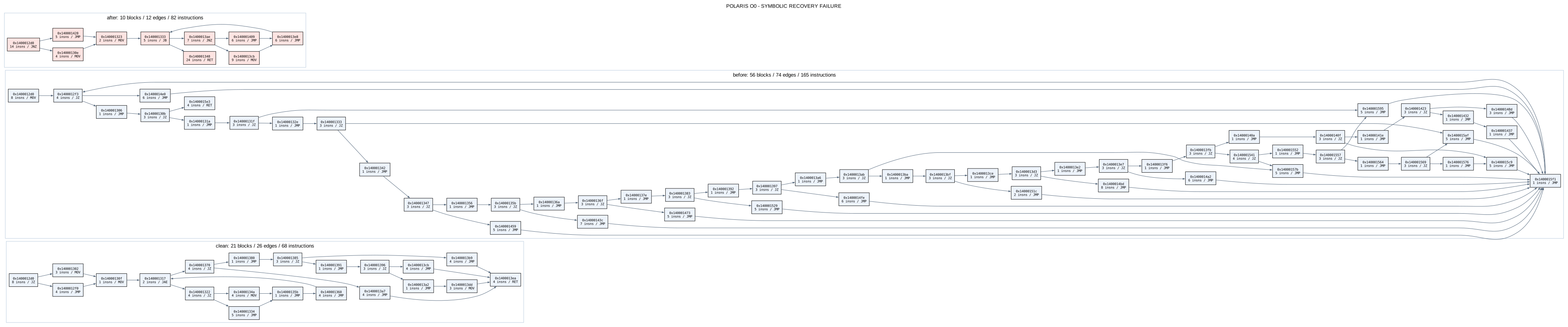
Clean, flattened, and the incorrect rewrite, at the same scale and in the same convention. The third graph is the most attractive one on the page.
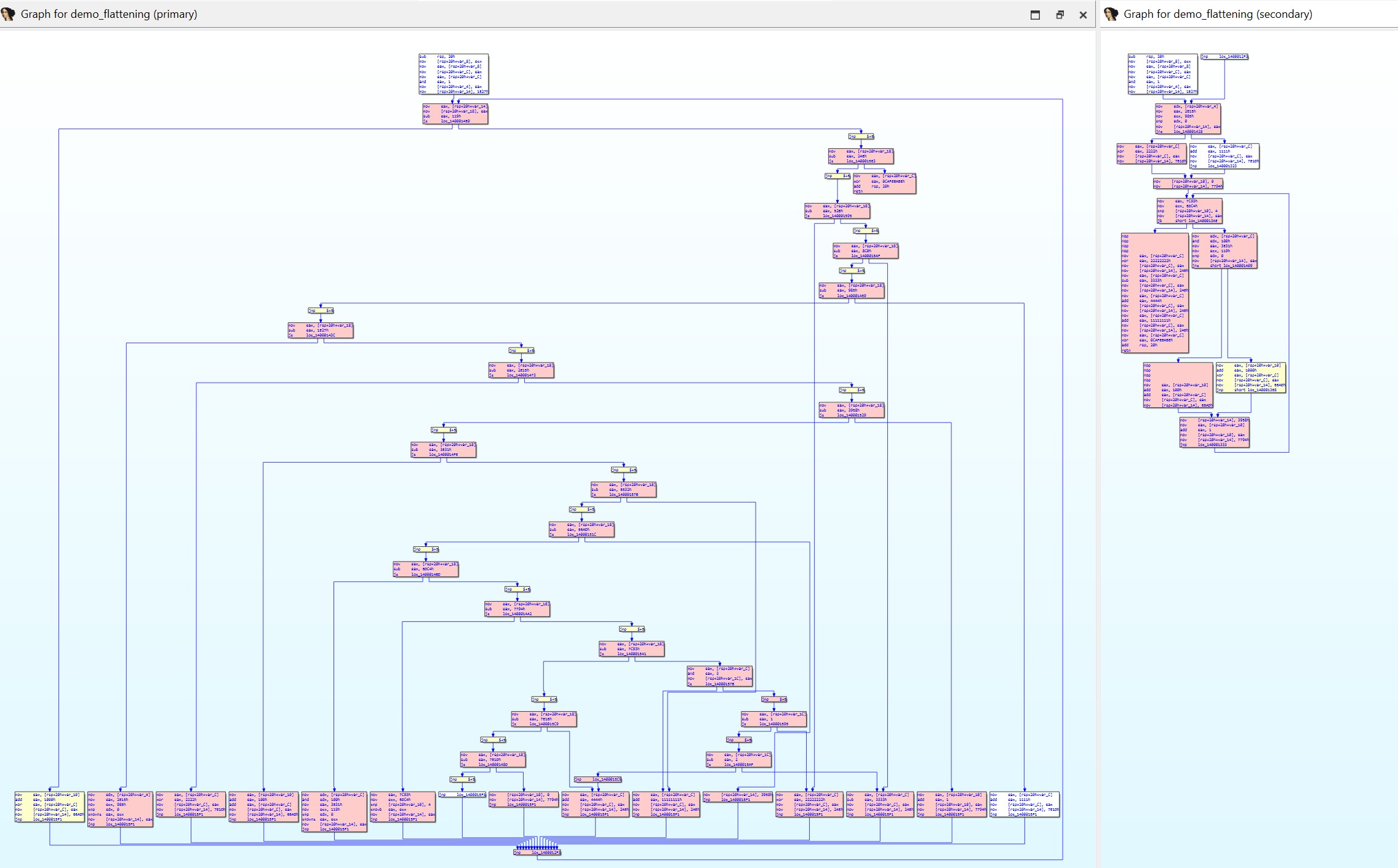
The original dispatcher beside the incorrect rewrite. The long straight-line region on the right is the collapsed switch. Visual simplification is not semantic correctness — and this image is the reason that sentence is in every block of this course.
The one that failed before it started#
The fourth run is a different kind of negative result, and confusing it with the third would be a mistake.
stock_result.json — the whole outcome
read the stderr line "exit_code": 0,
"timed_out": false,
"elapsed_seconds": 0.36,
"input": "E:\\Workspace\\seeing_through_obfuscation\\results\\showcase_matrix_v1\\optimization_survival\\tigress\\flatten\\O0\\showcase.exe",
"input_sha256": "4201A5095EFE5D367C7A261ED612F108CEE85AEBA7D002E6B2831F1E43F0549F",
"target_va": "0x140001020",
"output": "E:\\Workspace\\seeing_through_obfuscation\\results\\deobfuscation\\unflattening\\tigress\\o0\\stock_rewritten.exe",
"output_exists": false,
"stdout": "",
"stderr": "INFO:root:Unflattening function 0x140001020\r\nINFO:root:Function 0x140001020 is not flattened\r\n",INFO:root:Function 0x140001020 is not flattened. No output file. No patch. No
symbolic execution, no solver, no successor recovery — the tool’s discovery
stage saw six blocks where the jump-table-aware reference has 38, decided this
was not a flattened function, and stopped.
- blocks the stock discovery stage found
- 6blocks the stock discovery stage foundbefore_cfg.txt
- blocks in the jump-table-aware reference for the same function
- 38blocks in the jump-table-aware reference for the same functionreference_complete_cfg.txt
- dispatch targets it never saw, behind one indirect jump
- 21dispatch targets it never saw, behind one indirect jumpverified_jump_table.json
- solver queries issued — the failure is upstream of the analysis
- 0solver queries issued — the failure is upstream of the analysisstock_result.json
Six discovered blocks is not a six-block function. It is a graph with 32 missing blocks, because the edges out of the dispatcher go through an indirect jump and resolving those needs a jump-table model the discovery stage does not have. A disassembler with that model resolves them; this tool does not.
So the honest verdict is “blocked at discovery”, not “the symbolic execution failed” and certainly not “the solver could not handle it”. Lowering the acceptance threshold does not help either — a separately labelled scoring adapter was tried and also fails, which is what you would expect when the problem is 32 absent blocks rather than a score.
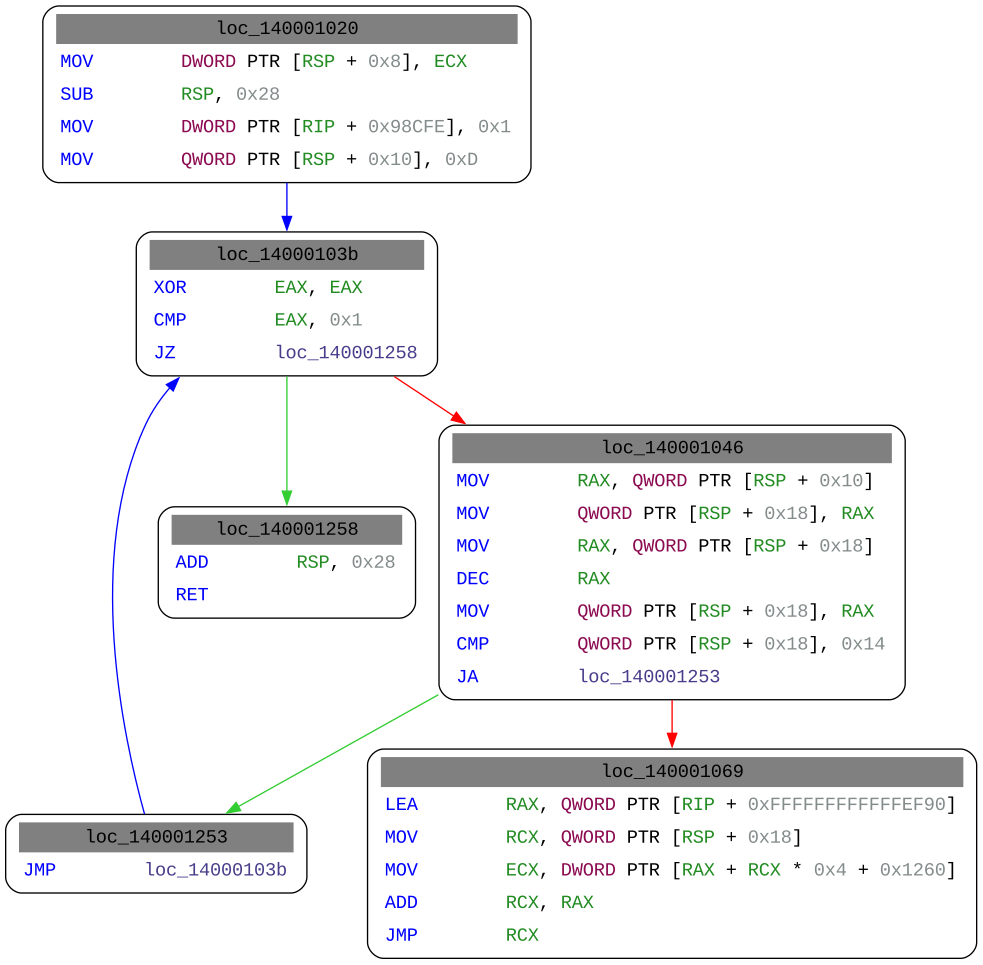
What the tool saw.
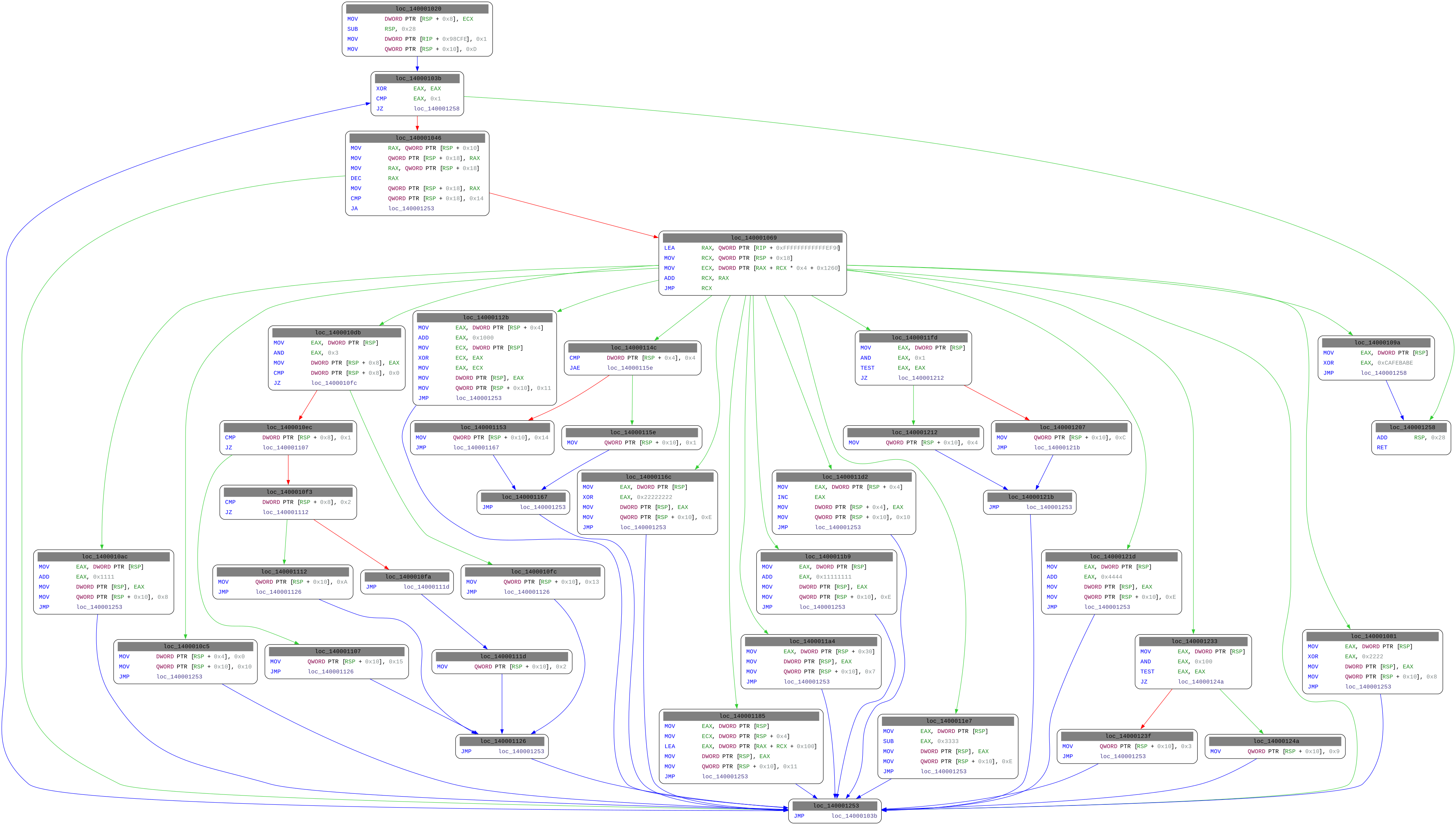
What was there.
The left graph is not simpler code. It is the same code, under an analysis
that could not follow it. If you take one habit from this week: a small
recovered graph is a claim about the recovery, not about the program.
What the four outcomes have in common#
Each of the four runs used the same tool with the same defaults, and the difference between them is an assumption about the representation:
- the two successes share the dispatcher shape and state layout the tool was written against;
- the wrong rewrite shares the shape closely enough to be accepted, and differs in how a multi-way source construct is represented in its states;
- the blocked run differs in the dispatch mechanism itself.
None of that is visible in a tool’s exit code, and none of it is visible in the output graph. It is visible in the successor score, in the ground-truth region map, and in eight hex digits of program output.
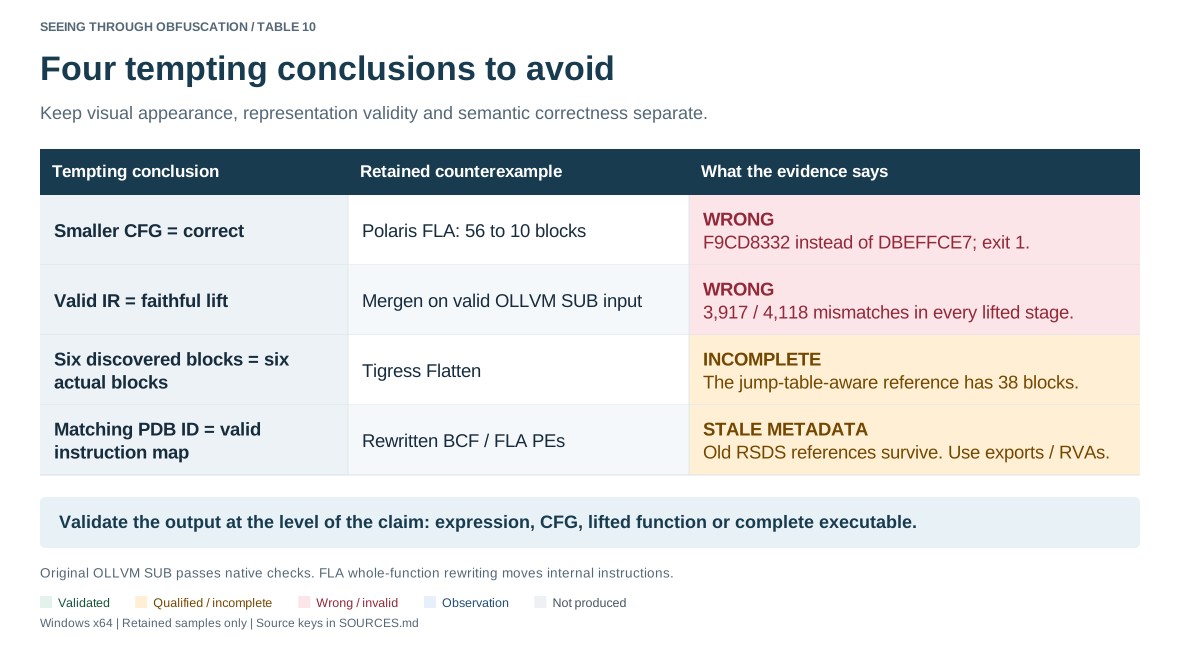
Four tempting conclusions to avoid
Keep visual appearance, representation validity and semantic correctness separate.
| Tempting conclusion | Retained counterexample | What the evidence says |
|---|---|---|
| Smaller CFG = correct | Polaris FLA: 56 to 10 blocks | WRONGF9CD8332 instead of DBEFFCE7; exit 1. |
| Valid IR = faithful lift | Mergen on valid OLLVM SUB input | WRONG3,917 / 4,118 mismatches in every lifted stage. |
| Six discovered blocks = six actual blocks | Tigress Flatten | INCOMPLETEThe jump-table-aware reference has 38 blocks. |
| Matching PDB ID = valid instruction map | Rewritten BCF / FLA PEs | STALE METADATAOld RSDS references survive. Use exports / RVAs. |
Validate the output at the level of the claim: expression, CFG, lifted function or complete executable.
Original OLLVM SUB passes native checks. FLA whole-function rewriting moves internal instructions.Open the original lecture figure (SVG)
Studio: audit a beautiful result#
Static analysis only. Do not execute the incorrect rewrite — you already know what it prints, and the exercise is to find the fault without that.
- In the clean listing, identify the four
switchalternatives and the block they all reconverge to. - In the rewritten listing, find the block that contains all four. Walk it
instruction by instruction and compute what it returns for an input whose
low two bits are
01. Compare with the clean path for the same input. - Find the four identical state stores and say what their repetition tells you about how the recovery went wrong.
- Now the assessment skill. Write the rejection: a paragraph that refuses the claim “this rewrite deobfuscated the function”, citing the successor score, the region map and the block listing — without citing the runtime output. That is the position an analyst is usually in.
- Finally, the counterfactual. What would the tool have had to represent differently to get this right? One sentence.
- after_cfg.txtthe incorrect rewrite, instruction by instruction4 kB
- clean_cfg.txtthe clean build of the same function, for the diff3 kB
- semantic_edge_score.json14 of 22, one false pair, eight unresolved — the warning nobody read418 B
- provenance_region_map.jsonground truth: the four switch regions the rewrite collapsed32 kB
- instrumentation.jsonthe recovery trace that grouped them under one state59 kB
- output_runtime_stdout.txtwhat it actually prints155 B
- stock_result.jsona successful run, for comparison: 862 bytes changed, exit 03 kB
- stock_result.jsonthe blocked run: no output file, no recovery attempted2 kB
- course_comparison.svgclean, flattened and incorrect rewrite, one figure82 kB
- unflattening_course_examples.mdall four cases, with addresses, states and region maps9 kB
Come to the studio with
The studio assumes you have done these. Each is written so you can tell whether you have, without asking.
- you can read a block listing and follow fall-through from one instruction to the next
- you have week 9's state table for the parity branch written down
- you can say what a precision and a recall of 1.0 do and do not tell you