Week 08 · Block III Proof
From proof to a working binary
Six bytes, of which four differ. The audit that reconciles seventy blocks with thirty-seven. And 4,591 test triples, which is a great many inputs and not all of them.
A solver proved an edge impossible. What has to happen next, and who has to do it?
The solver’s job finished last week. Nothing it did changed a file.
What happens now is a different program: a patch consumer that reads the frozen proofs, checks the bytes it is about to touch against what it expects to find, and writes a new executable. It ran no solver queries of its own — the recorded count is zero — and that separation is the reason this week’s result can be stated cleanly.
Six bytes#
Work out the displacement, because it is the whole trick. 0F 85 is a
two-byte opcode for jne rel32, so the instruction is six bytes long and the
next instruction begins at 0x166D; a displacement of 0x05 reaches
0x1672. E9 is a one-byte opcode for jmp rel32, so that instruction is
five bytes long and the next one begins at 0x166C; to reach the same
0x1672 the displacement has to be 0x06.
Same destination, different number, because the length of the instruction
changed. The sixth byte would otherwise be a stray tail, so it is filled with
0x90 — a one-byte nop — which keeps every subsequent byte in the file at
the address it was at before.
That is why four bytes differ out of six, and it is also the arithmetic behind the file-level number:
- gates patched, from 22 proved and 22 eligible
- 22gates patched, from 22 proved and 22 eligiblevalidation.json
- bytes changed in the whole file — 22 gates × 4 differing bytes
- 88bytes changed in the whole file — 22 gates × 4 differing bytesmetadata_audit.json
- bytes in the approved patch window — 22 × 6
- 132bytes in the approved patch window — 22 × 6metadata_audit.json
- bytes in the file, every other one of them identical
- 571,904bytes in the file, every other one of them identicalmetadata_audit.json
What the rewrite did not touch#
metadata_audit.json — the layout audit
every claim here is a checked file-level fact{
"file_size": 571904,
"image_size": 598016,
"bytes_changed": 88,
"approved_patch_window_bytes": 132,
"all_other_file_bytes_identical": true,
"entire_headers_identical": true,
"sections_identical": true,
"imports_exports_relocations_exception_debug_directories_and_payloads_identical": true,
"target_entry_and_unwind_ranges_identical": true,
"target": {
"va": 5368714800,
"rva": 5680,Headers identical. Sections identical. Imports, exports, relocations, exception and debug directories identical. The target’s entry and unwind ranges identical. No byte outside the approved window changed.
That is a layout-preserving rewrite, and it is a design choice with a cost. Nothing was deleted, nothing moved, and every unreachable instruction is still physically present in the file. The alternative — recompacting the function — would produce a smaller binary and would invalidate every address in it.
Read the last two fields of that record with care:
Seventy blocks, thirty-seven reachable, seventy still there#

What is reachable from the entry, after the patches.
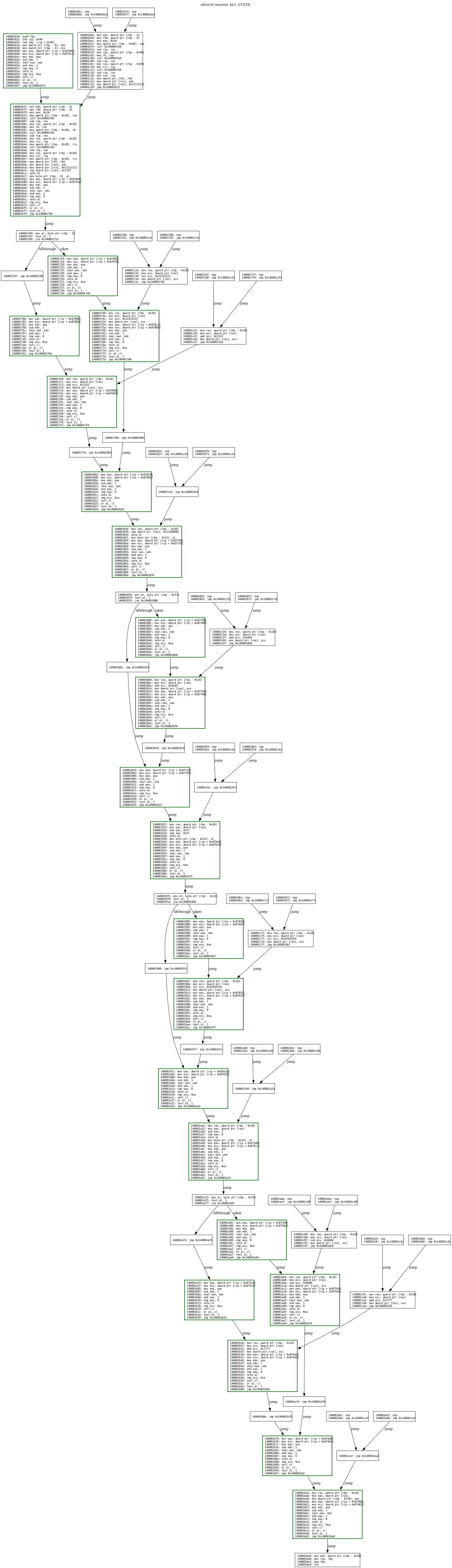
Every instruction still in the file, reachable or not.
The same binary, two projections. The left graph is what execution can
reach; the right graph is what the bytes contain. Both are true, and a
report that shows only the left one while calling the file “cleaned” is
misleading about the file.
projection_notes.json — what became unreachable, and what it was
a read-only graph projection; no block was deleted{
"original_blocks_now_unreachable": 33,
"classification_counts": {
"bogus clone": 11,
"jump stub": 22,
"predicate computation": 0,
"genuine semantic block": 0,
"unknown": 0
},
"projection": "rewritten_entry_reachable.dot/svg: read-only graph projection; no binary block deletion",Thirty-three blocks became unreachable: eleven bogus clones and twenty-two jump stubs. Note the two zeroes. Zero predicate computation blocks became unreachable — the arithmetic that computes each opaque condition still runs on every call, because the patched jump sits after it. And zero genuine semantic blocks became unreachable, which is the check that the rewrite did not remove program logic.
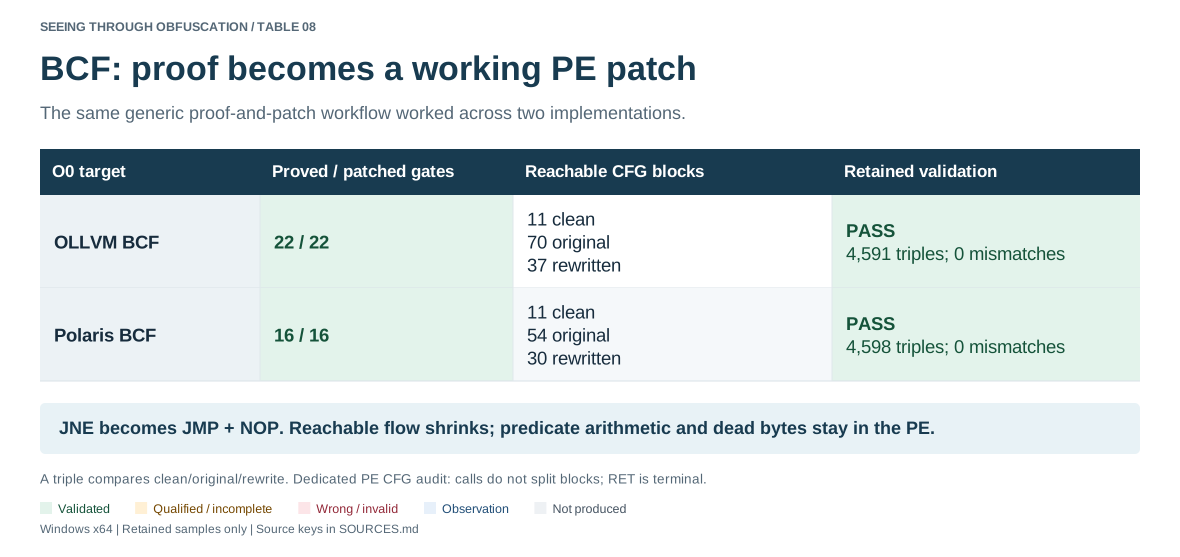
BCF: proof becomes a working PE patch
The same generic proof-and-patch workflow worked across two implementations.
| O0 target | Proved / patched gates | Reachable CFG blocks | Retained validation |
|---|---|---|---|
| OLLVM BCF | 22 / 22 | 11 clean70 original 37 rewritten | PASS4,591 triples; 0 mismatches |
| Polaris BCF | 16 / 16 | 11 clean54 original 30 rewritten | PASS4,598 triples; 0 mismatches |
JNE becomes JMP + NOP. Reachable flow shrinks; predicate arithmetic and dead bytes stay in the PE.
A triple compares clean/original/rewrite. Dedicated PE CFG audit: calls do not split blocks; RET is terminal.Open the original lecture figure (SVG)
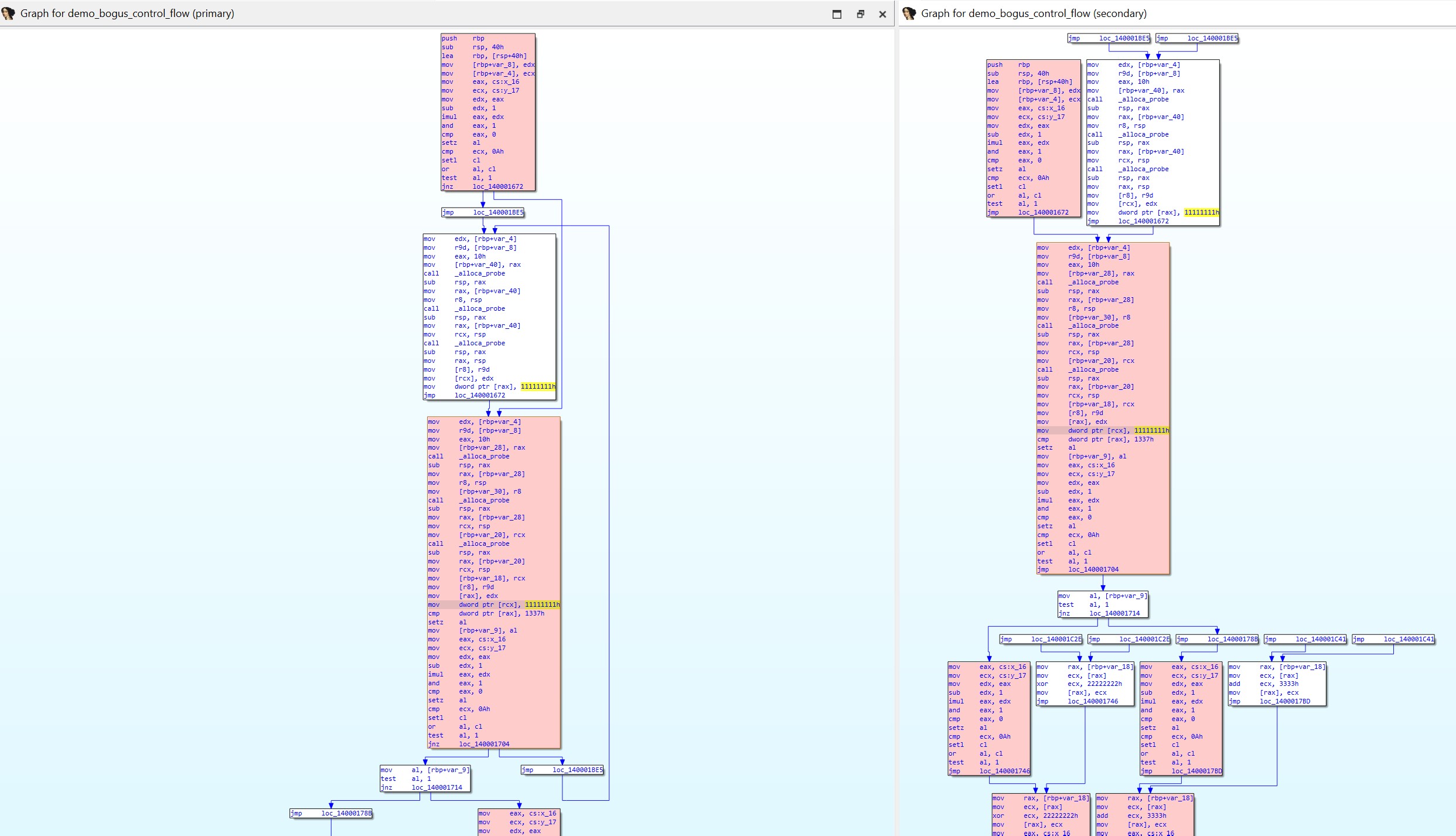
The conditional gates have become unconditional transfers. The predicate arithmetic above them and the stub blocks below them are still there. This is a partial rewrite, and calling it anything else would be wrong.
And then it was tested#
validation.json — the differential test record
4,591 triples, 0 mismatches{
"passed": true,
"eligible": 22,
"patched": 22,
"input_sha256": "3ED20E83BE53F28FAF64D1A1CFBC2FEB323B83EC35CCEE0FAF8D85AD7905285F",
"output_sha256": "15BF8731CD94663F5E0691983F1616969E28675E89B8595371DDBCBA51EA906A",
"output_path": "E:\\Workspace\\seeing_through_obfuscation\\results\\deobfuscation\\opaque_rewrite\\ollvm16_o0\\showcase_ollvm_bcf_deopaque.exe",
"canonical_pass": true,what the rewritten executable prints
the six canonical answers, unchangedSUB = 08080000
BCF = 6665BBBC
FLA = DBEFFCE7
CALLS = 12345F05
DATA = 57977293
COMBINED = EEBB6D71
SHOWCASE PASSA triple runs the clean, original and rewritten builds on the same input
and compares all three. 4,591 of them, 13,773 native function calls, zero
mismatches — including all four genuine conditions exercised both ways and
all twelve feasible joint combinations of them.
The same workflow, unmodified, on the second implementation: sixteen gates proved, sixteen patched, sixty-four bytes changed, reachable blocks 54 to 30, 4,598 triples, zero mismatches. That transfer is the strongest generic result in the course, and it is worth being exact about what made it transfer — the proof was about instruction semantics and the patch was about bytes. Neither step recognised an obfuscator.
Studio: justify a patch you did not write#
- At RVA
0x1667, derive both displacements from first principles and explain why they differ. Then explain why thenopis necessary rather than tidy. - Using the projection notes, reconcile three numbers: 70 physical blocks, 37 reachable blocks, 33 unreachable blocks. Say what each one is counting.
- Find the two zeroes in the classification counts and say what each one rules out.
- Separate the evidence: which part of this week’s result is a solver proof, which part is a byte-level argument, and which part is a test? For each, name the file.
- Then the A2 rehearsal: write a one-paragraph analyst’s summary of this week’s result that is too strong, and underline the words doing the overreaching.
No new patching. The point is the justification, not the edit.
- validation.jsoneligible, patched, triples, mismatches, hashes, genuine-branch coverage3 kB
- patch_manifest.jsonall 22 patches: address, expected bytes, written bytes396 kB
- metadata_audit.jsonthe file-level audit: what changed and what did not1 kB
- projection_notes.jsonthe reachability convention and the classification of what died1 kB
- rewritten_target_disassembly.txtthe rewritten function, instruction by instruction25 kB
- original_target_disassembly.txtthe same function before the patches, for the diff24 kB
- validation.jsonthe second implementation: 16 gates, 4,598 triples3 kB
- patch_manifest.jsonthe transfer case's 16 patches — different addresses, same method266 kB
- rewritten_target_disassembly.txtthe second rewritten function, instruction by instruction16 kB
- opaque_predicate_rewrite.mdthe rewriting study, including the preconditions the consumer checks24 kB
Come to the studio with
The studio assumes you have done these. Each is written so you can tell whether you have, without asking.
- you can compute an x86-64 relative branch displacement by hand
- you have week 7's two obligations written out for the gate at RVA 0x1667
- you can say what an RVA is and how it differs from a virtual address