Week 05 · Block II Simplification
Optimization versus obfuscation
The compiler flag is part of the experiment. Change it and a transformation can halve, double, or vanish — while the obfuscator's own output file stays exactly the same.
Is this result about the obfuscator, or about the optimisation flag that came after it?
Week 3 ended with a transformation that mostly stopped existing when the optimiser was turned on. That was not an accident of that tool. Optimisation level is not a nuisance variable in this field — it is part of the treatment, and this week is about designing comparisons that survive it.
How the matrix controls for it#
Two different problems, two different answers.
For the source-level lane the problem is easy to state and easy to get wrong: if you generate obfuscated C four times, once per optimisation level, you have four specimens and no control. So the matrix generates the C once and compiles that exact file at every level. Here is the check, in the two retained metadata records:
the O0 build
/Od /Ob0 "optimization": "O0",
"optimization_flag": "/Od /Ob0",
"optimization_note": "",
"dataset_role": "optimization_survival",
"selection": "Tigress --Functions=demo_substitution",
"canonical_source": "E:\\Workspace\\seeing_through_obfuscation\\src\\showcase.c",
"canonical_sha256": "39FEF0BB2A9742870F3D6F7CC864F7CFFA129136F6D2A59C4FB37F25906B99D2",the maximum-optimisation build
/Ox, recorded as O3 "optimization": "O3",
"optimization_flag": "/Ox",
"optimization_note": "MSVC has no /O3; /Ox is the maximum-optimization analogue.",
"dataset_role": "optimization_survival",
"selection": "Tigress --Functions=demo_substitution",
"canonical_source": "E:\\Workspace\\seeing_through_obfuscation\\src\\showcase.c",
"canonical_sha256": "39FEF0BB2A9742870F3D6F7CC864F7CFFA129136F6D2A59C4FB37F25906B99D2",input_source_sha256 is the same value in both records. One generated file,
two compilations — so any difference between the two binaries is the
compiler’s, and nothing else’s. Note also
"optimization_note": "MSVC has no /O3; /Ox is the maximum-optimization analogue." The directory says O3; the flag was /Ox, and quoting it as
/O3 would be a small lie that compounds.
For the IR-level lanes the problem is the opposite. If you run the
obfuscation pass and then hand the result to a normal compilation, the
middle-end runs twice and you cannot tell what the pass did from what the
second run did. So the matrix emits post-pass IR once, then generates object
and assembly from that exact IR with -Xclang -disable-llvm-passes. One
middle-end run, per build, on purpose.
The same generated C, twice#
- target instructions at /Od — against a matched clean 249
- 426target instructions at /Od — against a matched clean 249optimization_survival.md
- target instructions at /Ox — against a matched clean 106
- 226target instructions at /Ox — against a matched clean 106optimization_survival.md
- the surviving ratio at maximum optimisation
- ≈2.1×the surviving ratio at maximum optimisationselected_metrics.md
- the clean /Ox comparator — not the older, larger O2 figure
- 106the clean /Ox comparator — not the older, larger O2 figureobfuscator_comparison_summary.md
The absolute count nearly halved. The ratio against the correct comparator barely moved. Both statements are true, and only the second one is about the transformation.
That last number carries a warning worth repeating. An earlier measurement of
the clean /Ox target overran the function boundary — it measured to the next
export rather than to the return — and produced a larger clean figure and
therefore a smaller, flattering ratio. The corrected comparator is 106
instructions. If you are ever tempted to compare against a number you did not
scope yourself, that is the shape of the mistake.
What disappears#
Now the result that ought to make you nervous about every -O0 finding in the
literature.
Opaque flow: what survives optimization?
BCF = bogus control flow. The observation is about the measured native target.
| Treatment | At O0 | O1 through O3 / Ox | Interpretation |
|---|---|---|---|
| OLLVM BCF | Clones and opaque branches | RESIDUESmall optimized opaque-loop structure | Optimization removes much, not everything. |
| Hikari BCF | Injected native gates already folded | REMOVEDMeasured target matches clean | IR injection does not imply a native predicate. |
| Polaris BCF | Strong cloned/opaque topology | REMOVEDMeasured target matches clean | A strong O0 example can be weak at O1+. |
| Tigress AddOpaque | Initialization-dependent opaque flow | PERSISTS/Ox: 6 conditional jumps vs 1 clean | Runtime state matters to proof and optimization. |
Choose the optimization level deliberately: it can erase the phenomenon being taught.
Scope: demo_bogus_control_flow in the retained optimization study. Jump counts alone do not prove opacity.Open the original lecture figure (SVG)
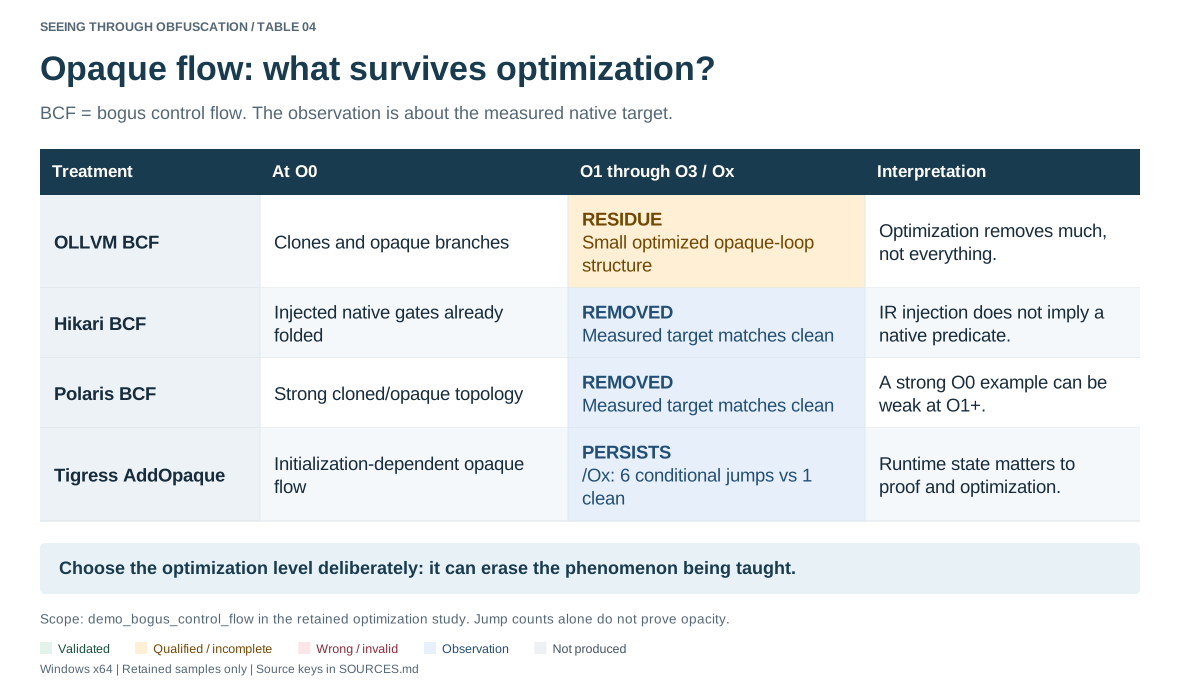
Two of the four opaque-control-flow lanes are gone by -O1. Not reduced —
the measured target is structurally identical to the clean target. One of them
was already mostly folded at -O0, because its injected guards were literal
icmp eq i32 1, 1 and the backend does not need an optimiser’s permission to
resolve that.
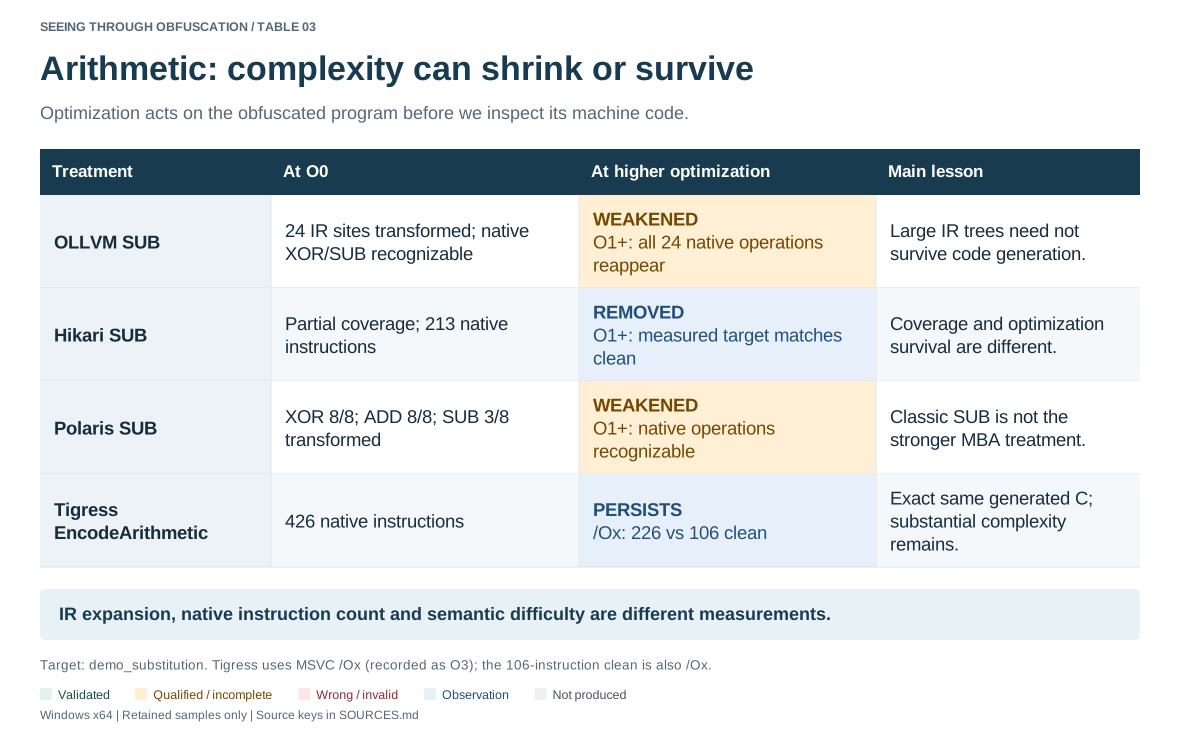
For arithmetic, the same pattern with different winners:
Arithmetic: complexity can shrink or survive
Optimization acts on the obfuscated program before we inspect its machine code.
| Treatment | At O0 | At higher optimization | Main lesson |
|---|---|---|---|
| OLLVM SUB | 24 IR sites transformed; native XOR/SUB recognizable | WEAKENEDO1+: all 24 native operations reappear | Large IR trees need not survive code generation. |
| Hikari SUB | Partial coverage; 213 native instructions | REMOVEDO1+: measured target matches clean | Coverage and optimization survival are different. |
| Polaris SUB | XOR 8/8; ADD 8/8; SUB 3/8 transformed | WEAKENEDO1+: native operations recognizable | Classic SUB is not the stronger MBA treatment. |
| Tigress EncodeArithmetic | 426 native instructions | PERSISTS/Ox: 226 vs 106 clean | Exact same generated C; substantial complexity remains. |
IR expansion, native instruction count and semantic difficulty are different measurements.
Target: demo_substitution. Tigress uses MSVC /Ox (recorded as O3); the 106-instruction clean is also /Ox.Open the original lecture figure (SVG)
And for flattening, the opposite result entirely:
Flattening can survive without an indirect jump
FLA = control-flow flattening. Look for state-driven dispatch, not one opcode.
| Treatment | At O0 | At higher optimization | What to look for |
|---|---|---|---|
| OLLVM FLA | State/switch dispatcher | Strong flattening persists | Repeated state tests and returns to dispatch. |
| Hikari FLA | State/switch dispatcher | Strong flattening persists | Dispatcher structure despite simpler blocks. |
| Polaris FLA | Strong state dispatcher | Smaller, but still flattened | Simplification is not full unflattening. |
| Tigress Flatten | Indirect jump table | O1: direct networkO2 and /Ox: indirect table | Same generated C, different native dispatch. |
A direct chain of comparisons can implement the same flattened state machine as a jump table.
Scope: demo_flattening. Survival of obfuscation does not establish compatibility with an unflattener.Open the original lecture figure (SVG)
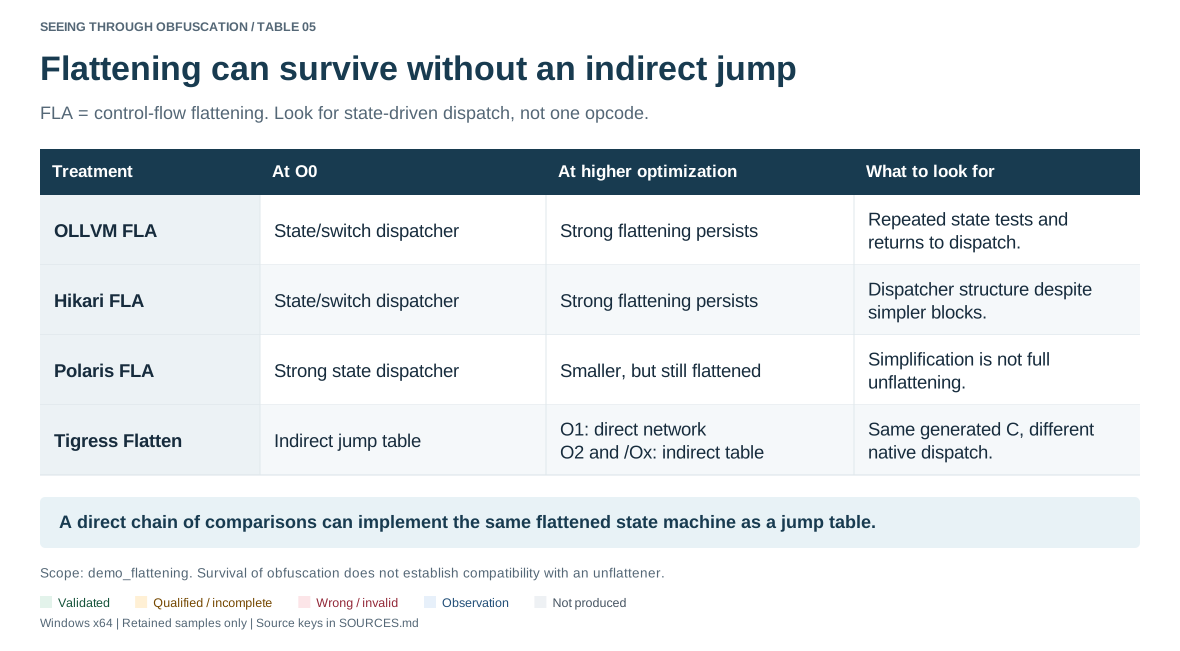
Flattening is the durable family. Two implementations keep essentially their
whole dispatcher from -O1 through -O3; a third loses about half its
structure and still has a dispatcher; the source-level one changes how the
dispatch is lowered — an indirect jump table at some levels, a direct
comparison network at another — without losing the state machine at all.
That last point is the one people get wrong. A missing indirect jump is not evidence that flattening disappeared. It is evidence about lowering.
What this does to course design, and to yours#
The study’s own recommendation is blunt: teach bogus control flow with explicit
-O0-versus--O2 pairs, because two of the four implementations vanish at
-O1 and presenting their -O0 structure as “an obfuscated binary” would be
straightforwardly false.
Which is why weeks 6 to 8 work on -O0 specimens and say so in every
sentence, and why week 10’s flattening work can use higher levels.
Studio: compare two builds fairly#
- Open the two metadata records and confirm for yourself that
input_source_sha256matches. Write down what that fact rules out. - Compare the two disassembly listings. Find one arithmetic site in each and say what the optimiser did to it.
- Compute both ratios — obfuscated against clean, at each level, using the matched control. Then write the one sentence that is supported by them.
- Now write the sentence that is not supported: the cross-tool comparison that this data does not license. Say precisely which control is missing.
A1 is due Friday at 17:00. Bring a draft of its “what this does not establish” section to the studio if you want it read.
- demo_substitution_O0_disassembly.txt426 instructions at /Od28 kB
- demo_substitution_Ox_disassembly.txt226 instructions at /Ox, from the same generated C16 kB
- demo_substitution_disassembly.txtthe matched clean /Od control — 249 instructions16 kB
- target_function_disassembly.txtthe matched clean /Ox control — 106 instructions7 kB
- metadata.jsonbuild record for the /Od specimen2 kB
- metadata.jsonbuild record for the /Ox specimen — same source hash2 kB
- exact_generated_encode_arithmetic.cthe generated C itself, all 387 kB of it378 kB
- optimization_metrics.jsonevery IR, machine and source metric in the matrix, per build205 kB
- optimization_survival.mdthe full survival matrix, IR and machine, for every lane9 kB
Come to the studio with
The studio assumes you have done these. Each is written so you can tell whether you have, without asking.
- you can say what `-O0` stops the compiler doing, in concrete terms
- you have week 3's finding written down — what survived to machine code, and what did not
- you can compute a ratio and say what the denominator has to be for it to mean anything