Week 07 · Block III Proof
Symbolic execution and SMT
One branch, two queries, and a solver that answers one of them with a witness and the other with nothing at all. Plus the assumption that turns zero proofs into three.
What exactly has a solver established when it returns UNSAT for one direction of a branch?
Last week ended with a hand argument and a hole in it: the product of two consecutive integers is even, over the integers, and the machine works modulo 2³². This week we stop arguing and write the obligation down.
Symbolic execution, in one paragraph#
Instead of running the function on a value, run it on a variable. Every
instruction updates an expression rather than a number: and eax, 1 turns the
expression in eax into bvand(previous, 1). When you reach a conditional
branch you have an expression for its condition, in terms of whatever you left
symbolic. Then you can ask a solver about it.
What you left symbolic is the whole ballgame. Here, the two globals the predicate reads are symbolic — nothing else about the program’s state is. That choice is the analysis’s model, and every result below is a result about that model.
One frozen gate#
The condition, translated from the actual instructions, with the framework’s own comments left in:
condition.smt2 — the branch condition, as bit-vectors
read it bottom-up; Extended part - SUB operation
(define-fun ref!54 () (_ BitVec 32) (bvsub g_14008901c_4 (_ bv1 32)))
; Extended part - IMUL operation
(define-fun ref!63 () (_ BitVec 32) (bvmul g_14008901c_4 ref!54))
; Extended part - AND operation
(define-fun ref!68 () (_ BitVec 32) (bvand ref!63 (_ bv1 32)))
; CMP operation
(define-fun ref!76 () (_ BitVec 32) ref!68)
; Zero flag
(define-fun ref!82 () (_ BitVec 1) (ite (= ref!76 (_ bv0 32)) (_ bv1 1) (_ bv0 1)))
; CMP operation
(define-fun ref!86 () (_ BitVec 32) (bvsub g_140089018_4 (_ bv10 32)))
; Overflow flag
(define-fun ref!89 () (_ BitVec 1) ((_ extract 31 31) (bvand (bvxor g_140089018_4 (_ bv10 32)) (bvxor g_140089018_4 ref!86))))
; Sign flag
(define-fun ref!91 () (_ BitVec 1) ((_ extract 31 31) ref!86))
; TEST operation
(define-fun ref!103 () (_ BitVec 8) (bvand (bvor (ite (= ref!82 (_ bv1 1)) (_ bv1 8) (_ bv0 8)) (ite (= (bvxor ref!91 ref!89) (_ bv1 1)) (_ bv1 8) (_ bv0 8))) (_ bv1 8)))
; Zero flag
(define-fun ref!108 () (_ BitVec 1) (ite (= ref!103 (_ bv0 8)) (_ bv1 1) (_ bv0 1)))
(assert (= ref!108 (_ bv0 1)))
(check-sat)ref!54 is g − 1. ref!63 is the product. ref!68 masks the low bit.
ref!82 is the zero flag from comparing that against zero — the sete.
ref!86 and ref!91 are the second global’s comparison against ten and its
sign flag. ref!103 is the or and the test, and ref!108 is the zero flag
the jne actually reads.
Every one of those is a 32-bit or 1-bit value. Nothing here is an integer.
Two queries#
Write P for the path prefix and C for “the branch is taken”. Then there are
exactly two things to ask, and they are separate questions:
P ∧ C
SATThe solver returns a model: both globals zero.
"model": { "g_140089018_4": 0, "g_14008901c_4": 0 }That is a witness inside the model. It is not automatically a reachable whole-program input, because nothing here checked that those globals can hold those values at this point in a real execution.
Reading: The taken direction is reachable within the model, and here is a state that reaches it.
P ∧ ¬C
UNSATNo model, because there is none. This is the result the rest of the block is built on, and it is the one most often quoted more strongly than it deserves.
Reading: No assignment to the symbolic globals makes the branch fall through — so under P and this model, that edge cannot be taken.
result.json — the recorded statuses
both queries, plus the unrestricted re-run "queries": {
"true": {
"status": "SAT",
"solver_reported_ms": 3,
"wall_ms": 15.608299989253283,
"model": {
"g_140089018_4": 0,
"g_14008901c_4": 0
}
},
"false": {
"status": "UNSAT",
"solver_reported_ms": 3,
"wall_ms": 13.061899997410364,
"model": {}
}
},
"unrestricted_queries": {
"true": {
"status": "SAT",The prefix here is trivial — (= (_ bv1 1) (_ bv1 1)), which is to say “no
constraints”, because the gate is reached unconditionally. The file records it
anyway. On a gate deeper in the function it would not be trivial, and a result
whose prefix was not written down would not be interpretable at all.
Doing it 41 times, generically#
The same harness, with no per-implementation pattern, on four -O0 lanes:
- OLLVM-16 O0 injected gates proved one-sided
- 22 / 22OLLVM-16 O0 injected gates proved one-sidedfamily_results.json
- Polaris O0 injected gates proved one-sided
- 16 / 16Polaris O0 injected gates proved one-sidedfamily_results.json
- genuine source branches across the lanes, every one of them two-sided
- 16genuine source branches across the lanes, every one of them two-sidedaggregate_accuracy.json
- false positives — no genuine branch was ever classified as opaque
- 0false positives — no genuine branch was ever classified as opaqueaggregate_accuracy.json
The false-positive count is the number that makes the rest mean something. A classifier that called everything opaque would score 38 out of 38 on the injected gates and be worthless. The genuine conditions staying two-sided is the control.
The aggregate across all four -O0 lanes is 38 true positives, 1 false
negative, 0 false positives, 16 true negatives, and 2 branches never reached
within the exploration budget. All three of the shortfalls — the false negative
and the two unreached — are in one lane, and that lane is the subject of the
next section.
The assumption that changes the answer#
One implementation’s opaque conditions are not algebraic. They are built from program state that gets initialised at start-up, and its generated C says so in the clear.
arbitrary symbolic globals — 0 of 3 proved
why it stopped "sha256": "EC0422510CB401B0EC004A32961F45F5D9A399EA9EB021F4B16A38B6FE8052BE",
"state_model": "GENERIC ENTRY-STATE RESULT",
"configuration": {
"max_runs": 128,
"max_instructions": 5000,
"solver_timeout_ms": 1500,
"solver": "Z3",
"symbolic_inputs": "ECX/EDX 32-bit",
"unknown_writable_globals": "first read symbolized, arbitrary concrete seed 1",
"symbolic_address_policy": "stop, no unrecorded concretization"
},
"exploration_complete": false,
"elapsed_seconds": 1.3108550000033574,
"runs": [
{
"index": 0,
"seed": {
"x": 4919,
"y": 305419896
},
"termination": "STATE INITIALIZATION LIMITATION",
"failure": {
"reason": "Symbolic effective address requires array/pointer model; no silent concretization",
"instruction": "0x1400011cc: mov eax, dword ptr [rcx + rax*4]",
"addresses": [
"0x14009b138"
]one captured initialised state — 3 of 3 proved
where the state came from{
"provenance": {
"method": "A: actual PE main initialization path emulated by Triton up to target entry",
"case": "tigress-add_opaque-O0",
"executable": "E:\\Workspace\\seeing_through_obfuscation\\results\\showcase_matrix_v1\\optimization_survival\\tigress\\add_opaque\\O0\\showcase.exe",
"sha256": "EC0422510CB401B0EC004A32961F45F5D9A399EA9EB021F4B16A38B6FE8052BE",
"main": "0x140001300",
"stop": "0x140001110",
"instruction_count": 763,
"malloc_summary": "successful fresh aligned synthetic heap allocation; no target-specific state constants",
"allocations": [
{
"address": "0x72000000",Same harness, same branches, same day. Read the left pane’s failure
block: the run did not fail to prove the gates, it stopped — at
mov eax, dword ptr [rcx + rax*4], a symbolic effective address, with the
policy "stop, no unrecorded concretization". Given an unconstrained
pointer it declined to guess. The right pane is the alternative: emulate
the real initialisation path for 763 instructions, capture the state, keep
the function’s two arguments symbolic, and the same three gates fall out.
The difference is not a technique — it is an assumption about the world,
made explicit and written to a file.
That stopping policy is worth dwelling on. An analysis that silently
concretised the pointer would have produced a number, and the number would have
been about one arbitrary heap layout while looking like a general result. The
configuration records "symbolic_address_policy": "stop, no unrecorded concretization" because refusing to answer is a defensible result and a quiet
guess is not.
Which means the honest statement of the right-hand result is long, and the long version is the only correct one: under the captured initialised state, with the function’s arguments still symbolic, three injected gates are one-sided. Not: these predicates are opaque. Allocation outcomes, heap layout, entropy sources and any later mutation of those globals are all outside the model, and a claim about arbitrary program state is a different claim that this evidence does not support.
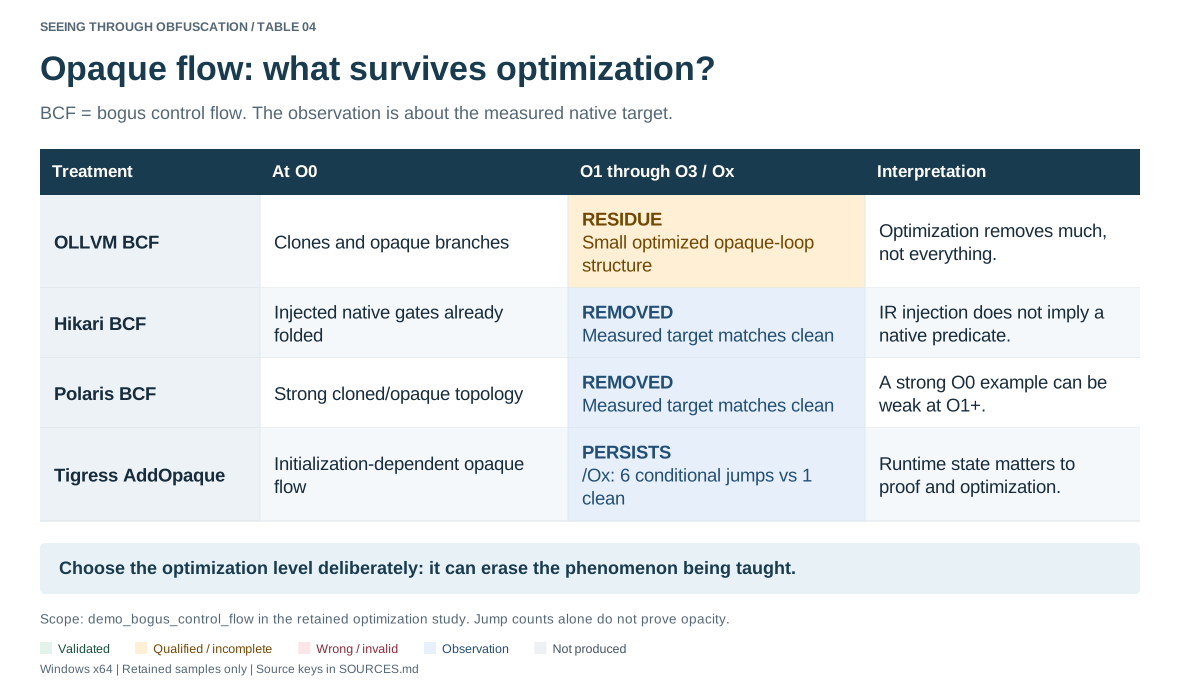
Opaque flow: what survives optimization?
BCF = bogus control flow. The observation is about the measured native target.
| Treatment | At O0 | O1 through O3 / Ox | Interpretation |
|---|---|---|---|
| OLLVM BCF | Clones and opaque branches | RESIDUESmall optimized opaque-loop structure | Optimization removes much, not everything. |
| Hikari BCF | Injected native gates already folded | REMOVEDMeasured target matches clean | IR injection does not imply a native predicate. |
| Polaris BCF | Strong cloned/opaque topology | REMOVEDMeasured target matches clean | A strong O0 example can be weak at O1+. |
| Tigress AddOpaque | Initialization-dependent opaque flow | PERSISTS/Ox: 6 conditional jumps vs 1 clean | Runtime state matters to proof and optimization. |
Choose the optimization level deliberately: it can erase the phenomenon being taught.
Scope: demo_bogus_control_flow in the retained optimization study. Jump counts alone do not prove opacity.Open the original lecture figure (SVG)
Studio: interpret a proof you did not run#
Nothing is executed this week. The solver artefacts are frozen and that is the point — you are practising the thing an analyst actually does, which is reading somebody else’s result and deciding what it licenses.
- Open
prefix.smt2,condition.smt2,true.smt2andfalse.smt2. Identify which assertion differs between the last two, and say in one sentence what each file is asking. - Write the two obligations for this gate in your own notation, including the bit widths. Then write the sentence that correctly reports the result — the long version, with the qualifiers.
- Now write the overclaimed version, the one that drops the prefix and the model. Keep both. A2 asks you to spot the second kind in somebody else’s prose.
- Compare the two Tigress result files. State the assumption the right-hand one adds, and list three things it still does not cover.
- result.jsonthe frozen gate: statuses, model, metrics, seed2 kB
- prefix.smt2the path prefix, trivial here and recorded anyway66 B
- condition.smt2the branch condition as bit-vectors, with the framework's comments1 kB
- true.smt2P ∧ C — returns SAT1 kB
- false.smt2P ∧ ¬C — returns UNSAT1 kB
- result.jsonarbitrary symbolic globals: 0 of 315 kB
- result.jsoncaptured initialised state: 3 of 326 kB
- add_opaque.cthe generated C, where the state-dependent guards are visible542 kB
Come to the studio with
The studio assumes you have done these. Each is written so you can tell whether you have, without asking.
- you can read a bit-vector SMT-LIB formula well enough to follow `bvand`, `bvsub` and `ite`
- you have week 6's hand-argument written down — the one with the hole in it
- you can state the difference between a satisfying model and a reachable program input