Week 03 · Block I Representation
Instruction substitution
The oldest trick in the book, applied to twenty-four sites, and largely undone by the compiler backend before anyone tried to analyse it.
If the obfuscator expanded every single addition, why can I still see additions in the machine code?
Instruction substitution replaces an operation with a longer sequence that computes the same value. For addition, one of the classic identities is
a + b ≡ (a + k) + b − k for any k, modulo 2³²which is true for every k, costs two extra instructions, and means nothing
to a reader who spots the cancelling constant. That is the whole technique. The
interesting question is what happens to it on the way to the executable.
One site, before and after#
Week 1 introduced SSA — every value named once and never reassigned. That property is what makes the next listing readable: to find out what a pass did, follow the chain of names backwards from whatever gets stored.
clean IR — site 0
one add %4 = load i32, ptr %2, align 4
%5 = add i32 %4, 16843009
%6 = getelementptr inbounds [8 x i32], ptr %3, i64 0, i64 0
store volatile i32 %5, ptr %6, align 16substituted IR — the same site
the identity, with k = 115893687 %4 = load i32, ptr %2, align 4
%5 = add i32 %4, 115893687
%6 = add i32 %5, 16843009
%7 = sub i32 %6, 115893687
%8 = add i32 %4, 16843009
%9 = getelementptr inbounds [8 x i32], ptr %3, i64 0, i64 0
store volatile i32 %7, ptr %9, align 16%5 adds the cancelling constant, %6 adds the real one, %7 subtracts
the cancelling constant back out, and %7 is what gets stored. Note %8:
the pass also emitted the original add i32 %4, 16843009 and then never
used it. The unsubstituted operation is sitting right there in the IR as
dead code.
Two things follow immediately. First, k is different at every site — the
next one uses −2076646197, the one after that uses a zero-subtract form
entirely — so pattern-matching one template does not find the others. Second,
the dead %8 tells you the pass works by adding a substituted computation
beside the original rather than by editing it in place. Which raises the
obvious question about what the backend does with a value nobody reads.
The same site, in the executable#
substituted x64 — demo_substitution at RVA 0x1070
sites 0, 1 and 20000000140001070 <demo_substitution>:
140001070: 48 83 ec 28 sub rsp, 0x28
140001074: 89 4c 24 24 mov dword ptr [rsp + 0x24], ecx
140001078: 8b 44 24 24 mov eax, dword ptr [rsp + 0x24]
14000107c: 05 b7 65 e8 06 add eax, 0x6e865b7
140001081: 05 01 01 01 01 add eax, 0x1010101
140001086: 2d b7 65 e8 06 sub eax, 0x6e865b7
14000108b: 89 04 24 mov dword ptr [rsp], eax
14000108e: 8b 44 24 24 mov eax, dword ptr [rsp + 0x24]
140001092: 2d cb e4 38 84 sub eax, 0x8438e4cb
140001097: 05 02 02 02 02 add eax, 0x2020202
14000109c: 05 cb e4 38 84 add eax, 0x8438e4cb
1400010a1: 89 44 24 04 mov dword ptr [rsp + 0x4], eax
1400010a5: 8b 44 24 24 mov eax, dword ptr [rsp + 0x24]
1400010a9: 31 c9 xor ecx, ecx
1400010ab: 81 e9 03 03 03 03 sub ecx, 0x3030303The dead operation is gone: instruction selection dropped it, at -O0, without
being asked. What survived is the three-instruction identity — add the
cancelling constant, add the real one, sub the cancelling constant — and
0x1010101 is still sitting in plain sight in the middle of it.
Site 2 used a different template: xor ecx, ecx then sub ecx, 0x3030303 then
sub eax, ecx, which is “subtract the negation”, and again the real constant
is visible.
Coverage, diversity and survival are three things#
The retained study measures all three separately, and they disagree.
- intended sites expanded in OLLVM SUB's O0 IR
- 24 / 24intended sites expanded in OLLVM SUB's O0 IRshowcase_matrix_v1.md
- distinct IR template shapes used across those sites (2 XOR, 4 ADD, 3 SUB)
- 9distinct IR template shapes used across those sites (2 XOR, 4 ADD, 3 SUB)showcase_matrix_v1.md
- native instructions in the target, clean to substituted, at O0
- 115 → 311native instructions in the target, clean to substituted, at O0selected_metrics.md
- intended native operations recognisable again at O1 and above
- 24 / 24intended native operations recognisable again at O1 and aboveoptimization_survival.md
Coverage is how many sites the pass touched: all of them, here. Template
diversity is how many distinct shapes it used: nine, which is more than one
and far fewer than twenty-four. Survival is what is left in the machine
code, and this is where it falls apart — the post-pass IR keeps its expanded
trees at every optimisation level, and the backend selects native immediate
operations for all twenty-four target sites from -O1 onward.
The same three measurements on the other two LLVM-family implementations make the point harder to dismiss:
- one implementation transformed XOR 2/8, ADD 4/8 and SUB 6/8 at
-O0— its pass is probabilistic — and by-O1its measured target is identical to the clean target. Complete loss of the requested treatment. - another transformed XOR 8/8, ADD 8/8 but SUB only 3/8, kept structurally
non-native IR at
-O1and above, and still had the backend select native immediate operations for every target site.
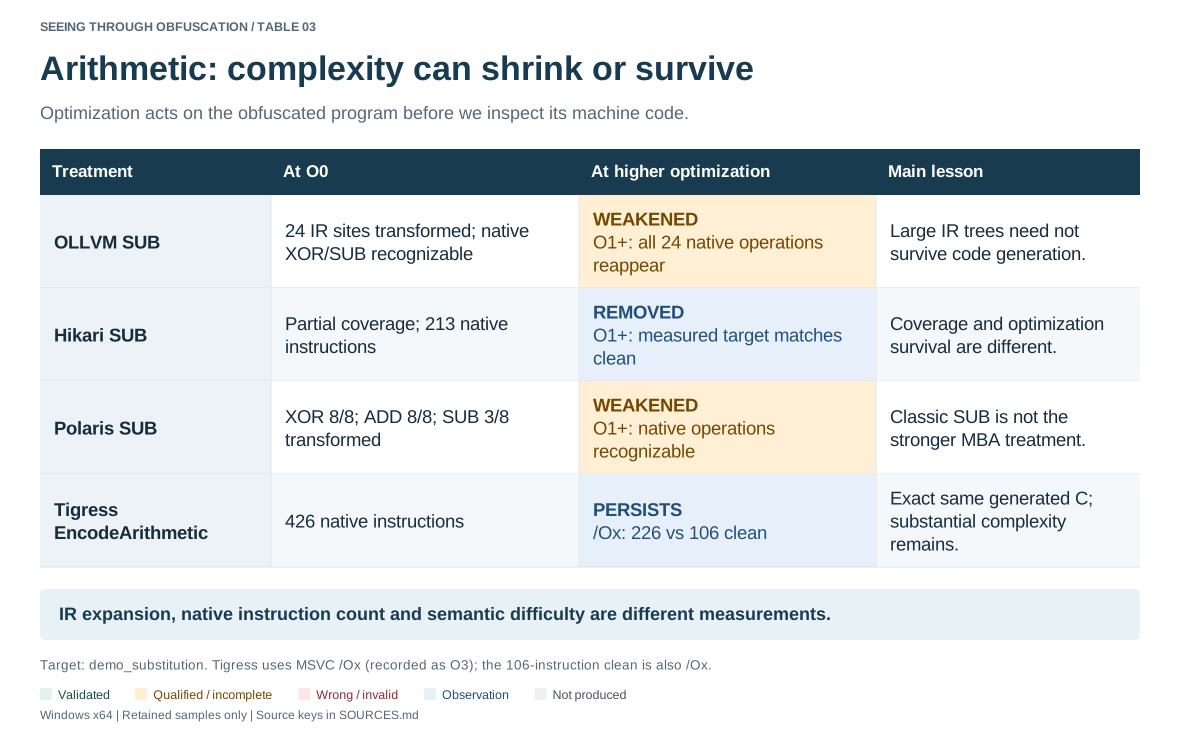
Arithmetic: complexity can shrink or survive
Optimization acts on the obfuscated program before we inspect its machine code.
| Treatment | At O0 | At higher optimization | Main lesson |
|---|---|---|---|
| OLLVM SUB | 24 IR sites transformed; native XOR/SUB recognizable | WEAKENEDO1+: all 24 native operations reappear | Large IR trees need not survive code generation. |
| Hikari SUB | Partial coverage; 213 native instructions | REMOVEDO1+: measured target matches clean | Coverage and optimization survival are different. |
| Polaris SUB | XOR 8/8; ADD 8/8; SUB 3/8 transformed | WEAKENEDO1+: native operations recognizable | Classic SUB is not the stronger MBA treatment. |
| Tigress EncodeArithmetic | 426 native instructions | PERSISTS/Ox: 226 vs 106 clean | Exact same generated C; substantial complexity remains. |
IR expansion, native instruction count and semantic difficulty are different measurements.
Target: demo_substitution. Tigress uses MSVC /Ox (recorded as O3); the 106-instruction clean is also /Ox.Open the original lecture figure (SVG)
What the analyst sees#
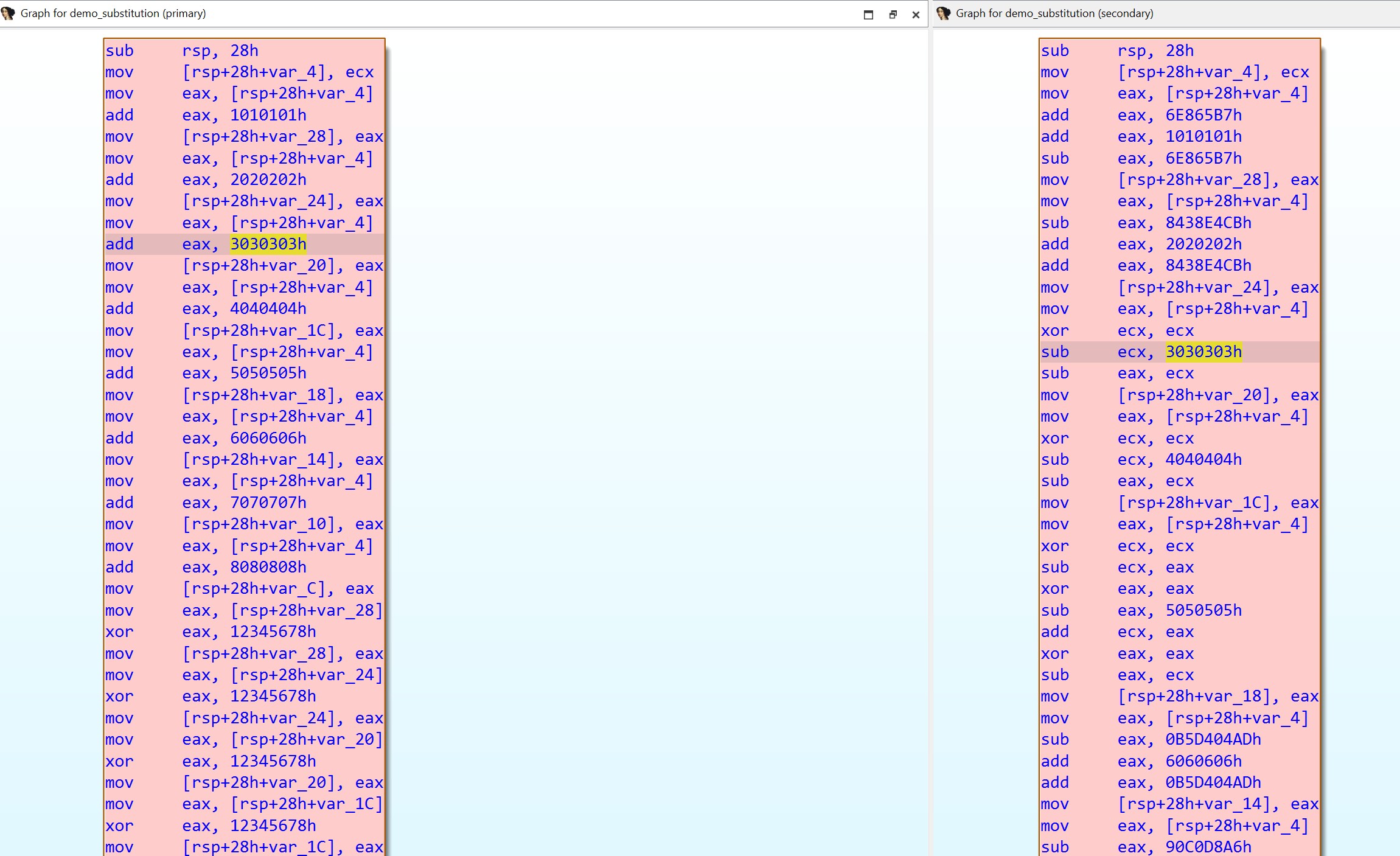
Now use both panes. On the right, find the cancelling constants, then find the real ones among them. The technique’s actual cost to an analyst is not difficulty — it is volume, plus the nagging possibility that one of the expansions is not an identity after all.
Studio: follow one operation through the pair#
Take one ADD site and one XOR site. For each:
- Write the identity the pass used, as algebra, and check it holds modulo 2³².
- Find the site in the substituted IR and in the substituted disassembly. Note which IR values are dead.
- Say what the backend did between those two files.
- Then find the same site in the
-O1metrics and say what is left.
Then the part that carries the marks: write two sentences about what you have established, one of which begins “this does not show that”. A1 is published now and is built from exactly this exercise on a pair you have not seen.
- demo_substitution.llclean O0 IR — the comparator7 kB
- target_function.llpost-pass substituted IR, all 24 sites12 kB
- demo_substitution_disassembly.txtclean x64, AT&T order8 kB
- demo_substitution_disassembly.txtsubstituted x64, Intel order18 kB
- msynth_validation.mdthe arithmetic study this week's site classifications come from31 kB
Come to the studio with
The studio assumes you have done these. Each is written so you can tell whether you have, without asking.
- you can expand `a + b` into an identity that uses a third constant and cancels it
- you can read a four-line SSA chain and say which value is stored
- you have week 1's annotated XOR site written down