Week 04 · Block II Simplification
MBA and semantic simplification
Mixed Boolean-arithmetic, the tools that reduce it, and the difference between a shorter expression and a proved one. The honest scoreboard is in here.
A simplifier returned a shorter expression. What exactly has been proved, and by what?
Last week’s substitution was an identity with a cancelling constant. This week the same source line becomes a nine-term expression mixing multiplication, XOR and complement — and it is still an identity, still with a cancelling structure, just one you have to do some work to see.
One addition, nine terms#
Polaris MBA IR — site 0, the whole expression
this computes input + 0x01010101 %4 = load i32, ptr %2, align 4
%5 = xor i32 %4, 16843009
%6 = xor i32 %5, -1
%7 = mul i32 42, %6
%8 = add i32 -1128481603, %7
%9 = mul i32 1, %4
%10 = add i32 %8, %9
%11 = add i32 %10, 1145324680
%12 = add i32 %11, -68
%13 = xor i32 %4, -1
%14 = xor i32 %13, 16843009
%15 = mul i32 -42, %14
%16 = add i32 %12, %15
%17 = getelementptr inbounds [8 x i32], ptr %3, i64 0, i64 0
store volatile i32 %16, ptr %17, align 16Work it through, because the semester’s central habit starts here — do the arithmetic yourself before believing a tool about it.
%6 is ~(x ^ 0x01010101). %14 is (~x) ^ 0x01010101, which is the same
value: complement and XOR commute. So %7 = 42 · %6 and %15 = −42 · %6
cancel exactly. %9 is 1 · x. What is left is a constant fold:
−1128481603 + 1145324680 − 68 = 16843009 = 0x01010101The expression is x + 0x01010101, spelled in nine operations, and every
choice in it — the 42, the split constants, the pointless multiply by one — is
noise placed to make the cancellation non-obvious.
Now the machine code the same expression became:
Polaris MBA x64 — site 0 at RVA 0x1030
fourteen instructions for one add0000000140001030 <demo_substitution>:
140001030: 48 83 ec 28 sub rsp, 0x28
140001034: 89 4c 24 24 mov dword ptr [rsp + 0x24], ecx
140001038: 8b 4c 24 24 mov ecx, dword ptr [rsp + 0x24]
14000103c: 89 c8 mov eax, ecx
14000103e: 35 01 01 01 01 xor eax, 0x1010101
140001043: 83 f0 ff xor eax, -0x1
140001046: 6b c0 2a imul eax, eax, 0x2a
140001049: 05 bd bc bc bc add eax, 0xbcbcbcbd
14000104e: 89 ca mov edx, ecx
140001050: c1 e2 00 shl edx, 0x0
140001053: 01 d0 add eax, edx
140001055: 05 88 44 44 44 add eax, 0x44444488
14000105a: 83 c0 bc add eax, -0x44
14000105d: 83 f1 ff xor ecx, -0x1
140001060: 81 f1 01 01 01 01 xor ecx, 0x1010101
140001066: 69 c9 d6 ff ff ff imul ecx, ecx, 0xffffffd6
14000106c: 01 c8 add eax, ecx
14000106e: 89 04 24 mov dword ptr [rsp], eaxThe backend kept all of it. imul eax, eax, 0x2a is the multiply by 42;
shl edx, 0x0 is the multiply by one, lowered to a shift by zero and then not
removed. This is the opposite of last week’s result: at -O0 the arithmetic
survived instruction selection completely.
What a simplifier is actually claiming#
A simplification workflow has three expressions, not two: the input lifted from the machine code, the candidate the tool proposes, and — only in a controlled study like this one — the expected expression from the known source. Two separate equivalence obligations follow, and they answer different questions.
input ≢ candidate
UNSATThe query that matters in practice, because it is the only one available when you do not have the source.
Reading: No 32-bit input makes the two disagree, so the candidate is a sound replacement for what was in the binary.
candidate ≢ expected
UNSATAvailable only in a study with ground truth. It measures the recovery, not the soundness.
Reading: The candidate is the original operation, not merely something equivalent to the obfuscated code.
Here is one accepted recovery, verbatim from the retained results:
the site, before
lifted input and the known original "family": "ollvm16-sub-O0",
"operation": "xor",
"site_index": 1,
"pe_sha256": "1219EFD932F81930556039CC0221AB757D8F9BA28A5036E5551D2C83BD69A65E",
"previous_classification": "NO SIMPLIFICATION",
"input": "ExprOp('|', ExprOp('&', ExprId('x', 32), ExprInt(0xEDCBA987, 32)), ExprOp('&', ExprOp('^', ExprId('x', 32), ExprInt(0xFFFFFFFF, 32)), ExprInt(0x12345678, 32)))",
"expected": "ExprOp('^', ExprId('x', 32), ExprInt(0x12345678, 32))",
"id": "ollvm16-sub-O0__xor_1",the two obligations, and the verdict
both UNSAT — accepted "already_canonical_before_msynth": false,
"settings": "Preregistered: seed 0, 50 synthesis samples, SMIR on, 10s search; AST/SiMBA internal SMT 2s; independent SMT 10s/query.",
"input_to_candidate": {
"result": "unsat",
"bit_width": 32,
"elapsed_seconds": 0.0007859999968786724,
"reason_unknown": null,
"counterexample": null
},
"candidate_to_expected": {
"result": "unsat",
"bit_width": 32,
"elapsed_seconds": 0.00029150000045774505,
"reason_unknown": null,
"counterexample": null
},
"classification": "EXACT RECOVERY",
"recovered": true,A nine-node input reduced to (x ^ 0x12345678) in 0.147 s, with both
32-bit obligations discharged. Note already_canonical_before_msynth: false — the study records it explicitly, because an expression that was
already simple before the tool ran must not be counted as a recovery.
And here is the one that matters more, because it is the one people report wrongly:
the same workflow, a different site
candidate → expected is UNSAT; input → candidate timed out "already_canonical_before_msynth": false,
"settings": "Preregistered: seed 0, 50 synthesis samples, SMIR on, 10s search; AST/SiMBA internal SMT 2s; independent SMT 10s/query.",
"input_to_candidate": {
"result": "unknown",
"bit_width": 32,
"elapsed_seconds": 10.01568430000043,
"reason_unknown": "timeout",
"counterexample": null
},
"candidate_to_expected": {
"result": "unsat",
"bit_width": 32,
"elapsed_seconds": 0.0008883999980753288,
"reason_unknown": null,
"counterexample": null
},
"classification": "SMT UNKNOWN",
"recovered": false,
"nontrivial_recovery": false,
"note": "Full 32-bit symbolic-input proof required. Nonzero-score synthesis best candidates are failures, not claimed sound rewrites; their SAT counterexamples are retained. No obfuscator/source-target hint is passed to the algorithm.",
"upstream_miasm_pretty_expression": "x + 0x1337",
"display_note": "Faithful AST renderer; upstream Miasm pretty text retained separately because binary subtraction may be printed as unary negation. No algorithm or proof was rerun."Read that carefully. The candidate was the right answer — the
candidate-to-expected query is UNSAT. The soundness query hit its ten-second
budget and returned unknown. So the recovery is not accepted, and it is
recorded as SMT UNKNOWN, not as a success with an asterisk.
UNKNOWN is not a weak yes. It is the absence of an answer. A workflow that treats it as a yes is a workflow that will one day accept something false.
The scoreboard#
- isolated repeated sites recovered with both 32-bit obligations proved
- 10 / 12isolated repeated sites recovered with both 32-bit obligations provedsynthesis_expansion.json
- candidates left SMT UNKNOWN, both from the MBA specimen
- 2candidates left SMT UNKNOWN, both from the MBA specimensmt_overview.json
- composed whole-function return expressions completely recovered
- 0 / 20composed whole-function return expressions completely recoveredcomplex_arithmetic_deobfuscation.md
- largest proved partial reduction, in AST nodes — against a 12-node source formula
- 305 → 79largest proved partial reduction, in AST nodes — against a 12-node source formulacomplex_arithmetic_deobfuscation.md
The first two numbers are the good news, and they are about isolated sites: one operation, one variable, a known shape. The second two are what happens when the operations feed each other.
A second frozen probe was built for exactly this — four small branchless
uint32 functions of four to ten operations, where intermediates are consumed
by later operations. Machine expressions were extracted for 44 of 48
build/function cases; the four that failed hit a preregistered AST size guard
on carry-flag expressions and never reached the simplifier, so they are
extraction limits and not simplifier failures. Of the twenty obfuscated
complete return expressions that were extracted, the fixed algebraic and
oracle configurations completely recovered none. They did produce proved
partial reductions, the largest being 305 AST nodes down to 79 — a 74%
reduction that is still six times the size of the twelve-node source formula.
So: local success, no composition. That is the honest shape of the result, and it is why the course does not describe expression simplification as a solved problem.
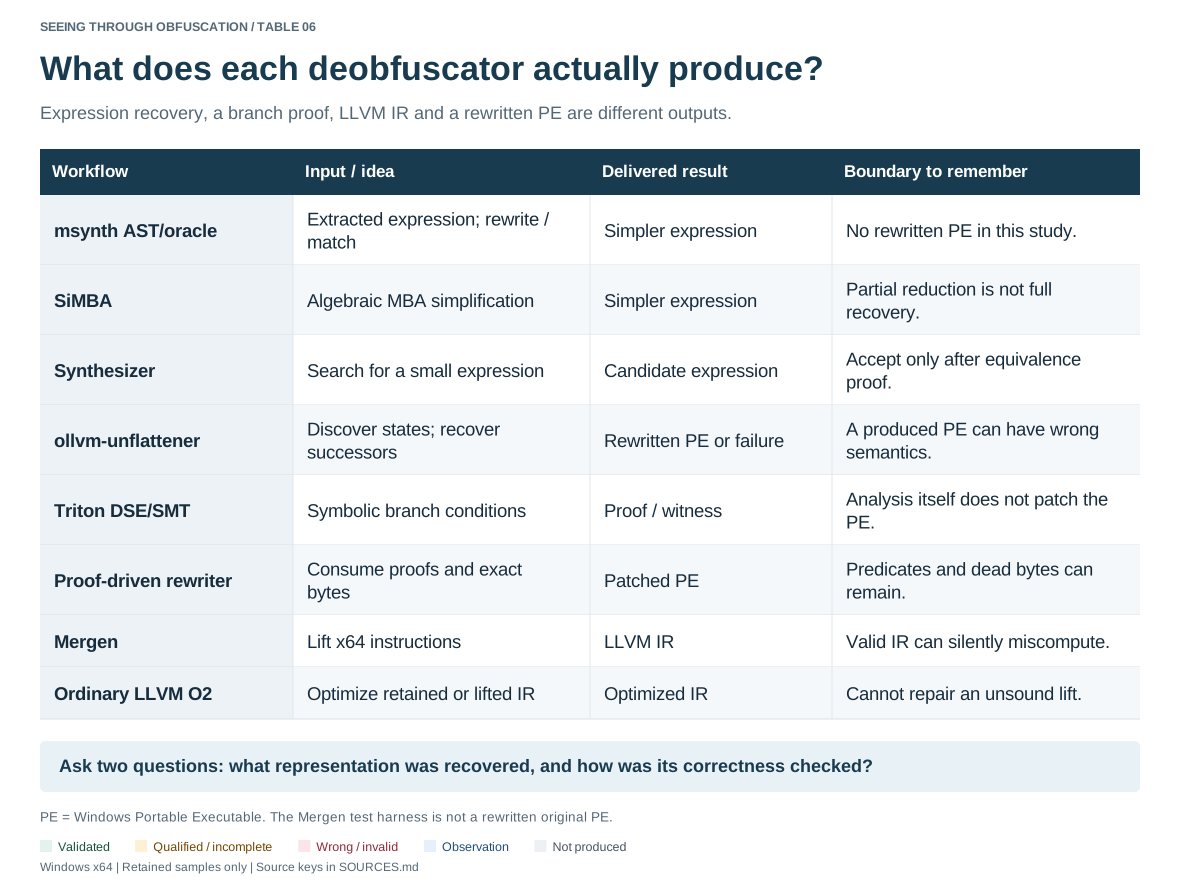
What does each deobfuscator actually produce?
Expression recovery, a branch proof, LLVM IR and a rewritten PE are different outputs.
| Workflow | Input / idea | Delivered result | Boundary to remember |
|---|---|---|---|
| msynth AST/oracle | Extracted expression; rewrite / match | Simpler expression | No rewritten PE in this study. |
| SiMBA | Algebraic MBA simplification | Simpler expression | Partial reduction is not full recovery. |
| Synthesizer | Search for a small expression | Candidate expression | Accept only after equivalence proof. |
| ollvm-unflattener | Discover states; recover successors | Rewritten PE or failure | A produced PE can have wrong semantics. |
| Triton DSE/SMT | Symbolic branch conditions | Proof / witness | Analysis itself does not patch the PE. |
| Proof-driven rewriter | Consume proofs and exact bytes | Patched PE | Predicates and dead bytes can remain. |
| Mergen | Lift x64 instructions | LLVM IR | Valid IR can silently miscompute. |
| Ordinary LLVM O2 | Optimize retained or lifted IR | Optimized IR | Cannot repair an unsound lift. |
Ask two questions: what representation was recovered, and how was its correctness checked?
PE = Windows Portable Executable. The Mergen test harness is not a rewritten original PE.Open the original lecture figure (SVG)
What it looks like in a disassembler#
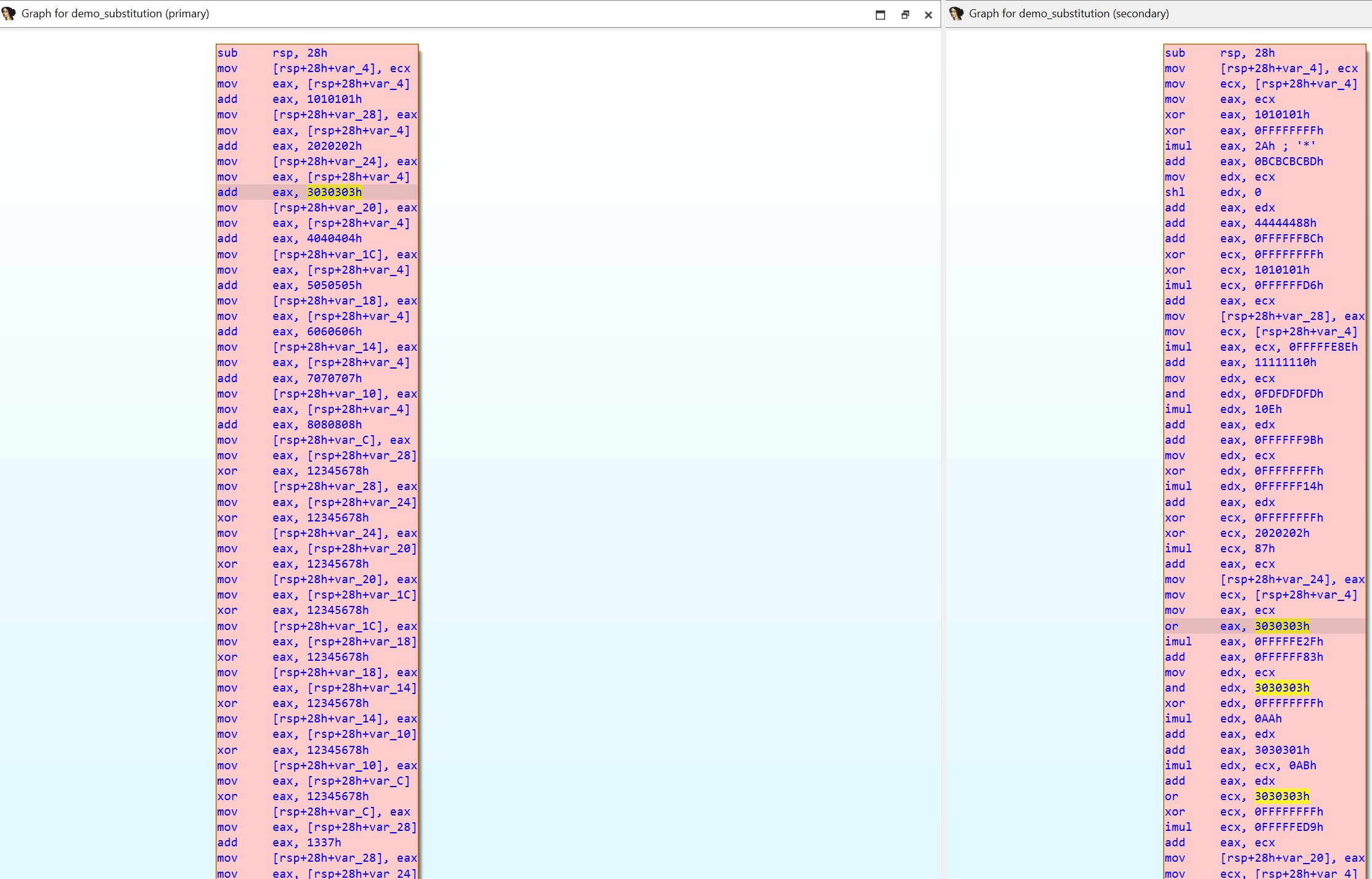
The reason a one-block function can be expensive: nothing here is structurally difficult, and the symbolic expression for the whole function is enormous. Correctness of any simplification of it comes from the retained equivalence proofs, not from this picture.
Studio: audit one accepted recovery and one UNKNOWN#
- Take site 0 from the MBA IR above and prove on paper that it equals
x + 0x01010101modulo 2³². State every step where the width matters. - Open
synthesis_expansion.jsonand find the two UNKNOWN records. For each, write the two obligations, the status of each, and one sentence on what is and is not known about that site. - Find a record where
already_canonical_before_msynthis relevant and explain why the study bothers to record that field. - In the composed-expression results, find the 305→79 reduction. Then state what you would still have to do before using the 79-node expression in an argument about the program.
A1 is due at the end of next week. Steps 1 and 2 are the shape of its two main sections.
- target_function.llthe full MBA IR for all 24 sites20 kB
- demo_substitution_disassembly.txt678 instructions of native MBA39 kB
- synthesis_expansion.jsonall 12 expansion records, with both SMT obligations each36 kB
- smt_overview.jsonevery solver status in the probe, counted922 B
- substitution_complex.cthe composed-expression probe source, frozen separately3 kB
- complex_arithmetic_deobfuscation.mdthe full composition study, including what failed27 kB
Come to the studio with
The studio assumes you have done these. Each is written so you can tell whether you have, without asking.
- you can evaluate `~(x ^ k)` and `(~x) ^ k` and say whether they are the same
- you know what SAT, UNSAT and UNKNOWN mean as answers to a question
- you can say what `modulo 2³²` changes about an algebraic identity