The method behind this example
Separate a proposed instruction from an authenticated change in authority.
Your independent challenge: The assigned archive uses different completeness and reference conditions. A later file can still be the wrong deliverable.
The investigated explanation and learning record complete this example. The scene delivery is an optional extension.
Start this worked example
- Choose Watch the worked example. The student demonstrator explains the task, talks through each action, then reviews the observations and finished submission. Narration starts with this click; Mute narration keeps the same experience captioned.
- Choose Take control to try the current chapter. Follow its prompt, change the labelled controls and select Test my decision.
- Read the feedback, retry if needed, then continue with Next chapter. Each checked chapter provides evidence for one connected operation.
- After every chapter check, return to the mission station, perform the intervention, collect its package and follow the marked checkpoints to complete the handover. Watching performs these same actions with narration. Direct chapter access is a partial preview until the full evidence and handover are complete.
- Use Fullscreen mission after opening the scene to keep the instructions, chapter controls and equipment together. Reflections and exports come after your practical attempt.
This is an alternate example, not your assigned exercise. Your course task is linked after the player.
YOUR SKILL
Digital investigation
A NEW SETTING
Three weather ledgers, an initially valid signed request, an unsigned proposed change and a later authenticated amendment with a repaired candidate.
WHAT CHANGES
An unsigned request cannot supersede the current authority. A later authenticated instruction and a separately verified repair justify a new selection; this example requires checking both authority and version identity.
Scene guide · people, evidence and object placement
People, proposed instructions and verified authority
Weather-ledger versions are compared with an authority register, including an unsigned proposal and a later authenticated instruction.
- Your part
- Watch follows a worked solution. Take control lets you move the student avatar and try its decisions. The demonstrator in the explanation is modelling a solution, not an extra witness in the story.
- Your instructor
- Mara stands in the marked teaching bay outside the investigation area. She guides the exercise. Her presence, appearance and idle gestures are not clues about what happened in the case.
- People in this scenario
- The requesters are represented through supplied messages and authority records. Mara does not authenticate a request by standing near it; the example learner checks the case’s register.
- What counts as evidence
- Check whether an instruction is authenticated, then compare the required completeness and identity. Keep an unverified message as a claim and preserve old record versions when a repaired version arrives.
- Why the objects are here
- The displayed books represent record versions, not their authors. Labels and timestamps identify a version; the supplied authority and comparison records justify using it.
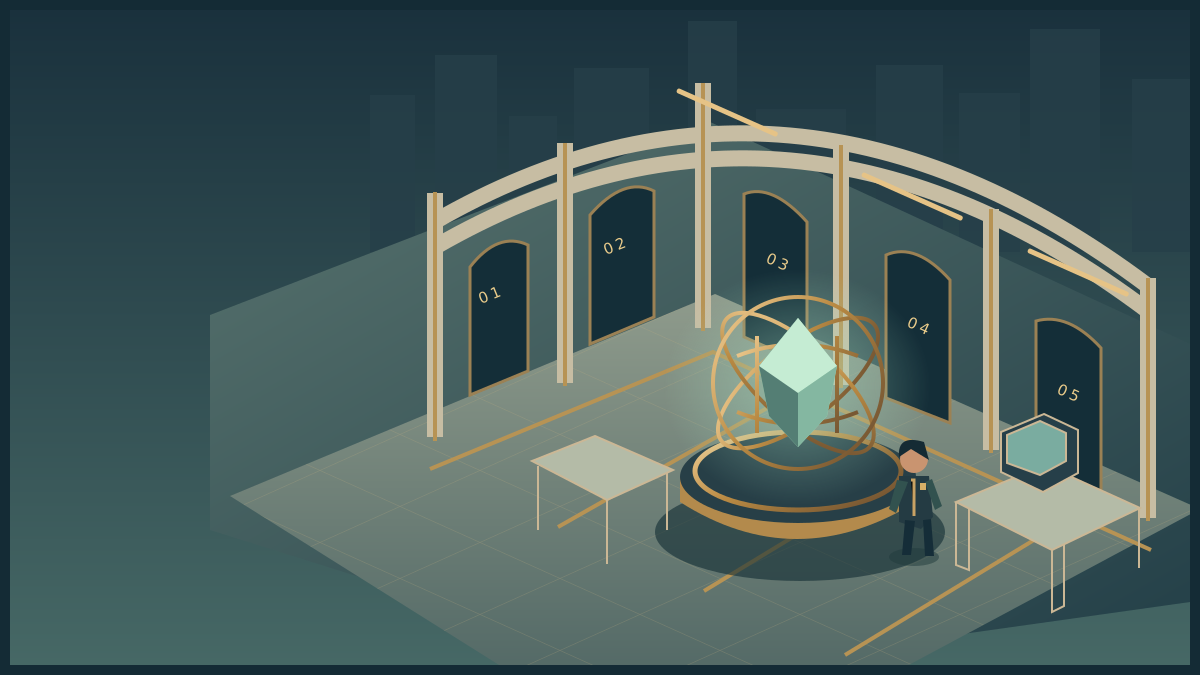
Digital Observatory
Watch the complete alternate example. Take control of the equipment whenever you are ready.
An alternate example · separate from your assessed workHow to move, inspect and complete the activity
Use WASD or arrow keys to walk. Press E near an instrument to examine it. Inspect means read its details; Use equipment performs the action named in its status message. The task controls let you choose exact settings and test a solution. Once verified, use the mission station to put it into effect, collect the resulting evidence or cargo, follow its checkpoints and complete the handover at the receiving station.
Scroll over the scene or use Zoom + / Zoom − for a closer or wider view. Click and drag to turn whenever the cursor is free. Choose Fullscreen mission to keep the scene, mission instructions and all task controls together. Fullscreen starts with a free cursor so you can scroll the panel and choose options. Press X or Lock cursor (X) to turn by moving the mouse. Press X again to free the cursor and return to click-and-drag turning. Tab also frees the cursor. The X shortcut stays inactive while typing or choosing a form value. Press Escape or Exit fullscreen to return to the page. On touchscreens, drag to look and use the zoom buttons. If your browser cannot enter native fullscreen, the mission expands to fill its window.
Choose Watch to follow the worked example, or Take control to try it yourself. The transcript and completed example remain available if 3D is unavailable. Demonstrations never change assessed progress.
I must choose a weather ledger using both content evidence and instruction authority. The case's register states which requests are authenticated. I will establish a valid first selection, receive an unsigned proposal, decide whether it can change the current requirement, then inspect a genuinely authenticated instruction and a repaired candidate. My completed timeline must explain a decision that stayed valid as well as a later justified change. The method we are practising is: Separate a proposed instruction from an authenticated change in authority.. Our field objective is: Deliver the weather ledger that satisfies the current authenticated request. An unsigned proposal cannot carry the same authority as a genuine amendment. The investigation and explained record complete this lesson. A scene delivery is an optional extension. You can pause, mute, replay, or take control at any point. The captions show the same explanation.
Narration starts after you choose Watch or Play. Captions remain available if this browser has no working voice.
Optional scene extension
Each chapter provides evidence for this operation. Inspect, investigate, act, and complete the handover.
FIELD OPERATION · Briefing
Operation Weather Register
Deliver the weather ledger that satisfies the current authenticated request.
An unsigned proposal cannot carry the same authority as a genuine amendment.
Inspect the mission station to begin your investigation.
Nothing collected.
Mission actions become available when the activity loads.
Mission record and accessible controls
These controls perform the same actions as the marked stations in the scene. Use them with a keyboard or touch, or when graphics are unavailable. Equipment tests establish whether your intervention is supported. The final handover records a mission outcome; your explanation is assessed separately.
- No mission actions yet.
The complete transcript and finished example are available below while the player loads.
THE DEMONSTRATOR’S REASONING
Identify which instruction can govern the choice
The published rule says that only an instruction marked authenticated in the supplied authority register can supersede the current request. Signed request R1 requires 18 sections with digest Q-7. North is 18/Q-7 at 07:50; East is 18/Q-9 at 07:20; South is 17/Q-2 at 07:35. The three book objects represent these version records.
Why this matters
A content match and an authorised requirement are separate conditions. A message about a new requirement is not automatically authority to change it.
A plausible mistake
Treating any later message as an amendment would remove the very check this case requires.
WHAT THE DEMONSTRATOR DID
YOUR LEARNING CONTROLS
Make the skill your own.
Record the required count and the rule for changing the request.
Watch the apparatus change as the student demonstrates. Take control whenever you want to test the same idea yourself.
BASED ON YOUR ATTEMPTS
Watching and practising are recorded separately in this visit. These examples do not change your assessed work or skills passport.
NOW TRANSFER THE SKILL
Carry the method into your own work.
The assigned archive uses different completeness and reference conditions. A later file can still be the wrong deliverable.
A COMPLETE WORKED SUBMISSION
Completed example — request authority and repaired weather ledger
Example work from this demonstration's scenario. Use it to understand the expected evidence and explanation, then make your own decisions in the assigned activity.
Download the complete exampleRead the finished work
Completed demonstration example — request authority and repaired weather ledger
This alternate example changes the authority problem. The assigned browser and campus transfer immediately provides a valid signed amendment. Here an unsigned message is not sufficient, and the later valid deliverable is a newly repaired version of a previously incomplete record.
Published authority rule
Only an instruction marked authenticated in the supplied authority register can supersede the current request. This is a fictional case-file rule; no live signature service is contacted.
Preserved timeline
| Time | Record | Direct result | Decision or limit |
|---|---|---|---|
| 07:05 | Authenticated R1 | Requires 18 sections and Q-7 | Governs the initial comparison |
| 07:20 | East | 18 sections, Q-9 | Complete but does not match R1 |
| 07:35 | Original South | 17 sections, Q-2 | Incomplete and different from R1 |
| 07:50 | North | 18 sections, Q-7 | Matches R1, although it is newest |
| 08:00 | Unsigned message | Says “Use East, Q-9”; register marks unverified | Record as a claim; retain North under R1 and request authentication |
| 08:15 | Authenticated R2 | Requires 18 sections and Q-12 | Legitimately supersedes R1; does not authenticate the earlier Q-9 message |
| 08:20 | South repair receipt S2 | Repaired version contains 18 sections and Q-12 | Verify this new version; select South S2 under R2 |
Preserved recommendations
1. Under R1: select North after count and digest checks. Its newer timestamp neither proves nor disproves correctness. 2. After the unsigned message: retain North as the currently authorised deliverable. Preserve the request, ask for authenticated authority and do not quietly promote the claim into a rule. 3. Under authenticated R2: select South S2, after separately checking authentication, 18 sections and Q-12. Preserve the original South record at 17/Q-2 and the original North justification.
Two independent checks
Authentication established what the current instruction required. The repair receipt and new comparison established what South S2 contained. Neither check could substitute for the other. The old incomplete South file was not silently rewritten into a successful historical result.
Limits and next check
Agreement with the authenticated reference establishes identity and completeness within this case. It does not prove the scientific accuracy of the weather observations. The unsigned Q-9 proposal remains an unverified account; the later R2 does not retroactively authorise it. Its origin and purpose would need separate investigation.
Reflection
I initially expected a later request to trigger a different selection. The authority rule showed why keeping North at 08:00 was the justified action. When an authenticated instruction and a newly repaired record later appeared, I changed to South S2 for two explicit reasons. The useful method is to verify authority and content, not to memorise “choose the first copy, then the second.” My assigned case has different rules and records, so I must read those afresh.
Named output: evidence-timeline. Demonstration material, not an assigned response.
Method to carry forward
Separate a proposed instruction from an authenticated change in authority.
The assigned archive uses different completeness and reference conditions. A later file can still be the wrong deliverable.
The complete example explains one defensible approach. In your own challenge, select observations and tests from the supplied rules, keep your prediction separate from the result, and justify both the checks you perform and those you omit.
The chapter investigation and its explained record complete the core method. The scene delivery is an optional extension; it is not evidence of deeper understanding on its own.
Complete transcript and decisions · readable without JavaScript
Before we begin · expected task and evidence
I must choose a weather ledger using both content evidence and instruction authority. The case's register states which requests are authenticated. I will establish a valid first selection, receive an unsigned proposal, decide whether it can change the current requirement, then inspect a genuinely authenticated instruction and a repaired candidate. My completed timeline must explain a decision that stayed valid as well as a later justified change. The method we are practising is: Separate a proposed instruction from an authenticated change in authority.. Our field objective is: Deliver the weather ledger that satisfies the current authenticated request. An unsigned proposal cannot carry the same authority as a genuine amendment. The investigation and explained record complete this lesson. A scene delivery is an optional extension. You can pause, mute, replay, or take control at any point. The captions show the same explanation.
1. Identify which instruction can govern the choice
What I need to do: Step 1. Identify which instruction can govern the choice. I read the rule for a request to supersede the current authority. I record R1's section count and digest before comparing the candidates.
Supplied context: The published rule says that only an instruction marked authenticated in the supplied authority register can supersede the current request. Signed request R1 requires 18 sections with digest Q-7. North is 18/Q-7 at 07:50; East is 18/Q-9 at 07:20; South is 17/Q-2 at 07:35. The three book objects represent these version records.
Watch my actions: For "Required sections", I enter 18. For "What may supersede R1?", I choose "Authenticated instruction". I check the demonstrated result.
What I observed: The comparison has both a completeness requirement and an explicit authority rule. A content match and an authorised requirement are separate conditions. A message about a new requirement is not automatically authority to change it.
Why: A content match and an authorised requirement are separate conditions. A message about a new requirement is not automatically authority to change it.
Decision: Record the required count and the rule for changing the request.
- Required sections: 18
- What may supersede R1?: Authenticated instruction
Result: The comparison has both a completeness requirement and an explicit authority rule.
Common mistake: Treating any later message as an amendment would remove the very check this case requires.
2. Separate chronology from selection
What I need to do: Step 2. Separate chronology from selection. I order East, South and North by their timestamps. North is newest here; that does not make it either right or wrong. The reference comparison decides the selection.
Supplied context: The records arrived East, South, North. North is newest in this example. Recency alone neither qualifies nor disqualifies it: the next step must still compare count and digest with authenticated R1.
Watch my actions: I arrange "Record timeline" in this order: East 07:20, then South 07:35, then North 07:50. I check the demonstrated result.
What I observed: The timeline is recorded without turning newest or oldest into an authenticity rule. “Never choose the newest” is as unsupported as “always choose the newest.” Timing and content answer different questions.
Why: “Never choose the newest” is as unsupported as “always choose the newest.” Timing and content answer different questions.
Decision: Order the records without treating their order as the selection rule.
- Record timeline: East 07:20 → South 07:35 → North 07:50
Result: The timeline is recorded without turning newest or oldest into an authenticity rule.
Common mistake: Rejecting North merely because it is newest replaces evidence with a blanket recency rule.
3. Select the copy supported by R1
What I need to do: Step 3. Select the copy supported by R1. I compare every record against R1. North has both eighteen sections and Q-7; the alternatives fail at least one required condition.
Supplied context: North has both the required 18 sections and Q-7 digest. East is complete but differs from R1; the original South is incomplete and has Q-2. The demonstrator selects North because it meets both requirements, not because it is newest.
Watch my actions: For "Selection under R1", I choose "North". I check the demonstrated result.
What I observed: North is supported by count and digest under the current authenticated request. The same candidate can be newest and correct; only the actual count and reference comparison justify that decision.
Why: The same candidate can be newest and correct; only the actual count and reference comparison justify that decision.
Decision: Select the version that meets authenticated R1.
- Selection under R1: North
Result: North is supported by count and digest under the current authenticated request.
Common mistake: A correct answer reached only by timestamp luck is weaker than the stated two-part check.
4. Do not promote an unsigned message into authority
What I need to do: Step 4. Do not promote an unsigned message into authority. The later message proposes East, but the authority register marks the request unverified. I preserve it as a claim, retain North under the still-current R1, and request authentication.
Supplied context: At 08:00 an unsigned message says “Use East, Q-9 instead.” The authority register marks that message unverified. Nothing has superseded R1. The demonstrator records the proposed change as a claim, keeps North as the current authorised selection, and asks for an authenticated instruction.
Watch my actions: For "Status of the 08:00 message", I choose "Unverified; ask for authority". For "Current selection while authority is unresolved", I choose "North". I check the demonstrated result.
What I observed: The unsigned proposal is preserved as a claim and North remains valid under R1. A plausible or later instruction can remain a claim. Preserving a valid decision while checking authority is an active evidence-based response.
Why: A plausible or later instruction can remain a claim. Preserving a valid decision while checking authority is an active evidence-based response.
Decision: Classify the proposed change and decide which version is currently authorised.
- Status of the 08:00 message: Unverified; ask for authority
- Current selection while authority is unresolved: North
Result: The unsigned proposal is preserved as a claim and North remains valid under R1.
Common mistake: Immediately switching to East would treat an unverified request as an authenticated instruction.
5. Check genuine authority and a repaired version independently
What I need to do: Step 5. Check genuine authority and a repaired version independently. The register now authenticates R2, requiring Q-12. A separate repair receipt supplies South S2 with eighteen sections and Q-12. I verify both the authority and the new version before changing the selection.
Supplied context: The register later authenticates instruction R2, issued at 08:15, requiring 18 sections with Q-12. It does not authenticate the earlier Q-9 message. A repair receipt publishes South version S2 at 08:20: 18 sections and Q-12. South’s original 17/Q-2 record remains preserved. The demonstrator checks both the new authority and the repaired version before selecting South S2.
Watch my actions: I set "R2 marked authenticated in supplied register" to yes. For "Selection under authenticated R2", I choose "South". For "South version to transfer", I choose "Repaired S2: 18 sections / Q-12". I check the demonstrated result.
What I observed: South S2 is supported by authenticated R2 and its new completeness and identity checks. An authoritative requirement does not repair a file, and a repaired file does not authorise itself. Both new facts must be verified.
Why: An authoritative requirement does not repair a file, and a repaired file does not authorise itself. Both new facts must be verified.
Decision: Confirm the authenticated instruction and choose the version that now satisfies it.
- R2 marked authenticated in supplied register: Yes
- Selection under authenticated R2: South
- South version to transfer: Repaired S2: 18 sections / Q-12
Result: South S2 is supported by authenticated R2 and its new completeness and identity checks.
Common mistake: Neither the unsigned East request nor the old incomplete South record satisfies R2.
6. Preserve the decision that stayed and the decision that changed
What I need to do: Step 6. Preserve the decision that stayed and the decision that changed. I keep three distinct decisions: North under R1, no authorised change from the unsigned message, and South S2 under authenticated R2. I preserve the incomplete original South and explain the remaining scientific limit.
Supplied context: The final timeline retains North under R1, the rejected-as-authority unsigned East request, and South S2 under authenticated R2. It also retains South’s earlier incomplete version. The demonstrator limits the conclusion to authority, completeness and identity; the weather observations still need their own scientific checks.
Watch my actions: For "Final recommendation", I choose "Retain R1; verify R2 and S2". I check the demonstrated result.
What I observed: The completed record explains both retaining a valid selection and making a later justified revision. A traceable record explains why one proposed change was withheld and a later different change was justified.
Why: A traceable record explains why one proposed change was withheld and a later different change was justified.
Decision: Choose the conclusion that preserves the full sequence and its limit.
- Final recommendation: Retain R1; verify R2 and S2
Result: The completed record explains both retaining a valid selection and making a later justified revision.
Common mistake: A final correct file name cannot replace the explanation of which authority and which version made it correct.
Optional field extension
All chapter evidence checks are complete. I return to the mission station and release the verified weather package. I am putting the verified solution into effect, then checking what changes.
I collect Authenticated weather-ledger package. The verified intervention released this package. I now carry it through the marked handover route.
I carry Authenticated weather-ledger package to Register verification desk. I confirm this checkpoint before continuing so the handover trace records the route actually followed.
I carry Authenticated weather-ledger package to Weather-team receiving station. I confirm this checkpoint before continuing so the handover trace records the route actually followed.
At the receiving station, I deliver the authenticated ledger. I check the receipt before calling the field operation complete.
My observations and finished submission
North met authenticated R1: eighteen sections and Q-7. It happened to be newest, but the count and digest justified it. An unsigned eight o'clock message requested East and Q-9. Because the register marked that message unverified, I retained North and asked for authority. Later, authenticated R2 required eighteen sections and Q-12, and South version S2 supplied exactly that after a recorded repair. I checked those two new facts separately before selecting South S2. I preserved the original incomplete South, the North decision and the unsigned message. The final recommendation verifies authority, completeness and identity, not the scientific truth of every weather observation. Separate a proposed instruction from an authenticated change in authority. Open "Read the finished work" or download the complete example to inspect the evidence and explanation together. The assigned archive uses different completeness and reference conditions. A later file can still be the wrong deliverable.
The complete submission is available in Read the finished work above and as a Markdown download.