The method behind this example
Change the method when its dependencies fail while keeping the objective and unresolved obligations explicit.
Your independent challenge: Lamplight first tests physical recovery, then uses a portable digital carrier. Last Light offers terminal transmission, physical carriage or supported handover; select only the checks your chosen approach actually needs.
The example includes the practical intervention and its required handover.
Start this worked example
- Choose Watch the worked example. The student demonstrator explains the task, talks through each action, then reviews the observations and finished submission. Narration starts with this click; Mute narration keeps the same experience captioned.
- Choose Take control to try the current chapter. Follow its prompt, change the labelled controls and select Test my decision.
- Read the feedback, retry if needed, then continue with Next chapter. Each checked chapter provides evidence for one connected operation.
- After every chapter check, return to the mission station, perform the intervention, collect its package and follow the marked checkpoints to complete the handover. Watching performs these same actions with narration. Direct chapter access is a partial preview until the full evidence and handover are complete.
- Use Fullscreen mission after opening the scene to keep the instructions, chapter controls and equipment together. Reflections and exports come after your practical attempt.
This is an alternate example, not your assigned exercise. Your course task is linked after the player.
YOUR SKILL
Integration of all twelve capabilities
A NEW SETTING
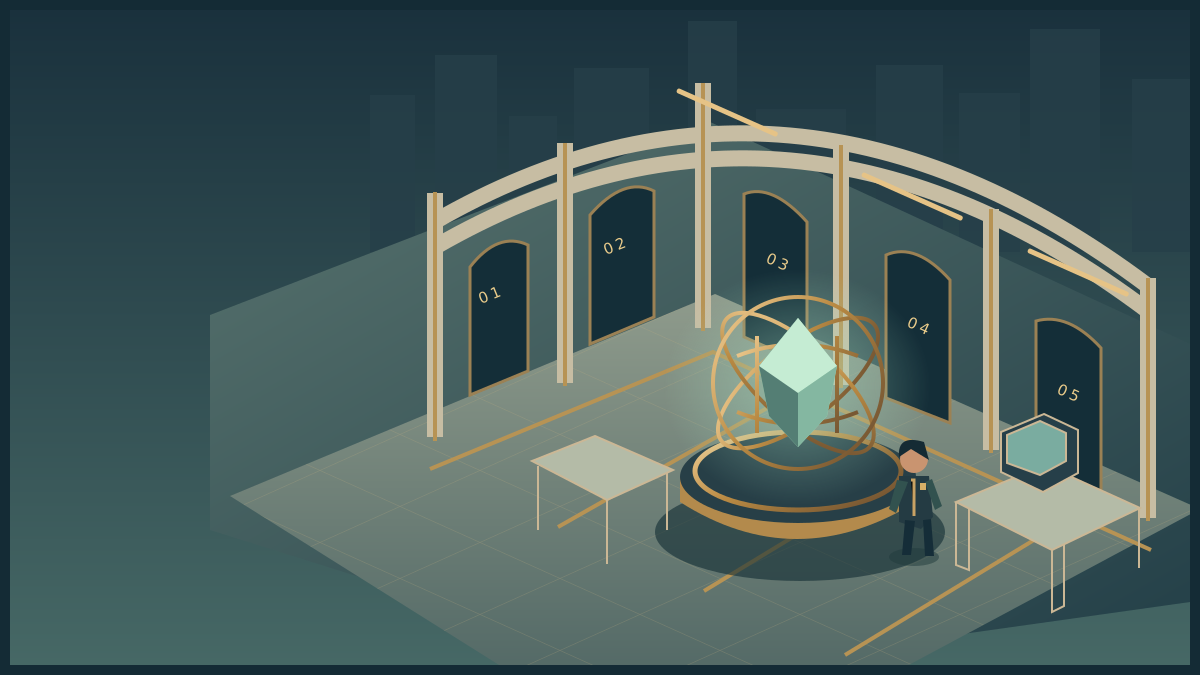
Storm-damaged Halcyon Observatory: arrival desk, workshop, power bay, record dome, instrumented gallery and dispatch balcony.
WHAT CHANGES
Halcyon, the star atlas, H-3/H-8 records, 24/36 lift, nine-volt circuit, kit and crew are separate from Meridian's assigned operation.
Scene guide · people, evidence and object placement
Who belongs to Operation Lamplight
Halcyon Observatory: an alternate worked final mission.
- Your part
- Watch follows a worked solution. Take control lets you move the student avatar and try its decisions. The demonstrator in the explanation is modelling a solution, not an extra witness in the story.
- Your instructor
- Mara stands in the marked teaching bay outside the investigation area. She guides the exercise. Her presence, appearance and idle gestures are not clues about what happened in the case.
- People in this scenario
- Lena observes and navigates; Omar diagnoses systems; Priya investigates; Jonah coordinates. They are the example team named in the narration and contribution records. The controllable student lets you try their decisions; Mara remains the instructor.
- Quill is the original's custodian and Venn is the named recipient in custody and receipt records. They are not Mara or the student. Their statements and receipts are evidence to check; the labelled council dossiers identify these roles.
- What counts as evidence
- Use the labelled arrival evidence, apparatus readings, signed references, capacity limits, routes and custody receipts. Keep the baseline, revised rehearsal and final run separate.
- Why the objects are here
- The observation room depicts arrival details. Other chapters use labelled lift, circuit, route and planning models; they do not depict every physical action at full scale.
Operations Studio
Watch the complete alternate example. Take control of the equipment whenever you are ready.
An alternate example · separate from your assessed workHow to move, inspect and complete the activity
Use WASD or arrow keys to walk. Press E near an instrument to examine it. Inspect means read its details; Use equipment performs the action named in its status message. The task controls let you choose exact settings and test a solution. Once verified, use the mission station to put it into effect, collect the resulting evidence or cargo, follow its checkpoints and complete the handover at the receiving station.
Scroll over the scene or use Zoom + / Zoom − for a closer or wider view. Click and drag to turn whenever the cursor is free. Choose Fullscreen mission to keep the scene, mission instructions and all task controls together. Fullscreen starts with a free cursor so you can scroll the panel and choose options. Press X or Lock cursor (X) to turn by moving the mouse. Press X again to free the cursor and return to click-and-drag turning. Tab also frees the cursor. The X shortcut stays inactive while typing or choosing a form value. Press Escape or Exit fullscreen to return to the page. On touchscreens, drag to look and use the zoom buttons. If your browser cannot enter native fullscreen, the mission expands to fill its window.
Choose Watch to follow the worked example, or Take control to try it yourself. The transcript and completed example remain available if 3D is unavailable. Demonstrations never change assessed progress.
We are Lena, Omar, Priya and Jonah, the example team for Operation Lamplight at Halcyon Observatory. We must recover verified research while preserving original records and custody. I will narrate our shared decisions, showing who owns each check and who receives it. We will preserve a baseline rehearsal, respond to a disruption, test a revised plan, execute the final run, and assemble the dossier, presentation script and delivery plan and individual defences. This is a complete alternate example for learning the method; your assigned operation has different conditions. The method we are practising is: Change the method when its dependencies fail while keeping the objective and unresolved obligations explicit.. Our field objective is: Deliver verified Cinder research from Halcyon while Quill retains the supported original. The east closure, withdrawn cradle and signed H-8 amendment invalidate physical recovery. I will perform the supported intervention and handover. You can pause, mute, replay, or take control at any point. The captions show the same explanation.
Narration starts after you choose Watch or Play. Captions remain available if this browser has no working voice.
Perform the practical outcome
Each chapter provides evidence for this operation. Inspect, investigate, act, and complete the handover.
FIELD OPERATION · Briefing
Operation Lamplight
Deliver verified Cinder research from Halcyon while Quill retains the supported original.
The east closure, withdrawn cradle and signed H-8 amendment invalidate physical recovery.
Inspect the mission station to begin your investigation.
Nothing collected.
Mission actions become available when the activity loads.
Mission record and accessible controls
These controls perform the same actions as the marked stations in the scene. Use them with a keyboard or touch, or when graphics are unavailable. Equipment tests establish whether your intervention is supported. The final handover records a mission outcome; your explanation is assessed separately.
- No mission actions yet.
The complete transcript and finished example are available below while the player loads.
THE DEMONSTRATOR’S REASONING
State Operation Lamplight's contract
Halcyon Observatory needs verified star-atlas research recovered after a storm. Preserve the original records and document custody. Physical removal is a preferred method, not the only acceptable research-access result.
Why this matters
A clear objective allows the team to judge later alternatives without disguising a changed goal.
A plausible mistake
Confusing the physical object with the entire objective can force a needless failure later.
WHAT THE DEMONSTRATOR DID
YOUR LEARNING CONTROLS
Make the skill your own.
Choose the mission's actual success condition.
Watch the apparatus change as the student demonstrates. Take control whenever you want to test the same idea yourself.
BASED ON YOUR ATTEMPTS
Watching and practising are recorded separately in this visit. These examples do not change your assessed work or skills passport.
NOW TRANSFER THE SKILL
Carry the method into your own work.
Lamplight first tests physical recovery, then uses a portable digital carrier. Last Light offers terminal transmission, physical carriage or supported handover; select only the checks your chosen approach actually needs.
A COMPLETE WORKED SUBMISSION
Complete final-project model submission — Operation Lamplight
Example work from this demonstration's scenario. Use it to understand the expected evidence and explanation, then make your own decisions in the assigned activity.
Download the complete exampleRead the finished work
Complete authored final-project example — Operation Lamplight
Example status
This is a complete authored teaching submission package for an alternate operation at fictional Halcyon Observatory. It is not a real team's work, a record of student playtesting or an answer to Operation Last Light. The event records describe the narrated example's domain states. No physical equipment test or delivered presentation is claimed.
Mission contract
Objective: recover usable research matching the current signed star-atlas reference while preserving the original records and an explicit custody trail.
Initial preference: supported physical recovery. This is a method, not an unconditional objective.
Constraints: verify content identity; verify support before movement; retain a named custodian; use the current published route and permission rules.
Stop conditions: an unresolved identity mismatch, support below the load requirement, an unavailable route or an unconfirmed custody handoff blocks the dependent action.
Resolution alternatives: supported original transfer, verified digital recovery, or stabilisation pending handover. Each requires a defensible match to the stated contract.
Six areas
- Arrival desk — observation, recall and initial contract.
- Workshop — connector and lift.
- Power bay — support-circuit diagnosis.
- Record dome — atlas comparison and permission charter.
- Instrumented gallery — route prediction, closure and revision.
- Dispatch balcony — agreement, receipt and debrief.
Team agreement and contribution record
| Person | Principal role | Own evidence | Cross-role dependency reviewed |
|---|---|---|---|
| Lena | Observer / navigator | Arrival record, kit recall, route prediction and trace | Omar's support verification before route recommendation |
| Omar | Systems specialist | Connector mapping, gear/readiness record, powered and isolated circuit trace | Priya's distinction between identity and physical requirements |
| Priya | Investigator | Both manifests, copy comparisons and permission expectations | Jonah's objective and custody agreement |
| Jonah | Coordinator | Contract, explicit handoffs, council agreement, preserved plans and receipt | Priya's current-reference result and Omar's support limit |
Any member can stop a dependent action when its published prerequisite is unresolved. A result is handed to its recipient explicitly rather than assumed to be shared.
Complete evidence register
- Arrival: 06:45, blue beacon, open hatch, cracked outer case. “All plates intact” remains a claim; outer damage alone does not establish internal loss.
- Kit: Wedge, Lens, Spool, Beacon at Gate, Basin, Workshop, Dome. The first retrieval swapped the middle items; the corrected retrieval and written checklist were both retained.
- Connector: initial north/west at level 0; clockwise 270 degrees gives west/south; translation to level 1 preserves orientation.
- Lift: driver 24, follower 36, input 6, output 4 opposite. Interlock released, cam 270, spring attached. Ratio and readiness checked separately.
- Circuit: powered source/fuse/cable/lamp 9/9/0/0 V; open cable diagnosed; isolated replacement; restored 9/9/9/9 V plus lamp light.
- Initial atlas requirement: 30 sections, H-3. Aster 30/H-3; Cinder 30/H-8; Dawn 29/H-1. Aster selected under the original authority.
- Permission charter: every role reads; maintainer services; custodian approves; all other combinations deny. Positive and negative cases checked.
- Environmental-pack handoff: West Store / 3 / AZURE, complete read-back and confirmation.
- Capacity: original mass 9; bare carrier capacity 7; checked cradle-supported capacity 11.
- Baseline route: 20 → 21 → 22 → 23 → 18 → 13 → 8 → 3. Sensor set 6, 7, 12. Predicted contacts 0; model trace contacts 0.
Route verification records
Cells use the same five-by-five, row-major grid in every record: 0–4 are the top row and 20–24 the bottom row. Moves join orthogonally adjacent cells. A contact is recorded on entry to a listed sensor cell; one contact is an observation event, not an automatic mission failure.
Preserved baseline — B-ROUTE-01: start 20; goal 3; route 20 → 21 → 22 → 23 → 18 → 13 → 8 → 3; sensors 6, 7, 12. Prediction: zero contacts. Authored trace: 20 (0), 21 (0), 22 (0), 23 (0), 18 (0), 13 (0), 8 (0), 3 (0), where parentheses give cumulative contacts. This original record remains unchanged.
Published storm route notice — H-ROUTE-02: east-gallery cells 23, 18, 13 and 8 are closed. The available west path is 20 → 15 → 10 → 5 → 0 → 1 → 2 → 3. Its current published sensor pattern is 5, 6, 12. Every move is adjacent, no closed cell is entered, and the only sensor entered is cell 5. Lena predicts one contact before each execution.
| West-path entry | Sensor contact on entry | Rehearsal 2 cumulative contacts | Final-run cumulative contacts |
|---|---|---|---|
| 20 (start) | No | 0 | 0 |
| 15 | No | 0 | 0 |
| 10 | No | 0 | 0 |
| 5 | Yes | 1 | 1 |
| 0 | No | 1 | 1 |
| 1 | No | 1 | 1 |
| 2 | No | 1 | 1 |
| 3 (goal) | No | 1 | 1 |
R2-ROUTE-02, authored 07:17: observed sequence equals the published west path; one contact at 5 matches the prior prediction. F-ROUTE-03, authored 07:10: the final run rechecks H-ROUTE-02, then records the same sequence and one contact independently. The earlier zero-contact result is never reused as the revised prediction.
Custody and receipt register
The original is O-HAL-01, the mass-nine star-atlas plate case initially held by Dr Edda Quill, observatory custodian, at Record dome, stable cabinet RD-2. The declared stable state is the closed case resting on the cabinet support with the position marker unchanged. This records preservation within the model; it does not establish the unseen condition of every plate.
The receiving archivist is Dr Tomas Venn at Dispatch balcony, intake DB-1. Jonah coordinates each handoff; Priya checks the content reference; Quill exercises the custodian approval. The digital carrier is DC-H8, containing the thirty-section Cinder package matching H-8. It travels along the west path; O-HAL-01 remains at RD-2. Carrier mass is 0.2 units, within the remaining capacity-seven handling limit.
Each rehearsal and the final run is a separate authored simulation starting with O-HAL-01 at RD-2 under Quill's custody. The baseline's simulated movement does not remove it from the next run's initial state. All times below are authored scenario event times, not browser-measured performance.
| Record | Authority and item | Transfer, location and acknowledgement |
|---|---|---|
| B-CUST-01 / B-RCPT-01, 07:12 | Initial H-3 authority; O-HAL-01 with accompanying Aster 30/H-3 record | Quill releases the supported original to Venn at DB-1 after the capacity-eleven cradle and baseline route checks. Venn acknowledges: “Received O-HAL-01 and Aster, thirty sections, H-3, at DB-1.” Baseline end custodian: Venn; end location: DB-1. |
| R2-CUST-02 / R2-RCPT-02, 07:26 | Signed H-8 amendment; carrier DC-H8 with Cinder 30/H-8; route R2-ROUTE-02 | Quill authorises the copy and retains O-HAL-01 at RD-2. Venn checks both section count and H-8, then acknowledges: “Received DC-H8, Cinder, thirty sections, H-8, at DB-1. Original O-HAL-01 remains with Dr Edda Quill at RD-2.” Jonah records the acknowledgement and Quill confirms the retained position marker. |
| F-CUST-03 / F-RCPT-03, 07:19 | Current H-8 authority rechecked; carrier DC-H8 with Cinder 30/H-8; route F-ROUTE-03 | Priya repeats the count/reference check; Venn independently acknowledges the same complete copy and retained-original details under receipt F-RCPT-03. Quill confirms O-HAL-01 is still closed, supported and unmoved at RD-2. Final copy recipient: Venn at DB-1; original custodian: Quill at RD-2. |
The copy receipts do not claim transfer of the physical original. A later physical handover requires a new supported handling plan and a new custody record.
Preserved Version 1
Inspect arrival → restore apparatus → verify H-3 atlas → verify cradle → cross east gallery → confirm custody.
Supporting conditions: H-3 reference current; east gallery available; cradle verified; supported capacity 11 for mass 9. Original objective and preferred physical method are recorded separately.
Rehearsal 1 — Baseline
| Checkpoint | Predicted / required | Authored result |
|---|---|---|
| Scene and kit | Record observations and retrieve four items | Middle-item recall substitution corrected and retained |
| Connector / lift | West/south at level 1; 4 opposite output turns | Both requirements met |
| Circuit | Localise supply break, isolate, verify | Open cable repaired; 9 V and light confirmed |
| Atlas / authority | 30/H-3; authorised custodian approval | Aster selected; positive and negative permission checks agree |
| Handling / route | Capacity 11 ≥ mass 9; east gallery available; 0 contacts | Supported path meets conditions |
| Custody | Quill releases O-HAL-01 to Venn at DB-1 under H-3 | B-CUST-01 and B-RCPT-01 record the physical item, Aster 30/H-3, recipient, location and 07:12 acknowledgement |
Result: supported physical recovery under baseline conditions. This result does not authorise movement after those conditions change.
Rehearsal 2 — Published storm changes
Notice: the east gallery closes and the cradle is unavailable. The remaining carrier capacity is 7 for a mass-9 original. A signed amendment requires the 30-section annotated H-8 research copy.
| Checkpoint | Proposed or expected | Authored result and diagnosis |
|---|---|---|
| Reuse physical plan | Continue the successful baseline | Stopped before movement: missing cradle invalidates support |
| Scope the change | Preserve valid evidence | Connector/circuit results retained within scope; current route and reference rechecked |
| Current atlas | Match amended 30/H-8 authority | Cinder selected; Aster's historical H-3 result preserved |
| New agreement | Research access with original preserved | Quill authorises DC-H8/Cinder and retains O-HAL-01, closed and supported at RD-2; R2-CUST-02 |
| Revised route | H-ROUTE-02: 20 → 15 → 10 → 5 → 0 → 1 → 2 → 3; sensors 5, 6, 12; predicted 1 contact | R2-ROUTE-02 records the same sequence and one contact at 5; closed east cells are avoided |
| Receipt | Venn confirms DC-H8/Cinder 30/H-8 at DB-1 and Quill's retained original at RD-2 | R2-RCPT-02 records the full acknowledgement at 07:26 |
Result: verified digital recovery after a documented revision. No unsupported original movement occurs.
Version 2 and revision rationale
Preserve original → verify H-8 copy → agree digital custody → check west route → transfer copy → confirm receipt.
The revision changes the affected transport and content conditions. It does not pretend the original baseline was unreasonable, erase its evidence or silently redefine physical recovery as digital recovery. The research-access objective remains; the preferred method changes. The original stays stable with the observatory custodian. Future physical-provenance work requires a supported handover.
Final run record
Current checks repeat rather than inheriting permanent approval from rehearsal. Priya verifies Cinder has 30 sections/H-8 under the current signed authority. Lena reads H-ROUTE-02, predicts one contact on 20 → 15 → 10 → 5 → 0 → 1 → 2 → 3, and records one contact at 5 in F-ROUTE-03. Venn confirms receipt of DC-H8/Cinder at DB-1 in F-RCPT-03 at 07:19. Quill confirms original O-HAL-01 remains closed, supported and unmoved at RD-2 in F-CUST-03. The precise trace and acknowledgements appear in the registers above.
Resolution: verified digital recovery with the original stabilised in place.
Consequence: research access is achieved while physical-original transport remains outstanding. Matching a reference does not establish calibration or scientific correctness.
Team account (984 words)
Operation Lamplight asked us to recover usable, verified star-atlas research from Halcyon Observatory while preserving the original instrument records. We defined success as delivering the currently authorised research copy or original with a documented custody trail. Physical removal was our initial preference, not an unconditional requirement. We agreed to stop any movement whose support conditions were unverified. This distinction mattered when the storm changed both the route and the equipment available to us.
Our four roles were observer/navigator, systems specialist, investigator and coordinator. The observer owned the arrival record and route predictions. The systems specialist owned the connector, lift and support-circuit checks. The investigator owned manifest comparison and permission expectations. The coordinator owned handoffs, custody and changes to the shared plan. We required each result to reach another role: a private successful test could not silently become permission for the whole team to act. Each member also reviewed one dependency outside their main responsibility.
At the arrival desk, the observer recorded a 06:45 display, blue beacon and open inspection hatch. A note claimed all atlas plates were intact. We preserved that statement as an account rather than an observation of every plate. The cracked outer case was evidence of damage to the case, not proof that every record inside was lost. This separation prevented the atmosphere of the scene from deciding the investigation before the manifest and handling checks had taken place.
The route-kit exercise used Wedge, Lens, Spool and Beacon at Gate, Basin, Workshop and Dome. The observer initially swapped the middle two items, then strengthened the Lens-at-Basin image and retrieved the sequence with the list covered. We retained that correction. The mnemonic supported carrying a short instruction set between stations, but the written kit remained available for consequential verification. We did not turn successful recall into a claim of unlimited memory or make memory a substitute for a required check.
The workshop connector began north/west at level zero. A 270-degree clockwise rotation mapped its ports to west/south; moving it to level one changed height without changing orientation. The lift then required four output turns from six input turns using a 24-tooth driver. The systems specialist selected a 36-tooth follower, released the interlock, set the 270-degree cam and attached the spring. Six input turns produced four opposite output turns. The model trace explains both the ratio and the readiness conditions; merely showing movement would have omitted half the diagnosis.
The support circuit provided another independent check. Powered readings were nine volts at the source and fuse output, then zero after the cable and at the lamp supply. That transition supported an open cable. The specialist isolated power, replaced the cable and restored power. Nine volts at the lamp together with visible light verified the complete repair. We treated these as authored model observations, not hardware measurements, and kept the apparatus state beside each reading so isolated zeros could not be mistaken for diagnostic evidence.
Under the initial signed reference, the required atlas contained thirty sections with digest H-3. Aster met both conditions, Cinder contained thirty with H-8 after annotation, and Dawn contained twenty-nine with H-1. The investigator selected Aster and stated the limit: a digest match establishes identity against that reference, not the scientific truth of every stellar observation. The local charter allowed all roles to read, maintainers to service and custodians to approve release. We checked useful operations as well as denied ones so a blanket lockout could not masquerade as a repair.
The coordinator arranged a delivery of three environmental packs to West Store with code AZURE. The receiver read back all fields before confirmation. At the council, the original atlas had mass nine while the unsupported carrier capacity was seven. A verified cradle raised supported capacity to eleven. The custodian accepted either a documented verified-copy transfer or supported original movement under the initial research-access mandate. We selected physical recovery for the baseline rehearsal only after the cradle check, rather than treating a confident equipment claim as permission.
Rehearsal one used the baseline conditions. The instrumented route was 20, 21, 22, 23, 18, 13, 8, 3 with published sensor cells 6, 7 and 12. We predicted zero contacts and the recorded model trace agreed. With the cradle verified, Aster selected and custody confirmed, physical recovery met the stated conditions. We saved this as Version 1. Its success demonstrated the plan under those conditions; it did not prove that the same sequence would remain possible after the storm.
The second rehearsal introduced a published east-gallery closure and made the cradle unavailable. The unsupported carrier still had capacity seven, so moving the nine-unit original could not be justified. A signed amendment also required the annotated H-8 research copy. We stopped the original transport proposal before movement, preserved the baseline result and revised the plan. Cinder became the correct current copy; the historical Aster comparison remained valid under H-3. The coordinator negotiated verified digital recovery while leaving the original stable with the custodian.
Version 2 retained the successful connector and circuit findings within their stated scope, added a current-reference check, used the available west route and required a new receipt. The second rehearsal completed that revised chain. Our final run repeated the current checks rather than treating the rehearsal as permanent authorisation. Cinder matched thirty sections and H-8, the recipient confirmed receipt, and the original's location and custodian were recorded. The resolution was verified digital recovery with stabilisation of the original, not physical extraction.
The change preserved research access while accepting a consequence: the physical original remained at Halcyon and would require a later supported handover if provenance work demanded it. Calibration and scientific accuracy also remained separate questions. Our strongest decision was recognising that the original objective allowed a different resolution; our weakest early assumption was treating cradle availability as a stable background fact. The completed record therefore includes both successful and interrupted plans, their authorities and the checks that justified changing course.
Ten-minute presentation package
The 984-word team account above is the complete prepared spoken script. The schedule budgets speech at 130 words per minute and rounds each spoken segment up to the next second: 458 seconds of speech, 120 seconds for six demonstrations, and 22 seconds for handoffs and visual transitions total 600 seconds. The demonstrations are silent pauses; pointing to records while speaking does not add an unbudgeted demonstration.
| Segment | Speaker | Script allocation | Speech / demonstration / transition budget |
|---|---|---|---|
| 0:00–1:15 | Jonah | Paragraphs 1–2; 154 words. Contract, roles and stop conditions. Show objective beside preferred method while speaking. | 72 / 0 / 3 seconds |
| 1:15–3:11 | Lena | Paragraphs 3–4; 158 words. Observation and mnemonic correction. Pause twenty seconds on the arrival record and twenty on covered-list retrieval. | 73 / 40 / 3 seconds |
| 3:11–5:14 | Omar | Paragraphs 5–6; 173 words. Connector, lift and circuit. Pause twenty seconds at the blocked/readied mechanism and twenty on the powered trace. | 80 / 40 / 3 seconds |
| 5:14–6:19 | Priya | Paragraph 7; 90 words. Reference identity and permissions. Pause twenty seconds on the comparison and matrix. | 42 / 20 / 3 seconds |
| 6:19–7:02 | Jonah | Paragraph 8; 86 words. Handoff and supported capacity. Show B-CUST-01 and its actual recipient while speaking. | 40 / 0 / 3 seconds |
| 7:02–7:42 | Lena | Paragraph 9; 79 words. Baseline route and preserved trace. Point to B-ROUTE-01 while speaking. | 37 / 0 / 3 seconds |
| 7:42–8:44 | Priya | Paragraph 10; 83 words. Closure, missing cradle and changed authority. Pause twenty seconds on the paired H-3/H-8 records. | 39 / 20 / 3 seconds |
| 8:44–10:00 | Jonah | Paragraphs 11–12; 161 words. Revision, final result and limits. Show the west trace and F-RCPT-03 beside both plans while speaking. | 75 / 0 / 1 second |
At a slower delivery rate the team must rehearse and shorten the spoken script before presenting; it must not silently borrow time from another segment. The full records remain available for questions outside the ten-minute presentation. This is a complete written script and timed delivery plan, not a claim that it has been performed.
Role notes: Lena must distinguish a camera viewpoint from the fixed grid and the baseline zero from the revised one-contact trace; Omar must distinguish ratio from readiness and supply from output; Priya must distinguish reference identity from scientific truth; Jonah must identify Venn's copy receipt and Quill's continuing custody of O-HAL-01 at RD-2.
Individual defences
Lena — Observer / navigator (300 words)
My contribution was to make the arrival and route records specific for other roles to use. I recorded the 06:45 display, blue beacon and open hatch separately from the note claiming all plates were intact. The damaged outer case did not establish the state of every plate. I wanted the investigator to receive observations and questions, not a story that already decided the answer.
I also used the four-location mnemonic for the route kit. My first retrieval exchanged Lens and Spool. Recording that substitution mattered because the second attempt could otherwise look effortless and reliable than it was. I made the Lens-at-Basin association more distinctive and retrieved again with the list covered. The written kit remained available for verification; I did not claim that memory should replace a record when a record can be carried.
For navigation I preserved the exact route and the published sensor cells before executing it. The baseline path produced zero contacts under its stated pattern. That result was not a general property of the corridor or a real surveillance claim. When the gallery closed, route availability changed independently of the old sensor prediction. I had to update the map used by the coordinator rather than merely repeat the earlier zero.
My cross-role dependency was the systems specialist's support result. A route that reached dispatch could still be unusable for an unsupported load. I therefore asked whether the cradle condition held before recommending original transport. An alternative was to focus only on the shortest path, but that would have optimised a route for a movement the equipment could not justify. The final digital transfer preserved research access, while leaving physical provenance work for a later supported handover. I can defend that choice within our charter, but I cannot use this demonstration to claim physical field proficiency.
Omar — Systems specialist (300 words)
I owned the connector, lift and support-circuit checks. For the connector I predicted the labelled mapping before moving it: a 270-degree clockwise turn took north/west to west/south, and the later move to level one did not change that orientation. Keeping those two requirements separate helped the observer use my result without relying on a similar-looking silhouette.
For the lift I calculated the follower rather than selecting a familiar part. Twenty-four driver teeth multiplied by six input turns, divided by four desired output turns, gave thirty-six follower teeth. The driven shaft turned oppositely. That calculation did not establish readiness: the interlock, cam and spring had their own conditions. I recorded their states before applying input so a later reader could distinguish a blocked mechanism from a wrong ratio.
The circuit trace showed nine volts before the cable and zero after it. I used that transition to localise the supply break, isolated power for replacement and then verified both supply voltage and light. The observations belong to this authored model. I did not measure a constructed apparatus and should not present the ideal values as physical test evidence.
My most consequential action was refusing to treat the unavailable cradle as a minor inconvenience. The original had mass nine and the unsupported carrier capacity was seven. A successful lift test did not change that capacity limit. The investigator depended on this distinction when comparing physical and digital recovery options.
A possible alternative was to wait for replacement support and preserve the original objective's physical preference. Our charter prioritised verified research access, so the coordinator could instead agree a digital transfer with stable custody. I supported that revision while recording that later physical movement still needed equipment verification. I would recheck the apparatus before any such handover rather than reuse this rehearsal's result indefinitely.
Priya — Investigator (300 words)
I owned the relationship between a selected atlas and the authority that made it the required deliverable. Under the first signed reference, Aster's thirty sections and H-3 digest satisfied both conditions. Cinder's later annotation and H-8 digest made it different, not automatically better or malicious. Dawn's twenty-nine sections were incomplete against the request. I recorded the comparison before recommending a copy.
The storm rehearsal included a signed amendment requiring H-8. I changed the recommendation to Cinder while preserving Aster's earlier match. This was a change in the authorised target, not evidence that the original calculation had been wrong. Explicitly putting both references next to their selections made the revision understandable without pretending we had known the amendment earlier.
I also checked the local permission charter. All roles needed reading, the maintainer needed service and the custodian needed release approval. Negative tests mattered because a reader should not approve release. Positive tests mattered equally because denying everything would stop legitimate recovery. The charter remained separate from the archive amendment: changing the required content did not silently change every role's authority.
My cross-role dependency was the coordinator's mission contract. If the task had required immediate physical provenance, a verified digital copy alone would not have completed it. The stated charter instead sought research access while preserving the original. I therefore supplied a bounded verification result and let the coordinator negotiate the resolution rather than claim technical certainty answered every value question.
I would have challenged an unsupported statement that matching H-8 proved the scientific truth of the atlas. Identity against a signed reference is narrower than calibration or research validity. A useful next investigation would inspect the amendment's rationale and the original observation records. The final account records those limits so a successful copy transfer does not hide the questions still open.
Jonah — Coordinator (300 words)
My responsibility was to turn technical results into a justified plan. I wrote the contract as verified research access with preservation of the original. Physical recovery was our baseline method, but it was not an requirement. That distinction gave the team room to revise the method without quietly changing what we claimed to have achieved.
I assigned each check an owner and identified who needed its result. For the environmental-pack handoff, the sender specified West Store, three units and AZURE. The receiver repeated all three fields before I accepted confirmation. A general statement that the team understood would not establish which instruction had been acknowledged. I treated delivery instructions as separate agreements rather than inheriting that confirmation.
The council made two constraints visible: the custodian retained responsibility for the original, and the unsupported carrier could not carry its nine-unit mass. The verified cradle made baseline physical recovery possible. When the cradle became unavailable and the east gallery closed, I stopped the transport proposal instead of asking the team to make the old plan happen regardless.
I negotiated verified digital recovery after the investigator applied the signed H-8 amendment. My cross-role dependency was explicit: I needed the investigator's current-reference result and the systems specialist's statement about support. Neither a correct digest nor a working lift alone authorised every recovery method. The revised plan therefore retained the original with a named custodian and required a recipient's new confirmation of the copy.
An alternative was to delay all delivery until replacement support arrived. Under the research-access charter, that would postpone usable information without improving the immediate digital check. We chose timely verified access while documenting the physical handover. I cannot claim that this resolved provenance research or calibration. My defence is that the chosen resolution met the stated contract within its recorded limits.
Attribution
All characters, records, rules, narrative and submission examples are authored teaching material. The 3D scene and takeover controls represent those same fictional facts. They do not certify real-world security work, physical construction or a student's personal experience. A learner should transfer the method to the assigned case and submit their own recorded reasoning.
Method to carry forward
Change the method when its dependencies fail while keeping the objective and unresolved obligations explicit.
Lamplight first tests physical recovery, then uses a portable digital carrier. Last Light offers terminal transmission, physical carriage or supported handover; select only the checks your chosen approach actually needs.
The complete example explains one defensible approach. In your own challenge, select observations and tests from the supplied rules, keep your prediction separate from the result, and justify both the checks you perform and those you omit.
Complete transcript and decisions · readable without JavaScript
Before we begin · expected task and evidence
We are Lena, Omar, Priya and Jonah, the example team for Operation Lamplight at Halcyon Observatory. We must recover verified research while preserving original records and custody. I will narrate our shared decisions, showing who owns each check and who receives it. We will preserve a baseline rehearsal, respond to a disruption, test a revised plan, execute the final run, and assemble the dossier, presentation script and delivery plan and individual defences. This is a complete alternate example for learning the method; your assigned operation has different conditions. The method we are practising is: Change the method when its dependencies fail while keeping the objective and unresolved obligations explicit.. Our field objective is: Deliver verified Cinder research from Halcyon while Quill retains the supported original. The east closure, withdrawn cradle and signed H-8 amendment invalidate physical recovery. I will perform the supported intervention and handover. You can pause, mute, replay, or take control at any point. The captions show the same explanation.
1. State Operation Lamplight's contract
What I need to do: Step 1. State Operation Lamplight's contract. We define success as verified research access with preservation and custody. Physical removal is a preferred method, not an unconditional requirement.
Supplied context: Halcyon Observatory needs verified star-atlas research recovered after a storm. Preserve the original records and document custody. Physical removal is a preferred method, not the only acceptable research-access result.
Watch my actions: For "Mission success", I choose "Recover verified research while preserving the original and custody". I check the demonstrated result.
What I observed: The charter can accommodate a justified recovery method. A clear objective allows the team to judge later alternatives without disguising a changed goal.
Why: A clear objective allows the team to judge later alternatives without disguising a changed goal.
Decision: Choose the mission's actual success condition.
- Mission success: Recover verified research while preserving the original and custody
Result: The charter can accommodate a justified recovery method.
Common mistake: Confusing the physical object with the entire objective can force a needless failure later.
2. Assign cross-role dependencies
What I need to do: Step 2. Assign cross-role dependencies. We assign each check to a role and identify the colleague who must receive its result before a dependent action.
Supplied context: Lena observes and navigates; Omar diagnoses systems; Priya investigates records and policy; Jonah coordinates agreements. Each result must be received by another role before it permits a dependent action.
Watch my actions: For "Identity-check owner", I choose "Priya — investigator". I check the demonstrated result.
What I observed: The check has an owner and a recipient. Four competent people do not automatically share the same model.
Why: Four competent people do not automatically share the same model.
Decision: Who owns the atlas identity check?
- Identity-check owner: Priya — investigator
Result: The check has an owner and a recipient.
Common mistake: A team may duplicate easy checks and omit difficult ones when ownership stays implicit.
3. Inspect the storm-damaged arrival desk
What I need to do: Step 3. Inspect the storm-damaged arrival desk. Lena records the display, damaged outer case and open hatch, but keeps the claim that all plates are intact separate from visible evidence.
Supplied context: The display reads 06:45 beside a blue beacon, cracked outer case and open hatch. A note claims all plates are intact. Lena records the claim separately from the visible damage.
Watch my actions: For "Display", I enter 06:45. For "Plate statement", I choose "claim". I check the demonstrated result.
What I observed: The evidence record supports investigation without inventing the contents' condition. A dramatic setting should not decide the contents of an investigation.
Why: A dramatic setting should not decide the contents of an investigation.
Decision: Record the display and classify the intact-plates assertion.
- Display: 06:45
- Plate statement: claim
Result: The evidence record supports investigation without inventing the contents' condition.
Common mistake: A broken case does not prove that every plate is ruined, and a note does not prove they are intact.
4. Carry a short kit sequence
What I need to do: Step 4. Carry a short kit sequence. Lena links the kit to stable locations, records the swapped middle items, strengthens the cue and retrieves with the list covered.
Supplied context: Wedge, Lens, Spool and Beacon are linked to Gate, Basin, Workshop and Dome. Lena initially swaps the middle items, strengthens the Lens-at-Basin association and retrieves again with the list covered.
Watch my actions: I arrange "Kit sequence" in this order: Wedge, then Lens, then Spool, then Beacon. I check the demonstrated result.
What I observed: The sequence is recovered and the earlier substitution remains in the record. A corrected retrieval is evidence of practice, not evidence that memory is infallible.
Why: A corrected retrieval is evidence of practice, not evidence that memory is infallible.
Decision: Reconstruct the kit in route order.
- Kit sequence: Wedge → Lens → Spool → Beacon
Result: The sequence is recovered and the earlier substitution remains in the record.
Common mistake: Deleting the first error would overstate reliability.
5. Fit the unfamiliar connector
What I need to do: Step 5. Fit the unfamiliar connector. Omar predicts the port mapping, rotates the connector two hundred and seventy degrees, then changes the level separately.
Supplied context: The connector begins north/west at level 0. The target is west/south on level 1. Omar predicts a 270-degree clockwise rotation, then a separate level change.
Watch my actions: For "Clockwise rotation", I enter 270 degrees. For "Required level", I enter 1. I check the demonstrated result.
What I observed: North becomes west and west becomes south; translation preserves that orientation. Tracking labels makes spatial reasoning checkable in a changed context.
Why: Tracking labels makes spatial reasoning checkable in a changed context.
Decision: Set the required orientation and level.
- Clockwise rotation: 270 degrees
- Required level: 1
Result: North becomes west and west becomes south; translation preserves that orientation.
Common mistake: A 90-degree turn would make east/north instead.
6. Restore the model lift
What I need to do: Step 6. Restore the model lift. Omar calculates the follower size and resolves the interlock, cam and spring dependencies before applying six input turns.
Supplied context: The lift has a 24-tooth driver and requires four output turns from six input turns. A 36-tooth follower satisfies the ratio, but the released interlock, 270-degree cam and attached spring are also required.
Watch my actions: For "Follower teeth", I enter 36 teeth. I set "Interlock engaged" to no. For "Cam angle", I enter 270 degrees. I set "Spring attached" to yes. For "Input turns", I enter 6 turns. I check the demonstrated result.
What I observed: The motion matches the requirement and its readiness conditions are explicit. Integrated work still needs distinct ratio and readiness checks.
Why: Integrated work still needs distinct ratio and readiness checks.
Decision: Set the lift's valid configuration.
- Follower teeth: 36 teeth
- Interlock engaged: No
- Cam angle: 270 degrees
- Spring attached: Yes
- Input turns: 6 turns
Result: The motion matches the requirement and its readiness conditions are explicit.
Common mistake: A familiar gear or cam setting may be wrong for this apparatus.
7. Diagnose the support-circuit break
What I need to do: Step 7. Diagnose the support-circuit break. Omar compares the powered readings, localises the first missing supply to the cable and isolates the model for replacement.
Supplied context: Powered readings are source 9 V, fuse 9 V, cable 0 V and lamp 0 V. Omar localises the first missing supply to the cable and isolates power before replacement.
Watch my actions: For "Open component", I choose "cable". I set "Source powered for replacement" to no. I check the demonstrated result.
What I observed: The repair follows a discriminating trace. The diagnosis must precede the repair and name the measurement context.
Why: The diagnosis must precede the repair and name the measurement context.
Decision: Select the fault and isolate the source.
- Open component: cable
- Source powered for replacement: No
Result: The repair follows a discriminating trace.
Common mistake: A dark lamp alone would support several different faults.
8. Verify the repaired output
What I need to do: Step 8. Verify the repaired output. Omar restores power and checks voltage and light. Jonah receives the verified result before treating support power as ready.
Supplied context: Power is restored. The lamp supply reads 9 V and the lamp lights. Jonah receives the result before treating the support circuit as ready.
Watch my actions: I set "Restore power" to yes. For "Verified supply", I enter 9 V. I check the demonstrated result.
What I observed: Both the physical model output and the cross-role handoff are recorded. A private check cannot support a team dependency until its result is communicated.
Why: A private check cannot support a team dependency until its result is communicated.
Decision: Restore power and confirm the expected supply.
- Restore power: Yes
- Verified supply: 9 V
Result: Both the physical model output and the cross-role handoff are recorded.
Common mistake: Replacing the cable is not itself a verification result.
9. Verify the baseline atlas
What I need to do: Step 9. Verify the baseline atlas. Priya compares each atlas with the original thirty-section H-3 request and states what that comparison can establish.
Supplied context: The original signed reference requests 30 sections/H-3. Aster is 30/H-3, Cinder 30/H-8 and Dawn 29/H-1. Priya selects Aster while stating the comparison's limit.
Watch my actions: For "Copy under H-3", I choose "Aster". I check the demonstrated result.
What I observed: The baseline selection meets both requirements. Count and identity checks support a bounded content recommendation.
Why: Count and identity checks support a bounded content recommendation.
Decision: Choose the baseline atlas.
- Copy under H-3: Aster
Result: The baseline selection meets both requirements.
Common mistake: A later file is not automatically the authorised one.
10. Check the recovery authority
What I need to do: Step 10. Check the recovery authority. Priya repairs the two reversed approval settings, then tests both the rejected reader request and permitted custodian request.
Supplied context: The charter permits all roles to read, the maintainer to service and the custodian to approve release. Priya finds the approval settings reversed: reader is allowed and custodian denied. She repairs those two decisions, then checks that reader approval fails while custodian approval works.
Watch my actions: I set "Reader approval" to no. I set "Custodian approval" to yes. I check the demonstrated result.
What I observed: The release authority is verified without disabling legitimate work. Useful and forbidden operations must both be tested.
Why: Useful and forbidden operations must both be tested.
Decision: Repair the two reversed approval settings.
- Reader approval: No
- Custodian approval: Yes
Result: The release authority is verified without disabling legitimate work.
Common mistake: Denying every action would undermine recovery rather than complete the policy check.
11. Send a precise environmental-pack instruction
What I need to do: Step 11. Send a precise environmental-pack instruction. Jonah issues the complete environmental-pack instruction and waits for every field to be read back and confirmed.
Supplied context: Jonah requests three environmental packs to West Store with code AZURE. The receiver repeats all fields before confirmation, rather than replying only 'understood'.
Watch my actions: For "Destination", I enter West Store. For "Pack count", I enter 3. For "Code", I enter AZURE. I set "Read-back confirmed" to yes. I check the demonstrated result.
What I observed: The team shares the same actionable instruction. A mission can fail through ambiguity after technically correct work.
Why: A mission can fail through ambiguity after technically correct work.
Decision: Complete the current handoff.
- Destination: West Store
- Pack count: 3
- Code: AZURE
- Read-back confirmed: Yes
Result: The team shares the same actionable instruction.
Common mistake: A past code or unspecified quantity would leave the task ambiguous.
12. Negotiate supported baseline movement
What I need to do: Step 12. Negotiate supported baseline movement. We compare the original's mass with carrying capacity. We verify cradle support and obtain the custodian's agreement before movement.
Supplied context: The original atlas has mass 9; the carrier alone supports 7. A checked cradle raises capacity to 11. The custodian permits supported original movement or a verified-copy transfer with custody.
Watch my actions: For "Verified cradle capacity", I enter 11 units. I check the demonstrated result.
What I observed: The supported arrangement meets the load condition. The constraint is numeric and authoritative, not a judgement of an actor's confidence.
Why: The constraint is numeric and authoritative, not a judgement of an actor's confidence.
Decision: Choose the required supported capacity.
- Verified cradle capacity: 11 units
Result: The supported arrangement meets the load condition.
Common mistake: Calling nine close to seven does not make the unsupported carrier adequate.
13. Run and preserve the baseline rehearsal
What I need to do: Step 13. Run and preserve the baseline rehearsal. We execute the predicted route, confirm the verified atlas and supported handling, record Venn's receipt, and preserve this separate baseline rehearsal as Version One.
Supplied context: The route 20→21→22→23→18→13→8→3 avoids published sensor cells 6, 7 and 12. With Aster verified and cradle support present, the baseline physical recovery completes and is saved as Version 1. Receipt B-RCPT-01 names Venn at DB-1. This separate simulated baseline is retained before the next rehearsal resets to initial custody.
Watch my actions: For "Predicted contacts", I enter 0. I check the demonstrated result.
What I observed: The predicted trace and required handling conditions agree. Success establishes behaviour under these conditions, not permanent reliability.
Why: Success establishes behaviour under these conditions, not permanent reliability.
Decision: Predict the baseline route's contacts.
- Predicted contacts: 0
Result: The predicted trace and required handling conditions agree.
Common mistake: A successful rehearsal is not permission to skip later changed-condition checks.
14. Stop the invalidated movement
What I need to do: Step 14. Stop the invalidated movement. The second rehearsal starts with the original back in Quill's custody. The new closure and withdrawn cradle invalidate the old movement plan, so Jonah stops it.
Supplied context: The second rehearsal resets O-HAL-01 to Quill's custody at RD-2. Its storm notice closes east cells 23, 18, 13 and 8 and withdraws the cradle. The original remains mass 9; the carrier supports only 7. Jonah stops original movement before reusing Version 1.
Watch my actions: I set "Original movement authorised now" to no. I check the demonstrated result.
What I observed: The team preserves the baseline and recognises that its conditions no longer hold. A changed prerequisite invalidates the dependent action even if it succeeded earlier.
Why: A changed prerequisite invalidates the dependent action even if it succeeded earlier.
Decision: Can the unsupported carrier move the original under the rule?
- Original movement authorised now: No
Result: The team preserves the baseline and recognises that its conditions no longer hold.
Common mistake: Trying harder cannot change the published capacity limit.
15. Apply the current research authority
What I need to do: Step 15. Apply the current research authority. Priya reads the signed H-8 amendment, selects its matching copy and retains the earlier H-3 decision in our history.
Supplied context: A signed amendment requires the annotated 30-section H-8 copy. Priya selects Cinder while retaining Aster's earlier H-3 result. The research-access charter still permits verified digital recovery.
Watch my actions: For "Current authorised copy", I choose "Cinder". I check the demonstrated result.
What I observed: The revision has a named authority and a preserved history. A changed deliverable and a changed transport condition must each be accounted for.
Why: A changed deliverable and a changed transport condition must each be accounted for.
Decision: Choose the copy under the amendment.
- Current authorised copy: Cinder
Result: The revision has a named authority and a preserved history.
Common mistake: Calling Aster never valid would falsify the earlier conditions.
16. Build and test Version 2
What I need to do: Step 16. Build and test Version 2. We build Version Two, preserve the original, verify Cinder, agree digital custody and test the west route. We record the predicted sensor contact and Venn's rehearsal receipt.
Supplied context: Version 2 verifies Cinder and retains O-HAL-01 with Quill at RD-2. Lena checks west cells 20, 15, 10, 5, 0, 1, 2, 3 against sensors 5, 6, 12: one predicted and recorded contact at 5. Venn acknowledges DC-H8/Cinder at DB-1 in R2-RCPT-02. Version 1 remains visible.
Watch my actions: I arrange "Revised operation" in this order: Preserve original, then Verify H-8 copy, then Agree digital custody, then Check west route, then Transfer copy, then Confirm receipt. I check the demonstrated result.
What I observed: The contrasting rehearsal validates a different resolution under changed conditions. A revision should be a testable dependency sequence, not a claim that the team adapted.
Why: A revision should be a testable dependency sequence, not a claim that the team adapted.
Decision: Arrange Version 2.
- Revised operation: Preserve original → Verify H-8 copy → Agree digital custody → Check west route → Transfer copy → Confirm receipt
Result: The contrasting rehearsal validates a different resolution under changed conditions.
Common mistake: A copy transfer without a new agreement or receipt would leave custody unresolved.
17. Execute the current contract
What I need to do: Step 17. Execute the current contract. We independently verify the current copy and repeat the current route. Venn confirms the final digital receipt, and Quill confirms the original remains supported and unmoved.
Supplied context: The final run independently verifies Cinder 30/H-8 and repeats the west trace: one predicted and observed contact at cell 5. Venn confirms DC-H8/Cinder at DB-1 in F-RCPT-03. Quill confirms original O-HAL-01 remains closed, supported and unmoved at RD-2. No unsupported original movement occurs.
Watch my actions: For "Achieved resolution", I choose "Verified digital recovery with original stabilised". I set "Recipient and custodian records confirmed" to yes. I check the demonstrated result.
What I observed: The final outcome meets the research-access charter within its recorded scope. The final record must name the resolution actually achieved.
Why: The final record must name the resolution actually achieved.
Decision: Select the accurate final result.
- Achieved resolution: Verified digital recovery with original stabilised
- Recipient and custodian records confirmed: Yes
Result: The final outcome meets the research-access charter within its recorded scope.
Common mistake: Describing this as physical extraction would misstate the result.
18. Defend the choice and its consequence
What I need to do: Step 18. Defend the choice and its consequence. We compare the final result with our contract and explain both rehearsals, each person's contribution and the limits of the chosen recovery.
Supplied context: The team account explains both rehearsals, preserved plans, individual contributions and the choice to deliver a copy. The original still needs a future supported handover if physical provenance work is required; scientific accuracy remains a separate question. The team distinguishes the baseline physical rehearsal from the revised digital run. It does not repeat the unavailable original cradle test as a gate for the lightweight carrier. Its current source, carrier route, recipient receipt and preserved-original custody still need evidence.
Watch my actions: For "Defensible debrief", I choose "Reference identity and custody are verified; provenance transport and scientific accuracy retain limits". For "Why does the revised digital carrier not need the original’s withdrawn cradle?", I choose "The supported original stays with Quill; the lightweight carrier uses its own handling and route evidence". I check the demonstrated result.
What I observed: The complete dossier can be assessed against the stated criteria without treating the ending as a grade. A complete recovery account includes consequences and credible alternatives, not only a success label. A justified omission states why a check is irrelevant to this approach; it does not waive a dependency that still applies.
Why: A complete recovery account includes consequences and credible alternatives, not only a success label. A justified omission states why a check is irrelevant to this approach; it does not waive a dependency that still applies.
Decision: Choose the honest final claim.
- Defensible debrief: Reference identity and custody are verified; provenance transport and scientific accuracy retain limits
- Why does the revised digital carrier not need the original’s withdrawn cradle?: The supported original stays with Quill; the lightweight carrier uses its own handling and route evidence
Result: The complete dossier can be assessed against the stated criteria without treating the ending as a grade.
Common mistake: A successful copy operation does not prove every other desired outcome.
Performing the field operation
All chapter evidence checks are complete. I return to the mission station and begin the revised lamplight recovery. I am putting the verified solution into effect, then checking what changes.
I collect Verified Cinder digital recovery package. The verified intervention released this package. I now carry it through the marked handover route.
I carry Verified Cinder digital recovery package to West gallery checkpoint. I confirm this checkpoint before continuing so the handover trace records the route actually followed.
I carry Verified Cinder digital recovery package to Venn’s receiving balcony. I confirm this checkpoint before continuing so the handover trace records the route actually followed.
At the receiving station, I record venn’s digital receipt. I check the receipt before calling the field operation complete.
My observations and finished submission
Our baseline recovered the verified H-3 atlas with cradle support and a recorded receipt. We kept that rehearsal as Version One. In the second rehearsal, the east route closed, the cradle was withdrawn and the signed research requirement changed to H-8. We stopped unsupported movement and built Version Two around verified Cinder data, the west route and explicit digital custody. Both the revised rehearsal and final run recorded one predicted contact at cell five. Venn acknowledged the copy; Quill confirmed the original stayed supported at its original location. Our dossier includes the contract, evidence, crew responsibilities, two rehearsals, preserved plans, final receipt, presentation script and delivery plan and individual defences. It explains that data identity and custody are verified while scientific accuracy and future physical provenance work remain separate questions. The ending supports our explanation; it does not determine an academic grade. Change the method when its dependencies fail while keeping the objective and unresolved obligations explicit. Open "Read the finished work" or download the complete example to inspect the evidence and explanation together. Lamplight first tests physical recovery, then uses a portable digital carrier. Last Light offers terminal transmission, physical carriage or supported handover; select only the checks your chosen approach actually needs.
The complete submission is available in Read the finished work above and as a Markdown download.