The method behind this example
Select records that expose learning, including errors and revised explanations.
Your independent challenge: Use your actual attempts. The authored portfolio demonstrates selection and traceability, not personal evidence you can submit.
The investigated explanation and learning record complete this example. The scene delivery is an optional extension.
Start this worked example
- Choose Watch the worked example. The student demonstrator explains the task, talks through each action, then reviews the observations and finished submission. Narration starts with this click; Mute narration keeps the same experience captioned.
- Choose Take control to try the current chapter. Follow its prompt, change the labelled controls and select Test my decision.
- Read the feedback, retry if needed, then continue with Next chapter. Each checked chapter provides evidence for one connected operation.
- After every chapter check, return to the mission station, perform the intervention, collect its package and follow the marked checkpoints to complete the handover. Watching performs these same actions with narration. Direct chapter access is a partial preview until the full evidence and handover are complete.
- Use Fullscreen mission after opening the scene to keep the instructions, chapter controls and equipment together. Reflections and exports come after your practical attempt.
This is an alternate example, not your assigned exercise. Your course task is linked after the player.
YOUR SKILL
Evidence selection and reflection
A NEW SETTING
The academy's record desk, using the alternate worked labs.
WHAT CHANGES
The completed portfolio contains twelve alternate scenarios and clearly labels all observations as authored demonstration records.
Scene guide · people, evidence and object placement
Whose portfolio is this
The academy record desk assembles an authored example portfolio.
- Your part
- Watch follows a worked solution. Take control lets you move the student avatar and try its decisions. The demonstrator in the explanation is modelling a solution, not an extra witness in the story.
- Your instructor
- Mara stands in the marked teaching bay outside the investigation area. She guides the exercise. Her presence, appearance and idle gestures are not clues about what happened in the case.
- People in this scenario
- The demonstrator is a fictional example student. Mara is the instructor; the displayed records are not your own completed work.
- What counts as evidence
- The example includes attempts, corrections, transfers and reflections from the alternate labs. Preserve attribution when using its structure.
- Why the objects are here
- The record desk and boards show how evidence is organised. Downloading the example does not complete your fieldwork.
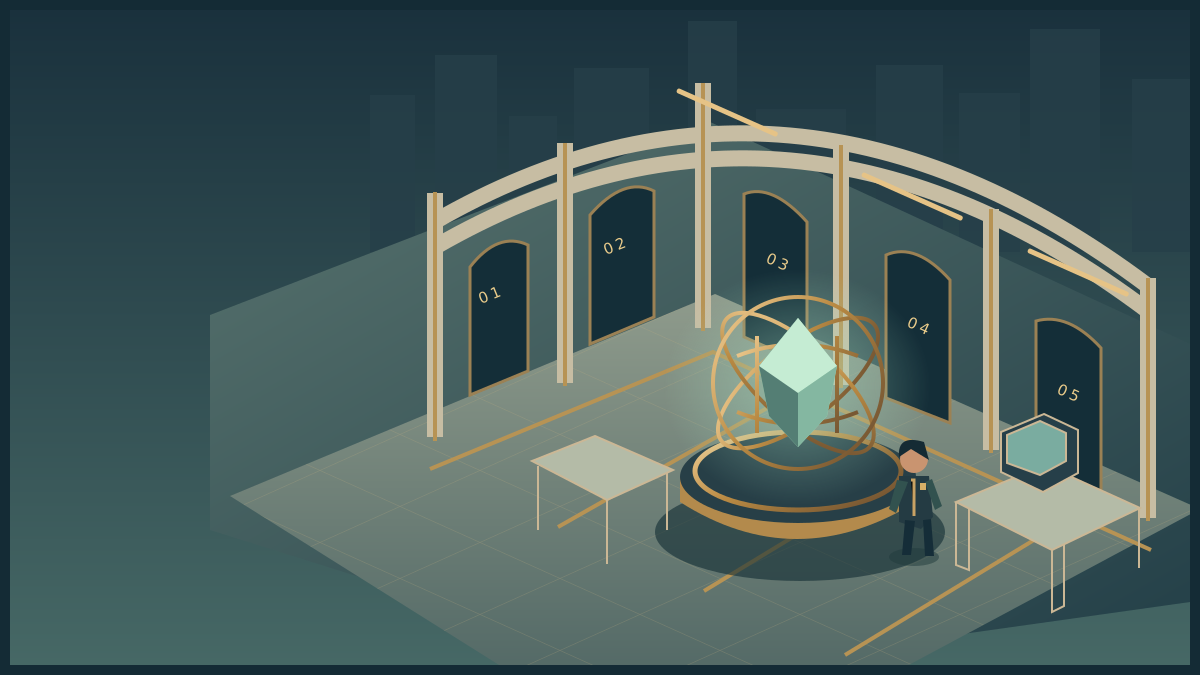
Operations Studio
Watch the complete alternate example. Take control of the equipment whenever you are ready.
An alternate example · separate from your assessed workHow to move, inspect and complete the activity
Use WASD or arrow keys to walk. Press E near an instrument to examine it. Inspect means read its details; Use equipment performs the action named in its status message. The task controls let you choose exact settings and test a solution. Once verified, use the mission station to put it into effect, collect the resulting evidence or cargo, follow its checkpoints and complete the handover at the receiving station.
Scroll over the scene or use Zoom + / Zoom − for a closer or wider view. Click and drag to turn whenever the cursor is free. Choose Fullscreen mission to keep the scene, mission instructions and all task controls together. Fullscreen starts with a free cursor so you can scroll the panel and choose options. Press X or Lock cursor (X) to turn by moving the mouse. Press X again to free the cursor and return to click-and-drag turning. Tab also frees the cursor. The X shortcut stays inactive while typing or choosing a form value. Press Escape or Exit fullscreen to return to the page. On touchscreens, drag to look and use the zoom buttons. If your browser cannot enter native fullscreen, the mission expands to fill its window.
Choose Watch to follow the worked example, or Take control to try it yourself. The transcript and completed example remain available if 3D is unavailable. Demonstrations never change assessed progress.
I am assembling an example fieldwork portfolio. I need twelve named activity records with evidence, changed-condition practice and reflection. I will use the mechanism record to show the required detail, then show the full twelve-record package. Teachers count the best ten; watching this example does not generate my own coursework. The method we are practising is: Select records that expose learning, including errors and revised explanations.. Our field objective is: Deliver an assessable portfolio of actual attempts, corrections and limits. Successful screenshots alone conceal the reasoning the assessor needs to examine. The investigation and explained record complete this lesson. A scene delivery is an optional extension. You can pause, mute, replay, or take control at any point. The captions show the same explanation.
Narration starts after you choose Watch or Play. Captions remain available if this browser has no working voice.
Optional scene extension
Each chapter provides evidence for this operation. Inspect, investigate, act, and complete the handover.
FIELD OPERATION · Briefing
Operation Field Record
Deliver an assessable portfolio of actual attempts, corrections and limits.
Successful screenshots alone conceal the reasoning the assessor needs to examine.
Inspect the mission station to begin your investigation.
Nothing collected.
Mission actions become available when the activity loads.
Mission record and accessible controls
These controls perform the same actions as the marked stations in the scene. Use them with a keyboard or touch, or when graphics are unavailable. Equipment tests establish whether your intervention is supported. The final handover records a mission outcome; your explanation is assessed separately.
- No mission actions yet.
The complete transcript and finished example are available below while the player loads.
THE DEMONSTRATOR’S REASONING
Name the output
The record desk receives the conservatory mechanism attempt. The demonstrator labels it mechanism-diagnosis, with scenario, route and assistance, before adding an explanation.
Why this matters
A result needs enough context for another reader to interpret it.
A plausible mistake
A screenshot without conditions cannot establish which rule was tested.
WHAT THE DEMONSTRATOR DID
YOUR LEARNING CONTROLS
Make the skill your own.
Select the correct named output.
Watch the apparatus change as the student demonstrates. Take control whenever you want to test the same idea yourself.
BASED ON YOUR ATTEMPTS
Watching and practising are recorded separately in this visit. These examples do not change your assessed work or skills passport.
NOW TRANSFER THE SKILL
Carry the method into your own work.
Use your actual attempts. The authored portfolio demonstrates selection and traceability, not personal evidence you can submit.
A COMPLETE WORKED SUBMISSION
Complete twelve-record demonstration portfolio
Example work from this demonstration's scenario. Use it to understand the expected evidence and explanation, then make your own decisions in the assigned activity.
Download the complete exampleRead the finished work
Completed demonstration portfolio — Weekly Fieldwork
Authored teaching example. These are twelve alternate worked records, not a real student's submission and not answers to the assigned configurations. The traces describe the authored demonstration path. No physical test or academic grade is claimed.
Portfolio register
- Week 1: Completed observation record — conservatory; record and transfer included below. - Week 2: Completed recall strategy — storm kit; record and transfer included below. - Week 3: Completed spatial model — dome connector; record and transfer included below. - Week 4: Completed mechanism diagnosis — conservatory lift; record and transfer included below. - Week 5: Completed example — beacon with two faults; record and changed-condition reasoning included below. - Week 6: Completed example — request authority and repaired weather ledger; record and changed-condition reasoning included below. - Week 7: The embargoed observatory charter — completed record; record and changed-condition reasoning included below. - Week 8: Five cases to the dome — completed record; record and transfer included below. - Week 9: The council that changes its brief — completed record; record and changed-condition reasoning included below. - Week 10: Predict the instrumented gallery — completed record; record and transfer included below. - Week 11: When the release authority expires — completed record; record and changed-condition reasoning included below. - Week 12: Recover the rainfall recorder — completed record; record and transfer included below.
Twelve records are supplied. Under the published rule, the best ten are counted by a teacher using skill 40%, transfer 40%, reflection 20%. The player does not invent grades or choose the best records by game completion.
Completed demonstration example — conservatory observation record
This alternate example shows a method. It is not an answer to the assigned lab.
Initial inspection
At the first inspection the clock displayed 11:35, a green mug stood beside the planting ledger and the service hatch was closed. These are supplied scene observations. A visible note asserted, “I checked every tray.” The note's presence is observable; its contents remain a claim.
Reconstruction and correction
I initially recalled the hatch as open. Rechecking the scene showed that I had inserted a familiar detail. I preserved the incorrect recollection and correction rather than rewriting the attempt. I classified “the tray inspection lasted thirty-five minutes” as an inference: the 11:35 reading alone supplies neither the inspection start nor its duration.
Changed situation
At the second inspection the clock read 11:50 and the hatch was open. The green mug remained unchanged. Two recorded features changed. No record established who opened the hatch or why.
Next investigation
Inspect the tray check records against the claimed complete inspection. Matching records would support the account within their scope; missing entries would require clarification.
Reflection
My main error was adding a plausible detail, not failing to look at an object. A regional inspection helped coverage, but preserving a separate interpretation column helped more with this mistake. In my own scene I would make the same distinction before building a story. I would not claim that two changed features prove a particular person's intent.
Route: authored 3D/interactive demonstration. Assistance: narrated example and one recorded correction.
Further reflection
The independent tray record is important because it could actually contradict the note. Asking the writer to repeat the same account would not add comparable independence. I would therefore preserve both the account and the proposed test instead of reducing the record to a confidence label.
---
Completed demonstration example — storm-kit recall strategy
This alternate worked example uses Gate, Pool, Press and Dome. It does not supply the assigned lab's item answers.
Baseline
I recalled Lens and Beacon: two correct items out of four. I kept that result before inspecting the full list.
Encoding route
1. Gate: a giant Lens frames the entrance. 2. Pool: a Tether splashes in the water. 3. Press: a Pocket atlas unfolds into maps under the rollers. 4. Dome: a Beacon lights the roof.
Retrieval and error
With the list covered, I retrieved Lens, Tether, Pocket atlas and Beacon in order. A later attempt produced “book” at the Press. I recorded the substitution and strengthened the map-specific cue rather than silently counting it as exact recall.
Comparison
The guided attempt improved from two correct items to four. That is a result of this small demonstration, not proof of permanent improvement or photographic memory. Rehearsal and item familiarity may also have helped.
Reflection
The fixed locations helped order, while the distinctive images helped item identity. The delayed substitution showed that a generic association preserved a category but not the required object. In another task I would preserve the route, change the items, and inspect whether the same weakness returned. For a critical instruction set that can be carried openly, a checklist may remain the better tool.
Route: guided example with list covering. Hints: association prompts. Named output: recall-strategy.
Further reflection
A second unfamiliar list would be a better transfer check than endlessly repeating these four items. I would also record the delay before recall, because immediate retrieval and remembering after an interruption are different demands. The example should not hide the effect of repeated practice.
---
Completed demonstration example — dome connector
The assigned connector uses different starting and target conditions.
Reference frame and prediction
World north and up remain fixed when the camera moves. The alternate connector initially has north/west ports at level 0. A clockwise 90-degree turn maps the original north port to east and the original west port to north.
Transformation record
- Initial: 0 degrees, level 0, north/west. - After rotation: 90 degrees, level 0, east/north. - After translation: 90 degrees, level 2, east/north. - Verification: both labelled ports and the required level match.
A mirrored substitute was rejected because outline similarity did not preserve the original label mapping.
Changed destination
The target moved to level 1 without changing port requirements. I lowered the connector and retained its 90-degree orientation.
Reflection
I initially treated reaching the right orientation as completion, but the target included a separate height condition. Writing two checks prevented that omission. Tracking the original north tip also made the rotation explainable when the camera changed. In a new configuration I would predict the label mapping before movement and then test position independently.
Named output: spatial-model. Evidence route: alternate worked simulation.
Further reflection
I would ask for another labelled view if the mapping remained ambiguous rather than rotating until the outline looked familiar. An ordered text account of the transformation makes the same reasoning available without relying on visual mental rotation or precise manipulation.
---
Completed demonstration example — conservatory lift
This alternate mechanism uses an 18-tooth driver, different turn requirements and a 270-degree cam.
Causal model
Input rotation → external gear pair → cam → spring-return follower → lift output. The interlock blocks cam adjustment until released. Motion also requires the spring and specified cam phase.
Prediction and diagnosis
For three output turns from five input turns: follower = 18 × 5 ÷ 3 = 30 teeth. The driven gear turns opposite the driver. A correct ratio did not initially produce a ready mechanism because the interlock was engaged and the return spring absent.
I released the interlock, set the cam to 270 degrees and attached the spring. I retained the ratio calculation because it was not contradicted by the readiness fault.
Verification
Five input turns produced three opposite output turns. Both the amount and direction matched the prediction.
Transfer
The changed task required two output turns from four input turns. I selected 36 follower teeth: 18 ÷ 36 × 4 = 2. The cam and spring conditions remained valid.
Reflection
The useful distinction was between an incorrect transmission ratio and a blocked dependency. Changing gears would not have released the cam. In a new apparatus I would record the output requirement, list readiness conditions and test both separately.
Named output: mechanism-diagnosis. This is a model, not a real lock or physical qualification.
Further reflection
The readiness conditions belong in the model rather than a footnote. I would test a blocked configuration as a counterexample so that another student could see why the correct gear ratio alone is insufficient. That negative example explains the distinction better than a successful run by itself.
---
Completed demonstration example — beacon with two faults
This is one fictional nine-volt beacon throughout the attempt. Its published case card allows multiple simultaneous open faults. The assigned browser and campus lab instead introduce exactly one fault at a time.
Initial evidence and first diagnosis
With power on, source / fuse output / cable output / lamp supply read 9 / 9 / 0 / 0 V relative to the common return. The lamp was dark. The first missing supply supported an open cable. The unpowered lamp's own condition remained unresolved; the readings did not prove it healthy.
First repair and failed whole-system check
I isolated the source and replaced the cable only. After restoring power, the trace became 9 / 9 / 9 / 9 V, but the same beacon stayed dark. The repair successfully restored supply without resolving the original symptom. I preserved both statements instead of calling the cable diagnosis wrong or declaring the job complete.
Second diagnosis and repair
With healthy supply and a dark load, I isolated power and tested lamp continuity. The result was open. I replaced that confirmed open lamp while isolated, then restored power. The supply remained 9 / 9 / 9 / 9 V and the lamp lit.
Preserved diagnostic chain
| Stage | Supported finding | Action | Verification |
|---|---|---|---|
| Initial trace | Open cable; lamp condition unknown | Isolated cable replacement | Supply restored, light still absent |
| Same beacon after first repair | Healthy lamp supply, dark output | Isolated lamp continuity test | Open load confirmed |
| Confirmed second fault | Open lamp as well as the earlier cable break | Isolated lamp replacement | 9 V supply and visible light |
Reflection
My first diagnosis was useful but incomplete. Assuming it explained the entire symptom would have stopped the investigation too early. The failed output check changed what I needed to test, without erasing the evidence that justified the cable replacement. In a new case I would read whether its rules permit multiple faults, diagnose from its own trace and check the original symptom after every repair. This example does not establish that the assigned one-fault circuit has two defects.
Limits
These are idealised authored model readings, not measurements from constructed hardware. A continuity check is performed only in the model's isolated state. The record establishes this fictional apparatus's behaviour and does not certify work on an arbitrary physical circuit.
Named output: circuit-diagnosis. Assistance: complete narrated worked example.
Method to carry forward
Repair only what the evidence supports, then test the original symptom again.
This example has two simultaneous faults; the assigned model has one. Use its observed trace, not this cable-and-lamp answer.
The complete example explains one defensible approach. In your own challenge, select observations and tests from the supplied rules, keep your prediction separate from the result, and justify both the checks you perform and those you omit.
Further reflection
The failed first verification was essential evidence: it showed a successful supply repair without a working beacon. I would retain that intermediate state when explaining the second test. The assigned one-fault promise should still be respected; I would not invent an additional defect when its own completed trace establishes the required result. Equally, I should not import that promise into a different case that explicitly allows several faults. Each intervention needs a specific reason and a return to the original symptom. A healthy voltage after replacement answered whether supply had been restored, while the dark lamp showed that illumination remained unresolved. Preserving both observations made the second continuity test purposeful rather than another speculative component swap.
---
Completed demonstration example — request authority and repaired weather ledger
This alternate example changes the authority problem. The assigned browser and campus transfer immediately provides a valid signed amendment. Here an unsigned message is not sufficient, and the later valid deliverable is a newly repaired version of a previously incomplete record.
Published authority rule
Only an instruction marked authenticated in the supplied authority register can supersede the current request. This is a fictional case-file rule; no live signature service is contacted.
Preserved timeline
| Time | Record | Direct result | Decision or limit |
|---|---|---|---|
| 07:05 | Authenticated R1 | Requires 18 sections and Q-7 | Governs the initial comparison |
| 07:20 | East | 18 sections, Q-9 | Complete but does not match R1 |
| 07:35 | Original South | 17 sections, Q-2 | Incomplete and different from R1 |
| 07:50 | North | 18 sections, Q-7 | Matches R1, although it is newest |
| 08:00 | Unsigned message | Says “Use East, Q-9”; register marks unverified | Record as a claim; retain North under R1 and request authentication |
| 08:15 | Authenticated R2 | Requires 18 sections and Q-12 | Legitimately supersedes R1; does not authenticate the earlier Q-9 message |
| 08:20 | South repair receipt S2 | Repaired version contains 18 sections and Q-12 | Verify this new version; select South S2 under R2 |
Preserved recommendations
1. Under R1: select North after count and digest checks. Its newer timestamp neither proves nor disproves correctness. 2. After the unsigned message: retain North as the currently authorised deliverable. Preserve the request, ask for authenticated authority and do not quietly promote the claim into a rule. 3. Under authenticated R2: select South S2, after separately checking authentication, 18 sections and Q-12. Preserve the original South record at 17/Q-2 and the original North justification.
Two independent checks
Authentication established what the current instruction required. The repair receipt and new comparison established what South S2 contained. Neither check could substitute for the other. The old incomplete South file was not silently rewritten into a successful historical result.
Limits and next check
Agreement with the authenticated reference establishes identity and completeness within this case. It does not prove the scientific accuracy of the weather observations. The unsigned Q-9 proposal remains an unverified account; the later R2 does not retroactively authorise it. Its origin and purpose would need separate investigation.
Reflection
I initially expected a later request to trigger a different selection. The authority rule showed why keeping North at 08:00 was the justified action. When an authenticated instruction and a newly repaired record later appeared, I changed to South S2 for two explicit reasons. The useful method is to verify authority and content, not to memorise “choose the first copy, then the second.” My assigned case has different rules and records, so I must read those afresh.
Named output: evidence-timeline. Demonstration material, not an assigned response.
Method to carry forward
Separate a proposed instruction from an authenticated change in authority.
The assigned archive uses different completeness and reference conditions. A later file can still be the wrong deliverable.
The complete example explains one defensible approach. In your own challenge, select observations and tests from the supplied rules, keep your prediction separate from the result, and justify both the checks you perform and those you omit.
The chapter investigation and its explained record complete the core method. The scene delivery is an optional extension; it is not evidence of deeper understanding on its own.
Further reflection
A record can justify waiting as well as changing. The unsigned message required an authority check, not a guess about which speaker sounded convincing. I would keep the current authorised selection, the proposed change and the later authenticated version in separate rows so neither hindsight nor a repaired file overwrites the original evidence. The newest original candidate was also the correct one here, which prevented me from turning an earlier warning about recency into a new rigid rule. South then became usable because a distinct repaired version satisfied a distinct authenticated request. If either authentication or the repair comparison had been absent, that final recommendation would remain unsupported. I would name the missing check rather than fill it in from expectation.
---
Completed demonstration example — embargoed observatory permission audit
Authored alternate example. Read this local research embargo before deciding any permission.
Published authority
Reader: read research only. Maintainer: service equipment only; embargoed research is not readable. Custodian: read research and approve release. Every other combination is denied.
Preserved faulty results
| Request | Expected | Observed before repair | | --- | --- | --- | | Maintainer / read | Deny | Allow | | Reader / read | Allow | Deny |
The other seven decisions already matched. The first failure exposed an embargoed resource; the second blocked an authorised reader.
Version 1 — repaired charter
| Role | Read | Service | Approve | | --- | --- | --- | --- | | Reader | Allow | Deny | Deny | | Maintainer | Deny | Allow | Deny | | Custodian | Allow | Deny | Allow |
All nine cells were compared with the charter. Positive checks preserved reader reading, maintainer service and custodian reading/approval. Negative checks retained the embargo and remaining limits. The repair changed only maintainer/read and reader/read.
Version 2 — new release hold
A later signed notice suspended custodian approval. The other eight decisions stayed as in Version 1. Reader and custodian could still read; maintainer could still service but could not read research. The previous correct approval is preserved under its earlier authority.
Reflection
I initially expected equipment responsibility to include research visibility. The embargo contradicted that shortcut. Checking forbidden operations alone would also have missed the blocked reader, so I recorded both kinds of failure. The release hold was a new rule, not proof that the original approval test was dishonest. In the assigned lab I must derive a fresh table from its own charter and identify exactly which right its later notice changes. I can reuse the testing method without reusing these permission answers.
Named output: permission-audit. These are fictional local decisions, not an external security test.
Method to carry forward
Derive expected permissions from a charter before testing observed behaviour.
The assigned role policy grants different read rights. Copying this completed matrix would apply the wrong authority.
The complete example explains one defensible approach. In your own challenge, select observations and tests from the supplied rules, keep your prediction separate from the result, and justify both the checks you perform and those you omit.
The chapter investigation and its explained record complete the core method. The scene delivery is an optional extension; it is not evidence of deeper understanding on its own.
Further reflection
The non-obvious decision is denying research reading to a role that still needs equipment service. I would use a fresh expected-versus-observed table for another charter, because role names and a familiar layout cannot establish rights. The signed hold changes one expectation while retaining the earlier evidence.
Completed demonstration example — dome handoff
Role information
Analyst card: five sealed cases to Dome, verification VIOLET. Operator: controls dispatch and must request exact destination, count and code.
Recorded exchange
Analyst: “Deliver five sealed cases to Dome; verification code VIOLET. Read back before dispatch.” Operator first read-back: “Dome, four, VIOLET.” Analyst: “Correct the count to five.” Operator corrected read-back: “Dome, five, VIOLET.” Analyst: “Confirmed.”
The count mismatch was found before movement. A bare acknowledgement would not have exposed it.
Changed situation
New card: Pool / 2 / SILVER. The team repeated the same protocol with new values. The operator's matching read-back was confirmed separately from the earlier handoff.
Agreement
The analyst owns instruction accuracy; the operator records and repeats the three fields; either role may stop if a field conflicts. A completed acknowledgement applies to one identified instruction, not every later delivery.
Reflection
The protocol was useful because it made the receiver's interpretation visible. My error was a wrong count, not unwillingness to cooperate. In another task I would preserve exact labels and ask which condition permits action, especially when the roles see different screens.
Named output: handoff-agreement. This is an alternate demonstration, not the assigned Relay/Archive/Dispatch answer.
Further reflection
The code is meaningful only because both roles know which current instruction it belongs to. I would record the instruction version as well as the acknowledgement when several deliveries are in progress. That prevents a correct read-back from being attached to the wrong task.
---
Completed demonstration example — changing-brief council agreement
Authored alternate example. This council reaches a different decision sequence from the assigned negotiation.
Responsibilities and original authority
Ada is the caretaker. Rin compares the record copies. Bo checks transport capacity. The mediator coordinates the agreement. Recipient Mira initially needs the physical ledger for a provenance examination; Ada authorises that handover if custody and return are recorded.
Claim and capacity checks
Rin claims the supplied copies have matching recorded content. Cedar and Birch each contain twelve sections with digest R-4. The record corroborates that limited claim; it does not prove the observations scientifically true or establish Rin’s intent.
The original weighs 7 units. Bo’s current certificate rates the standard cart for 9, and the supplied handling inspection is marked passed. The original fits; no additional cradle is required. Capacity establishes feasibility within this model, not independent permission to move the original.
Agreement Version 1 — prepared, not executed
Send the original to named recipient Mira using the certified cart, record custody with Ada and retain the return commitment. Copy-only delivery would not meet the physical provenance request. No dispatch occurs before the next notice.
Replacement brief and Agreement Version 2
The replacement signed brief cancels physical examination before dispatch. Mira now needs remote catalogue access; the original must remain with Ada. Transfer the verified Cedar copy, record the reference used and confirm the recipient’s access. The 9-unit cart remains usable but is no longer needed. The original stays with Ada.
Reflection and limit
I checked the claim even though it turned out to be supported. I did not infer honesty or deceit from the speaker’s manner. The adequate cart made the first physical agreement feasible, but it did not entitle me to ignore the later instruction. The change was in the requested outcome, not a new equipment failure. Preserving the unexecuted first agreement made that distinction visible. In the assigned council I must reread its comparison records, capacity certificate and current mandate instead of copying this physical-then-copy sequence.
Named output: claim-verification. These are authored example agreements, not evidence of a real delivery.
Method to carry forward
Compare feasible agreements against the participants’ priorities before choosing one.
Your council has different capacity and mandate constraints. More than one agreement may be feasible; state what your terms cost each role.
The complete example explains one defensible approach. In your own challenge, select observations and tests from the supplied rules, keep your prediction separate from the result, and justify both the checks you perform and those you omit.
The chapter investigation and its explained record complete the core method. The scene delivery is an optional extension; it is not evidence of deeper understanding on its own.
Further reflection
The first agreement was not invalidated by a new capacity problem. Its objective was replaced before execution. I would keep that timing explicit so a reader can distinguish a sound earlier plan from a delivery that never occurred, and distinguish corroboration of a statement from proof of its speaker’s intent.
Completed demonstration example — instrumented gallery routes
This alternate five-by-five model uses zero-based cells, start 20 and destination 3.
Original sensor set
15, 16, 11.
Route A: 20 → 15 → 10 → 5 → 0 → 1 → 2 → 3. Prediction: one contact. Trace: one contact at 15. Route B: 20 → 21 → 22 → 23 → 18 → 13 → 8 → 3. Prediction: zero. Trace: zero. Both routes use seven moves.
Changed sensor set
21, 22, 23. Route B now records three contacts; Route A records zero. The earlier records remain labelled with the original pattern.
Decision
If the objective is minimal recorded contact, Route B fits the original pattern and Route A fits the changed one. If the task is to verify detector observations, a route through the sensor cells may be more useful. Contact is a game event, not automatic failure.
Reflection
The most useful artefact was the ordered route plus the sensor set, because it made each count reproducible. I avoided treating a once-correct zero as a permanent property of the path. In my own task I would predict before execution and inspect the first disagreement rather than changing the route until an attractive ending appears.
Named output: sensor-route.
Further reflection
Explicit cell identifiers helped separate the model from camera position and intuition. I would keep the event trace when a prediction fails, because its first mismatch tells me more than the final contact count alone. Different objectives can justify different routes under the same rules.
---
Completed demonstration example — release-authority revision memo
Authored alternate example. Every route stays open. The disruption changes an authorisation dependency rather than equipment or transport availability.
Version 1 and its authority
Verify ledger → Seal case → Dispatch case → Log receipt.
The original release authority permitted this order. Ledger identity and equipment checks were supplied as valid; the plan was preserved before the replacement notice.
Published disruption
The replacement notice withdraws the old dispatch authority. Before sealing, the investigator must compare the recipient’s request with this ledger’s identity and purpose. The coordinator must record the new authorisation. Neither open routes nor working equipment removes those conditions.
Diagnosis and retained evidence
The failed dependency is the old authority to seal and dispatch. The unchanged signed ledger comparison remains useful for identity. Equipment remains available. Neither finding establishes that the recipient’s current request covers this ledger. No route change is required.
Version 2
Verify ledger → Check recipient scope → Record new authorisation → Seal case → Dispatch case → Log receipt.
The investigator owns scope comparison and sends the result to the coordinator. The coordinator records authority and authorises sealing only when both prerequisites are met. If scope is unresolved or authorisation absent, stop before sealing. The route, verified identity and receipt obligation remain unchanged.
Communication and status
The coordinator reads back the new order and stop condition; all roles acknowledge them. Version 1 stays preserved. This memo records a revised plan, not an invented completed authorisation or dispatch.
Reflection
My first temptation was to choose another route, but availability was not the dependency the notice changed. The important change was the point at which permission had to be established. Adding a scope check after dispatch would mention the new rule without satisfying it. I kept the identity evidence, named an investigator to check scope, and made the coordinator receive and record the result before sealing. In the assigned route or meter disruptions I must identify their different failed dependency instead of copying this sequence.
Named output: revised-plan. No physical dispatch or grant of authority is claimed.
Method to carry forward
Preserve valid decisions and revise only dependencies invalidated by new evidence.
This example changes authority while leaving equipment intact. Your disruption concerns availability and needs different replacement evidence.
The complete example explains one defensible approach. In your own challenge, select observations and tests from the supplied rules, keep your prediction separate from the result, and justify both the checks you perform and those you omit.
The chapter investigation and its explained record complete the core method. The scene delivery is an optional extension; it is not evidence of deeper understanding on its own.
Further reflection
The coordinator needs the scope-check result before the authority record can permit sealing. A named checker without that receipt leaves the sequence incomplete. I would ask a teammate to read back the actual stop condition rather than simply agreeing that the new document looks sensible.
Completed demonstration example — Lark Weather Mast recovery
Mission contract
Recover verified rainfall data while keeping the original recorder stable. Abort movement if the support apparatus cannot meet its required output. The original remains with the mast custodian.
Evidence and actions
The display read 16:25 and the service lamp was amber. The operator's completeness statement remained a claim until the manifest check.
A 16-tooth driver and 32-tooth follower produced two opposite output turns from four input turns after recorded readiness checks. Copy Ash contained 12 records and matched W-6; Birch contained 11/W-3 and did not meet the request.
The operator read back “Ash copy, twelve records, W-6.” The custodian confirmed transfer and retained the original at Lark.
Resolution
Verified digital data recovered; original stabilised in place; receipt and custody recorded.
Alternative and limit
Physical removal was unnecessary for the research-access objective and would introduce handling work. Matching W-6 establishes identity against the reference, not calibration accuracy. A calibration review remains the next question.
Reflection
The operation worked because several modest checks connected: observation informed investigation, mechanical verification supported handling, and a clear agreement defined what recovery meant. I would not describe this as physical recovery or as proof that every rainfall measurement is correct.
Named output: recovery-record. Separate from the Meridian assessment and the Halcyon final demonstration.
Further reflection
An honest debrief should include a next question that the completed mission did not answer. The calibration limit is consequential because matching a data reference does not verify the instrument that produced it. Preserving that distinction is part of a useful recovery record.
Attribution and completeness
All twelve records are labelled alternate demonstration material. Each retains its setting, supplied result, changed-situation response and reflection. A submitted personal portfolio would replace these with the student's own attempts and declared assistance. Exporting this example does not submit it.
Method to carry forward
Select records that expose learning, including errors and revised explanations.
Use your actual attempts. The authored portfolio demonstrates selection and traceability, not personal evidence you can submit.
The complete example explains one defensible approach. In your own challenge, select observations and tests from the supplied rules, keep your prediction separate from the result, and justify both the checks you perform and those you omit.
The chapter investigation and its explained record complete the core method. The scene delivery is an optional extension; it is not evidence of deeper understanding on its own.
Complete transcript and decisions · readable without JavaScript
Before we begin · expected task and evidence
I am assembling an example fieldwork portfolio. I need twelve named activity records with evidence, changed-condition practice and reflection. I will use the mechanism record to show the required detail, then show the full twelve-record package. Teachers count the best ten; watching this example does not generate my own coursework. The method we are practising is: Select records that expose learning, including errors and revised explanations.. Our field objective is: Deliver an assessable portfolio of actual attempts, corrections and limits. Successful screenshots alone conceal the reasoning the assessor needs to examine. The investigation and explained record complete this lesson. A scene delivery is an optional extension. You can pause, mute, replay, or take control at any point. The captions show the same explanation.
1. Name the output
What I need to do: Step 1. Name the output. I name the output and record its scenario, evidence route and assistance so it can be understood outside the player.
Supplied context: The record desk receives the conservatory mechanism attempt. The demonstrator labels it mechanism-diagnosis, with scenario, route and assistance, before adding an explanation.
Watch my actions: For "Output label", I choose "mechanism-diagnosis". I check the demonstrated result.
What I observed: The evidence has a useful identity. A result needs enough context for another reader to interpret it.
Why: A result needs enough context for another reader to interpret it.
Decision: Select the correct named output.
- Output label: mechanism-diagnosis
Result: The evidence has a useful identity.
Common mistake: A screenshot without conditions cannot establish which rule was tested.
2. Keep the cause and result
What I need to do: Step 2. Keep the cause and result. I retain the settings, readiness checks and observed output that support the mechanism explanation.
Supplied context: The example records an 18-tooth driver, 30-tooth follower, five input turns and three opposite output turns. The interlock and spring correction are included.
Watch my actions: For "Output turns in the example", I enter 3. I check the demonstrated result.
What I observed: The record supports the causal account rather than a bare completion label. The trace explains how the result followed from the model.
Why: The trace explains how the result followed from the model.
Decision: Record the demonstrated output turns.
- Output turns in the example: 3
Result: The record supports the causal account rather than a bare completion label.
Common mistake: Movement alone would not establish the specified output.
3. Include the changed situation
What I need to do: Step 3. Include the changed situation. I include the changed requirement and show why I changed the ratio while retaining valid readiness conditions.
Supplied context: The transfer uses 36 follower teeth and four input turns for two output turns. The demonstrator explains why the ratio changed while readiness conditions were retained.
Watch my actions: For "Changed-situation record", I choose "36 teeth / four input / two output". I check the demonstrated result.
What I observed: The changed attempt demonstrates the principle being reapplied. A portfolio should show application beyond the first familiar configuration.
Why: A portfolio should show application beyond the first familiar configuration.
Decision: Choose the transfer evidence.
- Changed-situation record: 36 teeth / four input / two output
Result: The changed attempt demonstrates the principle being reapplied.
Common mistake: Repeating the practice answer does not establish transfer.
4. Explain a specific error
What I need to do: Step 4. Explain a specific error. I describe the specific error of changing gears when the cam was blocked, and the interlock check that corrected my reasoning.
Supplied context: The reflection identifies confusing ratio with readiness and explains the observation that corrected it. It does not claim a generic lesson such as 'teamwork is important'.
Watch my actions: For "Reflection", I choose "I changed gears, but the blocked cam required an interlock check". I check the demonstrated result.
What I observed: The reflection supplies a concrete next practice target. Specific reflection can guide the next attempt and be checked against evidence.
Why: Specific reflection can guide the next attempt and be checked against evidence.
Decision: Choose the useful reflection.
- Reflection: I changed gears, but the blocked cam required an interlock check
Result: The reflection supplies a concrete next practice target.
Common mistake: A positive slogan can avoid analysing the actual attempt.
5. Apply the portfolio rule
What I need to do: Step 5. Apply the portfolio rule. I check that all twelve entries are present and explain the best-ten rule without inventing automated marks.
Supplied context: The example portfolio includes all twelve alternate records. The course counts the best ten using teacher-applied criteria; the software does not infer marks from completion.
Watch my actions: For "Counted records", I enter 10. I check the demonstrated result.
What I observed: The portfolio structure matches the published assessment rule. Submission quantity and counted contribution are different facts.
Why: Submission quantity and counted contribution are different facts.
Decision: How many records count toward the mark?
- Counted records: 10
Result: The portfolio structure matches the published assessment rule.
Common mistake: Counting all twelve at one point each would overstate the assessment weight.
6. Export with honest provenance
What I need to do: Step 6. Export with honest provenance. I label the package as authored teaching material before exporting it. It illustrates the expected record, not personal assessed work.
Supplied context: The finished example includes a register, all twelve records, transfer responses and reflections. It is labelled authored teaching material and exported as an example, not as personal work.
Watch my actions: I set "Label this as an authored demonstration" to yes. I check the demonstrated result.
What I observed: The downloadable portfolio can be studied without being mistaken for assessed personal evidence. The usefulness of a complete example depends on clear authorship and scope.
Why: The usefulness of a complete example depends on clear authorship and scope.
Decision: Confirm the example label.
- Label this as an authored demonstration: Yes
Result: The downloadable portfolio can be studied without being mistaken for assessed personal evidence.
Common mistake: Removing the example label would misrepresent who did the work.
Optional field extension
All chapter evidence checks are complete. I return to the mission station and assemble the checked portfolio. I am putting the verified solution into effect, then checking what changes.
I collect Alternate fieldwork portfolio. The verified intervention released this package. I now carry it through the marked handover route.
I carry Alternate fieldwork portfolio to Evidence archive. I confirm this checkpoint before continuing so the handover trace records the route actually followed.
I carry Alternate fieldwork portfolio to Academy record desk. I confirm this checkpoint before continuing so the handover trace records the route actually followed.
At the receiving station, I deliver the portfolio to the record desk. I check the receipt before calling the field operation complete.
My observations and finished submission
My portfolio contains a register and all twelve alternate activity records. The mechanism entry preserves its prediction, readiness fault, three-turn result and two-turn transfer, plus the specific error I learned from. Each entry identifies its evidence and assistance. I label and download this as authored demonstration material. To complete my own fieldwork, I must supply my own attempts, transfer records and reflections; the teacher applies the best-ten rule. Select records that expose learning, including errors and revised explanations. Open "Read the finished work" or download the complete example to inspect the evidence and explanation together. Use your actual attempts. The authored portfolio demonstrates selection and traceability, not personal evidence you can submit.
The complete submission is available in Read the finished work above and as a Markdown download.