THE WHOLE PRODUCT Act IV · iMac & Cube · 1998–2000
  1. 1 · Apple II
  2. 2 · Lisa/Mac
  3. 3 · NeXT
  4. 4 · iMac/Cube
  5. 5 · iPod

Act IV · 1998–2000

iMac G3 and Power Mac G4 Cube: Return, Focus and Form

Central question

When does bold design become a product, and when does it remain an object?

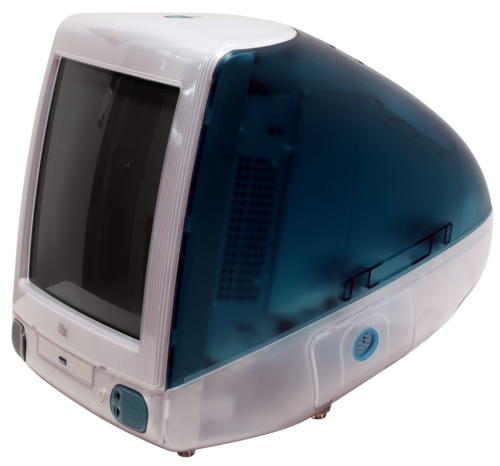
Bondi Blue iMac G3, a rounded translucent all-in-one computer
iMac G3, Bondi Blue. Photo: Rama, alterations by David Fuchs, CC BY-SA 4.0, via Wikimedia Commons.
Exhibit E · iMac G3 · 1998

iMac G3

The promise. Jobs returned to Apple in 1997 with the company close to collapse. The iMac's promise was blunt: one box, out of it, online, in one afternoon — no expansion cards, no separate modem to install, no confusing model lineup to choose from.

The object. Design was led by Jony Ive and Apple's industrial design group: a translucent "Bondi Blue" case that let people see it was a computer, not office beige furniture, and a bet on the USB port — dropping the floppy drive and legacy connectors entirely — that a contested internal decision turned into an industry standard almost overnight.

The outcome. A major commercial success, widely credited with stabilising Apple's finances and giving the company room to build what came next.

What remained. Colour and translucency as legitimate consumer-electronics design language, and USB-only connectivity as the new default — a case of a single product decision outliving the product itself.

Technical record
Released
August 1998
Design
Jony Ive and Apple's Industrial Design Group
Ports
USB only — no floppy drive, no serial/ADB legacy ports
Case
Translucent "Bondi Blue" polycarbonate, all-in-one CRT
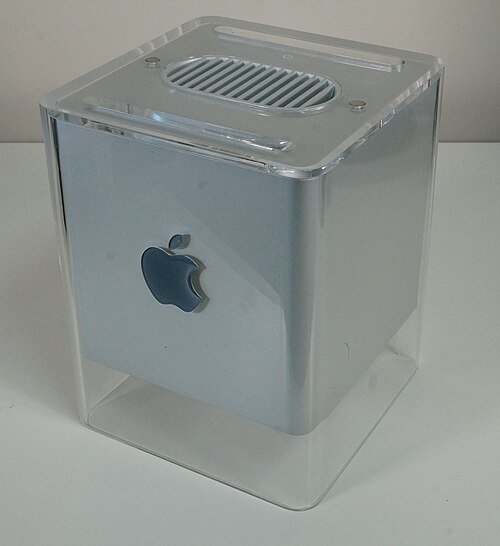
Power Mac G4 Cube, a small clear polycarbonate cube suspended in an acrylic frame
Power Mac G4 Cube. Photo: Binarysequence, CC BY-SA 4.0, via Wikimedia Commons.
Exhibit F · Power Mac G4 Cube · 2000

Power Mac G4 Cube

The promise. A serious desktop computer with none of the visual and mechanical clutter of a tower — no fan, almost no visible ports, a shape closer to a sculpture than a PC.

The object. Jony Ive's team suspended an 8-inch clear polycarbonate cube inside an acrylic frame; Apple's hardware engineers made it work without a fan at all, relying on convection cooling — a genuine engineering constraint the design demanded and had to solve.

The outcome. A commercial flop. Priced close to a full Power Mac tower with comparable specifications, it found few buyers and was discontinued after about a year, with roughly 150,000 units sold.

What remained. A design object more celebrated after its discontinuation than during its sale — it holds a place in the Museum of Modern Art's collection — and a clear answer, in hindsight, to this act's own question: the Cube was a superb object that never became a viable product.

Technical record
Released
July 2000
Design
Jony Ive's Industrial Design Group; convection cooling, no fan
Discontinued
2001, after roughly 150,000 units sold
Since
Held in the Museum of Modern Art's permanent collection

The iMac proved bold design could sell in the millions; the Cube, barely two years later, proved the same design language could just as easily produce an object nobody needed to buy. The next act takes that lesson somewhere smaller — small enough to fit in a pocket, and, its designers hoped, small enough to stop thinking about at all.