THE WHOLE PRODUCT Museum Entrance
  1. 1 · Apple II
  2. 2 · Lisa/Mac
  3. 3 · NeXT
  4. 4 · iMac/Cube
  5. 5 · iPod

Unofficial educational exhibit · established 2026

The Whole Product

An unofficial journey through Apple's design ambitions: the belief, pursued across four decades and several different teams, that technology should become simpler, more personal and more human. Some of the objects in this museum sold in the millions. Some sold barely at all. Every one of them left an idea behind that outlived the product.

Central question

What does it take to build "the whole product" — hardware, software and the experience of using them, treated as one design problem instead of three separate ones?

Welcome Window Curator's Note

This exhibition is a student project, not a corporate history. It does not credit every idea here to one person — several of the objects on display were the work of engineers and designers whose names rarely make the highlight reel. Where that matters, we say so.

Begin the Journey →

Prologue: Apple I, 1976

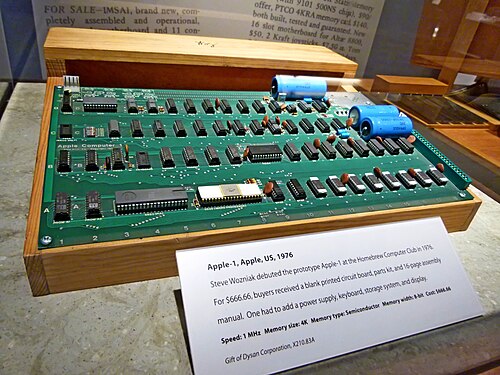
Apple I circuit board on display, mounted without a case, keyboard or monitor
Apple I, Computer History Museum. Photo: Jordiipa, CC BY-SA 3.0, via Wikimedia Commons.
Prologue exhibit · Apple I · 1976

Before the product, a board

The Apple I was a bare circuit board: no case, no keyboard, no power supply, no monitor. Buyers soldered on their own. It was designed and hand-built almost entirely by Steve Wozniak, who wrote the firmware as well as the hardware; Steve Jobs' contribution was the deal that got about 200 of them into the Byte Shop and into hobbyists' hands.

It is the exhibit before the exhibits: a working computer with none of the "whole product" thinking yet applied to it. What happens when someone starts trying to close that gap is where Act I begins.

A year later, the board grew a case, a keyboard and a price tag you could put in a shop window. Act I asks what that turned it into.

Journey Map

The primary path through this museum is linear — Home → Act I → Act II → Act III → Act IV → Act V — and each act ends with a link to the next. If you'd rather browse out of order, use the map below or the navigation bar at the top of any page; both go anywhere, any time.

Act I · 1977

Apple II

From Machine to Product.

What changes when a machine becomes a product?

Act II · 1983–1984

Lisa & Macintosh

The Graphical Dream.

Should people learn the computer, or should the computer learn people?

Act III · 1988–1990

NeXT Computer

Intermission: Away from Apple.

What happens when purity matters more than the market?

Act IV · 1998–2000

iMac G3 & Power Mac G4 Cube

Return, Focus and Form.

When does bold design become a product, and when does it remain an object?

Visitor Instructions

Guided route: follow "Next Act" at the bottom of each page for the intended order — the story is written to be read Act I through Act V.

Free route: the navigation bar and Journey Map above are always live; jump to any act directly and double back whenever you like. Nothing here is gated.

Unofficial educational student project. Not affiliated with or endorsed by Apple Inc. or NeXT. Product names and trademarks belong to their respective owners.

Credits & Sources

Historical claims in this exhibition are drawn from public record — company and museum archives, and standard secondary accounts of Apple, NeXT and their design teams — and written fresh for this project; no marketing copy is reproduced. All photographs are freely licensed and sourced from Wikimedia Commons, downloaded as web-sized thumbnails via Wikimedia's own thumbnail service (no further editing). Full attribution:

Image Title Creator Licence Source
Apple I CHM Apple I Jordiipa CC BY-SA 3.0 commons.wikimedia.org
Apple II Apple II computer at the Smithsonian Kevin Burkett CC BY-SA 2.0 commons.wikimedia.org
Apple Lisa Apple Lisa Computer Timothy Colegrove CC BY-SA 4.0 commons.wikimedia.org
Macintosh 128K Computer Macintosh 128k, 1984 (All About Apple onlus) Sailko CC BY 3.0 commons.wikimedia.org
NeXTcube NeXT Cube Rama CC BY-SA 2.0 FR commons.wikimedia.org
iMac G3 iMac G3 Bondi Blue, three-quarters view Rama; alterations by David Fuchs CC BY-SA 4.0 commons.wikimedia.org
Power Mac G4 Cube PowerMac Cube Uelef (Ulf Cronenberg) Public domain commons.wikimedia.org
iPod (1st generation) Ipod 1G Rjcflyer CC BY 2.5 commons.wikimedia.org
iPhone (2007) First iPhone, Macworld 2007 ArnoldReinhold CC BY-SA 4.0 commons.wikimedia.org