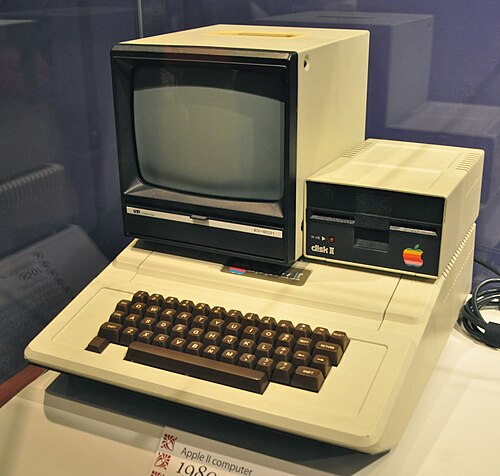
Apple II
The promise. That a computer could be something you bought finished, plugged in and used — not something you built. The Apple I had proven the hardware worked; the Apple II had to prove it could be a product.
The object. The hardware and system software were Steve Wozniak's work, largely alone — colour graphics, expansion slots and a design far ahead of the hobbyist boards around it. Rod Holt engineered the compact switching power supply that let it run cool and quiet. Jobs pushed for a real, molded plastic enclosure instead of a bare board, designed by Jerry Manock: the case, keyboard and price tag that turned a hobbyist board into something a family could own.
The outcome. A genuine commercial success, and one that outlasted its launch year by a decade. Its trajectory changed again in 1979 with VisiCalc, the first spreadsheet program — the first piece of software people bought a computer specifically to run.
What remained. The idea that hardware, packaging and price are part of the same design problem as the circuit board — that "product" is a design discipline, not just a manufacturing step. Every later act in this museum inherits that idea, even where it disagrees about what else belongs in it.
Technical record
- Released
- June 1977
- Design
- Steve Wozniak (logic board, firmware); Rod Holt (power supply); Jerry Manock (case)
- CPU
- MOS 6502, 1 MHz
- Memory
- 4 KB–48 KB RAM (model dependent)
- Notable software
- VisiCalc (1979), the first personal-computer spreadsheet