Week 5 Module: Protein Aggregation and Gelation
The moment soy milk becomes tofu — percolation, the gel point, and the Winter-Chambon criterion for when a liquid becomes a solid network.
Research question
Add a coagulant (nigari or gypsum) to hot soy milk and, within seconds to minutes, a suspension of individual soy protein particles becomes tofu (豆 腐): a continuous, self-supporting solid. Somewhere in that window there is a precise instant at which the material stops being a liquid and starts being a solid. Can that instant be identified from a measurement, rather than by eye?
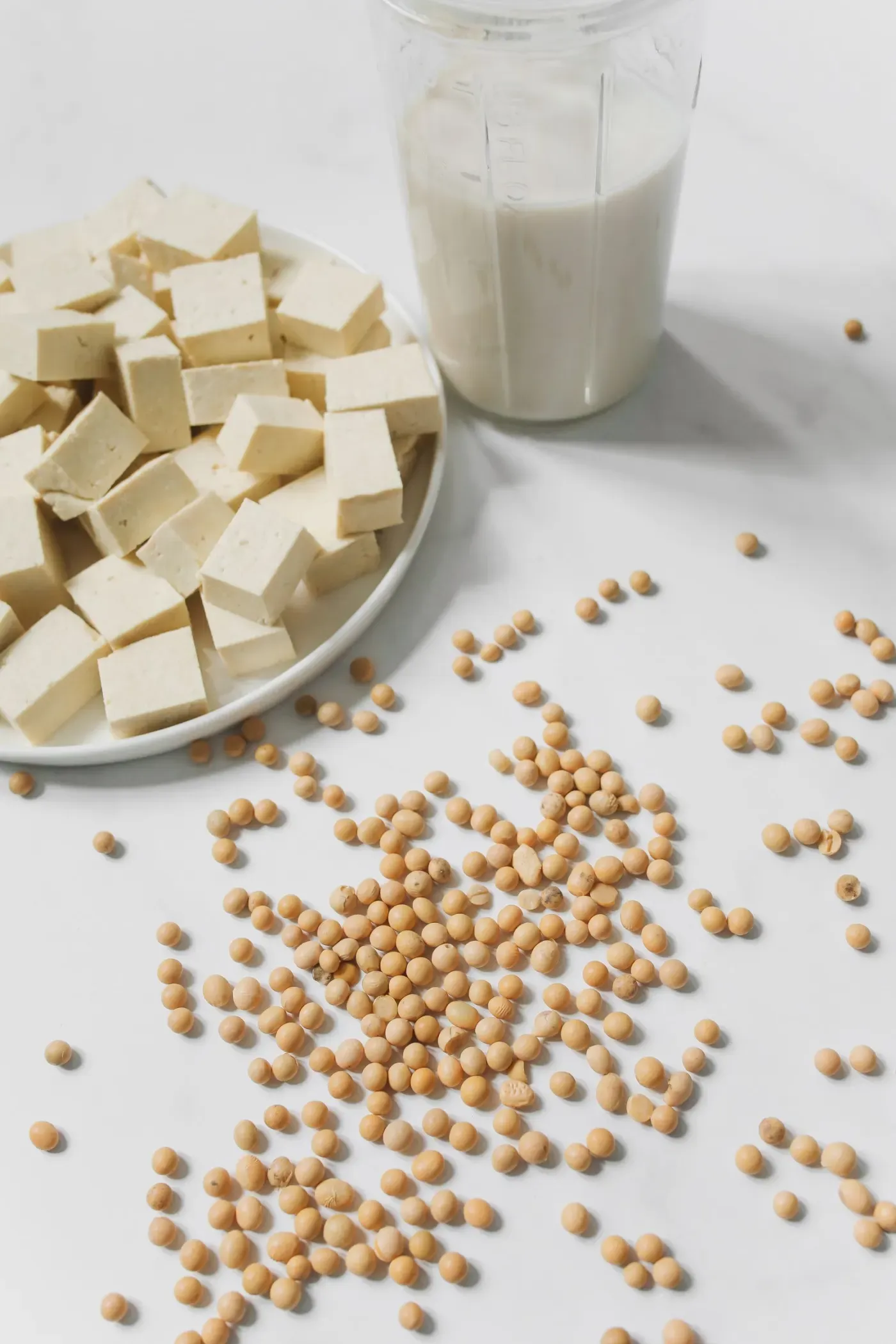
Specimen soy milk mid-coagulation, approaching the gel point
Where this sits
Second module of Stage 2, Structures and Networks. Module 4 built a network from starch chains reassociating on cooling; this module builds one from protein particles aggregating irreversibly once a coagulant neutralises the electrostatic repulsion that was keeping soy milk a stable suspension. The underlying mathematics — a percolating network appearing at a critical threshold — is the same idea in a different material, which is why it gets its own module rather than being folded into Module 4.
The model: percolation and the gel point
As coagulant is added, individual protein particles aggregate into progressively larger clusters. Percolation theory (Flory, 1941; Stockmayer, 1944) predicts that below a critical extent of crosslinking, clusters stay finite and the material remains a (viscous) liquid; above it, a single cluster spans the whole sample and the material becomes a solid network, in principle abruptly:
- p (extent of crosslinking, dimensionless, 0–1)
- the fraction of possible crosslinks between particles that have actually formed.
- pc (critical extent, dimensionless)
- the threshold at which a sample-spanning cluster first appears.
- f (functionality)
- the average number of crosslinking sites available per particle; a higher f reaches the gel point at a lower pc.
Because p is not directly observable during cooking, the gel point is found rheologically instead, using the Winter-Chambon criterion: at the gel point, and only at the gel point, the loss tangent (tan δ = G″/G′, introduced in Module 1) becomes independent of oscillation frequency. Before gelation, tan δ varies with frequency because the material still relaxes like a liquid at long timescales; after gelation, it varies with frequency because the network is now a solid with its own elastic timescale; exactly at the transition, curves at different frequencies all cross at one point.
- Percolation eqn
- pc = 1/(f−1)
- Criterion
- Winter–Chambon
- Gel point is
- a moment, not a texture
What you measure and analyse
Using a supplied set of tan δ vs. time curves recorded at several oscillation frequencies for a coagulating soy-protein suspension, you identify the time at which the curves converge — the gel point — and compare it against the time a texture reading first shows measurable solid-like resistance, to see how much (if at all) the two disagree.
Activity
Gypsum (calcium sulfate) and nigari (largely magnesium chloride) coagulate soy protein by different ionic mechanisms and are known to produce tofu with different final textures (softer and firmer respectively, at comparable protein content). Using the percolation model above, argue whether a coagulant that produces a firmer final gel is more likely to be raising or lowering the effective functionality f of the protein particles, and what evidence from a gel-point measurement would support your answer.
References
- Flory, P.J. (1941). “Molecular Size Distribution in Three Dimensional Polymers. I. Gelation.” Journal of the American Chemical Society 63(11), 3083–3090.
- Stockmayer, W.H. (1944). “Theory of Molecular Size Distribution and Gel Formation in Branched Polymers. II. General Cross Linking.” Journal of Chemical Physics 12(4), 125–131.
- Winter, H.H. & Chambon, F. (1986). “Analysis of Linear Viscoelasticity of a Crosslinking Polymer at the Gel Point.” Journal of Rheology 30(2), 367–382.
The spec
What you bring to the session. Written so a reader can tell whether it has been met without asking you.
- state the Winter-Chambon criterion for locating a gel point
- explain what "percolation" means for a network of aggregating protein particles
- say why the gel point is a moment, not a texture, and why that distinction matters
Teaching team
- Idris Fenn — tutor