Week 5: Building a consistent world
Character bibles, world bibles, costume and prop references and a visual style guide — and why consistency is the hard problem in generative film
22 March 2027
Last week you chose what each cut lets the audience see. Now imagine the phone changes shape between the wide and the insert. The cut asks the viewer to follow a decision; the prop change asks them to solve a different problem. A bible is the short, shared reference that tells everyone which person, place and objects must survive that cut.
What you’ll be able to do#
- Write character and location entries using concrete, repeatable details.
- Separate a fixed continuity fact from an action or state that changes during a shot.
- Diagnose an entry using a stranger’s account of it, then revise the text where the evidence warrants it.
The lecture runs for 90 minutes: recap 5, outcomes 5, technique and worked entries 45, comparison 15, judgement practice 15, synthesis 5.
A character entry is a set of decisions#
Start with the named characters in your screenplay, including someone who appears only as a caller. For each, record their role and how the audience encounters them: on screen, voice only, or a name on a display. Then specify what another person needs to reproduce that appearance: age or age range, build, hair and one distinguishing feature, exact wardrobe, and voice where heard. Choose details that are visible or audible, rather than substituting an interpretation such as “mysterious.”
“An unusual jacket” leaves two readers free to choose different jackets. For an independent practice example, “a charcoal zip-front jacket, worn open, with no visible logo” gives them decisions they can agree on. This example is a writing exercise, not Nadia’s costume. You do not need to describe every stitch: include details whose change would make the viewer question identity or continuity. A voice entry can name a reference and repeatable vocal qualities; it does not need to prescribe an emotion for every line.
An undecided field should say pending, with the decision needed to close it. Do not fill it with an adjective to make the entry appear complete. For a caller never shown, an on-screen wardrobe may be not applicable to this sequence; that is different from an unresolved costume for someone we see.
A location entry gives details a place#
A list of objects is not yet a location. Record the room and story time, then describe relationships: which surface holds the phone, where the character is relative to it, and which fixed landmarks orient the viewer. A small plan or labelled reference can help, but the text should tell the reader what to preserve from it.
Record the source and direction of light once agreed, rather than merely calling the room “moody.” A costume and prop reference should identify the chosen item, its distinguishing features and its reference file or version. A short visual-style guide states decisions about palette, light and surface treatment that belong to the whole sequence. Keep a shot’s framing and camera movement on the shot list, referring back to these shared facts.
For Nadia’s kitchen, the table and phone matter to the closing action. The current references record the phone appearance, room materials and lighting. The expanded kitchen geometry remains an illustrated proposal awaiting production approval. A generated image is a candidate, not an instruction to quietly rewrite the bible.
Fixed facts, changing states#
A useful reference distinguishes what the thing is from what it does now. The same phone can be on the table in one shot and at Nadia’s ear in the next because an action connects those states. A different phone case without such a reason is a continuity question.
| Keep fixed across the closing sequence | Let the shot specify |
|---|---|
| Nadia’s agreed appearance and costume | Whether she holds still, reaches, stops or speaks |
| The same phone and room layout | The phone’s position before and after she lifts it |
| Theo is the caller; the display identifies him | The display state before and after acceptance |
| Agreed lighting and visual treatment | Framing and the camera’s planned movement |
Keep the current approved reference available when requesting each shot. Where a tool accepts image references, pass the selected reference through its supported controls as well. A bible defines what to check; identical wording is not a guarantee that two outputs will match. Compare the result with the reference before accepting it.
If a design decision changes deliberately, make a new dated version and identify affected shots. Reusing a stable reference does not mean retaining an error forever. Avoid letting one shot use an old costume reference while the next uses its replacement.
Worked entries: “Before It Stops”#
Read or download the three worked entries. These entries describe Nadia, Theo and the kitchen using the visual references below. Nadia’s appearance and costume, the kitchen layout and lighting, and the phone’s appearance are recorded alongside the story facts. Use them with the Week 4 storyboard to preserve continuity while allowing each shot’s action to change. Voice references remain to be selected.
Nadia — the person and the action#
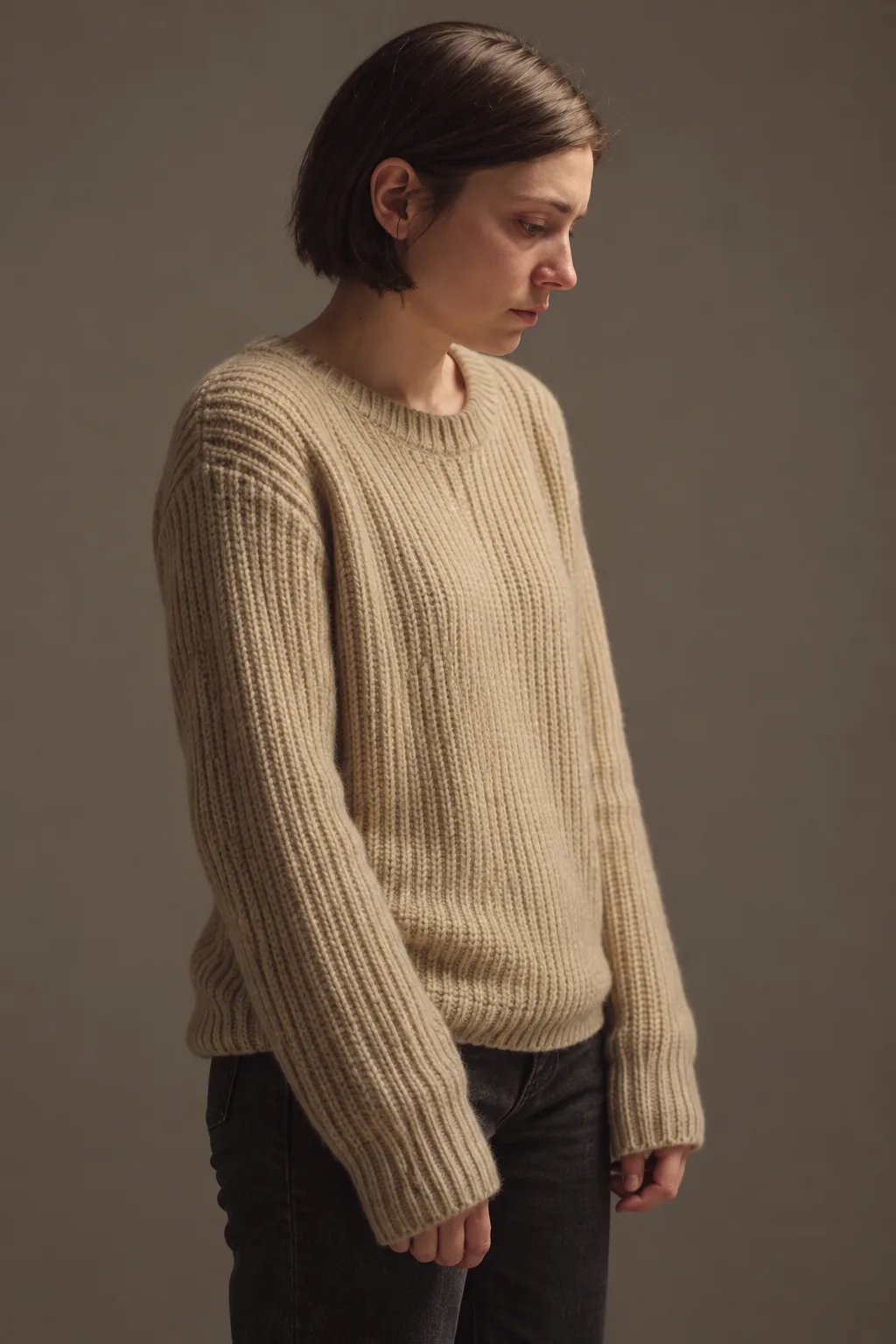
Nadia is the on-screen protagonist receiving Theo’s call. In the closing sequence she remains still, reaches toward the phone and stops, then accepts on the final ring. The phone rises to her ear within the final continuous shot as she says “Hey.” She is in her thirties, with a short brown bob tucked behind the ear, an oatmeal chunky knit sweater and dark trousers. Preserve the pictured face, haircut and costume throughout; her gaze, hand position and expression change with the action.
Notice the separation: “the same agreed costume throughout” is a continuity rule; “reaches and stops” belongs to one moment. Repeating that action in all prompts would make the later acceptance impossible to direct clearly.
Theo — represented by the call#
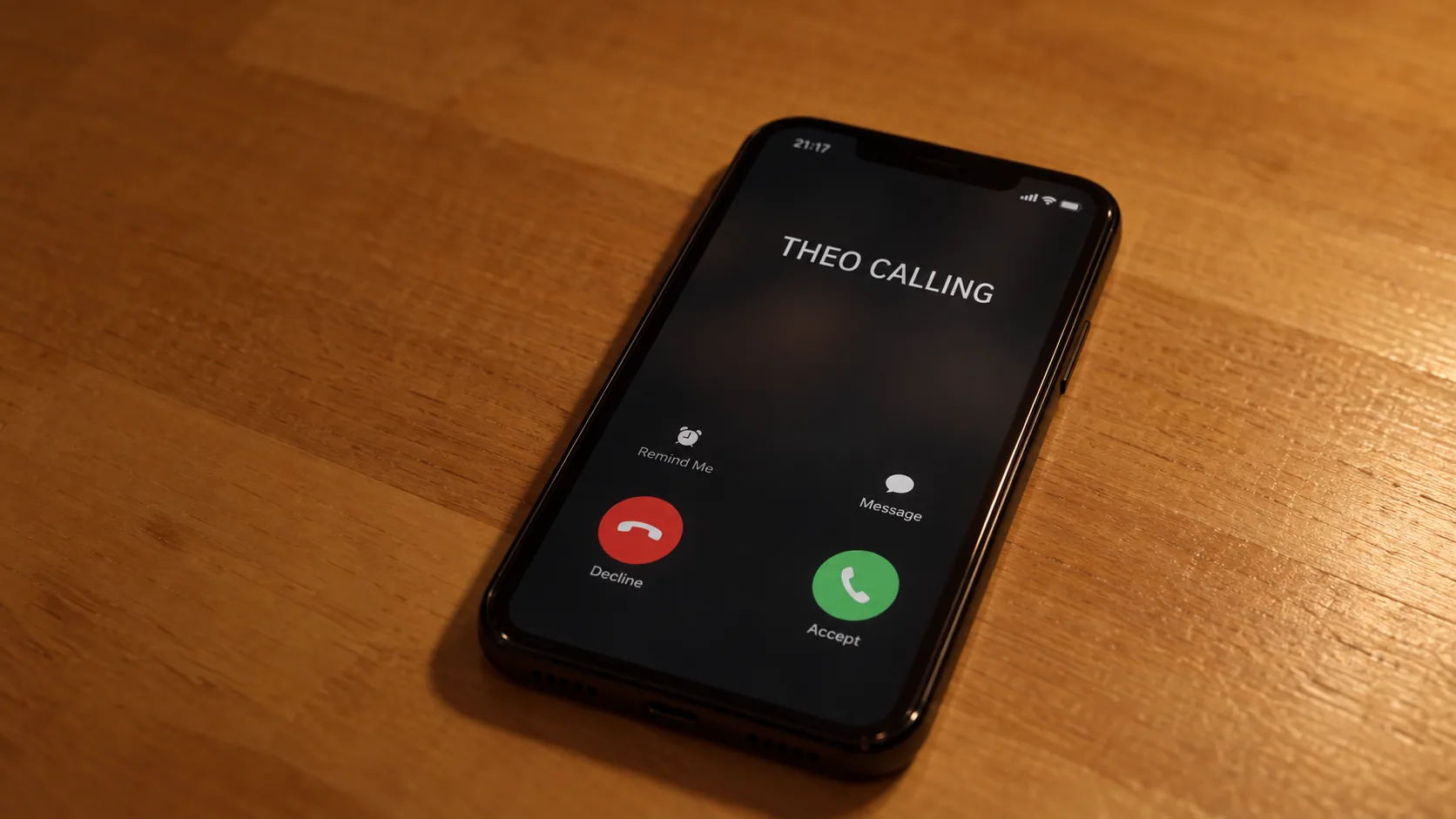
Theo is Nadia’s estranged brother, identified on the phone as THEO CALLING. The closing shot list does not cut to him. An entry must preserve that representation, rather than manufacture a second location or an on-screen costume. If the sequence later includes his audible response, a voice reference must be selected; no unheard line or vocal identity is established by the current shot list. His on-screen appearance is not applicable to this closing sequence. Recheck the entry if another scene shows him.
Kitchen — preserve the geography of the decision#
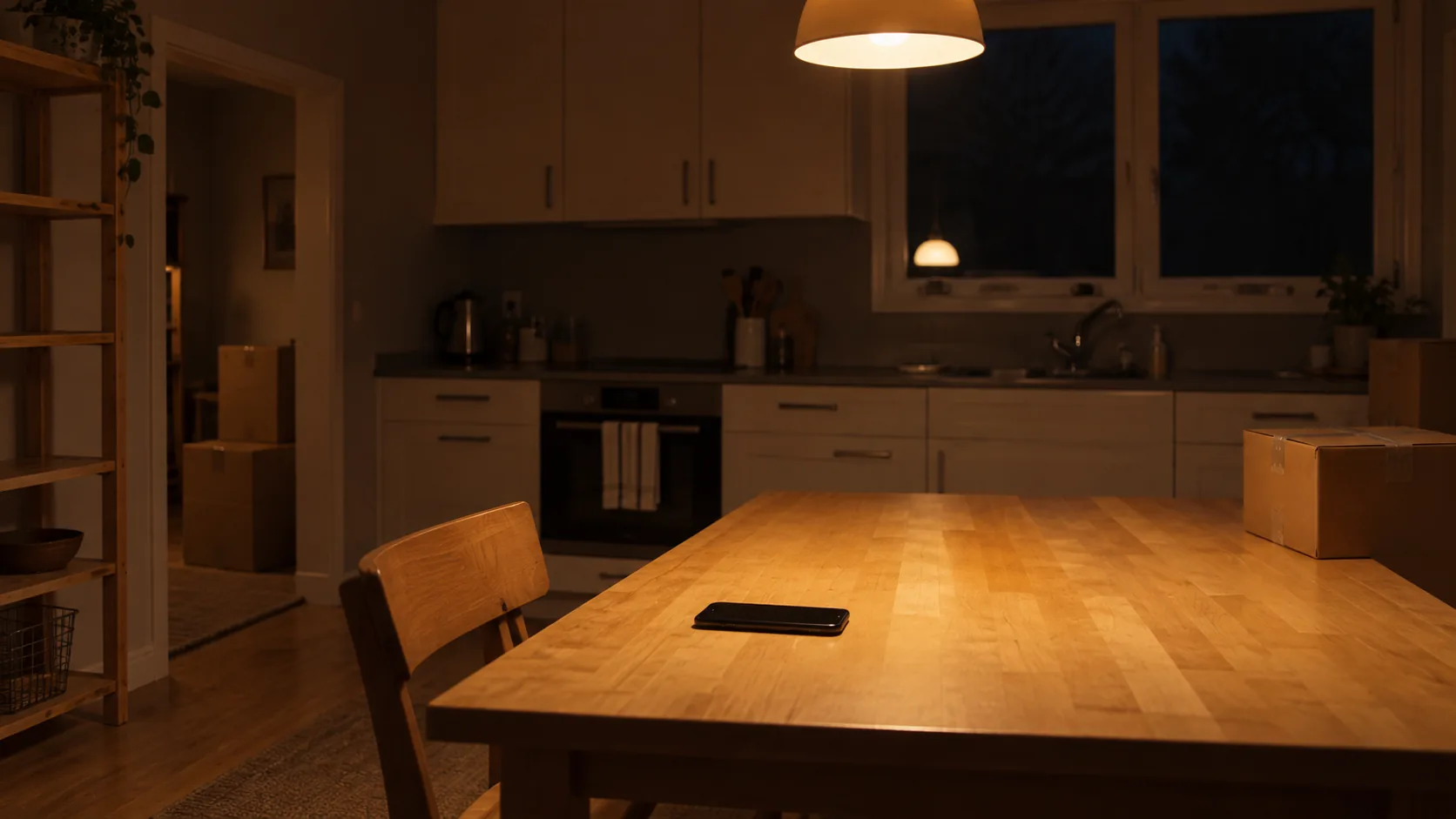
The setting is her late mother’s apartment kitchen on the final night before it is cleared. The phone starts on the table; Nadia can reach it. The insert must be the same phone in that room, not a new object on an unrelated surface. The final lift changes its position intentionally. The current illustrated reference records a honey-coloured wooden table, a wooden chair on the left, cream cabinets, a dark window behind the table and warm overhead pendant light. Packing boxes sit by the doorway and at the far end of the table. Keep the same black phone and the approved spatial relationships across the sequence. The expanded room layout is still awaiting production approval; its presence in this teaching image does not establish that approval.
A worked revision you can check#
Draft: “Her phone is nearby. Keep it in the same place.”
That instruction conflicts with the planned lift. Revised: “Use the same phone throughout. It rests on the kitchen table during the incoming call and reach-and-stop beat. In the final shot, Nadia accepts, lifts it from the table to her ear and says ‘Hey.’ Preserve its identity while its position changes.”
A correct read-back identifies one phone, a table-to-ear movement, and no requirement to leave it on the table after acceptance. Saying “the phone must never move” contradicts the revised entry. This is a worked answer, not a report from a real peer test.
Compare a description with a usable reference#
| Draft wording | What the next reader still has to invent | Useful revision |
|---|---|---|
| “A striking woman” | Age, hair, costume and distinguishing feature | Select concrete visible details and an agreed reference; mark them pending until selected |
| “The kitchen looks lonely” | Room layout, light source and objects | Describe the surfaces and relationships needed by the shot, then specify the selected lighting reference |
| “Everything stays the same” | Whether a planned movement is forbidden | Name fixed identity separately from changing action state |
A pending field is honest but not finished. Your own bible should resolve needed details before it is relied on to reproduce a character. An optional mood board can suggest a direction; a selected reference says which choices have actually been made.
Guided judgement: what needs fixing?#
Read this practice entry: “The phone rests on the kitchen table until Nadia accepts the call. She then lifts it to her ear. Use the same phone throughout.” A reader reports: “The phone stays on the table for the whole scene, and it has a red case.” Identify one contradiction, one unsupported addition, and one field that the entry does not settle. Decide before opening the answer.
Compare your diagnosis
The permanent table position contradicts the stated lift. The red case is an unsupported addition; the entry never specifies a case colour. Case appearance is an unresolved design field, so obtain the selected reference before adding it. Ask the reader to point to the words behind each claim. A missed sentence warrants rereading; an unresolved prop detail warrants a design decision and revision. Neither makes every disagreement the writer’s fault, and neither lets the writer claim a colour that was never supplied.
For the workshop, use the same method on an unfamiliar partner’s entry. Record their account before explaining your intentions. Compare it against written facts, label contradiction, omission or ambiguity, and change the entry where it actually leaves the wrong choice open. If a fresh reader is unavailable for the second pass, record that the returning reader already knows the project; do not call that retest blind.
What you take to the workshop#
Bring a draft entry for every named character and location in your short. The printable bible worksheet provides character, location and peer-review pages; repeat pages as needed. Its fields help you write and check the entries, rather than adding grading criteria. Images are optional and no generation is needed for this exercise.
You leave with concrete entries and a partner’s account of your protagonist that agrees with what the entry actually says. Keep the revised reference with your shot list for Week 6’s full pre-production package.
Teaching team
- Marisol Quaye — convenor