Week 11: Generalisation, Supervision, and One Honest Ablation
Template and paraphrase shift, outcome versus process supervision, verifiable rewards as frontier context, and a matched ablation design
10 May 2027
Stage: Build a specialist · Project 3 drop-in clinic
Summary#
A specialist model is useful only if its capability survives beyond examples that look like its training set. This lecture begins with template and paraphrase shift, then develops outcome versus process supervision and the role of verifiable rewards. Outcome supervision is cheap and objective when a final answer can be checked; process supervision can diagnose steps but is expensive and may inherit errors from automated annotation. GRPO and RL from verifiable rewards are presented as frontier extensions that explain current reasoning systems, not required Project 3 methods. The practical centre is a matched ablation: change one factor, measure task performance and one retained capability, classify errors, and avoid claiming a mechanism the experiment cannot identify.
Learning outcomes#
After this lecture, you should be able to:
- design tests for paraphrase, template, operand-range, and composition shift;
- compare outcome and process supervision by signal quality, annotation cost, and diagnostic value;
- explain how verifiable rewards differ from a learned reward model and how group-relative baselines work conceptually;
- run or specify a matched ablation with controlled data, compute, and evaluation; and
- state a supported conclusion alongside a plausible alternative explanation.
1. Generalisation is a family of shifts#
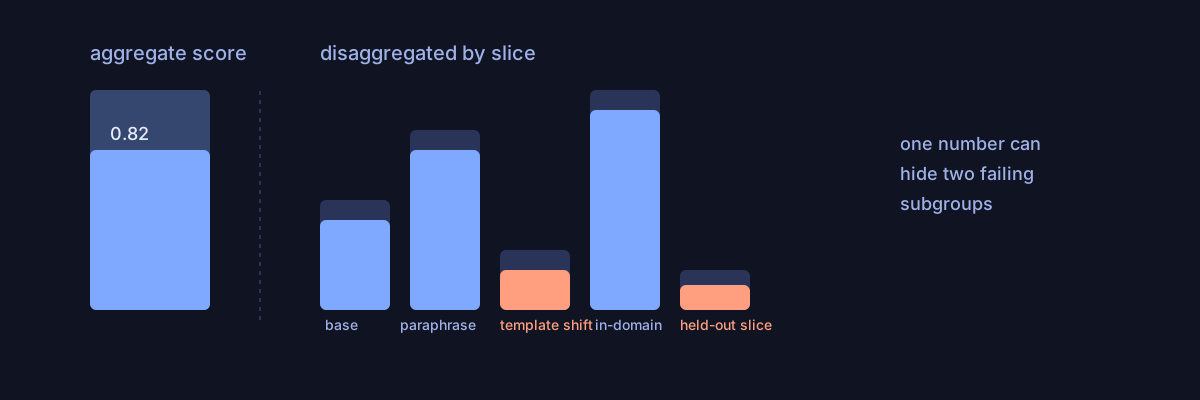
Held-out examples from the same template test interpolation, not broad reasoning. Students vary surface wording, operation combinations, story structures, and allowed numeric range while keeping the published task scope. Track A uses analogous constraint or prompt changes. Performance is reported by slice so one easy subset cannot hide a failure.
2. Outcome and process supervision#
An outcome reward checks the final answer; a process reward scores intermediate steps. Process labels can support search and error localisation, but human step annotation is expensive and automated rollouts can drift from the policy being evaluated. A correct outcome does not certify every stated step, while a flawed rationale can occasionally reach a correct answer.
3. Verifiable rewards and GRPO as frontier context#
When a task has an objective checker, RL can use rule-based rewards without a learned reward model. GRPO compares a group of responses to the same prompt and uses the group mean as a prompt-specific baseline instead of a separate value model. Students should understand the signal path and limitations, but Project 3 does not require implementing RLVR, PPO, GRPO, or a process reward model.
4. The ablation and the claim#
A useful ablation changes one factor — rationale targets, data mix, learning rate, starting checkpoint, or decoding rule — while holding evaluation constant. Results include cost and regressions. If several factors changed, the comparison can show a system difference but cannot isolate which change caused it. Postgraduate analysis is expected to examine mechanism and alternative explanations more deeply.
Required reading#
- Hunter Lightman et al., Let’s Verify Step by Step, abstract and Sections 1–2.
- Jeffrey Zhou et al., Instruction-Following Evaluation for Large Language Models, Section 2, as an example of rule-verifiable behaviour.
Optional reading#
- Zhihong Shao et al., DeepSeekMath: Pushing the Limits of Mathematical Reasoning in Open Language Models, Sections 1 and 4.
- Liangchen Luo et al., Improve Mathematical Reasoning in Language Models by Automated Process Supervision, abstract and Section 3.
This week’s action#
Support: Project 3 drop-in clinic. Before Week 12: freeze the candidate checkpoint and write the strongest conclusion your comparison supports plus one conclusion it does not support.
Teaching team
- Dr Yiwei Easton — convenor