Week 12: Audit the Training System
Reconstructing the artifact chain, reproducing the core metric, what transfers across scale, and the final engineering retrospective
17 May 2027
Stage: Build a specialist · Project 3 due
Summary#
The course ends by treating the model as one component of an auditable training system. Students reconstruct the path from task definition through data, configuration, compute ledger, checkpoints, evaluation, and final claim. A peer or fresh process must be able to load the exact artifact and reproduce the core metric. The lecture then revisits scale transfer: large-model scaling laws, emergent-behaviour claims, long reasoning traces, RLVR, and inference-time compute can inspire a small experiment, but evidence at one scale does not automatically establish a mechanism at another. The final retrospective asks where the original plan changed, which evidence caused the change, and what uncertainty remains.
Learning outcomes#
After this lecture, you should be able to:
- audit the consistency of a checkpoint, tokenizer, configuration, data revision, sampler, and evaluation command;
- reconcile the compute ledger with the final report and model card;
- distinguish reproducibility of an artifact from replicability of a scientific claim;
- evaluate whether a frontier result plausibly transfers to a 32M experiment; and
- write a concise engineering retrospective grounded in decisions and evidence.
1. The artifact chain#
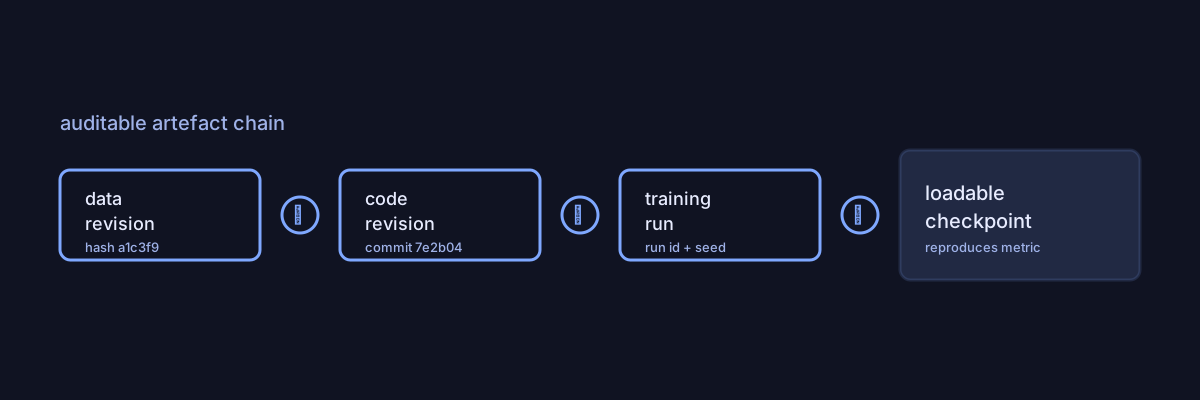
Every reported result points to a frozen GitLab commit, data version, starting and final checkpoint revision, configuration, seed policy, sampler, and evaluation command. Checksums and tensor shapes catch mismatched weights; a fresh load catches hidden notebook state and missing files.
2. Reproduce the number and the behaviour#
The core metric is rerun from the packaged model. Fixed prompts and generation settings reproduce comparable outputs, while a small additional sample shows the model is not only replaying a cached artifact. Technical validity, task performance, and human judgement are recorded separately.
3. What transfers across scale#
Scaling laws describe fitted empirical regimes, not promises for every architecture and dataset. Claims of emergence depend on metrics and sampling; data quality can dominate quantity in small settings; longer reasoning and more samples trade compute for probability of success. Students identify which course results are direct evidence and which are analogies to frontier systems.
4. The final retrospective#
A strong retrospective names the original plan, the observation that challenged it, the revision made, the cost of that revision, and the remaining uncertainty. It does not need a perfect final model. It needs a traceable explanation of why the final system is the most defensible use of the available budget.
Required reading#
- Jared Kaplan et al., Scaling Laws for Neural Language Models, limitations relevant to extrapolation.
- Rylan Schaeffer, Brando Miranda, and Sanmi Koyejo, Are Emergent Abilities of Large Language Models a Mirage?, abstract and Sections 1–2.
Optional reading#
- Xuezhi Wang et al., Self-Consistency Improves Chain of Thought Reasoning in Language Models, discussion of inference cost and limitations.
This week’s action#
Deadline: Project 3, Sunday 23 May 2027 at 23:59 AET. Complete the fresh-environment audit before submission.
Teaching team
- Dr Yiwei Easton — convenor