Week 10: Train a Specialist That Can Be Tested
Task contracts, frozen starting checkpoints, split integrity, and full versus parameter-efficient adaptation for Project 3
3 May 2027
Stage: Build a specialist · Formal Lab 3
Summary#
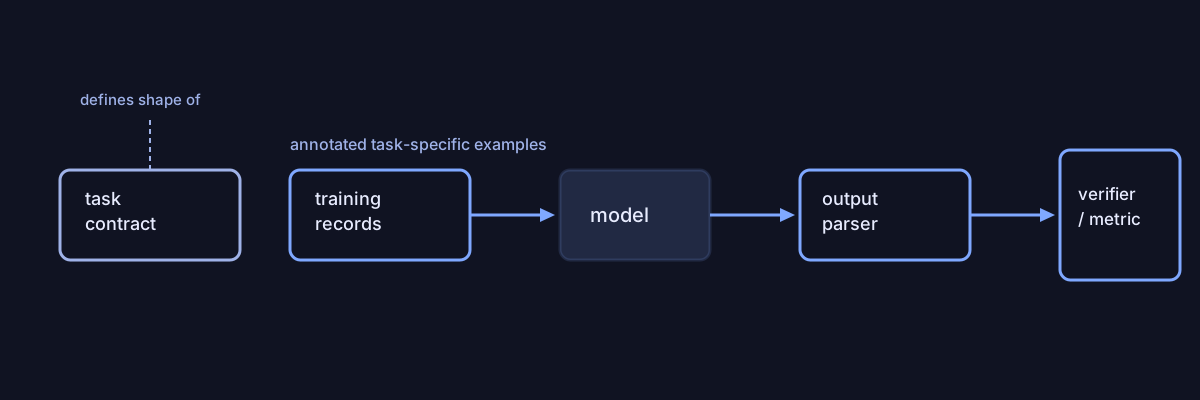
Specialisation is post-training with a narrower contract. This lecture turns that contract into data, targets, and a controlled comparison. Students choose a permitted starting checkpoint, define the task schema, create source- or template-aware splits, inspect response-only masks, and decide whether to train direct answers, short rationales, or both. Curriculum, counterexamples, data balance, full fine-tuning, and parameter-efficient adaptation are framed as engineering choices whose value depends on model size and implementation overhead. Project 3A and 3B share the same experimental logic: one primary capability, one unchanged baseline, one meaningful comparison, one regression check, and a package that can be loaded independently.
Learning outcomes#
After this lecture, you should be able to:
- translate a bounded task definition into a schema, metric, split, and validity gate;
- choose a permitted starting checkpoint and document its frozen identity;
- design examples, counterexamples, and curriculum without leaking evaluation templates;
- compare direct-answer and rationale-supervised targets for Project 3B; and
- justify full or parameter-efficient adaptation using total trainable parameters, memory, runtime, and reproducibility.
1. A task contract before a dataset#
The primary capability is written as an input, allowed output, success
measure, and out-of-scope boundary. Track A proposals use the approved
metric and human-evaluation plan; Track B follows test_pilot, exact answer
extraction, and format validation. Data is selected only after the contract
is explicit.
2. Starting checkpoint and split integrity#
The frozen revision, parameter count, tensor shapes, and checksum identify the starting model. Template families, story sources, or generated problem seeds are separated so validation measures transfer rather than repetition. Public tutor prompts remain excluded from training even when their wording is visible.
3. Targets, rationales, and curriculum#
Direct answers minimise output burden; short rationales expose intermediate structure and can make word problems easier to learn, but they also increase sequence length and can introduce plausible wrong steps. A curriculum may move from single operations to mixed operations and from direct arithmetic to short word problems. Difficulty and format should be balanced deliberately, not inferred from file order.
4. Adaptation method and regression#
Full fine-tuning updates the entire permitted model. Parameter-efficient methods may reduce trainable-state and memory costs but add adapter configuration and may not save total runtime on a tiny model. Either method must be counted correctly and load in the marker’s environment. A retained narrative or general-language check runs alongside the task metric.
Required reading#
- Karl Cobbe et al., Training Verifiers to Solve Math Word Problems, abstract and Sections 1–2.
- Eric Zelikman et al., STaR: Self-Taught Reasoner Bootstrapping Reasoning With Reasoning, abstract and Section 2.
Optional reading#
- Edward Hu et al., LoRA: Low-Rank Adaptation of Large Language Models, abstract and Section 4.
This week’s action#
Practical: Lab 3 — Train and Verify a Specialist. Before Week 11: produce one loadable pilot checkpoint, one valid task metric, and one unchanged-model baseline result.
Teaching team
- Dr Yiwei Easton — convenor