Week 9: Reasoning as Generated and Verifiable Behaviour
Chain-of-thought as generated intermediate tokens, self-consistency, exact-answer verification, and rationale faithfulness
26 April 2027
Stage: Build a specialist · Project 3 begins
Summary#
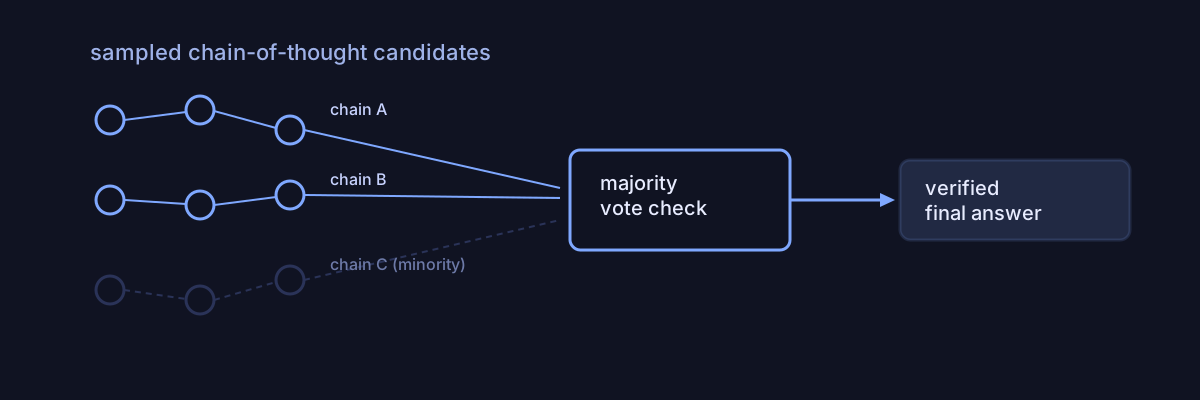
Reasoning is introduced as generated intermediate tokens and decisions, not a hidden faculty that switches on when a model crosses a size threshold. A model may assign some probability to a correct path while greedy decoding selects a wrong one. Chain-of-thought demonstrations can reshape the output distribution; self-consistency spends additional inference compute to sample multiple paths and aggregate final answers; a verifier separates generating a candidate from checking it. These tools connect directly to Project 3B, while the same generate–compare–verify pattern helps Project 3A define and test a narrative capability. Students also confront a central limitation: a correct final answer does not prove that the written rationale is faithful or correct.
Learning outcomes#
After this lecture, you should be able to:
- represent a rationale as intermediate generated tokens preceding a final answer;
- compare direct, zero-shot CoT, few-shot CoT, and self-consistency inference;
- explain why sampling more paths can improve final-answer accuracy and increase cost;
- implement an exact final-answer and format verifier for bounded arithmetic; and
- distinguish answer correctness, reasoning validity, and rationale faithfulness.
1. The correct path may not rank first#
Greedy decoding returns a locally high-probability continuation, not a proof that no better reasoning path exists. Inspecting several candidates shows that both correct and incorrect answers can arise from fluent text. Longer is not automatically more correct.
2. Chain-of-thought as an interface#
Few-shot CoT supplies examples of intermediate steps; zero-shot prompts provide a weaker generic cue. The original gains were demonstrated primarily on much larger models, so Project 3 treats CoT as a hypothesis to test at 32M rather than an assumed benefit. Short, task-aligned rationales may be more learnable than verbose traces.
3. Self-consistency and inference-time compute#
Self-consistency samples diverse reasoning paths and selects the most frequent final answer. The aggregation is over final answers, not identical wording. Accuracy may improve, but sample count and rationale length consume inference budget and must be reported. Correlated errors limit the value of additional samples.
4. Verification#
For Project 3B, the parser extracts the final answer and checks it against ground truth; formatting validation prevents an unparsable output from being treated as correct. For open-ended narrative tasks, verification becomes a mixture of explicit constraints and human judgement. In both tracks, generation and evaluation remain separate pipeline components.
Required reading#
- Jason Wei et al., Chain-of-Thought Prompting Elicits Reasoning in Large Language Models, abstract and Sections 1–2.
- Xuezhi Wang et al., Self-Consistency Improves Chain of Thought Reasoning in Language Models, abstract and Section 2.
Optional reading#
- Takeshi Kojima et al., Large Language Models Are Zero-Shot Reasoners, Sections 1–2.
This week’s action#
Milestone: Project 3 alternative-task proposals are due Sunday 2 May 2027 at 23:59 AET. All students should establish the unchanged-model baseline before training.
Teaching team
- Dr Yiwei Easton — convenor