Week 8: Did the Behaviour Change, and What Regressed?
Multi-objective post-training evaluation, blind A/B review, paraphrase robustness, and checkpoint selection against a pre-declared priority
19 April 2027
Stage: Shape model behaviour · Project 2 due
Summary#
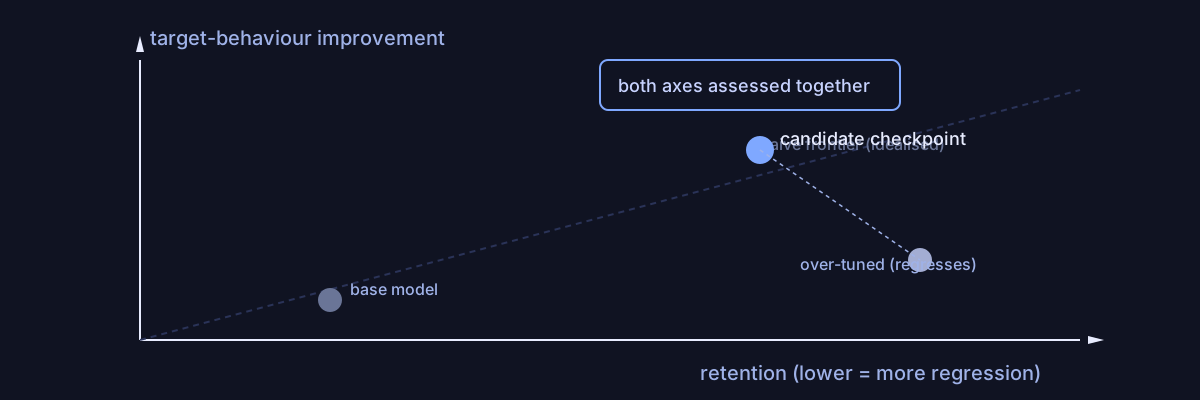
Post-training creates a multi-objective evaluation problem. A checkpoint may match target vocabulary while becoming repetitive, follow an exact instruction while failing a paraphrase, or improve style ratings while losing general narrative coherence. This lecture shows how to define target-style, instruction-compliance, narrative-quality, memorisation, and retention measures without collapsing them into one opaque score. Students practise blind paired comparisons, recognise evaluator and prompt-order effects, inspect source overlap, and select checkpoints against a declared priority rather than whichever metric looks best. The resulting report should say what changed, what did not, and which evidence cannot distinguish competing explanations.
Learning outcomes#
After this lecture, you should be able to:
- operationalise a behavioural target using observable anchors and held-out evidence;
- design a blind A/B review that separates model identity from candidate quality;
- evaluate paraphrase robustness, copying, and retained narrative ability;
- select a checkpoint across competing objectives using a pre-declared rule; and
- write a calibrated claim that distinguishes measurement, interpretation, and uncertainty.
1. Separate target behaviour from surface mimicry#
Target-word frequency can rise without a convincing voice. Human anchors therefore cover coherence, target behaviour, and major defects, while target-domain PPL provides a complementary distributional measure. Selected examples must include failures and cannot be silently edited.
2. Blind comparison and rater variability#
Candidate order is randomised and model identities are hidden. Three raters score official story outputs independently under the published anchors; medians reduce sensitivity to one extreme score, and adjudication addresses large disagreement. Student-run formative reviews should record prompt, sampler, rater count, and order policy.
3. Robustness, retention, and copying#
The same intent is tested through paraphrased prompts or changed story openings. General narrative prompts reveal catastrophic forgetting. Exact and near-duplicate checks plus phrase-level inspection distinguish plausible genre convention from suspicious reproduction of source text.
4. Multi-objective checkpoint selection#
Students identify one primary target and minimum acceptable floors for retained behaviour and technical validity. A checkpoint that wins one metric but violates a floor is not selected. The report presents the trade-off openly instead of manufacturing a single composite score after seeing results.
Required reading#
- Jeffrey Zhou et al., Instruction-Following Evaluation for Large Language Models, abstract and Sections 1–2.
- Course page, Human review protocol and rating anchors.
Optional reading#
- Percy Liang et al., Holistic Evaluation of Language Models, Sections 1–2.
This week’s action#
Deadline: Project 2, Sunday 25 April 2027 at 23:59 AET. Preserve the unchanged-checkpoint baseline outputs alongside the final outputs.
Teaching team
- Dr Yiwei Easton — convenor