Week 7: Learning from Preferences Without Hiding the Cost
Bradley–Terry preference data, reward models and RLHF, RLAIF and DPO, and proportionate preference learning at 32M parameters
12 April 2027
Stage: Shape model behaviour · Project 2 drop-in clinic
Summary#
Some qualities — voice, helpfulness, restraint, or overall story preference — are easier to compare between two outputs than to demonstrate with one perfect answer. This lecture follows a preference signal through reward modelling, RLHF, RLAIF, and DPO. The mathematics is kept sufficient to interpret the objective and failure modes: Bradley–Terry ranking, sequence-level policy gradients, KL control, implicit rewards, and reference policies. Full PPO-scale RLHF is not a compulsory course implementation. The engineering lesson is to distinguish what each label actually supports, recognise reward hacking and distribution shift, and ask whether a small preference stage provides evidence worth its data and compute.
Learning outcomes#
After this lecture, you should be able to:
- construct a pairwise preference record and explain the Bradley–Terry ranking assumption;
- describe the SFT, reward-model, and policy stages of classical RLHF;
- explain intuitively why sampled sequence rewards require a policy-gradient estimator and why KL control is used;
- compare human feedback, AI feedback, and DPO without mislabelling one as another; and
- identify reward hacking, off-policy distribution shift, label inconsistency, and reference-policy drift.
1. Preference data#
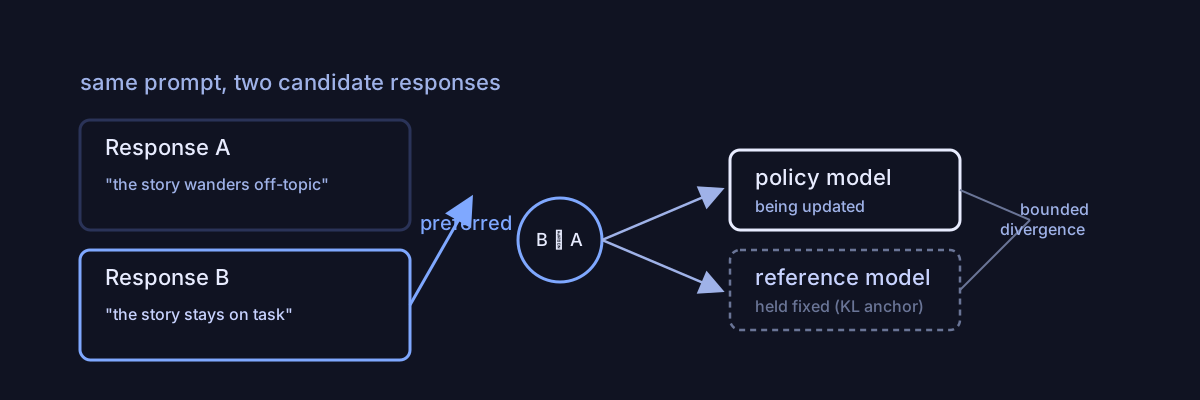
For one prompt, labelers compare candidates under published anchors. The result says one observed output was preferred under those conditions; it does not reveal a universal scalar truth. Candidate order, sampler, rater reliability, ties, and the proximity of candidates to the current policy affect the dataset.
2. Reward models and RLHF#
A reward model learns to score preferred outputs above rejected outputs. A policy then samples sequences and is updated toward higher reward. Because sampling is discrete, the reward weights gradients of the sampled sequence log-probability rather than being differentiated through the sampled words. A KL penalty discourages the policy from moving into regions the SFT reference assigns negligible probability.
3. RLAIF and DPO#
RLAIF replaces or supplements human preference labels with an AI judge and therefore inherits judge capability, prompt, order, and bias risks. DPO removes the separately trained reward model and directly increases the relative preference of chosen over rejected responses against a reference policy. It is simpler operationally, not evidence-free; pair quality and the reference remain central.
4. Proportionate choices at 32M#
The supported course exercise uses a tiny fixed preference set and an inspectable loss. Students may use a preference method in Project 2 only when the target, labels, baseline, and retained-capability evaluation justify it. Work using AI labels is described as AI feedback; work without genuine human preference labels is not called full RLHF.
Required reading#
- Long Ouyang et al., Training Language Models to Follow Instructions with Human Feedback, Sections 2 and 3.4.
- Rafael Rafailov et al., Direct Preference Optimization: Your Language Model Is Secretly a Reward Model, abstract and Sections 3–4.
Optional reading#
- Yuntao Bai et al., Constitutional AI: Harmlessness from AI Feedback, Sections 1–2.
This week’s action#
Support: Project 2 drop-in clinic. Before Week 8: freeze the final comparison set and decide whether every extra training stage produced evidence strong enough to retain in the final pipeline.
Teaching team
- Dr Yiwei Easton — convenor