Week 6: Supervised Fine-Tuning and Data That Teaches Behaviour
Response-only loss masking, instruction schemas, synthetic demonstration data, and learning without catastrophic overwriting
29 March 2027
Stage: Shape model behaviour · Formal Lab 2
Summary#
Supervised fine-tuning uses the familiar next-token loss on deliberately formatted demonstrations, but its data meaning is different from pre-training. This lecture follows an instruction–response example from raw record to tokens, attention context, response-only target mask, loss, and updated behaviour. It then examines data diversity, special tokens, synthetic demonstrations, learning-rate choice, mixing with pre-training text, and catastrophic overwriting. Students learn why a model can appear successful on the exact training wording yet fail on a paraphrase, and why data provenance and a visible loss mask are part of the scientific result rather than implementation trivia.
Learning outcomes#
After this lecture, you should be able to:
- design and document a consistent instruction or structured-continuation schema;
- distinguish attention masking from loss masking and verify which tokens receive SFT loss;
- explain how task diversity, example quality, and prompt phrasing affect transfer;
- identify risks introduced by synthetic demonstrations and over-training; and
- design a small SFT pilot with a lower learning rate, retained-capability check, and unchanged-checkpoint baseline.
1. The SFT objective#
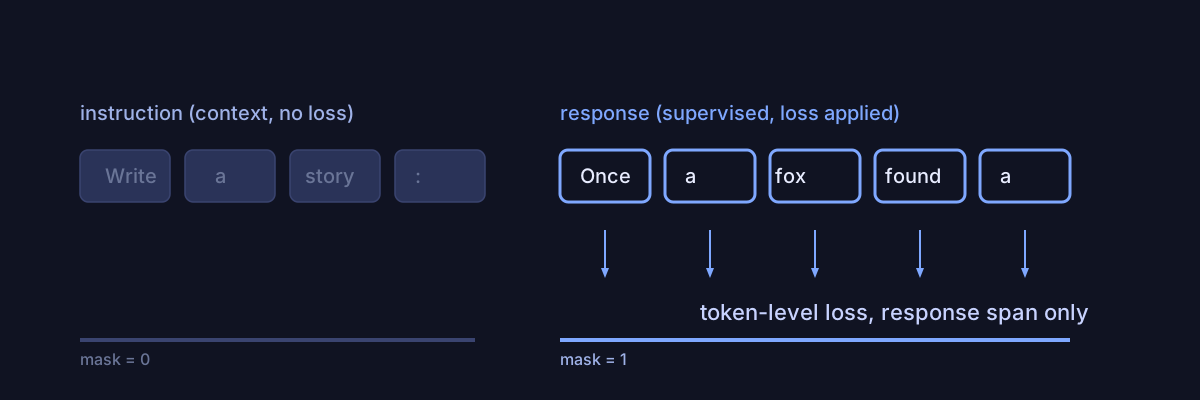
The model conditions on the prompt and preceding response tokens, then predicts the next response token. In response-only SFT, prompt tokens provide context but do not contribute target loss. We distinguish this loss mask from the causal attention mask. A rendered token table is used to catch off-by-one targets, missing separators, and accidental prompt learning.
2. Schemas and special tokens#
An instruction, optional input, and output must be serialised consistently at training and inference. Chat-role tokens are one possible schema, not a universal requirement. At small scale, every extra format consumes examples and context, so students should choose only the structure their target behaviour needs and test EOS explicitly.
3. What makes useful demonstration data#
More examples of one narrow template may yield less transfer than a smaller set with meaningful task and phrasing diversity. Generated demonstrations can expand coverage cheaply, but students must disclose the generator, prompts, filtering, quantity, and validation. Synthetic confidence is not ground truth, and a teacher model’s style can dominate the intended voice.
4. Learning without erasing#
Post-training usually needs a smaller learning rate than training from random initialisation. Excessive epochs, homogeneous data, or an aggressive rate can overwrite narrative ability. Mixing a controlled amount of original-domain text, selecting an earlier checkpoint, or reducing update strength can preserve capability, but each choice must be measured rather than assumed.
Required reading#
- Jason Wei et al., Finetuned Language Models Are Zero-Shot Learners, Sections 2–3.
- Long Ouyang et al., Training Language Models to Follow Instructions with Human Feedback, Sections 3.1–3.2.
Optional reading#
- Hyung Won Chung et al., Scaling Instruction-Finetuned Language Models, Sections 2–3.
This week’s action#
Practical: Lab 2 — Build and Inspect a Post-Training Batch. Mid-semester break: Monday 5–Sunday 11 April. Preserve logs and checkpoints outside the active runtime before the break.
Teaching team
- Dr Yiwei Easton — convenor