Week 5: From a Base Model to a Target Behaviour
Capability versus elicited behaviour, continued pre-training versus SFT versus preference learning, and a measurable narrative-voice target
22 March 2027
Stage: Shape model behaviour · Project 2 begins
Summary#
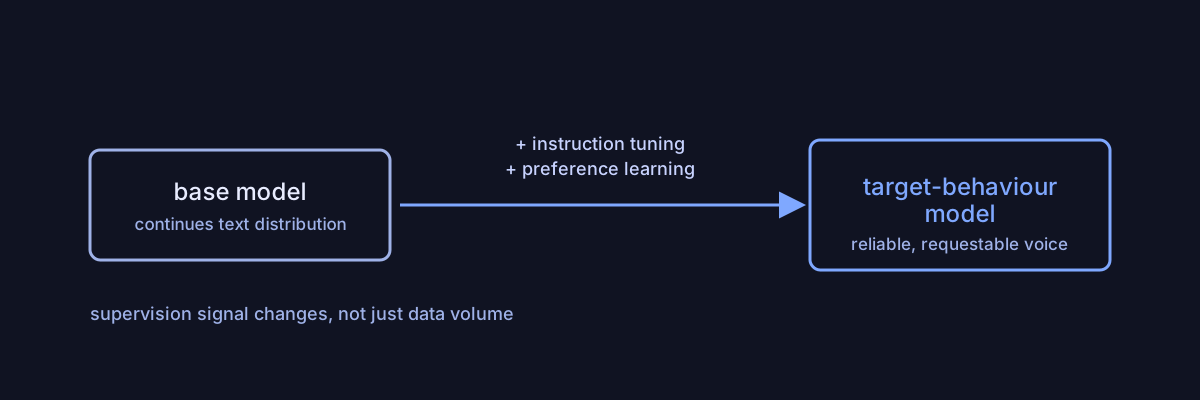
Pre-training teaches a model to continue text from its data distribution; it does not guarantee a stable voice, an instruction-following interface, or a behaviour a user can request reliably. This lecture defines post-training by its supervision signal rather than by a single algorithm. Continued pre-training changes the text distribution the model imitates. Supervised fine-tuning trains desired prompt–response or structured continuations. Preference learning compares candidate outputs when quality is difficult to express as one reference. Students map these choices to Project 2 and learn that the simplest method capable of testing the target is often stronger engineering than an expensive pipeline whose additional stages cannot be validated.
Learning outcomes#
After this lecture, you should be able to:
- distinguish language capability from elicited and user-facing behaviour;
- compare continued pre-training, SFT, and preference-based post-training by data, objective, cost, and evidence;
- define a narrative voice using observable output criteria rather than an impressionistic label;
- identify a baseline and retained capability needed to measure behavioural change; and
- choose a proportionate post-training route for a 32M checkpoint.
1. Why the pre-training objective is not a user specification#
A base model was asked to predict internet or story tokens, and it does exactly that. It may produce fluent text while responding unstably to an instruction or drifting between styles. Post-training supplies additional evidence about which continuations are useful in a particular interaction or domain.
2. Three routes through Project 2#
Continued pre-training is appropriate when the target is naturally represented as unlabelled target-domain prose. SFT is appropriate when the desired behaviour can be demonstrated as examples with a declared input/output schema. Preference optimisation may help when relative quality is easier to label than a single ideal output, but it requires trustworthy pairs, a reference policy, and additional validation.
3. Turn “voice” into a measurement plan#
Students decompose a target voice into dimensions such as diction, sentence rhythm, dialogue balance, narrative perspective, thematic motifs, and coherence. A target-style hold-out measures domain fit; blind human comparisons assess whether the behaviour is recognisable; a general narrative set checks retention. No one metric stands in for all three.
4. Baselines and method claims#
Every intervention is compared with the unchanged starting checkpoint under the same prompts and sampler. If two post-training routes are compared, their data and compute must be reported. Students may combine methods, but each added stage must answer a stated uncertainty rather than merely make the pipeline look more advanced.
Required reading#
- Jason Wei et al., Finetuned Language Models Are Zero-Shot Learners, abstract and Sections 1–2.
- Long Ouyang et al., Training Language Models to Follow Instructions with Human Feedback, abstract and Figure 2.
Optional reading#
- Rohan Taori et al., Stanford Alpaca, project overview and data-generation description.
This week’s action#
Before Week 6: write an operational target-voice statement, choose the unchanged checkpoint baseline, and identify the minimum data needed for one viable route.
Teaching team
- Dr Yiwei Easton — convenor