Week 12 Seminar: The blind spot
Nothing is added. You apply eleven weeks of account to your own judgement, and the question from week 1 comes back in a form no card will find.
No new mechanism this week. Everything is already on the table, and the job is to point it at ourselves.
The punchline, handled carefully#
Dunning-Kruger is what everyone expects this week to be about, and the honest version is more interesting than the meme.
Krueger and Mueller argued in 2002 that the classic curve is substantially reproducible from regression to the mean plus a better-than-average effect, with no metacognitive deficit required. Kruger and Dunning replied in the same issue. Burson, Larrick and Klayman raised related objections in 2006. The exchange is unresolved, and the effect that survives is real but weaker and differently shaped than the version in circulation.
Which puts us in an awkward and appropriate position: the single most famous claim about not knowing what you don’t know is itself a claim we don’t fully know. Grade [C], and notice that this is the best possible week 12 for this course rather than an embarrassment for it.
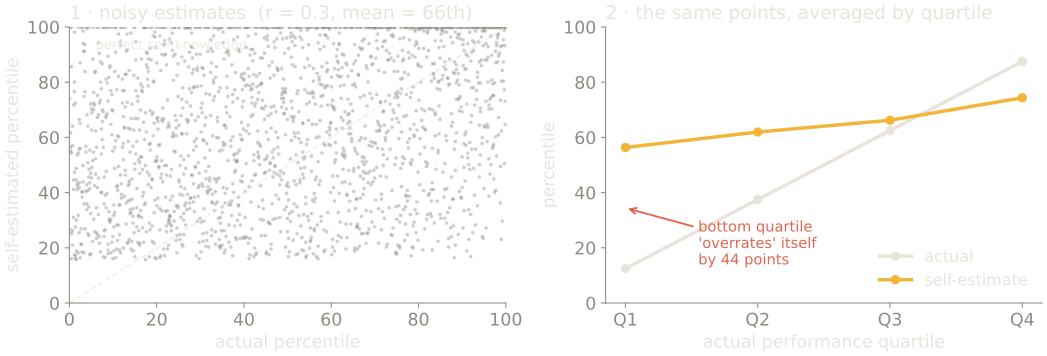
Two thousand simulated people, with no metacognitive deficit anywhere in the model — only a weak correlation between actual and estimated skill, plus a better-than-average shift. Averaged into quartiles, they reproduce the famous crossing lines. That does not show the effect is nothing; it shows the classic figure is not evidence for it.
The formal shape of the problem#
Then the epistemology, which is where the course has been heading since week 1.
No observation tests a hypothesis alone — Duhem’s point, sharpened by Quine in 1951 into the underdetermination thesis. Laudan and Leplin argue the thesis is far weaker than usually claimed, and you should read them too, because teaching the strong version unopposed would violate this course’s own rules. Goodman’s new riddle is sharper than Hume’s problem for our purposes: the difficulty isn’t a shortage of evidence but that evidence never uniquely fixes a hypothesis.
Agrippa’s trilemma, via Sextus, is the formal skeleton. Any justification is circular, infinite, or stops somewhere arbitrary. Pick a horn in the seminar and defend it.
The formal result worth knowing is Wolpert and Macready’s: averaged over all problems, every learning algorithm performs identically. Any inductive bias that helps somewhere must hurt elsewhere. There is no assumption-free learner, and that is a theorem rather than an observation about brains.
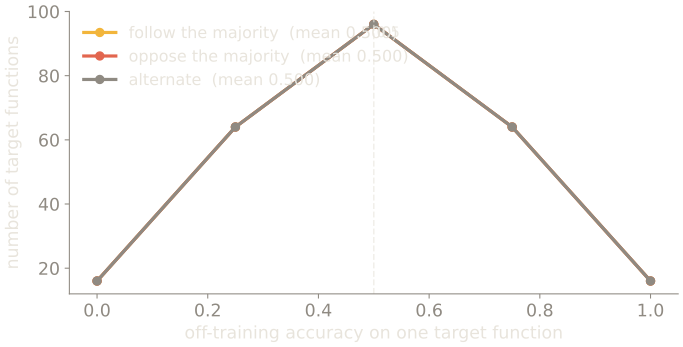
Not a depiction — a computation. Three learners with different biases, scored exhaustively against all 256 target labellings of eight binary points. The distributions differ; all three means are exactly 0.500000.
What this is not#
Fallibilism is not relativism, and I will be strict about this. “All models rest on assumptions” does not license “all models are equal”. Models are comparable by their track record, and Tetlock’s twenty years of scored forecasts are the demonstration — calibration is measurable, some people are reliably better, and the best of them update frequently in small increments rather than holding positions.
If you leave this course thinking nothing can be known, you have the argument backwards, and I would rather you argued with me about it now than believed it quietly.
Live, at the edge#
We close on a science currently arguing about whether its own central theory is testable. In September 2023, 124 researchers signed a letter calling integrated information theory pseudoscience. The Cogitate consortium’s adversarial collaboration, with predictions agreed in advance by proponents of two rival theories, returned results that challenged both.
That is what this course has been describing, happening to professionals in real time. Your own blind spot is the same shape as theirs, and it is not findable with a card.
Reading#
The paper this seminar is built around:
- Krueger and Mueller (2002). Unskilled, unaware, or both? Journal of Personality and Social Psychology.
The rest of the week’s reading:
- Kruger and Dunning (2002). Unskilled and unaware — but why? A reply. JPSP — read the reply immediately after, and form your own view; the exchange is unresolved.
- Burson, Larrick and Klayman (2006). Skilled or unskilled, but still unaware of it. JPSP.
- Quine (1951). Two dogmas of empiricism. The Philosophical Review.
- Laudan and Leplin (1991). Empirical equivalence and underdetermination. The Journal of Philosophy — the counterweight, and required.
- Wolpert and Macready (1997). No free lunch theorems for optimization. IEEE Transactions on Evolutionary Computation.
- Tononi (2004). An information integration theory of consciousness. BMC Neuroscience.
- Fleming and colleagues (2023). The integrated information theory of consciousness as pseudoscience. PsyArXiv preprint, 124 signatories.
- Cogitate Consortium (2025). Adversarial testing of global neuronal workspace and integrated information theories. Nature.
- Sextus Empiricus, Outlines of Pyrrhonism I.164–169 — Agrippa’s trilemma, two pages.
Grades are not attached to papers here, because a grade belongs to a claim rather than to the paper it appears in — see evidence grades. Several of these papers contain claims at two different grades.
The spec
What you bring to the session. Written so a reader can tell whether it has been met without asking you.
- you can explain why the classic Dunning-Kruger curve is partly a statistical artefact
- you can state Agrippa's trilemma and say which horn you take
- you can explain why fallibilism is not relativism
Teaching team
- Halvard Emms — convenor