Recall the end of week 11
Much of the canonical literature on human error did not replicate, and the literature on error is subject to error.
The question we left open
If the account is right, it applies to the account. What follows from accepting that?
Where this week sits
| Now | Part | Weeks | What it does |
|---|---|---|---|
| Premise | weeks 1–2 | the constraint, and what a sense organ is for | |
| Interior models | weeks 3–7 | trace, association, map, prediction, self | |
| Control group | weeks 8–10 | other minds, as the only outside vantage | |
| → | The human case, and its limits | weeks 11–12 | the catalogue, and the blind spot |
The third part is not a tour. It is the only place a bound is visible from outside, which is what the fourth part needs.
The blind spot
SLOP3233 · Week 12 · Halvard Emms
Nothing new today
Dunning–Kruger
What you expect this week to be
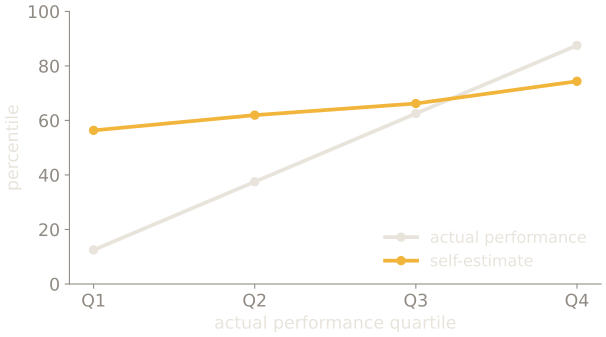
The bottom quartile overrates itself enormously. The top underrates slightly.
A metacognitive deficit, apparently.
Krueger & Mueller, 2002: build it from nothing
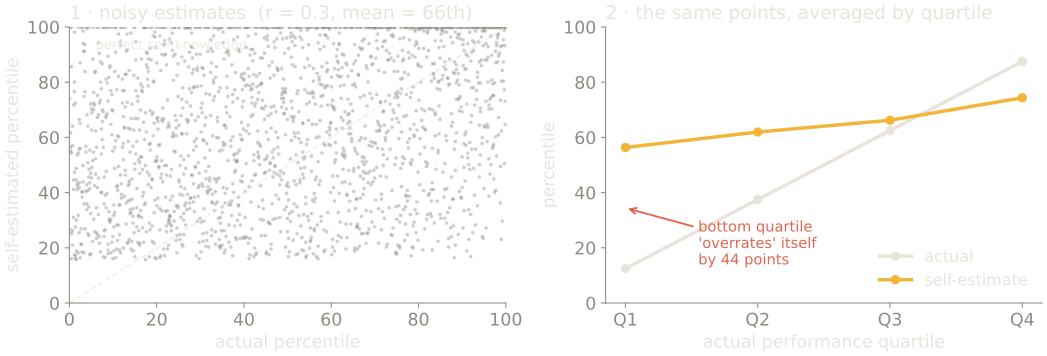
Simulated: r = 0.30, mean estimate at the 66th percentile, n = 2000, seeded.
Nothing in that model knows anything about competence-to-judge. Q1 still “overrates” itself by 44 points.
The exchange, unresolved
| Year | Who | Claim |
|---|---|---|
| 1999 | Kruger & Dunning | the unskilled are unaware |
| 2002 | Krueger & Mueller | regression + BTA predict the pattern |
| 2002 | Kruger & Dunning, reply | unreliable tests, bad mediators |
| 2006 | Burson, Larrick & Klayman | task difficulty drives miscalibration |
[C] — the effect that survives is real, weaker, and differently shaped.
The most famous claim about not knowing what you don’t know is itself not fully known.
That is the right week 12 for this course
The formal shape
Nothing tests alone
Underdetermination, drawn
Underdetermination: the available evidence is compatible with more than one hypothesis, so observation alone cannot select between them.

Why this is not scepticism
It does not follow that theory choice is arbitrary.
It follows that a single failed prediction cannot locate the fault — which is why science proceeds by accumulating constraints across many tests rather than by decisive refutation of one hypothesis at a time.
Laudan & Leplin argue the thesis is far weaker than its popular statement, and our own rules require you to read them.
Hume, and then the sharper version
Hume’s problem: no number of observed instances entails the next one. Induction cannot be justified deductively, and justifying it inductively is circular.
Goodman’s new riddle is worse, and more useful to us.
Grue
Define grue: examined before time t and green, or examined after t and blue.
Every observation of a green emerald so far confirms “all emeralds are green” and “all emeralds are grue” equally well.
Why that is the deeper problem
Hume says the evidence is insufficient. Goodman says the evidence never uniquely fixes a hypothesis at all, you need a prior commitment about which predicates are projectible before evidence can do any work.
Which is to say: the bias has to come first, and no amount of data supplies it. Hold that for the No Free Lunch slide.
Agrippa’s trilemma

Via Sextus, Outlines of Pyrrhonism I.164–169. Pick a horn and defend it.
No Free Lunch: the bias is not optional
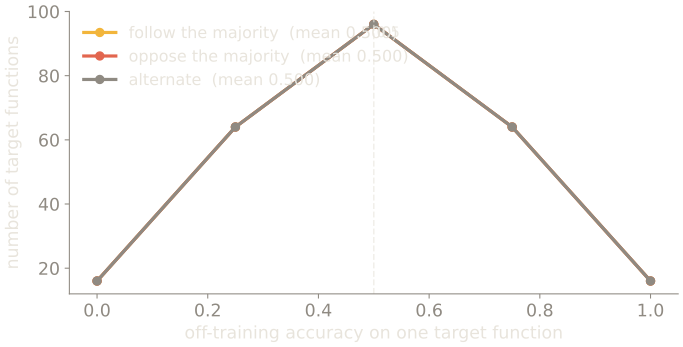
Exhaustive, not sampled: all 256 target functions, trained on the same 4 points. All three means are exactly 0.500000.
Neurath’s boat
We are like sailors who have to rebuild their ship on the open sea, never able to dismantle it in dry dock and reconstruct it from the best materials.
Which is the constructive reading of Agrippa. You cannot inspect your foundations from outside, and you can still replace a plank at a time.
Two warnings before you use any of this
Do not reach for Gödel. Lucas and Penrose argued from the incompleteness theorems to the non-computational nature of mind, and the argument is near-universally rejected. Gödel constrains formal systems; the leap requires premises about human mathematical ability that were never established.
A marker who knows this spots it instantly. [E] that the arguments fail.
And do not overstate Kuhn
The Structure of Scientific Revolutions (1962) is not the claim that theory choice is irrational or that paradigms are incommensurable in a way that makes comparison impossible.
Kuhn spent much of his later career resisting exactly that reading. Cite him for the observation that normal science is puzzle-solving inside assumptions — not for licence to say anything goes.
One formal constraint worth knowing
The tractable cognition thesis (van Rooij): a theory of cognition should posit only computations that are feasible for the system in question.
Which rules out a great deal of otherwise elegant theory — including several accounts of rationality that require intractable optimisation, and which week 11’s bounded-rationality literature was reacting to all along.
Fallibilism is not relativism
I will be strict about this
You have been measuring this all semester
The quizzes have been scoring your calibration since week 1, using a proper scoring rule.
If your accuracy was around 80% and your certainty-based score was around half the maximum, the gap between those two numbers is the subject of this lecture, in your own data.
Look at it before the seminar.
Calibration, scored
The Brier score is the mean squared error of a probabilistic forecast:
BS = mean((p − o)²), where o is 1 if the event happened and 0 if not.
Lower is better.
Two forecasters, same ten questions, both get 7 right:
Confident Clara   says 0.95 every time
Careful Karim     says 0.70 every time
Work both
Clara:  7 hits at (0.95−1)² = 0.0025
        3 miss at (0.95−0)² = 0.9025
        BS = (7×0.0025 + 3×0.9025)/10 = (0.0175 + 2.7075)/10 = 0.272

Karim:  7 hits at (0.70−1)² = 0.09
        3 miss at (0.70−0)² = 0.49
        BS = (7×0.09 + 3×0.49)/10 = (0.63 + 1.47)/10 = 0.210
Karim wins on identical accuracy, because he said 0.70 and was right 70% of the time.
The moral
Being right is not the whole of being good at this. Saying how right you are likely to be is the other half, and it is separately measurable.
Which is exactly what your quizzes have been scoring since week 1, and why Tetlock’s programme could rank forecasters at all.
Calibration is a measurement, not a mood
Live, at the edge
Which is week 7’s structure, at field scale

Two things to separate
Is IIT false? A scientific question, and the Cogitate results bear on it.
Is IIT pseudoscience? A question about whether it is the kind of claim evidence can reach the claim at all, and the letter did not define the term.
Conflating those is what made the dispute so bad-tempered. Seth and Goff’s defence turns on exactly that distinction.
A field arguing about its own testability
Week 1 asked this with a card
In week 1 the claim was that a finite system must discard most of its world.
Twelve weeks later it is narrower and worse: the discarding is not reportable, the checking is done by the system being checked, and the literature on that problem is subject to it.
What you get instead of certainty is a track record. That is not a consolation prize. It is the only thing that was ever on offer.