Week 8 Seminar: Small brains
Everything so far, running on a million neurons — and the collapse of the brain-size story that made it puzzling.
From here to week 10 the course stops adding and starts testing. If the account built over seven weeks only describes vertebrates, it was never an account of intelligence, and these are the weeks where we find out.
The puzzle, and why it was the wrong puzzle#
Corvids and parrots do things comparable to great apes with brains a fraction of the size, which looked like a deep problem for any information-processing view. Olkowicz and colleagues measured it properly in 2016 across 28 species: parrot and songbird brains carry roughly twice the neurons of primate brains of equal mass, and a higher proportion sits in the forebrain. Large parrots and corvids match or exceed monkeys with far bigger brains on forebrain neuron count.
The puzzle largely dissolves. They were never small in the currency that matters.
Herculano-Houzel, a co-author there, runs the complementary argument about us: the human brain is an ordinary primate brain scaled up, with no special encephalisation. What’s unusual is the absolute cortical neuron count and the metabolic budget required to run it. Chittka and Niven’s 2009 review makes the insect case, that differentiated behaviour and something like categorisation need far fewer neurons than anyone assumed.
The ant#
Then the best experiment on the course.
Cataglyphis fortis navigates by path integration — direction from polarised skylight, distance from counting its own strides. Wittlinger, Wehner and Wolf tested the distance half in 2006 by gluing pig-bristle stilts to the ants’ legs after the outbound run, or trimming their legs to stumps. Stilted ants overshot the nest. Stumped ants undershot. Ants altered before the outbound run navigated correctly, having counted the same stride in both directions.
What the ant stores is a vector, not a path. So it always knows where home is and never knows how it got where it is, and the integrator has no independent reference against which to check itself. An ant that is lost behaves exactly like an ant that is not. Hold that sentence until week 12.
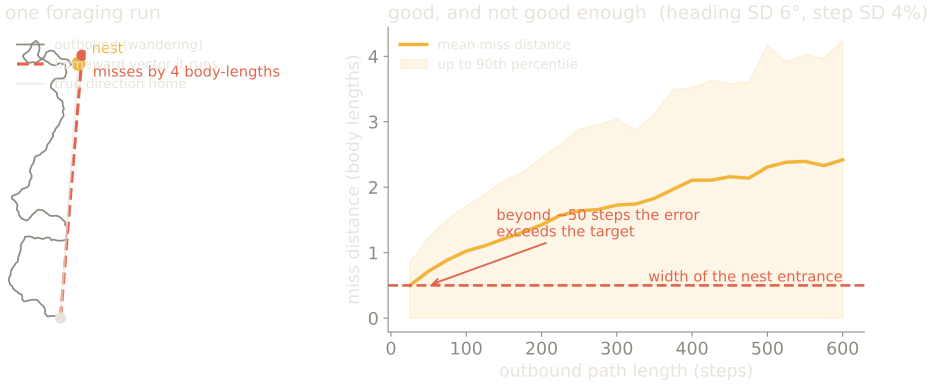
Simulated path integration. The integrator is good — errors partly cancel on a wandering path — and it is still not good enough, because the target is a hole. Past roughly fifty steps the expected miss exceeds the nest entrance, which is why a returning ant spirals.
Two things with no obvious function#
Bumblebees roll wooden balls with no reward attached, detouring to do it, younger ones more than older — which meets behavioural criteria for play. Jumping spiders, observed as unpigmented spiderlings whose retinal tubes are visible through the cuticle, show regular bouts of retinal movement with limb twitching that lengthen through the night, which looks a great deal like REM sleep.
Neither result tells us what we want it to. Both are graded [C], and the seminar is about what evidence would move either one.
Reading#
The paper this seminar is built around:
- Wittlinger, Wehner and Wolf (2006). The ant odometer: stepping on stilts and stumps. Science.
The rest of the week’s reading:
- Olkowicz and colleagues (2016). Birds have primate-like numbers of neurons in the forebrain. PNAS.
- Chittka and Niven (2009). Are bigger brains better? Current Biology — the numbers in this week’s lecture are read out of this paper rather than paraphrased.
- Herculano-Houzel (2009). The human brain in numbers. Frontiers in Human Neuroscience.
- Galpayage Dona and colleagues (2022). Do bumble bees play? Animal Behaviour.
- Howard and colleagues (2018). Numerical ordering of zero in honey bees. Science.
- Jackson and Cross (2011). Spider cognition. Advances in Insect Physiology.
Grades are not attached to papers here, because a grade belongs to a claim rather than to the paper it appears in — see evidence grades. Several of these papers contain claims at two different grades.
The spec
What you bring to the session. Written so a reader can tell whether it has been met without asking you.
- you can explain why the small-brain puzzle largely dissolves once neurons are counted rather than mass
- you can describe the stilts-and-stumps experiment and what it establishes
- you can name one capacity in an insect that has no obvious function
Teaching team
- Rosalind Achebe — lecturer