Week 2 Seminar: Measurement
What a sense organ is for, and the case that settles it — an animal with twelve colour channels that discriminates colour worse than a goldfish.
The first organism on the course holds nothing. E. coli runs and tumbles up a chemical gradient with a memory measured in seconds, no map, no target, and no representation of the thing it is swimming towards. It is worth spending an hour on because almost everything students want to say about it is a projection. The bacterium does not know where the food is. It knows whether things are getting better.
That is a measurement plus a comparison, and it is enough to solve a real problem. Keep it as the floor of the course: whatever we add later, this is what we are adding to.
The case that does the work#
Then the mantis shrimp, which is the single most useful animal in this course because the popular story about it is precisely inverted.
You will have heard that it sees millions more colours than we do. It has twelve photoreceptor types spanning 300 to 720 nanometres, against our three, so the inference is natural. When Thoen and colleagues actually tested wavelength discrimination in 2014, it came out roughly ten times worse than goldfish, butterflies, birds or us.
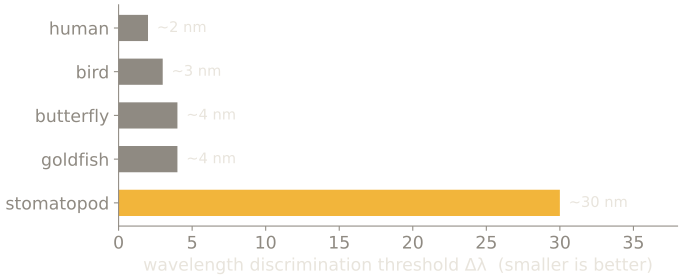
Wavelength discrimination thresholds, smaller being better, from Thoen and colleagues (2014). The stomatopod is the twelve-channel animal.
The proposed explanation is that it isn’t comparing channels to compute a hue at all. It reads which of twelve narrow bins fires hardest — recognition rather than discrimination, closer to a barcode scanner than an eye. Which is a reasonable thing to build if you strike prey in milliseconds and need to know that rather than which.
Hence the lesson that sets up weeks 3 to 7: more sensors is not better sensing. A sensory system is a commitment about which distinctions are worth the cost of making, and the mantis shrimp committed to speed.
In the room#
Half the seminar is a structured argument, in pairs, about whether the 2014 result licenses the sentence “the mantis shrimp has poor colour vision”. It does not, quite, and working out why is the exercise. A 2021 review notes the mechanism is still unresolved, which is a good early demonstration that [C] is a normal state for a claim rather than a failure of the field.
Reading#
The paper this seminar is built around:
- Thoen and colleagues (2014). A different form of color vision in mantis shrimp. Science.
The rest of the week’s reading:
- Macnab and Koshland (1972). The gradient-sensing mechanism in bacterial chemotaxis. PNAS.
- Marshall and Arikawa (2014). Unconventional colour vision. Current Biology — the dispatch written alongside Thoen, and the clearest short statement of what the result does and does not show.
- Berg (2004). E. coli in Motion. Springer — reference rather than reading; use it for the mechanism.
Grades are not attached to papers here, because a grade belongs to a claim rather than to the paper it appears in — see evidence grades. Several of these papers contain claims at two different grades.
The spec
What you bring to the session. Written so a reader can tell whether it has been met without asking you.
- you can describe E. coli chemotaxis without attributing a representation to it
- you can explain why twelve photoreceptor types produce worse colour discrimination than four
- your position statement is submitted
Teaching team
- Rosalind Achebe — lecturer